
Legga questo articolo in italiano.
Can you buy Italian land without a notary?
On this page
In Italy’s ordinary recording system, a land sale may use a private written contract, but a private agreement with unauthenticated signatures is not by itself sufficient for trascrizione, property-register recording. Article 2657 requires a suitable title. Check the sale’s form and protection before paying.
In short
- Ordinary system: Article 1350 permits a public deed or private written agreement, subject to the sale’s other requirements.
- Recording needs an Article 2657 title. An unauthenticated private agreement alone is insufficient.
- Property-register priority matters against third parties; signing first does not provide the same protection.
- Municipal planning-designation certificate (CDU) requirements can affect private deeds too. Have exceptions assessed rather than inferring them from the low price.
- Tavolare land-book properties have specific rules; this guide concerns ordinary trascrizione.
Article 1350
Written form
Public deed or private written agreement, with other applicable requirements.
Italian civil code
Article 2657
Recording title
Public deed, authenticated or judicially established signature, or judgment.
Italian civil code
The report brings together public information about the land, with sources and dates, to prepare questions for the relevant offices: €29 in English or Italian · €39 in both languages · total, VAT included.
Separate a contract’s validity from protection against third parties
In Italy’s ordinary property-recording system, Article 1350 of the civil code allows an immovable-property transfer by public deed or private written agreement, on pain of nullity. It would therefore be inaccurate to say that every sale without a notarial deed is legally nonexistent. An ordinary private agreement, however, is not by itself the title required to record the purchase through trascrizione.
This guide concerns that ordinary recording system. Land within the tavolare, or land-book, system needs its own assessment of the rules governing entry. Do not automatically apply an explanation of ordinary trascrizione to a land-book property. The tavolare guide explains the distinction.
The practical question is whether signing a piece of paper safely removes the cost of the purchase process. Before calling that a saving, establish the sale’s requirements and how the acquisition will be protected against third parties. A small field’s low asking price does not settle its title, documentation or recording position.
What the different forms actually mean
In a scrittura privata, a private written agreement, the parties sign their contract. Article 1376 links the transfer of rights to consent lawfully expressed; property transactions must also meet the applicable written-form and other requirements. “Private agreement” should not be understood as a guarantee that any downloaded form containing names and a price will complete a valid land sale.
For a scrittura privata autenticata, the notary or another public official authorised for the purpose certifies that the signature was made in their presence after checking the signatory’s identity, under Article 2703. The qualification “authorised” matters. Do not assume that any public counter can authenticate an Italian property sale.
Both a public deed and a private agreement with an authenticated signature are forms of title recognised by Article 2657 for recording. Ask the notary which form suits the actual purchase and what their quotation includes. The appropriate form depends on the property, parties and required checks, rather than the heading on a template found online.
- Ordinary private agreementForm allowed by Article 1350 with other requirements; alone not a recording title
- Public deed or authenticated signatureTitles recognised by Article 2657
- Judicially established signature or judgmentOther Article 2657 titles; ask a lawyer about the relevant procedure
Sources: Civil code, Article 1350; Civil code, Article 1376; Civil code, Article 2643; Civil code, Article 2644; Civil code, Article 2657; Civil code, Article 2703; DPR 380/2001, Article 30: land-transaction requirements; accessed 13 November 2026.
Why recording is part of the purchase decision
Article 2643 includes contracts transferring immovable property among acts subject to trascrizione, recording in the property registers. Article 2644 governs their effect against third parties who acquire rights through acts recorded or registered earlier. This is more than proving that you signed a contract first: the priority of recorded rights matters.
Imagine the same seller granting incompatible rights over the same plot through documents signed on different dates. Under the ordinary Article 2644 rule, the order of recording is decisive. A private paper retained in a drawer does not give the same protection as a properly recorded acquisition. The professional must assess the actual circumstances, including any court claims already recorded.
Mortgage checks also belong in the relevant registers. A cadastral search describes cadastral information but does not replace a search for adverse property-register entries. Read the guides to an ispezione ipotecaria, the property-register search, and the notary’s checks when preparing the purchase file.
Which documents can support recording?
| Form or record | What needs checking? | Recording position |
|---|---|---|
| Ordinary private agreement | Written form and sale requirements | By itself, not the Article 2657 title |
| Agreement with authenticated signature | Authentication by an authorised person | A title recognised by Article 2657 |
| Public deed | Deed requirements and professional checks | A title recognised by Article 2657 |
| Agreement with judicially established signature | The competent court’s determination | An alternative contemplated by Article 2657 |
| Cadastral search or map | Property identity and cadastral details | Does not replace the recording title |
The court route should not be described as cheap authentication automatically obtainable after signing privately. Where a dispute already exists, a lawyer must examine the action, evidence and timing. A statutory form of title is not a promise that litigation will succeed.
Land-sale documentation can also affect validity
Article 30 DPR 380/2001 applies to specified lifetime transactions concerning rights over land, whether made in public or private form. Paragraph 2 provides for nullity where the CDU, the certificato di destinazione urbanistica planning-designation certificate, is not attached. Its exception concerns land appurtenant to buildings entered in the urban buildings cadastre, with a total appurtenant area below 5,000 m². Other paragraphs, including paragraph 10’s exclusions and the specific supplementary procedures, also require examination.
Being a small plot is not enough for that exception. The provision concerns the relationship to a building entered as specified, as well as the area threshold. Ask the notary to identify the provisions applying to the actual deed rather than accepting a general claim that fields below 5,000 m² need no certificate.
Request the certificate from the competent municipal office using its local form. Article 30(3) provides for issue within thirty days of application and one-year validity from issue if the seller or a co-owner declares that the planning instruments have not changed. If it is missing or no longer valid, ask the notary to examine the relevant Article 30 procedure and conditions; do not invent a substitute statement. See the CDU guide.
Three checks before paying
- Property identityReconcile parcel and title documents
- Sale requirementsForm, documents and CDU where required, with exceptions assessed
- Property recordingSuitable title and required formalities
Sources: Civil code, Article 1350; Civil code, Article 1376; Civil code, Article 2643; Civil code, Article 2644; Civil code, Article 2657; Civil code, Article 2703; DPR 380/2001, Article 30: land-transaction requirements; accessed 13 November 2026.
Find out what “registered” means in the seller’s file
Ask for the receipt and the exact document to which it relates. Fiscal registration, property-register recording and a cadastral update have different functions. Your file needs to show which formalities were actually performed. Article 2657 still governs the title for recording; a generic payment receipt is not a substitute.
If the seller says that the position is settled because a name appears in the Catasto, have the notary reconstruct the acquisition document and its property-register history. The guide to title documents identifies the records to seek. A parcel map can show which piece of land a document describes; it does not itself establish ownership.
Before another payment, collect the signed original, attachments, payment evidence and correspondence. The adviser needs to read exactly what was agreed. Do not replace an existing signed document with a backdated paper or a reconstruction from memory. If you do not understand the Italian text, arrange an accurate explanation before signing any further document.
Compare complete costs, not an isolated signature fee
For a planned purchase, request a notarial quotation separating professional fees, taxes and expenses, with the fiscal assumptions stated. Include the missing documents and post-signing formalities. Comparing that total with an isolated authentication price does not compare the same service or establish the same protection.
For arithmetic only, suppose a breakdown contains a €900 professional fee and €1,200 of other items: the partial total is €2,100. Deleting the fee from a spreadsheet does not show that the other items disappear or that the sale is protected. These are invented inputs, not a tariff. Actual costs require the quotation and fiscal assessment rather than a percentage guessed from the field’s price.
If an unauthenticated agreement already exists, seek two assessments. Ask the notary what can be arranged consensually with the seller, and ask a lawyer about the position if cooperation is missing or third-party rights intervene. Obtain timing and fee estimates from those professionals. No automatic cure should be promised merely because both parties once signed a paper.
Where several sellers are involved, give the adviser the complete list and the documents each supplies. Ask whether further records or representatives are needed and when they should be arranged. A quotation prepared around one owner needs reviewing if the actual transaction involves a different group of parties.
Put the work in a practical order
- Before agreement: identify the parcel and title history with the notary. Agree documents, quotation and a realistic signing date.
- While assembling the file: request the CDU where required and other identified records. Ask the municipality about local charges and follow the applicable procedure.
- Before payment: have the registers and contract reviewed. If you already signed, show the original promptly instead of waiting until the next payment falls due.
- After the deed: ask when the notary will supply evidence of the completed formalities and retain it with the acquisition documents.
Can you buy Italian land without a notary?
https://terrenocheck.it/en/guide/buying-land-without-notary-italy
Checklist
Before treating the purchase as complete
Common questions
Is a private agreement always void?
No. Article 1350 allows it, but sale requirements still apply and recording requires a suitable title.
Does fiscal registration replace property recording?
Check which formalities were performed. A fiscal receipt does not replace the Article 2657 title.
Can any public office authenticate the sale?
Article 2703 requires a notary or another public official authorised for the relevant authentication.
What if I have already signed?
Take the original, attachments, receipts and correspondence to the notary or lawyer before further payments.
Keep reading
Italian notary checks before a property purchase
How to check an Italian property for mortgages, seizures and court charges before you buy (ispezione ipotecaria)
The certificato di destinazione urbanistica (CDU): Italy’s zoning certificate, explained for foreign buyers
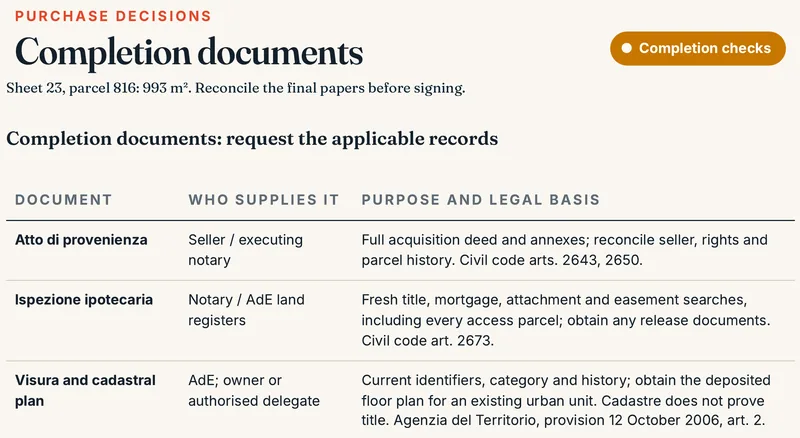
Proof of title for land in Italy: how to check the seller’s deed
Prepare the questions for your parcel
Select the land on the map to review its territorial information, sources and questions to take to the relevant offices before buying.
€29 in English or Italian · €39 in both languages · total, VAT included