
Buyer guide
Italy land-buying guide
49 guides to checking land in Italy before a deposit: cadastral records, CDU, zoning, constraints, flood and landslide risk, access, utilities and tax.
Updated
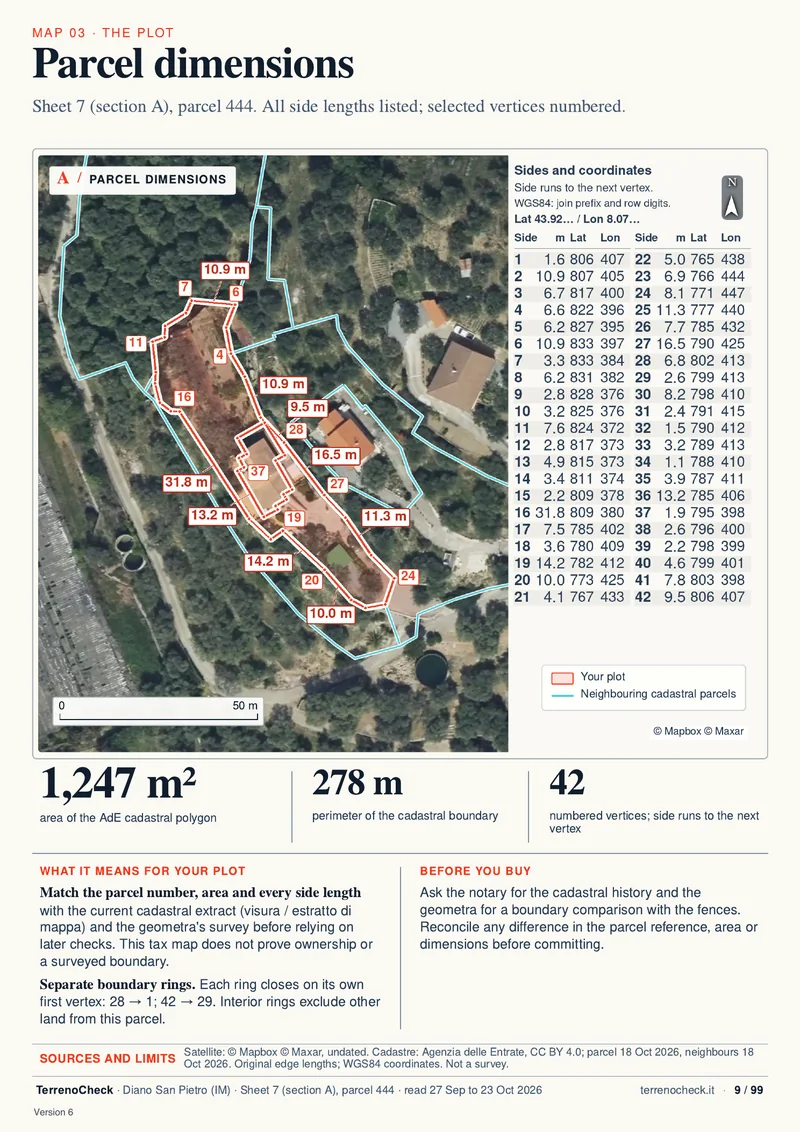
Source: TerrenoCheck, report page 9
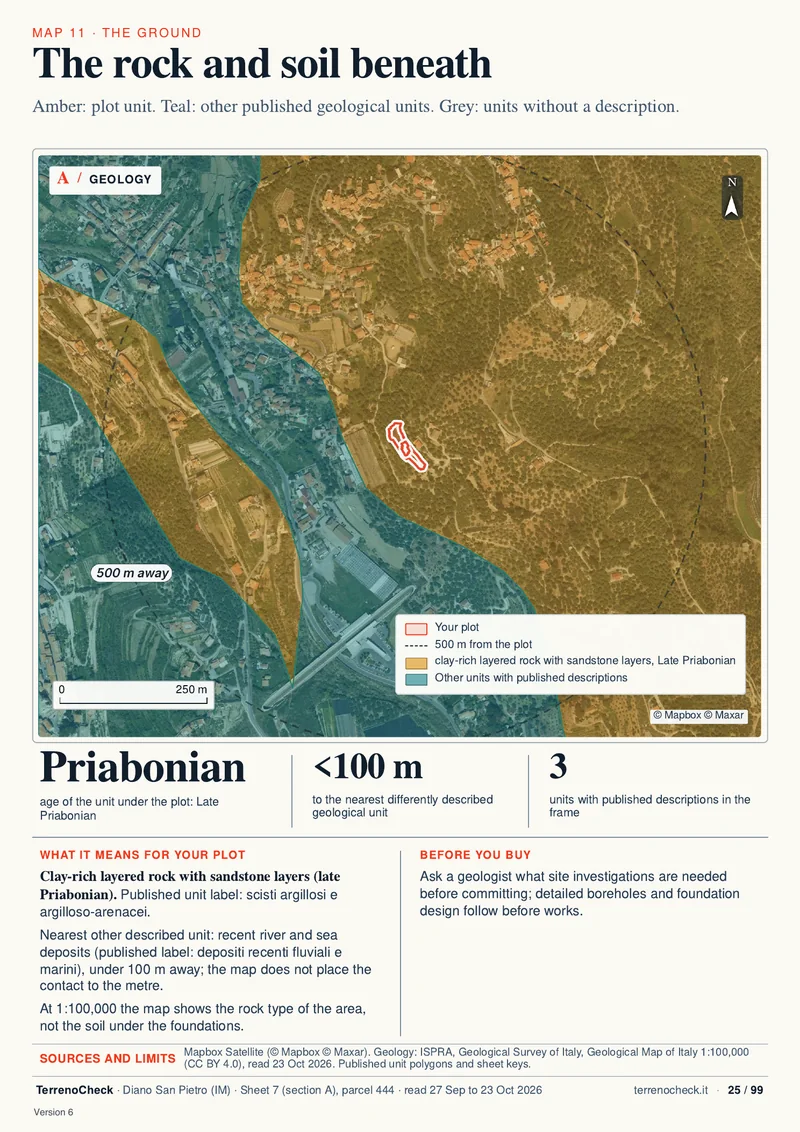
Source: TerrenoCheck, report page 25
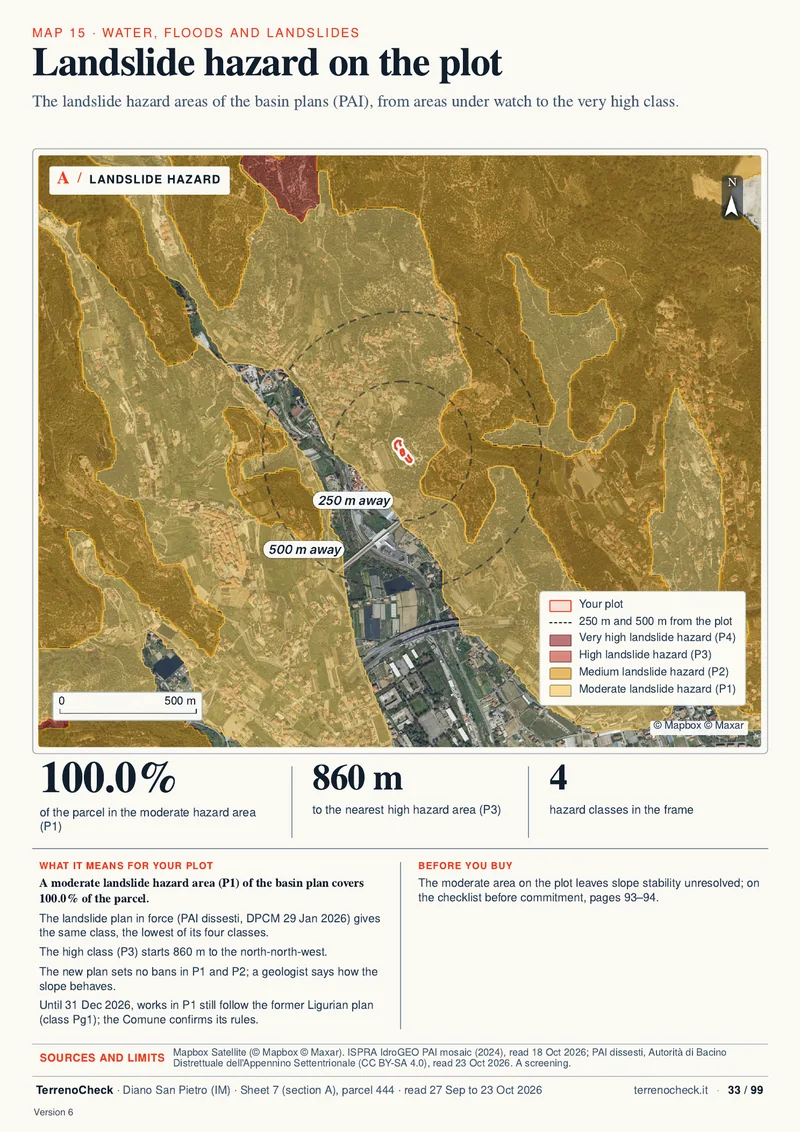
Source: TerrenoCheck, report page 33
The report is an automated screen of available sources, not a check of ownership, title, encumbrances or legal buildability. Regional and municipal sources do not have uniform coverage: data that could not be obtained remains labelled as such.
Documents and contract
Identity, title and the conditions to close before committing money.
Visura catastale and the cadastral parcel: proving which land you are actually buying
A visura catastale can identify the parcel, expose a missing building record and show where the seller’s story does not fit. It cannot prove that the seller owns the land or that you can build on it.
12 minItalian notary checks before a property purchase
An Italian notaio protects the legal transfer, not your building project. This guide explains the checks before the rogito, the gaps that hurt land buyers, and the bill you should ask to see.
12 minPreliminary contract and deposit in Italy
A signed offer can put real money at risk before you own the land. This guide explains the compromesso, deposit labels, transcription, tax, conditions and agency commission a buyer should settle before signing.
12 minMortgages, liens and seizures on Italian land
A clean cadastral extract is not a clean title. This guide shows a buyer how to read Italy’s property registers, find mortgages, seizures and lawsuits, and price the professional work before committing money.
13 minBuying inherited property in Italy: succession checks
An inherited home can look straightforward and still fail a bank’s title review. Here is what to check in the succession file, the land registers and the family history before you make an offer.
14 minHow to find the foglio and particella of Italian land
The foglio and particella of a plot can be read on the Agenzia delle Entrate cadastral geoportal, even when the listing leaves them out. Trento and Bolzano keep their own cadastre.
9 minItaly land search: obtain a free historical cadastral extract for a parcel
Get a free historical cadastral extract for Italian land, choose a property search rather than a person history and compare changes in parcel identifiers.
6 minItalian cadastral map online: download a parcel map extract in PDF
Download an Italian cadastral map extract from the official service and distinguish the PDF from WMS viewing, private floor plans and regional data copies.
6 minItalian parcel not found: check the cadastral section and municipality
Find a missing Italian parcel by checking its cadastral municipality, section, map sheet and register type, using original identifiers from the extract.
6 minItaly land registry search: how to find out who owns a plot or a house, and why the cadastre is not proof
Buyers used to a single land register, with one title page per property, often look for the Italian equivalent. Most of Italy does not work that way. The exception is the land-book system (*sistema tavolare*, R.D. 28 March 1929 no. 499), kept from the Austrian period in the provinces of Trento, Bolzano, Trieste and Gorizia and in some municipalities of the provinces of Udine, Brescia, Belluno and Vicenza; this guide does not cover those areas. Everywhere else there are two public archives, both run by the Italian Revenue Agency (*Agenzia delle Entrate*), and neither of them is a register of title:
12 minHow to check an Italian property for mortgages, seizures and court charges before you buy (ispezione ipotecaria)
Foreign buyers in Italy usually meet the *visura catastale* first: the cadastral extract that shows the parcel, its owners on record and its taxable income. It is useful, and it is silent on the question that loses buyers the most money. Is there a bank mortgage on the house? Has a creditor seized it? Is there a court order freezing it? None of that is in the cadastre. It sits in a separate public archive, the property registers (*registri immobiliari*), run by the Italian Revenue Agency (*Agenzia delle Entrate*) through its Property Publicity Service (*Servizio di pubblicità immobiliare*), still called the *Conservatoria* by most Italians.
14 minNCT or NCEU: which Italian cadastral record do you need?
Understand NCT and NCEU, choose the correct Italian cadastral archive and match a land parcel to the building units included in the proposed purchase.
6 minFree online visura catastale, even for land you do not own
Since 1 January 2025 the online visura catastale is free even for land that is not registered to you. You need SPID, CIE or CNS; at the counter the fee still applies.
9 minPlanning and the building
The records that determine use, compliance, works and building performance.
The certificato di destinazione urbanistica (CDU): Italy’s zoning certificate, explained for foreign buyers
If you are buying land in Italy, sooner or later someone (the agent, the surveyor, the notary) will mention the CDU. It stands for *certificato di destinazione urbanistica*, literally "certificate of planning designation", and it is the town hall’s written statement of which planning zone each cadastral parcel falls in and which rules apply there. For a sale of land it is compulsory: the notary will not sign the deed without it attached.
14 minCan you build on land in Italy? PRG, PUC and zoning
To establish whether you can build on land in Italy, have your specific project checked against effective and adopted municipal plans, remaining capacity and constraints before paying a deposit.
15 minUnauthorised building work in Italy: spot an abuso
A house can be mapped, taxed and occupied while its building work is still illegal. Learn how to match the building, the Comune file and the Catasto before you inherit somebody else’s problem.
13 minAgibilità in Italy: what it proves
An agibilità document says a building can be used under a defined set of safety, health, energy and systems rules. It does not prove that every alteration is lawful or that the land can take another building.
14 minAPE energy certificate in Italy: what buyers need
An APE is about a building, not a parcel of soil. Here is how to tell when a rural purchase needs one, how to read the class, and what to verify before signing.
13 minBuying a ruin in Italy: can you rebuild it?
A ruin can qualify for reconstruction as renovation if its previous form and dimensions can be established, but check lawful status, permitted use and restrictions before paying a deposit.
15 minBuilding a house on agricultural land in Italy: who may, on how many hectares, and how much
The listing says "terreno agricolo, 7,000 m², splendid view, possibility to build". The buyer does the sum everyone does: 7,000 m² × 0.03 m³/m² = 210 cubic metres, a small 70 m² house. In Sardinia that sum is wrong twice. The plot is below the one-hectare minimum, so the residential volume is zero. And even above one hectare, a house is allowed only if it serves a farm that actually produces something.
13 minHow far from the neighbour can you build in Italy? The 10-metre rule, the 3-metre rule and the local plan, explained for buyers
Most buyers who come to Italian land from abroad ask about the plot: is it buildable, how many cubic metres, is it under a scenic-protection order (vincolo paesaggistico). Fewer ask about the house next door. Yet the position of the neighbour’s wall, and whether it has a window in it, can cut the buildable width of a plot by more than a third before anyone has drawn a line.
18 minHow to buy land in Italy: taxes, the notary, the CDU and every check before you sign
Buying land in Italy ends with a deed signed before a notary (*notaio*). Most foreign buyers assume the notary will catch any problem. The notary will confirm that the seller owns the land, that the mortgages are dealt with and that the zoning certificate is attached. The notary will not walk the plot, will not tell you whether the house you have in mind can be built, will not check whether the access track crosses a neighbour’s field without a legal right of way, and will not read the landslide map for you.
35 minRegistered in the cadastre, never legalised: why Italian cadastral registration is not planning permission
Buyers from Britain, Ireland, Scandinavia or the United States tend to read an Italian property file with a home-country reflex: if the state’s register shows the building, with a floor plan and a taxable value, the state must have accepted it. In Italy that reflex is wrong, and it is one of the most expensive mistakes a foreign buyer can make.
14 minCorrecting a property boundary in Italy: from a cadastral fix to a court case
Article 950 of Italy’s Civil Code provides the starting point for an uncertain line between two properties: either owner may ask the court to establish it, any means of evidence is admissible and cadastral maps are the fallback where other evidence is lacking. A fence must therefore be compared with the deeds and technical documents. Before changing a map, establish whether the problem concerns a cadastral error, an uncertain boundary or ownership of the disputed strip.
13 minA mobile home, tiny house or caravan on your Italian land: when you need a building permit
A common plan among foreign buyers goes like this: buy a cheap plot of farmland with a view, put a tiny house or a mobile home on it, and live there part of the year while deciding what to build. In Italy that plan is, in most cases, a criminal offence.
13 minWhen the house doesn’t match the drawings: stato legittimo, tolerances and the 36-bis amnesty for foreign buyers
Most foreign buyers learn the phrase *stato legittimo* (lawful status) from their surveyor, a few weeks before completion, in a sentence like "the kitchen window is not on the 1978 drawings". What happens next depends on how far the house is from its permit, and on a set of rules Italy rewrote in 2024 with the Salva Casa decree (D.L. 29 May 2024 no. 69, converted by Law 24 July 2024 no. 105).
13 minLand, rights and services
Boundaries, access, water, utilities and rules attached to the land.
Buying agricultural land in Italy: pre-emption rights
A tenant farmer or qualifying neighbour can take Italian farmland under the statutory conditions from the buyer after completion. Here is the order of rights, the deadlines and the paperwork that keeps the risk visible.
12 minUsi civici in Italy: how civic use rights can block a land purchase, and how buyers clear them
Foreign buyers usually hear the words *usi civici* for the first time from the notary, a few days before completion, when a search turns up a line in an old regional decree. Civic use rights are collective rights of the people of a municipality or a hamlet over particular land: to graze animals, gather firewood, cut hay, sow. They are older than modern Italy, they survive changes of ownership, and in central and southern Italy they turn up on mountain pasture, old farmland and even plots that now have houses on them.
13 minAccess rights in Italy: servitù di passaggio
A dirt track is not proof that your Italian plot has a legal right of way. Learn how servitù di passaggio, landlocked land, public roads and planning access fit together before you pay.
12 minUtility connections on Italian land: real costs
A plot can be buildable on the plan and still be a financial trap because the water main, sewer, electricity and broadband stop far short of it. This is how to test the connection before you buy.
12 minWell water rights in Italy: what buyers must check
A well can look like free water on a rural property. It is really a regulated use of public water, with regional paperwork, testing and costs that can follow the land after completion.
12 minCadastral vs real boundaries in Italy
The line on an Italian cadastral map may identify the parcel without identifying the legal boundary. Check deeds, physical markers and survey evidence before paying for land with an uncertain boundary.
12 minBuying part of a plot in Italy: how the frazionamento works and what to check before the deed
A common version of the Italian countryside purchase goes like this. You have found a farmhouse with a garden. Next to the garden is an olive grove that belongs to the same seller, and the listing says you can "have a piece of it too", maybe 3,000 m², for a vegetable patch, a pool, a guest annex later. Or the seller owns 2.4 hectares and will sell you one hectare, keeping the rest.
18 minHazards and constraints
Maps that open a technical or statutory check without replacing it.
Seismic zones in Italy: what they cost buyers
The zone printed beside an Italian comune is a starting label, not a structural verdict. Here is what it changes, what it does not, and which documents can stop an expensive mistake.
14 minPAI flood and landslide risk in Italy: before you buy
PAI maps identify hazardous areas and land-use rules: before buying, check the parcel’s class and the provisions affecting your intended project.
15 minVincolo paesaggistico: what it permits
A vincolo paesaggistico does not automatically make Italian land unusable. It changes the order of work: identify the exact protection, design around it, and obtain the right clearance before touching the site.
12 minAsbestos, contaminated land and radon in Italy: what a foreign buyer inherits and how to check before signing
Grey corrugated roofing on a barn, a lean-to or a water tank is one of the most common sights on Italian farmland. Much of it is asbestos cement, known in Italy by the old brand name *eternit*. For a foreign buyer of a rural property it raises three questions that the estate agent rarely answers: do I have to remove it, what does that cost, and who is liable if there is more asbestos (or worse) in the ground?
14 minCoastal property in Italy: the strip that changes everything
A ruin near the water is not a shortcut to a seaside house. The 300-metre national constraint, maritime state land, regional plans and flood maps can each remove a different part of the deal.
14 minBuying woodland in Italy: what the forest rules let you do, and what to check before you sign
Many rural houses in Italy come with woodland attached. The agent’s listing calls it "two hectares of chestnut wood", the land registry extract (*visura catastale*) says *bosco ceduo* (coppice), and nobody explains what that means for the buyer. It means a separate set of rules: a national forest code, a regional forestry regulation, an automatic landscape protection, and, if the wood has burned in the last fifteen years, a building ban that runs with the land whoever owns it.
14 minBuying land near a cemetery or a road in Italy: buffer zones and what is left to build on
A plot can be zoned for building on the town plan (PRG, piano regolatore generale), have access, power and water, and still not take so much as an extension. That happens when part or all of it lies inside a buffer zone (fascia di rispetto): around a cemetery, or along a road outside the built-up area. These restrictions come from national law, not from the town plan, and listings aimed at foreign buyers seldom mention them.
14 minThe hydrogeological constraint (vincolo idrogeologico): what it stops, who approves works, and what to check on an existing house
Foreign buyers in the Langhe, the Monferrato, Chianti or the Apennine foothills often meet the phrase *vincolo idrogeologico* for the first time in a zoning certificate, after they have fallen for the house. It sounds alarming, and agents tend to wave it away. Both reactions are wrong.
13 minCosts, tax and use
Total cost, the buyer’s position and rules affecting later use.
Cost of buying property in Italy: taxes and fees
The asking price is only part of the budget. Add Italian taxes, professional fees and recurring bills before deciding what you can afford.
12 minBuying property in Italy as a foreigner: codice fiscale
A foreign passport does not decide the whole purchase. This guide explains reciprocity, the Italian tax code, payment evidence, signing arrangements and the tax consequences that arrive after the keys.
14 minOne-euro houses in Italy: the real cost
A one-euro house is a renovation obligation wrapped around a symbolic transfer price. Here is how the published comune schemes work, what stone buildings cost to repair, and what a buyer must check before committing.
12 minItalian building tax bonuses in 2026: current rules
A building bonus can reduce the cost of work, but it can also leave a buyer with a missing file and an unusable deduction. Check the rate, claimant and paperwork before you price the property.
12 minShort lets in Italy: CIN and regional rules
A short-let income forecast is useless if the property cannot be advertised legally. Before signing, verify the CIN, local filings, safety equipment, tax treatment and condominium documents.
12 minCondominio and shared costs in Italy
An apartment purchase includes a second property: your share of the building’s common parts, decisions and debts. Here is what to check before you sign.
14 minBuying land at an Italian court auction: what to read, what to pay, what survives the sale
Italian court auctions (*aste giudiziarie*) look made for foreign buyers: prices are set by a court-appointed valuer, the mortgages are wiped when the sale completes, and since the national portal went online you can find every lot from your laptop. All three statements are true. None of them tells you whether you can build on the plot, who pays to finish the road in front of it, or whether your tax bill will be 9% or 22%.
14 minIMU on building land in Italy: what a foreign buyer pays each year, and what to check before buying
IMU on Italian building land: market value and council tables, 0.86% base rate, worked figures from Senorbì, farmer exemption, constraints and value.
13 min