
Asbestos, radon and contaminated land in Italy
Source: INAIL, ISI 2017 Annex 4
A rural plot can carry a roof liability, a radon problem or a buried contamination file that no estate listing will mention. Here is what to check before you sign.
Contents
- Asbestos: the 1992 ban did not remove every old roof
- Regional asbestos registers are real, but there is no single national parcel register
- Radon: measure the building, not the map
- Contaminated land: the file can follow the owner
- Former agriculture, buried waste and old fuel tanks
- How much due diligence is proportionate?
- What to put in the preliminary contract
Before buying land with an existing building, check for asbestos-containing materials, measure indoor radon where relevant and investigate recorded soil contamination. Each issue has a different evidence trail and remediation route.
Buyers argue over planning zones and never ask what was buried behind the tractor shelter. A clean-looking house can produce high radon, while a former workshop changes hands with no soil file because everybody calls it “agricultural land”.
Use this before purchase, not as an environmental report, legal opinion or guarantee that a parcel is clean. Start with the Italian land-buying checklist, identify the parcel with the visura catastale, and read the CDU guide. A cadastral description is not soil testing.
Asbestos: the 1992 ban did not remove every old roof
Law 27 March 1992, no. 257 stopped asbestos extraction, use, production and trade in Italy. The ban ended the legal supply of new asbestos products. It did not make the sheets already fixed to a farmhouse disappear. INAIL says that, before the ban, more than one billion square metres of asbestos-cement sheet roofing were in place. That is why the corrugated grey roof on a rural building is a live due-diligence question, not an old-fashioned curiosity.
There is no blanket national rule saying every existing asbestos sheet must be removed immediately. The national management framework is the Ministerial Decree of 6 September 1994. The owner or person responsible for the building activity must know where it is, keep documentation, control its condition and prevent maintenance work from disturbing it. For friable material, the decree calls for at least annual inspection by competent personnel and a written report. A sound compact sheet may be managed in place; a cracked or disturbed one needs assessment and controlled work.
On agricultural land, a roof can be compact asbestos-cement and still become a serious cost when you remove it, add solar panels, alter rafters or demolish the shed. Do not climb onto it, pressure-wash it or let a builder cut a hole “just to see”. Sampling and removal are specialist work.
For a roof removal, check the contractor’s entry in the Albo Nazionale Gestori Ambientali, Category 10. Category 10A covers building materials bound in cement or resin matrices, normally relevant to asbestos-cement sheets; Category 10B covers friable and other listed materials. Article 256 of Legislative Decree 9 April 2008, no. 81 requires a work plan before removal. Ask for the plan, waste route and disposal paperwork.
INAIL ISI 2017 eligible asbestos-remediation cost limits
| INAIL ISI 2017 eligible-cost limit | Amount | What the figure includes |
|---|---|---|
| Removal of asbestos-cement roof | €30/m² | Remediation, transport and disposal of the asbestos waste |
| Replacement roof | €30/m² | Purchase and installation of the replacement covering and accessories |
| Removal plus replacement | €60/m² | The two limits added together |
| Additional asbestos sub-roof removal | €20/m² | Extra remediation limit where a sub-covering is present |
| Additional sub-roof replacement | €10/m² | Extra replacement limit in the same case |
| Roof plus sub-roof, removal and replacement | €90/m² | The four published limits added together |
The arithmetic is simple: €30 + €30 = €60; €30 + €20 + €30 + €10 = €90. These are maximum eligible project costs under a 2017 grant scheme. A small rural roof can cost more per square metre because scaffolding, access, safety arrangements and mobilisation charges do not shrink with sheet area. Get two written quotes. A quote omitting transport or disposal is incomplete.
Pages from the delivered dossier
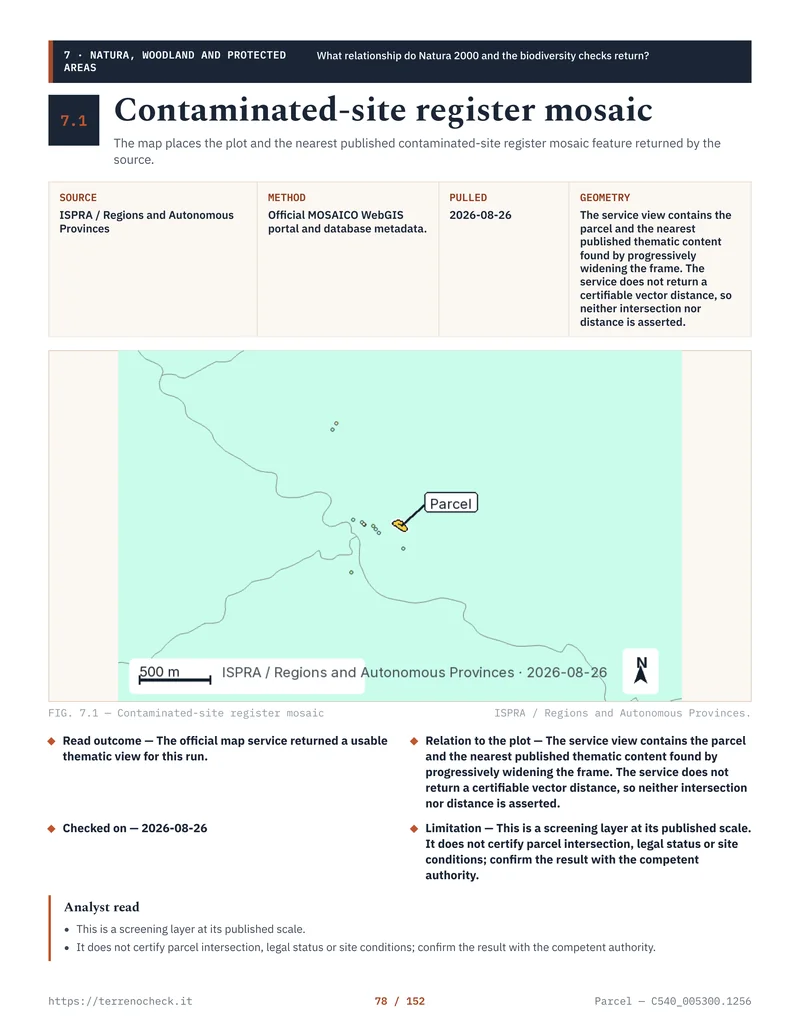 Open the full page
Regional asbestos registers are real, but there is no single national parcel register
The national mapping obligation is different from a buyer-facing register. Law 23 March 2001, no. 93, Article 20, led to Ministerial Decree 18 March 2003, no. 101, which sets the framework for mapping areas affected by asbestos. It does not certify that an unlisted farmhouse has no asbestos.
The clearest formal register is in Lombardia: Article 5 of Regional Law 29 September 2003, no. 17 establishes a public register at each ASL, alongside the PRAL approved by D.G.R. VIII/1526 in 2005. Piemonte has a regional asbestos portal and procedures involving Comune, ARPA and ASL. Emilia-Romagna describes a mapping programme under D.G.R. 497/1996. Its 2026 guidance lists different frameworks for Liguria, Marche, Molise, Puglia, Sardegna, Sicilia, Toscana, Umbria, Valle d’Aosta and Veneto. These systems are not interchangeable.
An official Emilia-Romagna workshop reports 31,321 buildings surveyed, 1,889 with friable material, 30,023 companies surveyed and 2,540 with friable material. It reports all mapped sites remediated by removal. These are regional programme figures, not evidence about your plot.
Emilia-Romagna friable-asbestos census reported in 2025
| Emilia-Romagna friable-asbestos census reported in 2025 | Figure | Scope |
|---|---|---|
| Buildings surveyed | 31,321 | Regional mapping programme |
| Surveyed buildings with friable asbestos | 1,889 | 1,889 of 31,321 buildings |
| Companies surveyed | 30,023 | Regional mapping programme |
| Surveyed companies with friable asbestos | 2,540 | 2,540 of 30,023 companies |
Source: Regione Emilia-Romagna, 2025 asbestos-mapping workshop data
Ask the region, ARPA, ASL and Comune which system covers the municipality. Search by parcel, address and building where possible. “Not found” means “not found in this register”, not “no asbestos”.
Radon: measure the building, not the map
Radon is an odourless radioactive gas that can move from soil into a building through cracks, joints and service penetrations. It is not a land-use designation. A radon map can flag a reason to measure, but it cannot give you the annual concentration in a specific house. ISS says adjacent buildings can produce very different results.
Article 12, paragraph 1, letters a) and c), of Legislative Decree 31 July 2020, no. 101, sets the reference level for existing homes and workplaces at 300 Bq/m³ of annual average concentration. For buildings constructed after 31 December 2024, letter b) of the same paragraph identifies 200 Bq/m³. These are reference levels, not a magic line between harmless and dangerous.
The same decree makes the regional distinction important. Regions and the autonomous provinces identify “priority areas”. Under Article 11, paragraph 3, the provisional definition uses an estimated 15% or more of buildings exceeding 300 Bq/m³, based on ground-floor measurements. The DPCM of 11 January 2024 adopted the National Radon Action Plan for 2023–2032. It helps regions decide where to measure and act; it does not clear a private plot by postcode.
The affected parts of Italy are not a tidy north-versus-south list. Geology, foundations, basements, ventilation, cracks and use all matter. The PNAR cites published priority areas including Sardegna and Piemonte; regional lists change as surveys are completed. If the building is occupied, measure it. If the plot is empty, there is no indoor result yet.
The practical measurement is straightforward: put passive track detectors in representative occupied rooms at the lowest relevant level, leave them for 12 months continuously or in consecutive periods totalling a year, and send them to the laboratory. ARPA Piemonte describes two six-month periods as normal because concentrations vary by season and habits. A short handheld reading can investigate, but it is not an annual average. Keep the report, locations, dates, floor level and room use; after mitigation, repeat the annual measurement.
- First measurement period6 months
- Second measurement period6 months
- Annual result12 months total; reference level for existing homes and workplaces: 300 Bq/m³
- Priority-area indicator15% or more of buildings above 300 Bq/m³
Source: ISS, “Protezione dal radon”; ARPA Piemonte, “Come si misura il radon”; Legislative Decree 31 July 2020, no. 101, Article 11.
Radon reference and measurement values
| Radon number | Meaning for a buyer | Authority and scope |
|---|---|---|
| 300 Bq/m³ | Reference level for existing homes and workplaces, measured as an annual average | D.Lgs. 101/2020, Article 12, paragraph 1, letters a) and c) |
| 200 Bq/m³ | Reference level identified for homes built after 31 December 2024 | D.Lgs. 101/2020, Article 12, paragraph 1, letter b) |
| 15% of buildings | Threshold used in Article 11’s priority-area identification method | Regional/provincial mapping, not a parcel result |
| 12 months | Total period for a representative annual indoor measurement | National practice described by ISS |
Source: D.Lgs. 101/2020, Article 11; ISS, Protezione dal radon; ARPA Piemonte, Come si misura il radon
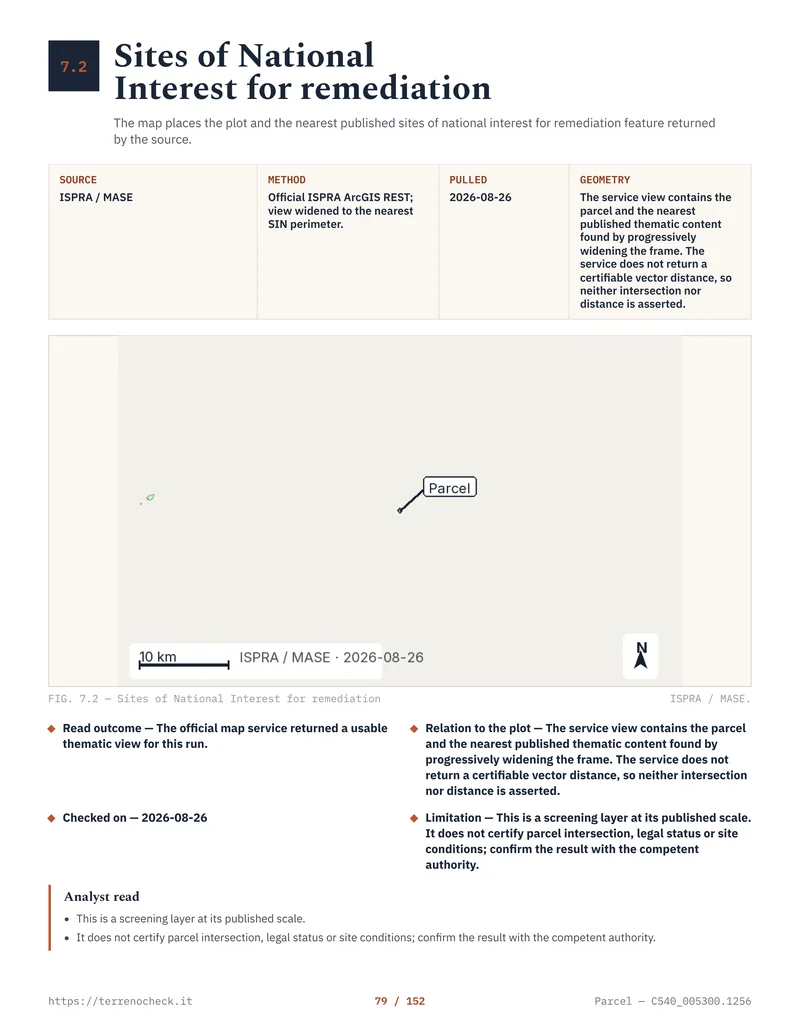 Open the full page
Contaminated land: the file can follow the owner
Part IV, Title V of Legislative Decree 3 April 2006, no. 152 is the national regime for contaminated sites. Article 239 sets the scope and “polluter pays” principle; Article 242 sets the operational procedure. When a potentially contaminating event occurs, under paragraph 1 the responsible party must take prevention measures within 24 hours and notify the authorities. That clock is not a buyer’s permission to investigate casually after completion.
The buyer’s uncomfortable point is Article 245, paragraph 2. An owner or manager who detects an exceedance, or a concrete and current risk of exceeding concentration threshold values (CSC), must notify the Region, Province and Comune and implement prevention measures through Article 242. The non-responsible owner is not automatically the polluter, but the property can still carry consequences.
Article 251 requires each Region to prepare an anagrafe of sites subject to remediation. Article 253, paragraph 1, provides that authority-led works can create a real charge on the site, recorded in property registers and indicated in the CDU. If the responsible party cannot be identified or recovery is impossible, the non-responsible owner can face public-cost recovery within statutory limits, including the Article 253(4) market-value limit. Official administrative-justice guidance stresses the difference between polluter liability and the non-responsible owner’s prevention, notice and property-burden position.
That is why a seller statement is not enough. Ask for the regional anagrafe dei siti da bonificare, ARPA records, municipal orders, old authorisations and remediation reports. MASE describes roughly 30,000 regional sites and 42 SIN in its transition plan. That is a programme snapshot, not a clean-site count.
Published contaminated-site indicators
| Contaminated-site system | Published figure | What it means |
|---|---|---|
| Sites of regional remediation competence | About 30,000 | MASE transition-plan estimate; not a clean count of confirmed contamination |
| Sites of National Interest (SIN) | 42 | MASE transition-plan figure; SIN procedure is a national-competence category |
| SIN land area | About 170,000 ha | MASE/official strategy figure for the 42-SIN snapshot |
| SIN share of Italian territory | About 0.57% | Same snapshot, not a parcel probability |
Source: MASE, Piano di transizione, sites contaminated, regional sites and SIN data; MASE, implementation report 2021–2022
Former agriculture, buried waste and old fuel tanks
Former agricultural use lowers one kind of suspicion and raises another. Pesticide stores, wash areas, waste pits, asbestos sheds, diesel tanks and improvised burn sites are historical features to ask about. “It was only a field” proves nothing.
Buried waste is the classic viewing-day miss. Soil can look undisturbed above rubble, drums, ash or a filled trench. An old fuel tank can be under a concrete pad or outside the building footprint. A metal detector, walkover and photographs cannot establish clean soil or groundwater. They can identify clues: stains, dead vegetation, vents, patched slabs, pipework, a disused dispensing point, different soil mounds, or a neighbour who remembers what the site was before the olive trees.
The inspection cannot define contamination’s extent, distinguish clean fill from waste reliably, prove a tank is empty, or replace a sampling plan. If records justify concern, commission a historical review and, where indicated, targeted soil, soil-gas or groundwater work. Do not take random samples and call the result “clear”.
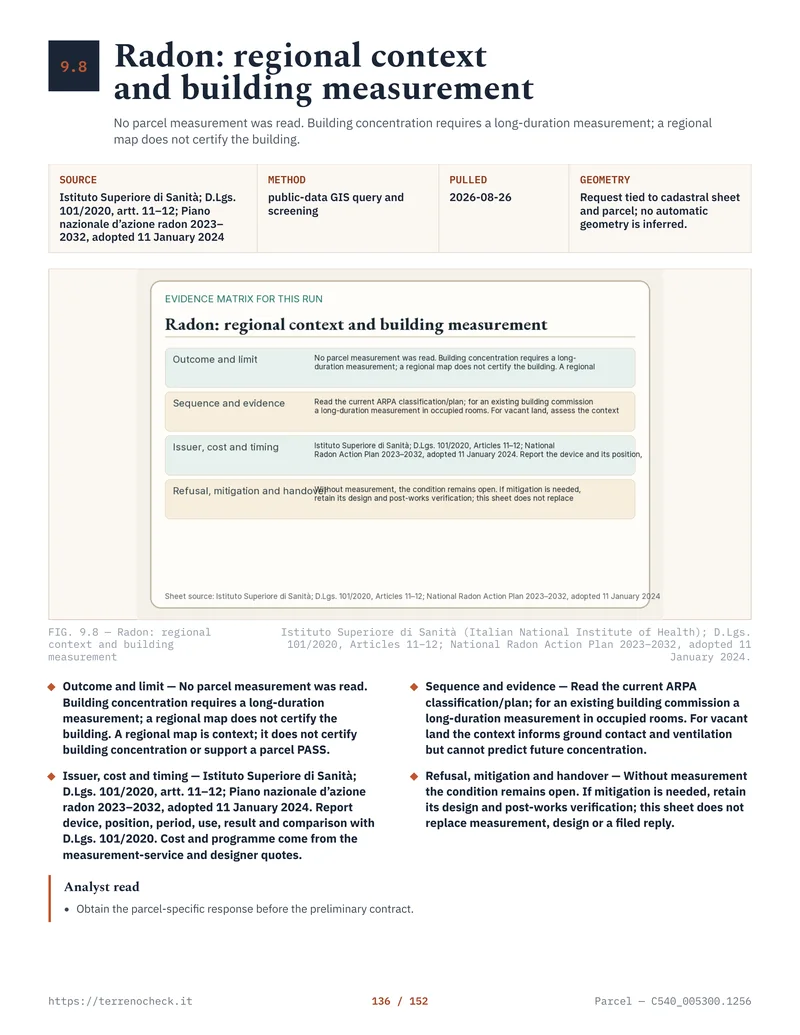 Open the full page
How much due diligence is proportionate?
For a small rural plot with no building, industrial history, tanks, visible dumping or register hit, start with desktop work: parcel identity, aerial history, CDU, planning history, regional and municipal records, and a site inspection. If there is a farmhouse, add asbestos work when the roof or materials are suspect; if occupied, budget radon measurement.
For a former workshop, petrol station, quarry, landfill, depot, dry cleaner, metal yard, waste site or factory, that is not enough. Obtain historic permits, environmental authorisations, waste and tank records, activity history, groundwater information, any anagrafe or SIN file, and a written environmental assessment. Future use matters: a risk analysis for an industrial yard is not interchangeable with one for a home garden. Read the PRG/PUC building-rights guide because intended use affects the work needed.
The agricultural-land guide helps with the separate pre-emption issue. The utility guide is relevant when old tanks, wells, drainage and buried service routes appear in the history. Keep these questions separate. A field can have no contamination record and still have no lawful water or access route.
- Existing home at or above 300 Bq/m³ annual averageDesign radon mitigation and repeat the measurement.
- New home built after 31 December 2024 at the 200 Bq/m³ reference levelUse the ISS 200 Bq/m³ reference level.
- Contamination procedure in a regional or municipal fileObtain the full file before signing.
- Potential exceedance of CSC under Article 245The owner or manager must notify and take prevention measures, even if they did not cause the contamination.
Source: D.Lgs. 101/2020, Article 11; ISS, “Protezione dal radon”; D.Lgs. 152/2006, Articles 245 and 253 and Normattiva · consolidated legislation; Albo Nazionale Gestori Ambientali, Category 10; INAIL ISI 2017 Annex 4.
What to put in the preliminary contract
Do not write “the land is free from environmental problems” unless the investigation, date, sampling and meaning of “free” are defined. Use the preliminary contract or an annex to make the unknowns visible.
Ask an Italian lawyer and notary to turn these points into enforceable wording:
- the exact cadastral parcels, buildings and appurtenant land covered by the seller’s declarations;
- a declaration of known asbestos, tanks, wells, buried waste, spills, remediation orders, environmental proceedings and former industrial uses, with documents attached;
- delivery of regional anagrafe, ARPA, Comune, ASL, SIN and remediation files received or held by the seller;
- access before completion for asbestos sampling, radon placement, historical review and targeted investigation;
- who pays for investigations, removal or remediation, and whether the buyer can reject, renegotiate or delay completion;
- a condition tied to acceptable written results, not the seller’s verbal opinion;
- allocation of any public order, remediation procedure, onere reale, privilege or pre-completion cost;
- handover of asbestos work-plan, waste records, remediation certificates and laboratory reports.
Do not accept a clause saying “buyer has inspected and accepts everything” while the seller refuses access to the shed, tank area or records. That is how an inexpensive plot becomes an expensive lesson.
Sources
- Gazzetta Ufficiale — Law 27 March 1992, no. 257, cessation of asbestos use
- Gazzetta Ufficiale — Ministerial Decree 6 September 1994, asbestos management methods
- Normattiva — Ministerial Decree 18 March 2003, no. 101, national asbestos mapping
- INAIL — Asbestos: materials, risk factors and reference information
- Albo Nazionale Gestori Ambientali — Category 10 asbestos remediation
- INAIL — ISI 2017 Annex 4, eligible asbestos-remediation cost limits
- Regione Lombardia — Regional Asbestos Plan and remediation information flows
- Regione Lombardia — Regional Law 29 September 2003, no. 17, Article 5 registers
- Regione Emilia-Romagna — 2025 asbestos mapping workshop data
- Regione Emilia-Romagna — 2026 guidance on regional asbestos frameworks
- Normattiva — Legislative Decree 9 April 2008, no. 81, Article 256
- Normattiva — Legislative Decree 31 July 2020, no. 101, Article 11
- Normattiva — Legislative Decree 31 July 2020, no. 101, Article 12
- ISS — Protection from radon and measurement guidance
- ISS — Technical coordination note on D.Lgs. 101/2020 radon reference levels
- ARPA Piemonte — How radon is measured
- Gazzetta Ufficiale — DPCM 11 January 2024, National Radon Action Plan 2023–2032
- Normattiva — Legislative Decree 3 April 2006, no. 152, Article 239
- Normattiva — Legislative Decree 3 April 2006, no. 152, Article 242
- Normattiva — Legislative Decree 3 April 2006, no. 152, Article 245
- Normattiva — Legislative Decree 3 April 2006, no. 152, Article 251
- Normattiva — Legislative Decree 3 April 2006, no. 152, Article 252
- Normattiva — Legislative Decree 3 April 2006, no. 152, Article 253
- MASE — Transition Plan, contaminated sites, regional sites and SIN figures
- MASE — National Sustainable Development Strategy implementation report, 2021–2022, SIN area figures
- Giustizia Amministrativa — official review of soil contamination case law