
Utility connections on Italian land: real costs
A plot can be buildable on the plan and still be a financial trap because the water main, sewer, electricity and broadband stop far short of it. This is how to test the connection before you buy.
Contents
- The trap: buildable does not mean serviced
- Electricity: ask the distributor, not the electricity seller
- Water: the ATO decides who answers
- Sewer: public connection, or a permitted private system
- Gas, LPG and the heat-pump decision
- Telecoms: a resale issue, not a luxury
- The pre-purchase test I would actually run
The estate agent says the plot is edificabile. You look at the road, see a few houses nearby, and assume the services are nearby too.
That assumption has emptied more than one buyer’s contingency fund. A water pipe can be visible on the next road and still be too far away for an ordinary connection. A power line can serve a different network point. A sewer downhill may require a pump, road opening and permissions nobody mentioned at the viewing.
Use this before purchase, not as an engineering opinion, planning decision or legal advice. The written answer for the exact parcel, road and proposed building is what matters. Start with the Italian land-buying checklist, then check the CDU and the planning rules in what you can build under the PRG or PUC.
The trap: buildable does not mean serviced
The national rule is more qualified than an estate listing. Under Article 12(2) of Presidential Decree 6 June 2001, no. 380, a permesso di costruire depends on primary urbanisation works existing, being planned by the municipality within three years, or being built by the applicant alongside the development. Article 16(7) lists sewerage, water, electricity, gas, roads, lighting and equipped green areas as primary urbanisation works. Regional parameters and municipal council decisions shape the charges.
That does not mean the Comune will extend every pipe to your boundary. A planning route may exist in principle while funding, technical feasibility, road permissions and affordability remain unresolved.
The phrase I want in the file is: “written feasibility and connection quotation for this cadastral parcel, from this delivery point, for this project”. Without it, price the land as unserviced.
Source: ARERA, TIC, Annex C, Table 1, 2026 column; e-distribuzione, “Costi di connessione alla rete”.
Pages from the delivered dossier
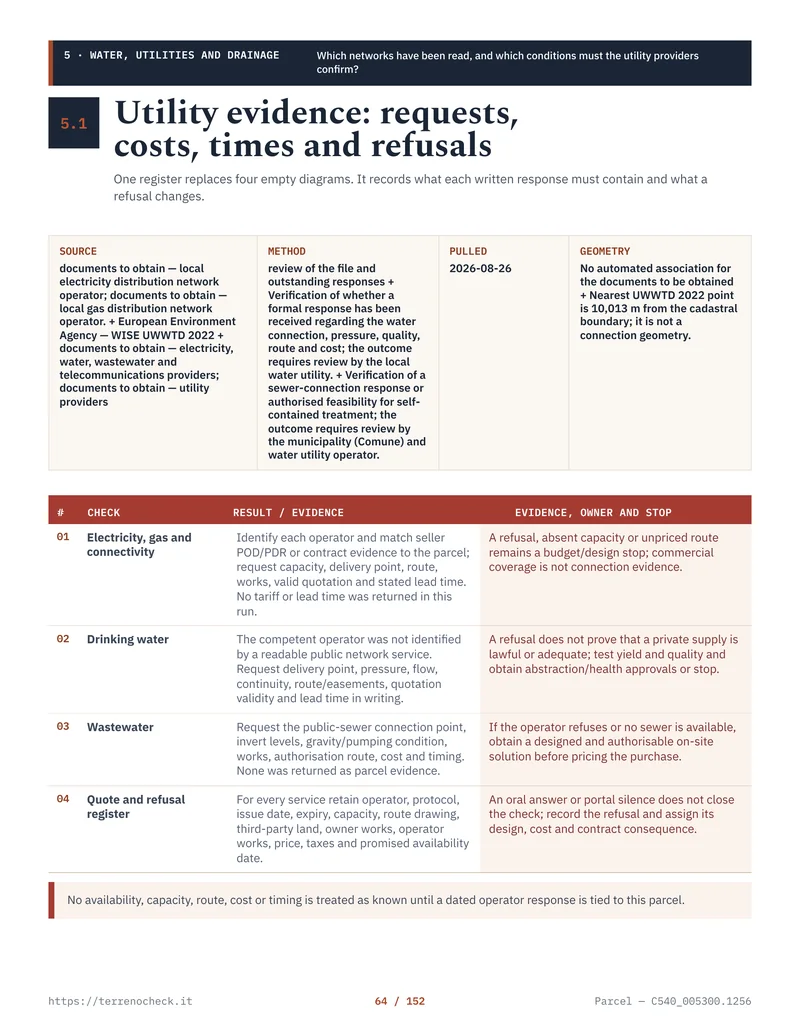 Open the full page
Electricity: ask the distributor, not the electricity seller
For many Italian homes the physical distribution network is operated by e-distribuzione, although other distributors operate locally. The seller sells energy; the distributor assesses the connection, designs network work, installs the meter and issues the technical quotation. A seller can forward a request when activation is wanted too, but for a bare plot the distributor’s answer is the document you need.
The 2026 ordinary low-voltage contribution has two main parts. Article 11, paragraph 11.1, of the TIC, Annex C to ARERA resolution 616/2023/R/eel, ties them to the available power and to the conventional distance from the reference MT/BT cabin, with the amounts set in Table 1, 2026 column. The power quota is €78.81 per kW of available power. The distance quota is €209.62 within 200 m of the reference MT/BT cabin, then €105.08 per additional 100 m or fraction over 50 m up to 700 m, €209.62 per additional 100 m or fraction over 50 m up to 1,200 m, and €419.24 for each further 100 m or fraction over 50 m. These are the regulated numbers, not the cost of excavating your access road.
2026 low-voltage connection contribution components
| 2026 low-voltage item | Amount | What it covers |
|---|---|---|
| Power quota | €78.81/kW | Requested available power |
| Distance quota, up to 200 m | €209.62 | Reference cabin distance band |
| Extra 100 m, over 200 m to 700 m | €105.08 | Each 100 m or fraction over 50 m |
| Extra 100 m, over 700 m to 1,200 m | €209.62 | Each 100 m or fraction over 50 m |
| Extra 100 m, over 1,200 m | €419.24 | Each 100 m or fraction over 50 m |
Source: ARERA, TIC, Annex C, Table 1, 2026 column; e-distribuzione, connection costs for 2026
There are awkward exceptions. A building outside the inhabited area, not continuously occupied, more than 2,000 m from the cabin, without a vehicle-passable road, or separated by sea, lake or lagoon can be a “particular” low-voltage connection under Article 7, paragraph 7.2, letters f) and g), of the TIC. Under Article 23, paragraph 23.1, the contribution then uses the distributor’s spesa relativa, materials and labour plus general expenses, rather than the ordinary formula. That is where a cheap-looking parcel turns expensive.
For a building site, request a temporary connection. In 2026, under Article 7, paragraph 7.3, of the TIC, a temporary connection may last one year, extendable by another year; a construction site may last three years, extendable by a maximum of another three. Up to 40 kW in low voltage and within 20 m of existing permanent network, Article 20, paragraph 20.1, of the TIC applies Table 5: the fixed charge is €168.01 without a road crossing or €280.01 with one, excluding VAT. Beyond 20 m, above 40 kW, or where a temporary transformer cabin is needed, Article 21, paragraph 21.1, of the TIC bases the price on actual cost. The temporary supply gets you through construction. It does not prove that the permanent connection for the finished house will cost the same.
Give the distributor the cadastral reference, plan, meter position, power, access road and temporary or permanent status. Ask for the reference cabin, distance, contribution, work description, validity, permits, easements and road-reinstatement responsibility.
Water: the ATO decides who answers
There is no single national water company pricing every Italian parcel. The integrated service is organised by territorial areas, normally an ATO, and operated by the local gestore. ARERA directs applicants to that manager, whose user regulation and price list control the ordinary connection charge.
The RQSII, Annex A to ARERA resolution 655/2015/R/idr of 23 December 2015, sets timing, not a cheap extension. Under Table 1 of Article 67, paragraph 67.1, a quotation without inspection has a maximum of 10 working days; with inspection, 20. A simple water connection has a maximum execution time of 15 working days after acceptance. Complex work may involve design, road permissions and network extension.
Here is a real tariff example, not a national average. Acque SpA publishes prices for its Basso Valdarno area, excluding VAT. A domestic water connection up to 1½ inches costs €742.50 for the first 4 m on a country road with same-material refill, then €27.50 per metre. A bitumen road with stabilised-cava refill starts at €1,249.00, then €118 per metre. The surface does the damage, not the tap.
Acque SpA published domestic connection prices
| Acque SpA published domestic connection item | First 4 m, excl. VAT | Each extra metre, excl. VAT |
|---|---|---|
| Water, country road, same-material refill | €742.50 | €27.50 |
| Water, bitumen road, stabilised-cava refill | €1,249.00 | €118.00 |
| Sewer, country road, same-material refill | €665.00 | €79.00 |
| Sewer, bitumen road, mixed cement refill | €1,327.00 | €188.50 |
Source: Acque SpA, “Allacciamenti acquedotto”; Acque SpA, “Allacciamenti fognatura”.
The price schedule in Annex A to the ATO 2 Lazio Centrale - Roma user regulation shows how another area can charge differently: the contribution payable by a domestic final user is 50% of the values listed in the annex, for both water and sewer works. Copying a price from another province is a bad habit. Ask the actual gestore for a written preventivo di allaccio.
If the network does not reach the plot, “drill a well” is not an automatic answer. A well needs a route permitted by the region or delegated provincial office, and the rules differ. Lombardia applies Royal Decree 11 December 1933, no. 1775, and Regional Regulation 24 March 2006, no. 2, with concession and annual demanial fee for covered uses. Emilia-Romagna distinguishes domestic groundwater withdrawals subject to communication from non-domestic withdrawals subject to concession. Toscana Regulation 61/R/2016, Article 20, sets stated annual domestic volumes, 700 m³ potable and 350 m³ non-potable, while requiring prior authorisation for extraction and works and limiting potable use where an aqueduct can be used.
Those are regional examples, not an Italy-wide well licence. Ask the Regione or Genio Civile which title, use category, protection-zone limits, testing and metering apply, and whether an existing well is regular. A pump producing water is not proof of drinking-water compliance.
Surface restoration and route length can outweigh the pipe connection itself; these are one operator’s published prices for its service area, not a national band or a promise that a 20-metre extension is technically available.
| Connection | Route | 20 m total, excl. VAT |
|---|---|---|
| Water | Country road, same-material refill | €1,182.50 |
| Water | Bitumen road, stabilised-cava refill | €3,137.00 |
| Sewer | Country road, same-material refill | €1,929.00 |
| Sewer | Bitumen road, mixed-cement refill | €4,343.00 |
Source: Acque SpA, “Allacciamenti acquedotto”; Acque SpA, “Allacciamenti fognatura”.
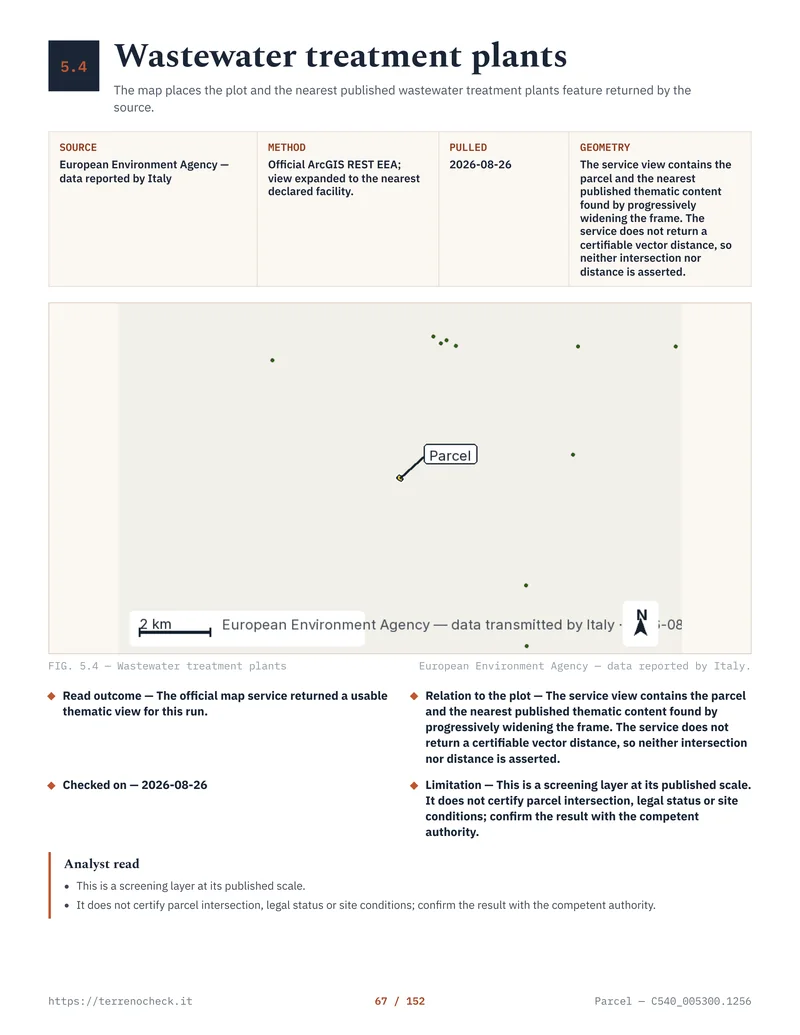 Open the full page
Sewer: public connection, or a permitted private system
If a public sewer is available and local rules require connection, use the manager’s procedure, respect the delivery point and pay the quoted works. Acque SpA says that in areas it serves there is an obligation under Article 14 of Toscana Regional Law 20/2006, particularly to the black-water sewer where present. That is Tuscan law and operator guidance, not an Italy-wide rule.
Nationally, Article 124(1) of Legislative Decree 3 April 2006, no. 152 says that all discharges must be authorised in advance. Article 124(3) leaves the authorisation regime for domestic discharges and sewer networks to the regions. Article 124(4) says domestic discharges into sewers are admitted under the manager’s regulations approved by the ente di governo dell’ambito. The legal detail therefore changes by region, ATO and municipality.
Where there is no public sewer, an autonomous system may be possible, such as an Imhoff tank with secondary treatment or a biological plant accepted by the authority and regional rules. It must suit the soil, groundwater, slope, receiving body and occupancy. A tank buried by a previous owner is not a permit. Nor is “the neighbours have one”.
Lombardia’s Regional Regulation 29 March 2019, no. 6, Article 7, addresses isolated settlements; Toscana uses Regulation 46/R/2008, as amended. Elsewhere ask the Comune, Province or ATO who receives the application and where discharge may go. An unauthorised discharge can stop use of the building and cost more than a connection.
Gas, LPG and the heat-pump decision
Natural gas is also a local distribution question. ARERA says the request goes to the local distributor if you want the connection without immediate supply, or through a seller if connection and activation are requested together. The distributor’s obligation is conditional: there must be system capacity, the works must be technically and economically feasible, and the connection contribution must be paid. Article 16(2) of Legislative Decree 23 May 2000, no. 164 sets the first two conditions. The price is set in the distributor’s user regulation or published price list and must be in the quotation.
Do not budget gas from a neighbour’s bill. Ask for the meter, route, pressure, road and private-land works, easements, contribution, activation and economic feasibility. If the main is distant, LPG may be practical. A heat pump can remove the gas question where electricity can be sized and the unit is allowed. I give no national LPG or heat-pump band because no official schedule covers all equipment and regional permissions. Get an installer design.
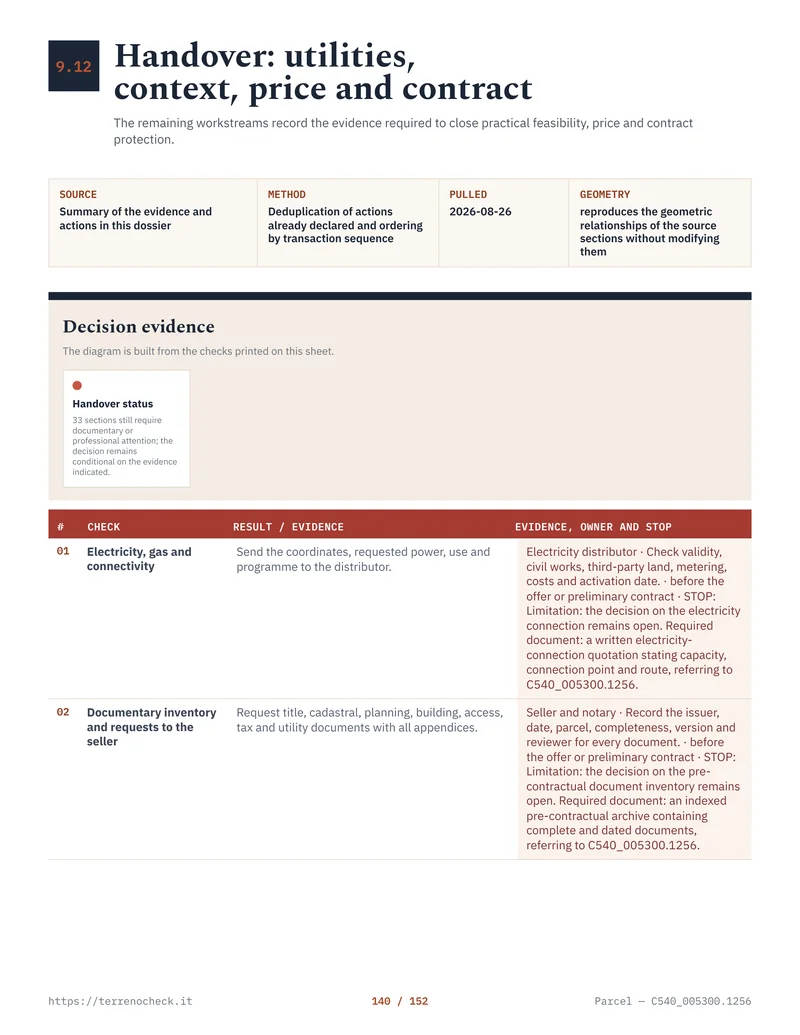 Open the full page
Telecoms: a resale issue, not a luxury
Broadband belongs in the resale calculation. A house with no fixed service, weak mobile signal and no reliable fixed-wireless line is harder to run and sell.
Use AGCOM’s Broadband Map against the exact address or nearest validated civic number. It reports fixed, FWA and mobile technologies and performance. Do not rely on “fiber nearby”. Ask an operator for technology, download and upload speeds, installation charge, waiting list and whether the final drop is included. A map is evidence to investigate, not a service contract.
AGCOM reported 20.53 million fixed-network accesses in December 2025: FTTC 40.5%, FTTH 34.1%, and FWA 2.68 million lines. These are Italy-wide access figures, not coverage at your parcel.
AGCOM fixed connectivity indicators, December 2025
| Fixed connectivity indicator reported by AGCOM | December 2025 |
|---|---|
| Total fixed-network accesses | 20.53 million |
| FTTC share of fixed accesses | 40.5% |
| FTTH share of fixed accesses | 34.1% |
| FWA accesses | 2.68 million |
Source: AGCOM, Communications Observatory no. 1/2026, data for December 2025
- Quotation without inspectionMaximum 10 working days
- Quotation with inspectionMaximum 20 working days
- Simple water connectionMaximum execution time 15 working days after acceptance
- Simple sewer connectionMaximum execution time 20 working days after acceptance
- Water-supply activationMaximum 5 working days
- Complex water and sewer connection90% completed within 30 working days under the RQSII standard
Source: ARERA, Resolution 655/2015/R/idr, RQSII consolidated text, Articles 5, 6, 8, 9, 10 and Tables 1–2.
The pre-purchase test I would actually run
Do this before the preliminary contract, not after the house is designed.
- Give every utility the same parcel plan, cadastral references, building use, floor area, meter positions and access route. A vague request produces a vague answer.
- Ask the Comune’s technical office to confirm the planning zone, primary-urbanisation status, planned extensions, road ownership and municipal permits for the route. Check the current planning instrument, not an old listing.
- Send water and sewer requests to the correct ATO manager. Ask whether a main is at the boundary, the connection point, pressure, sewer availability, gravity feasibility, the authority for autonomous treatment and the permitted discharge.
- Ask the electricity distributor for permanent and temporary-site options. Require the distance, reference cabin, contribution, network works, road crossings, easements, timing and customer works.
- Ask the gas distributor whether the address is served and an extension is technically and economically feasible. Obtain the full quote or written reason for refusal.
- Check AGCOM’s map and ask two operators for written availability. Test mobile coverage from the parcel, not the village centre.
- Overlay routes with access rights, flood and landslide mapping and landscape constraints. A trench through a neighbour’s land needs a right to cross. Read the PAI flood and landslide guide and access-rights guide. If a route affects protected landscape, Article 146 of Legislative Decree 42/2004 requires submission and authorisation before work, subject to statutory exceptions. See the landscape-constraint guide.
- Put a condition in the offer or preliminary contract requiring acceptable written connection outcomes, or reduce the price by the documented extension costs plus a contingency. “The seller says it should be fine” is not a condition.
Add the quotations, private trenching, road opening and restoration, easements, design, permits, well or treatment plant, pumps, tanks, electrical upgrades, temporary supply and a contingency. Compare the total with a serviced plot. If it fails, it is an unserviced plot with a planning label, not a bargain.
Sources
- ARERA, electricity connection charges, TIC in force from 1 January 2026
- e-distribuzione, connection costs for 2026
- ARERA, electricity service and new connections
- e-distribuzione, temporary connection costs and durations
- ARERA, water service general information and local manager rules
- ARERA, RQSII contractual quality rules for water and sewer, consolidated text
- Acque SpA, water connection tariffs
- Acque SpA, sewer connection tariffs
- Normattiva, DPR 6 June 2001, no. 380, Article 12
- Government Civil Protection, DPR 6 June 2001, no. 380, consolidated text including Article 16
- Normattiva, Legislative Decree 3 April 2006, no. 152, Article 124
- Regione Toscana, Regulation 16 August 2016, no. 61/R, Article 20, domestic groundwater
- Regione Lombardia, public-water derivations and Regulation 24 March 2006, no. 2
- Regione Emilia-Romagna, public-water concessions and domestic groundwater communication
- Regione Toscana, Regional Law 31 May 2006, no. 20, Article 14
- Regione Toscana, Regulation 8 September 2008, no. 46/R, wastewater rules
- Regione Lombardia, Regulation 29 March 2019, no. 6, isolated wastewater systems
- ARERA, gas service general information
- Normattiva, Legislative Decree 23 May 2000, no. 164, Article 16, obligations of gas distribution undertakings
- ATO 2 Lazio Centrale - Roma, 2025 water-service user regulation and connection price schedules
- AGCOM, Broadband Map
- AGCOM, Communications Observatory no. 1/2026, data for December 2025
- Ministry of Culture, Legislative Decree 22 January 2004, no. 42, Article 146