
Vincolo paesaggistico: what it permits
A vincolo paesaggistico does not automatically make Italian land unusable. It changes the order of work: identify the exact protection, design around it, and obtain the right clearance before touching the site.
Contents
- The legal base: D.Lgs. 42/2004
- Declared by decree versus protected by law
- What the autorizzazione paesaggistica does
- Ordinary, simplified and free of authorisation
- What you can usually do, and what to stop pricing in
- An abuse inside a vincolo is not an ordinary condono
- Refusal, and the appeal buyers misunderstand
- How to check before making an offer
If a listing says terreno con vincolo paesaggistico, do not translate that in your head as “nice countryside”. It is a legal control on changes to a protected place. It may come from a decree with a map and written prescriptions, or apply automatically because the parcel falls into a category named by national law.
The second version catches buyers: there may be no warning in the cadastral extract or estate-agent brochure. A stream, wood, lake shore or archaeological area can put the parcel inside the regime. For many visible changes you need an autorizzazione paesaggistica before a permesso di costruire. Buy the wrong parcel and you can own land zoned for a use on paper that cannot take the shape you wanted in the real view.
This guide covers the national framework. The applicable plan, decree, regional delegation and municipal rules still have to be read for the particular foglio and particella. For the wider order of checks, start with the pre-purchase checklist for foreign buyers. Use it neither as a title or building opinion nor as a substitute for the authority’s written decision.
The legal base: D.Lgs. 42/2004
The main national statute is Legislative Decree 22 January 2004, no. 42, the Codice dei beni culturali e del paesaggio. Article 134 identifies the classes of beni paesaggistici. Two groups matter most to a land buyer:
- areas of notable public interest under Article 136, identified through a declaration and its acts; and
- areas protected by law under Article 142, usually called ope legis constraints.
A landscape plan under Article 143 can identify additional areas. Once approved, its prescriptions bind and prevail over conflicting territorial and urban-planning provisions under Article 145(3).
Article 136 covers four broad types: individual natural beauties or places with geological or historical character; unusually beautiful villas, gardens and parks; groups of places with a characteristic aesthetic and traditional appearance, including historic centres; and panoramic beauties or public viewpoints. The declaration should explain the protection, boundary and prescriptions. “The village is historic” is not that document.
Article 142 is more mechanical. Use the table as a first screen, not a permit. Its Article 142(2)–(3) exceptions matter: a regional process can exclude some watercourses, and historic urban zones can fall under statutory exceptions. Read the current plan and official act before relying on a measurement.
Article 142 categories and thresholds
| Category under D.Lgs. 42/2004, Article 142, paragraph 1 | National statutory threshold or test | What a buyer must not assume |
|---|---|---|
| Coast, letter a) | 300 m from the shoreline, including land elevated above the sea | The cadastral boundary or listing distance is the legal shoreline |
| Lake, letter b) | 300 m from the shoreline, including land elevated above the lake | A small lake is automatically outside the rule |
| Listed river, torrent or watercourse, letter c) | 150 m from each bank or foot of the embankment | Every visible ditch is a listed watercourse, or every listed course is obvious on a map |
| Alpine mountains, letter d) | Land above 1,600 m above sea level | The 1,600 m line is a permission to build |
| Apennine mountains and islands, letter d) | Land above 1,200 m above sea level | The lower threshold applies to every Italian mountain |
| Glaciers and glacial cirques, letter e) | The protected feature itself | A boundary can be settled from a national-scale map alone |
| National or regional parks and external protection areas, letter f) | The park or external protection perimeter | Park rules and landscape rules are the same thing |
| Forests and woods, and reforestation areas, letter g) | The legal forest/wood definition and the protected area | A land-cover screenshot answers the legal classification |
| Agrarian universities and land burdened by usi civici, letter h) | The relevant collective-right area | A private cadastral owner is proof that the collective right is gone |
| Wetlands on the statutory list, letter i) | The listed wetland | Every marshy patch has the same status |
| Volcanoes, letter l) | The volcanic area | The word “volcano” in a tourist description identifies the boundary |
| Archaeological-interest zones, letter m) | The zone identified under the Code and its acts | A landscape clearance replaces archaeological clearance |
Source: D.Lgs. 42/2004, Article 142
Source for table: D.Lgs. 42/2004, Article 142, Article 142(1)–(4).
Source: Normattiva, D.Lgs. 22 January 2004, no. 42, Article 142(1), consolidated text
Pages from the delivered dossier
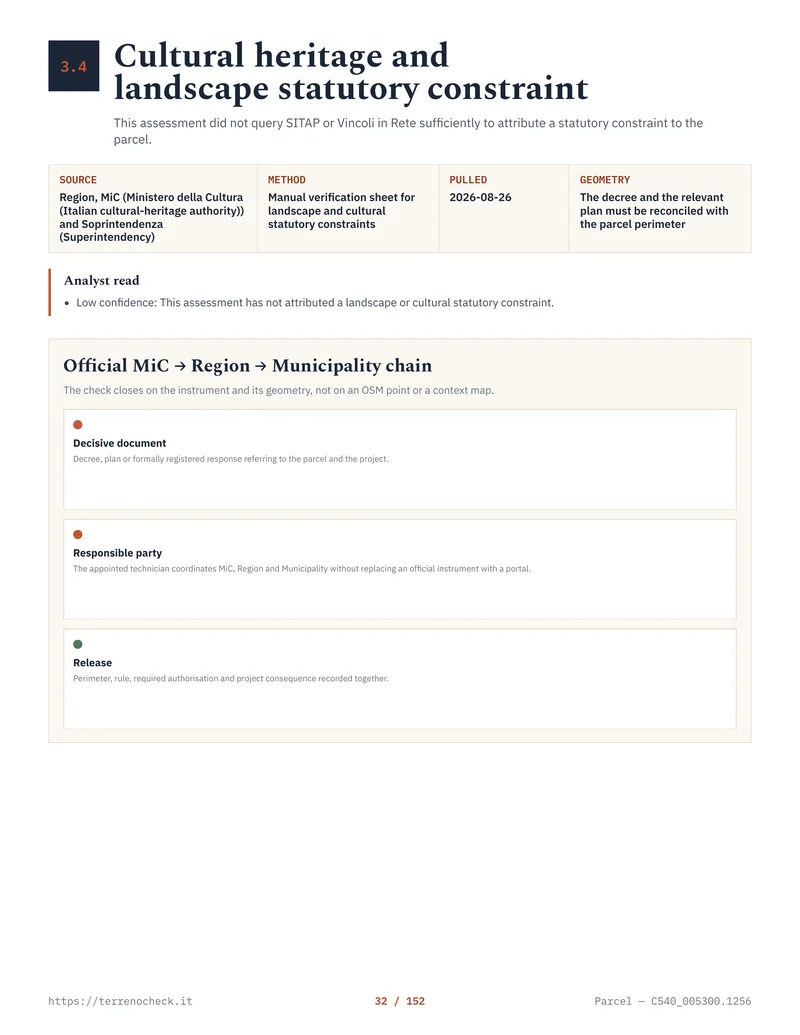 Open the full page
Declared by decree versus protected by law
A competent process leads to a dichiarazione di notevole interesse pubblico. It is published, deposited with affected municipalities and, for relevant Article 136 cases, notified and transcribed in the property registers under Article 140. Read the act, its planimetric attachment and later amendments, not just a GIS layer title.
An ope legis constraint works differently. Article 142 makes specified land “in any event of landscape interest” because of its relationship to a coast, lake, listed watercourse, wood, park, mountain threshold or other category. It does not wait for a decree addressed to the owner. “There is no decree on this parcel” therefore does not answer the authorisation question.
The systems can overlap: a river corridor can be protected by Article 142 and an older Article 136 declaration, while a regional plan adds prescriptions. The CDU guide explains the planning certificate, not this check.
SITAP is useful for a first pass. The Ministry’s description says it covers Article 136/157 and Article 142 constraints, but its data are informative, non-certifying, non-exhaustive and variable in positional accuracy. A national-scale polygon is a reason to investigate, not a title document or clean bill of health.
What the autorizzazione paesaggistica does
Article 146 of the Code is the operating gate. Under Article 146(2), the owner, possessor or other lawful holder must submit the project and landscape documentation to the competent administration and must not start until authorisation is obtained. It comes before the building title. A residential planning use can still fail on siting, height, materials, roof, access or retaining works.
Under Article 146(6), the region can delegate the function to a province, association, park body or municipality with the required technical structure and separation from ordinary building administration. Often the front door is the municipal SUE; elsewhere it is a regional office or park authority. “The Soprintendenza issues your permit” is usually inaccurate.
The Soprintendenza is the Ministry’s territorial office. In the ordinary route, under Article 146(7), the competent authority checks the file and sends its proposal and technical report within 40 days. Under Article 146(8), the Soprintendente gives an opinion within 45 days of receiving the acts. In the circumstances in Article 146(5), it is binding. The competent authority then has 20 days to issue the authorisation or proceed with the negative notice. The Soprintendenza is not checking ownership, septic tanks or cadastral income. It is assessing the protected place and the project’s effect on it.
The ordinary clock is not a promise of a fast answer. An incomplete relazione paesaggistica, weak survey, missing decree attachment or changed project can stop the clock or send the file back. Building, hydrogeological, park, archaeological and utility approvals are separate.
For route planning, the published statutory numbers are more useful than a vague “it takes a while”.
Published landscape-authorisation intervals
| Route | Administration’s published step | Soprintendenza step | Final statutory clock shown by the sources | Buyer’s planning use |
|---|---|---|---|---|
| Ordinary, D.Lgs. 42/2004, Article 146, paragraphs 7 and 8 | 40 days to check and send a complete proposal | 45 days for the opinion; administration then has 20 days to act | 40 + 45 + 20 = 105 days to the measure in the clean sequence; authorisation becomes effective after 30 days under Article 146(11) | Budget a real design and a long conditional period |
| Simplified, DPR 31/2017, Article 11 | 20 days to send a positive, procedible file | 20 days for the opinion | 10 days for the final act after a favourable opinion; Article 10 sets a 60-day maximum for the simplified procedure | Use only for an exact Annex B category, not because the work feels small |
| Post-work compatibility, D.Lgs. 42/2004, Article 167, paragraphs 4 and 5 | Authority decides within 180 days | Binding opinion within 90 days | 180 days for the authority, after the 90-day opinion route | Never make an offer assuming an abuse will be regularised |
Source: D.Lgs. 42/2004 Articles 146 and 167; DPR 31/2017 Articles 10 and 11
Source for table: D.Lgs. 42/2004, Articles 146 and 167; Soprintendenza Parma and Piacenza procedure summary; Soprintendenza Brindisi, Lecce and Taranto deadlines.
- Ordinary, Article 14640 days review/transmission · 45 days Soprintendenza opinion · 20 days decision · +30 days before effectiveness = 135 days
- Simplified, DPR 31/201720 days transmission · 20 days opinion · 10 days final act after a favourable opinion · 60-day maximum
- Post-work compatibility, Article 16790 days binding Soprintendenza opinion · 180 days authority decision
Source: Normattiva, D.Lgs. 42/2004 Articles 146 and 167 and DPR 31/2017 Articles 10 and 11; procedural summaries from Soprintendenza Parma and Piacenza and Soprintendenza Brindisi, Lecce and Taranto — sabap-le.cultura.gov.it · source document
In practice, I put four to six months into a straightforward ordinary authorisation budget from a complete design, and more when the act or regional plan is unclear. That is a working allowance, not a national statistic. Nobody can give the actual timing without knowing the office, file quality, plan and other authorities involved.
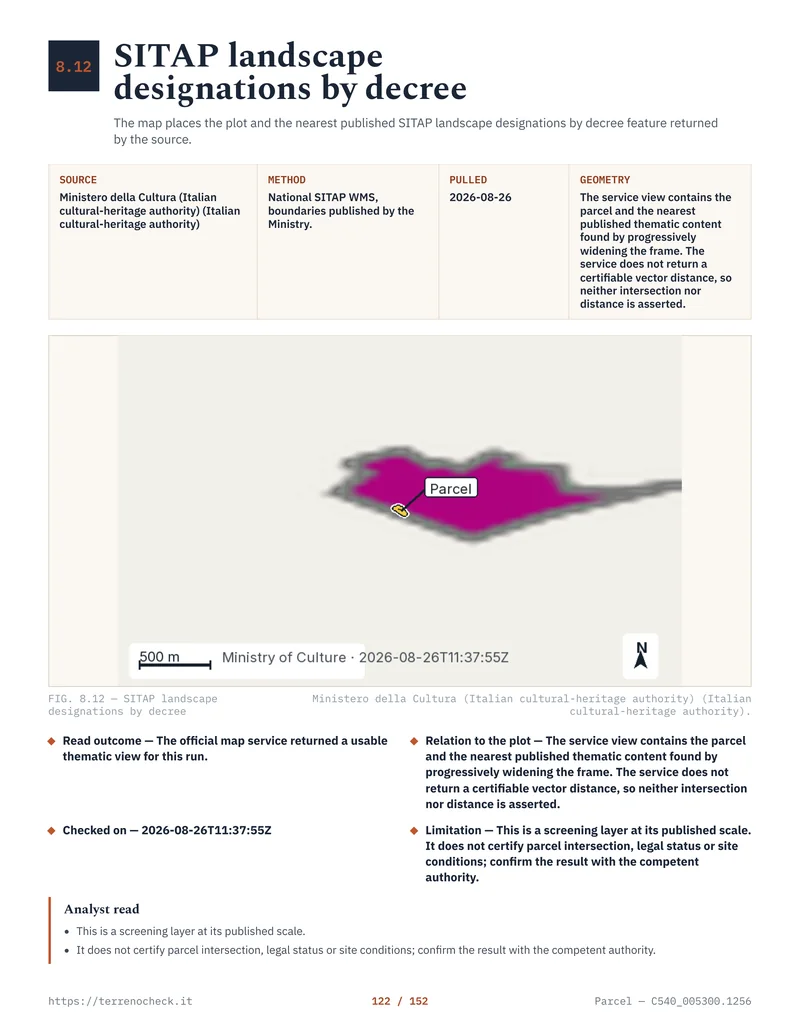 Open the full page
Ordinary, simplified and free of authorisation
DPR 13 February 2017, no. 31 sorts interventions into three routes. Annex A has 31 categories excluded from landscape authorisation. Annex B has 42 types of minor works using the simplified procedure. Everything else normally follows Article 146.
Do not generalise from a project name: the annexes contain conditions, dimensions and technical wording. “Solar panels”, “a fence” or “a small pool” is not a legal category by itself. Location, visibility, existing authorisation, volume, materials and form decide which entry applies.
Article 149 of the Code gives starting examples. Ordinary and extraordinary maintenance, static consolidation and conservative restoration can be free when they do not alter places or exterior appearance. Agricultural, forestry and pastoral work can be free when it does not permanently alter land with buildings or civil works or the hydrogeological arrangement. Certain forest cuts, afforestation, reforestation, reclamation, fire-prevention and conservation works can be free when provided for and authorised by forestry rules.
Free of autorizzazione paesaggistica does not mean free of every permission. A farm track can raise planning, forest, hydrogeological or park questions, and a wall can be a landscape change without being a building. The PRG and PUC guide covers that separate planning question.
- No landscape authorisationNo applicable constraint, or one of DPR 31/2017 Annex A’s 31 excluded categories with its conditions
- Simplified authorisationProtection applies; Annex B category, not A · 20-day opinion and 60-day maximum
- Ordinary Article 146Protection applies; neither Annex A nor B · 40-day, 45-day and 20-day steps
- StopWork already exists or is partly built · investigate Article 167(4), 90-day opinion and 180-day decision
Source: Normattiva, D.Lgs. 42/2004 Articles 136, 142, 146 and 167 and DPR 31/2017 Articles 10–11 and Annexes A–B; Regione Emilia-Romagna, count of 31 excluded and 42 simplified types
What you can usually do, and what to stop pricing in
A vincolo is not a demolition order for every existing house. Maintained buildings can often be repaired within no-authorisation conditions or authorised with a project respecting the protected character. Existing agricultural activity may continue under national and regional rules.
“Sympathetic” is not a legal test. Drawings must address the protected reasons: a view, skyline, traditional settlement pattern, woodland edge, watercourse corridor, historic setting or the materials and profile named in the act. A compact extension may pass where a larger volume blocks a view; repairs may pass where a terrace cut into a slope does not.
As a pre-offer rule, do not price in a new house, volume, large pool, tall retaining wall, new access cut, major grading, cleared wood or broad hardstanding until the proposal is matched to the applicable decree and plan. None is automatically impossible, but all are bad items to treat as an entitlement.
The landscape authorisation does not cure an unlawful planning position. A favourable opinion will not create a missing right to build, and a building permit does not override landscape prescriptions. That hierarchy is where “the comune said it was buildable” conversations end.
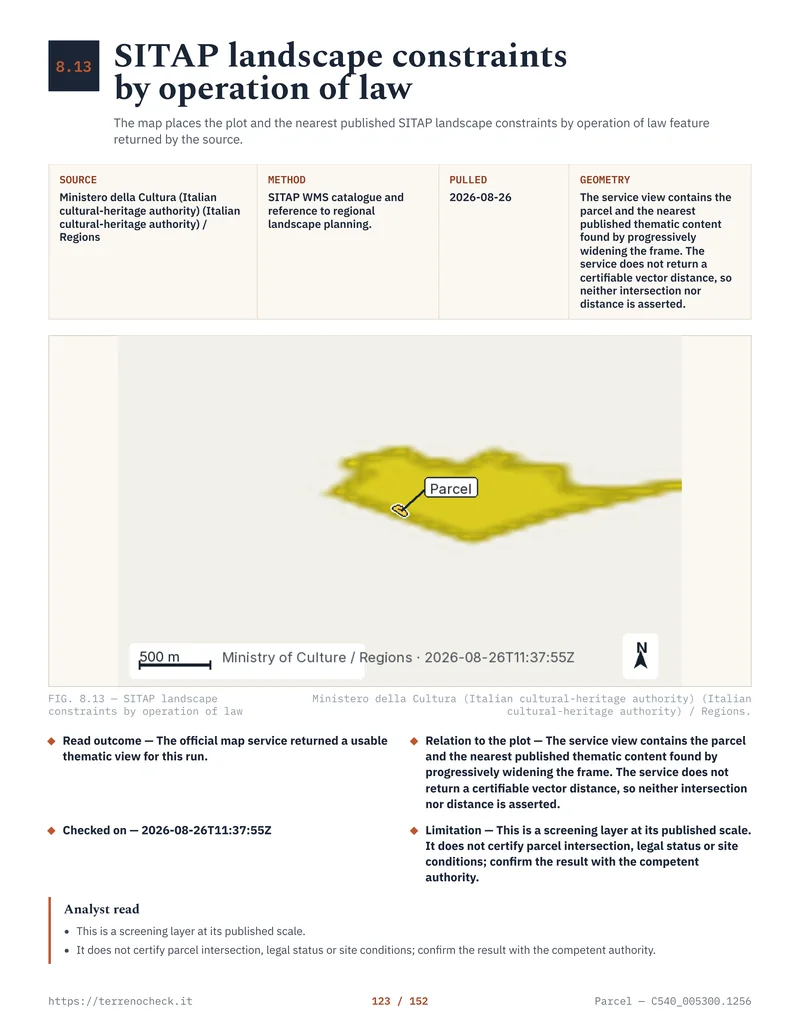 Open the full page
An abuse inside a vincolo is not an ordinary condono
Buyers often hear, “It can be sanato.” Ask which procedure, for which work, under which article, and with what written outcome.
Article 146(4) says that landscape authorisation cannot normally be issued in sanatoria after the work, even if the work is only partly complete. Article 167(4) of the Code is the narrow exception called accertamento della compatibilità paesaggistica. It covers only:
- work done without or contrary to an authorisation that created no useful surface or volume and did not increase an existing lawful surface or volume;
- materials used contrary to the authorisation; or
- work classifiable as ordinary or extraordinary maintenance under Article 3 of DPR 380/2001.
That is a small door. A new enclosed room, increased volume or useful floor area is not eligible because it looks harmless from the road. The Ministry’s Circular 18/2022 describes Article 167 as an ex-post route for minor interventions with very limited impact, not a general fix for unauthorised transformation. Under Article 167(5), the authority decides within 180 days after the binding 90-day Soprintendenza opinion. If accepted, the transgressor pays the greater of assessed damage or profit, based on an expert valuation. If rejected, restoration/demolition applies.
That is different from a building condono, a special amnesty mechanism governed by its own law and conditions. A condono file is not proof that the landscape side is clear. Ask for the application, municipal decision, landscape opinion or compatibility decision, approved drawings and proof that the building matches them. The article on unauthorised building work and condono goes deeper into that review.
Refusal, and the appeal buyers misunderstand
A refusal is common enough in buyer work to budget for. There is no national public refusal rate that I could verify, so I will not invent one. The Ministry’s transparency portal publishes recent diniego decisions, including a January 2026 Umbrian case involving external changes, roof work, panels and outdoor works. That is not a national percentage, but it kills the idea that simplified means automatic yes.
The useful response to a negative opinion is often redesign: reduce visibility, remove the volume, change the roof profile, retain the slope differently, use the act’s materials and colours, or abandon the conflict. The pre-notice under Article 10-bis of Law 7 August 1990, no. 241 gives the applicant a chance to respond, not an entitlement.
Legal challenges exist. The Ministry’s published procedure identifies a claim to the competent Tribunale amministrativo regionale within 60 days, or an extraordinary appeal to the President of the Republic within the 120 days set by Article 9 of DPR 24 November 1971, no. 1199, subject to notification and standing rules. Those routes address legal defect, inadequate reasoning or procedural error. They are not a second design meeting. A refusal is hard to appeal in practice when the project plainly conflicts with a binding prescription. Redesign is often cheaper.
How to check before making an offer
Do this while your money is still yours.
First, fix the parcel identity. Obtain the current visura catastale and cadastral map from the Agenzia delle Entrate’s cadastral and mortgage services, and obtain the seller’s title documents separately. Match comune, foglio, and particella. An estate-agent pin is not a boundary. The visura guide explains this step.
Second, run the parcel through SITAP and save the date, visible layers and scale. Check declared and ope legis layers. Treat a blank result as “not found in this informational layer”, not “no vincolo”. SITAP warns that its database is not exhaustive or certifying. Near a wood, watercourse, coast, park or archaeological area, consult regional sources too.
Third, open the regional landscape plan: PPR, PTPR, PPTR or the local name. Read the rules for the exact landscape unit and official boundary layer. A regional portal may have a better-scale map than SITAP. The Emilia-Romagna portal separates Article 136 assets, ope legis assets and watercourse data, and warns that the legal value comes from the instituting act. Other regions organise their data differently.
Fourth, request the municipal CDU, relevant PRG/PUC/PGT extract and NTA. A Comune di Firenze CDU service is one example of a municipal route; other comunes set their own forms and portals. Check historic centre, park, urban exception and specific prescriptions. Ask the SUE or regional office, in writing, which administration receives an Article 146 application and which decree, plan and Annex A/B entry applies to the proposed work. Keep the written file. Check ISPRA’s IdroGEO and PAI data and the applicable district authority PAI layer alongside the separate PAI flood and landslide risk guide; hazard rules can block earthworks even when the landscape route is clear.
Fifth, ask the seller for every old landscape authorisation, refusal, compatibility application, condono decision and approved drawing. Compare the paperwork to the roof, terraces, walls, paths, pool, solar equipment and outbuildings. “Authorised in 1988” is not enough if the current object is different.
Finally, make the offer conditional on document review and the project you intend to build. Do not use “subject to planning approval”. Name the landscape authorisation, building title, project envelope and seller documents. If feasibility depends on a blurry boundary, value the plot as uncertain land until the competent office resolves it.
Sources
- Normattiva, D.Lgs. 22 January 2004, no. 42, consolidated text
- Normattiva, DPR 13 February 2017, no. 31, consolidated text
- Agenzia delle Entrate, cadastral and mortgage assistance services
- Ministero della Cultura, SITAP description and limitations
- SITAP, public landscape-constraint web GIS
- Regione Emilia-Romagna, protected landscape assets
- Regione Emilia-Romagna, when landscape authorisation is required
- Comune di Firenze, CDU service
- ISPRA, geological and natural-hazard databases
- Autorità di Bacino Distrettuale dell’Appennino Settentrionale, Arno PAI landslide layer
- Soprintendenza Parma and Piacenza, authorisation and compatibility procedure
- Ministero della Cultura transparency portal, binding landscape opinion procedure
- Soprintendenza Brindisi, Lecce and Taranto, landscape opinion deadlines
- Ministero della Cultura, Circular 18/2022 on Article 167 compatibility
- Ministero della Cultura transparency portal, recent landscape refusal example
- Normattiva, D.Lgs. 42/2004, Article 142, areas protected by law
- Normattiva, D.Lgs. 42/2004, Article 146, landscape authorisation
- Normattiva, D.Lgs. 42/2004, Article 167, post-work landscape compatibility
- Normattiva, DPR 1199/1971, Article 9, extraordinary appeal deadline