
Unauthorised building work in Italy: spot an abuso
A house can be mapped, taxed and occupied while its building work is still illegal. Learn how to match the building, the Comune file and the Catasto before you inherit somebody else’s problem.
Contents
- Two different problems hide under the word “irregular”
- What the deed has to say
- The three condoni are not three open doors
- A pending condono is not a completed condono
- Ordinary sanatoria: double conformity, then the Salva Casa exception
- How to detect an abuso before signing
- 1. Walk the building with the planimetria
- 2. Pull the Comune’s pratica edilizia file
- 3. Compare aerial images over time
- The consequences are practical, not theoretical
- What to demand from the seller
An existing alteration is not lawful merely because it is finished or has been used for years. Compare the current building with the Comune file and resolve any unauthorised work, incorrect drawings or undecided condono application before the purchase becomes binding.
That is an abuso edilizio: building work carried out without the required title, or not as the title allowed. It does not have to look dramatic. A closed veranda, a moved staircase, a converted storeroom, an extra bathroom or a house that is larger than the approved drawings can be enough.
If you are buying an Italian house with land, make this check part of the same early work as the visura catastale, the CDU and the planning check described in what you can build in Italy. If the parcel also carries a vincolo paesaggistico or sits in a hazard class, read those checks before you price the risk. The order matters. A clean-looking cadastral record does not rescue an unauthorised building.
Two different problems hide under the word “irregular”
Italian agents and sellers often use difformità as if it were a diagnosis. It is not. Ask: irregular in which record, and by how much?
A formal or documentary irregularity may be a missing reference, an old drawing that does not show a minor internal change, a cadastral plan that was never updated, or a file whose paperwork is incomplete. It can still delay a sale. Some defects can be corrected with a cadastral update, a later filing or a technical reconstruction of the stato legittimo.
A substantial planning illegality is different. The built work may exceed the permitted volume, sit outside the authorised footprint, change use without the required title, breach a condition of the permit, or exist where no permit was issued. The Comune can order removal or demolition. In the more serious cases, the issue is not “which form do we file?” but whether the work can legally remain at all.
The Catasto is a tax and land-record system, not the authority that grants planning permission. The Agenzia delle Entrate’s buying guide requires the deed to identify the cadastral data and planimetria and to contain a declaration that the real situation matches them. That is cadastral conformity, not proof that the Comune approved the building.
The two records must agree with the physical building, but they answer different questions:
Cadastral and urbanistic conformity are different checks
| Check | What it compares | What a mismatch means |
|---|---|---|
| Conformità catastale | The building on site against the Catasto Fabbricati data and planimetria | The deed declaration may be defective; an update may be needed, but a new plan does not authorise the work |
| Conformità urbanistica-edilizia | The building on site against the Comune’s titles, approved drawings, variants and lawful historic evidence | The work may be an abuso, require a national sanatoria route, need removal, or be impossible to regularise |
Source: Agenzia delle Entrate, buying guide and cadastral declaration
Do not let anyone “solve” an urbanistic problem by sending a new plan to the Catasto. That only makes the paper trail worse.
The legal route is national, but the planning rules applied to the property also come from the relevant regional law and the Comune’s PRG, PUC, PGT or NTA. That is why a rule that sounds national can produce a different answer in two municipalities.
Pages from the delivered dossier
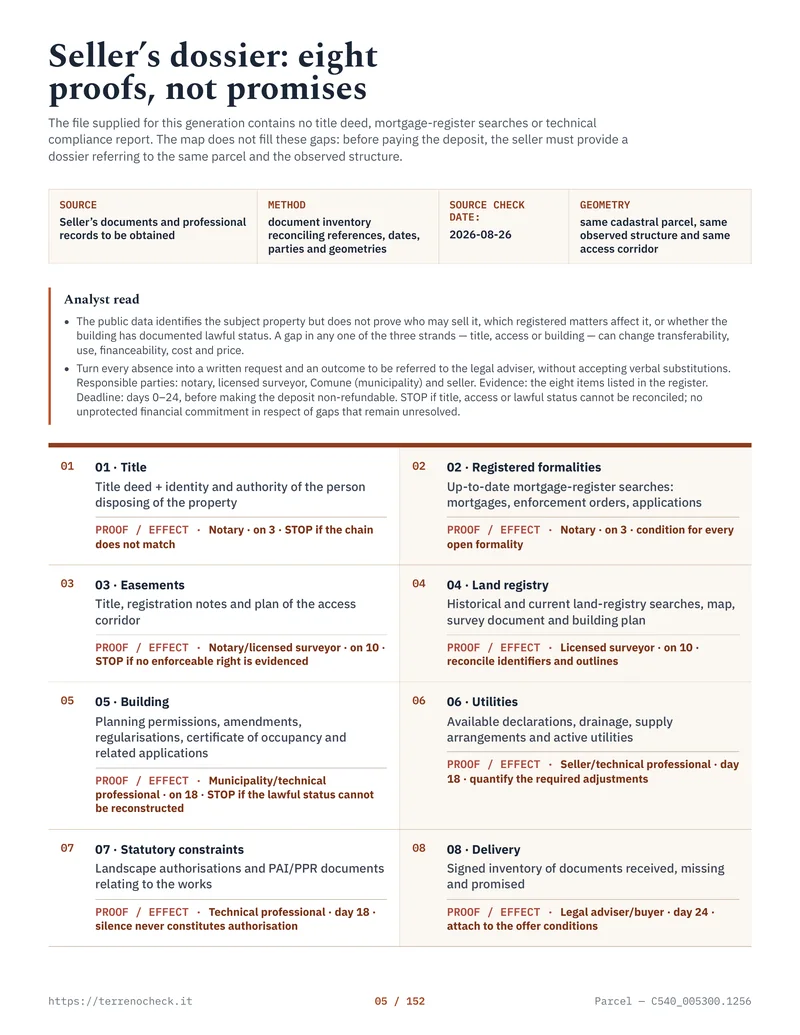 Open the full page
What the deed has to say
For buildings started after 17 March 1985, Article 46 of DPR 380/2001 makes certain transfers of real rights void if the deed does not state the details of the permesso di costruire or the permit in sanatoria. Article 40 of Law 47/1985 covers the older statutory situation and requires the relevant licence, concession, sanatoria details or the prescribed historic declaration for the acts it covers.
The rule does not permit an arbitrary number in the deed. The title must exist and relate to that building. The Supreme Court’s Sezioni Unite, judgment no. 8230/2019, treats this as a formal statutory nullity: a real, identifiable title mentioned in the deed is the central test for that particular nullity, even though physical non-conformities can still trigger other disputes and sanctions. A fabricated or unrelated title is not a cure. An untrue declaration can therefore leave the sale void where it means the deed lacks a real, referable title, and it can expose the seller to the consequences of a false declaration under Article 76 of DPR 445/2000. The narrower Supreme Court rule still matters: a real title does not, by itself, make every physical difference a deed-nullity case.
There is a second deed check. Under the cadastral rules explained by the Agenzia delle Entrate, the urban unit’s cadastral identifiers and planimetria must be stated, with a declaration that the actual state matches them or an attestation from an authorised technician. That declaration does not replace the urbanistic file. You need both sides checked before the notary prepares the final wording.
The three condoni are not three open doors
Condono edilizio is an exceptional amnesty created by a specific law. Ordinary sanatoria is a route within the current building-control system. They are not synonyms, and there is no permanent application window for a new condono just because a seller uses the word confidently.
The three condono regimes
| Law | Works cut-off in the national rule | What the buyer should understand |
|---|---|---|
| Law 47/1985, first condono | Completed by 1 October 1983 | Historic applications may still be in municipal archives; the application, payments, drawings and final measure must be checked |
| Law 724/1994, second condono, Article 39 | Completed by 31 December 1993; new construction applications were subject to a 750 m³ limit per request | The law extended the first framework with new limits; regional and municipal processing still matters |
| Law 326/2003, third condono, Article 32 of Decree-Law 269/2003 as converted | Completed by 31 March 2003 | The law preserved regional and local competences and applied tighter categories and exclusions; do not assume a national yes |
Source: Law 47/1985, Law 724/1994 Article 39 and Decree-Law 269/2003 Article 32
Source for the cut-off dates and volume figure: Law 47/1985, Law 724/1994 Article 39 and Article 32 of Decree-Law 269/2003.
The cut-off dates are statutory, not estimates. They tell you when work had to be finished to enter a scheme, not whether a particular building qualified.
- Law 47/1985 · works cut-off1 October 1983
- Law 47/1985 · law date28 February 1985
- Law 724/1994 · works cut-off31 December 1993
- Law 724/1994 · law date23 December 1994
- Law 326/2003 · works cut-off31 March 2003
- Law 326/2003 · law date24 November 2003
Source: Normattiva, Law 47/1985 Articles 31 and 40; Law 724/1994 Article 39; Decree-Law 269/2003 Article 32
A pending condono is not a completed condono
Buyers lose months here. A stamped domanda di condono proves only that someone applied. It does not prove acceptance, full payment of oblazione and charges, the required opinions, or a final concessione in sanatoria.
Ask for the full file: application, protocol number, drawings, photographs, every payment receipt, integration requests, opinions, refusal if any, final concession or legally effective silence-assent, and cadastral update. The Comune’s procedure is local. Milan, for example, publishes separate routes for ordinary building files and the first, second and third condono files. That is a model of what to request, not a national fee or deadline.
Do not accept “the condono is automatic”. A pending file can contain a missing payment, wrong volume, protected-area problem, regional exclusion or unanswered document request. Protect the point in the preliminary contract, or price the risk as if the work were still unauthorised. A seller who refuses to release the file has answered your question.
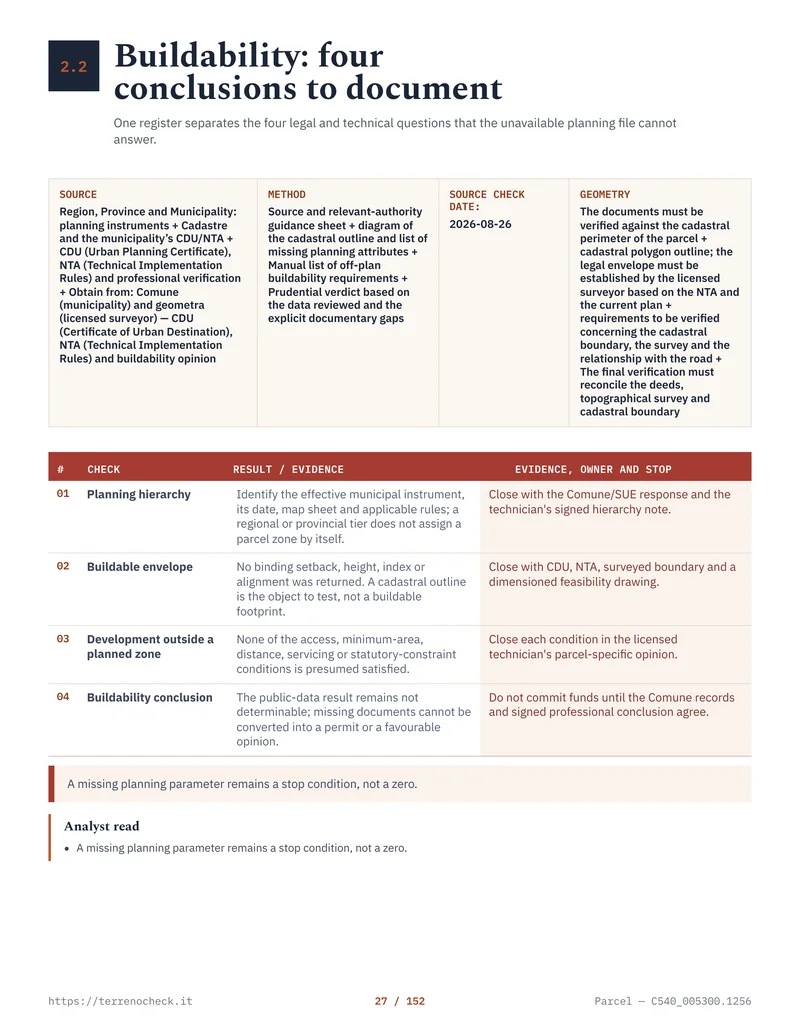 Open the full page
Ordinary sanatoria: double conformity, then the Salva Casa exception
Article 36 of DPR 380/2001 is the classic accertamento di conformità for work without a permit or in total difformity. The work must satisfy the planning and building rules in force when it was built and when the application is made. That is doppia conformità. A later plan change does not ordinarily cure an earlier illegality under Article 36.
Article 37 concerns works requiring a SCIA that were carried out without it or contrary to it, with its own sanction and procedure. The technician must classify the work first. Calling a new room a “CILA issue” does not make it one.
The 2024 Salva Casa reform is Law 105/2024, converting Decree-Law 69/2024. It changed Article 34-bis, added Article 34-ter for particular old in-course variants, and inserted Article 36-bis. The MIT’s January 2025 guidelines describe a defined easing for partial differences, certain essential variations and specified SCIA cases, not a general amnesty.
The practical numbers matter:
Source: Normattiva, DPR 380/2001 Article 34-bis, text in force from 28 July 2024; Law 105/2024, conversion of Decree-Law 69/2024
Article 36-bis relaxes the old double-conformity test only for its named categories. The work must comply with planning rules in force when the application is made and building requirements in force when it was carried out. That is not “anything legal today can be saved”. The work must fit Article 36-bis, the evidence must establish what was built and when, and the Comune must process the application.
For an Article 36-bis permit in sanatoria, the Comune’s decision period is 45 days; for a SCIA in sanatoria, 30 days. A landscape-protected property adds another authority: Article 36-bis of DPR 380/2001 gives the compatibility assessment 180 days, with a binding Soprintendenza opinion due within 90 days, and the municipal period is suspended meanwhile. These are procedural numbers, not a promise that a file will be complete in 45 days.
- Article 34-bis tolerance bandsWork completed by 24 May 2024; test tolerance against the existing title first
- Article 36-bisPartial difference, specified essential variation or Article 37 SCIA absence/difference; 45 days permit or 30 days SCIA
- Article 36Absence or total difference outside Article 36-bis; two conformity dates; 60-day decision and silence is rejection
- No route or refusalArticle 31/34 consequences include removal or demolition and possible Comune acquisition after an ignored order
Source: Normattiva, DPR 380/2001 Articles 31, 34, 34-bis, 36, 36-bis, 37 and 46, consolidated text; Ministero delle infrastrutture e dei trasporti, Salva Casa guidelines; Regione Lazio, Article 36-bis procedure
Salva Casa did not legalise a complete unauthorised house, erase a demolition order, replace a landscape authorisation or turn a pending municipal file into an approval. It did not make the Catasto a planning authority. A technician still has to reconstruct the title history and the Comune still has to decide the case.
How to detect an abuso before signing
1. Walk the building with the planimetria
Obtain the current cadastral plan and walk every room. Count the doors, windows, stair flights, bathrooms, enclosed terraces, garages, storage spaces and external structures. Check the footprint, not just the internal walls. Compare the plan with photographs taken on the same visit.
The obvious clues are a veranda missing from the plan, a garage converted into a bedroom, a window in a blank wall, a second kitchen, a roof terrace enclosed with frames or a building on the parcel that does not appear in the Catasto at all. The less obvious clue is a building whose cadastral plan matches the present condition but whose permesso di costruire drawings do not. That is why the planimetria is the first filter, never the last word.
2. Pull the Comune’s pratica edilizia file
Request the fascicolo edilizio from the Comune’s SUE or archive. Give the technician the cadastral identifiers, address, owner’s details and every title the seller mentions. Ask for the original permit, approved drawings, variants, start and end-of-work filings, relevant structural or landscape filings, agibilità material, and enforcement or condono documents.
Municipal systems differ. Milan says its building-file service covers factory records and modifications from 1928 onward, while its condono service separately identifies the three condono laws. Another Comune may have paper archives, different fees, restricted access or a backlog. Do not assume that an online search showing no result means no file exists. Ask the archive how it searches historic addresses and parcel numbers.
The technician should compare the approved drawings to the building dimension by dimension. “The permit exists” is not the conclusion. The question is whether the permit describes this building.
3. Compare aerial images over time
Use the official cadastral map and available orthophotos as a chronology aid. The Agenzia del Territorio described its national “undeclared buildings” check as starting with high-resolution orthophoto and cadastral-map overlays. An extension appearing between two image dates gives you a construction window to test against the Comune file.
It is evidence, not a permit. Resolution, image date, tree cover, shadows and georeferencing can mislead. A small roof, internal change or demolished structure may never show. Use the images to ask better questions, then prove the answer with dated titles, technical records and the municipal archive.
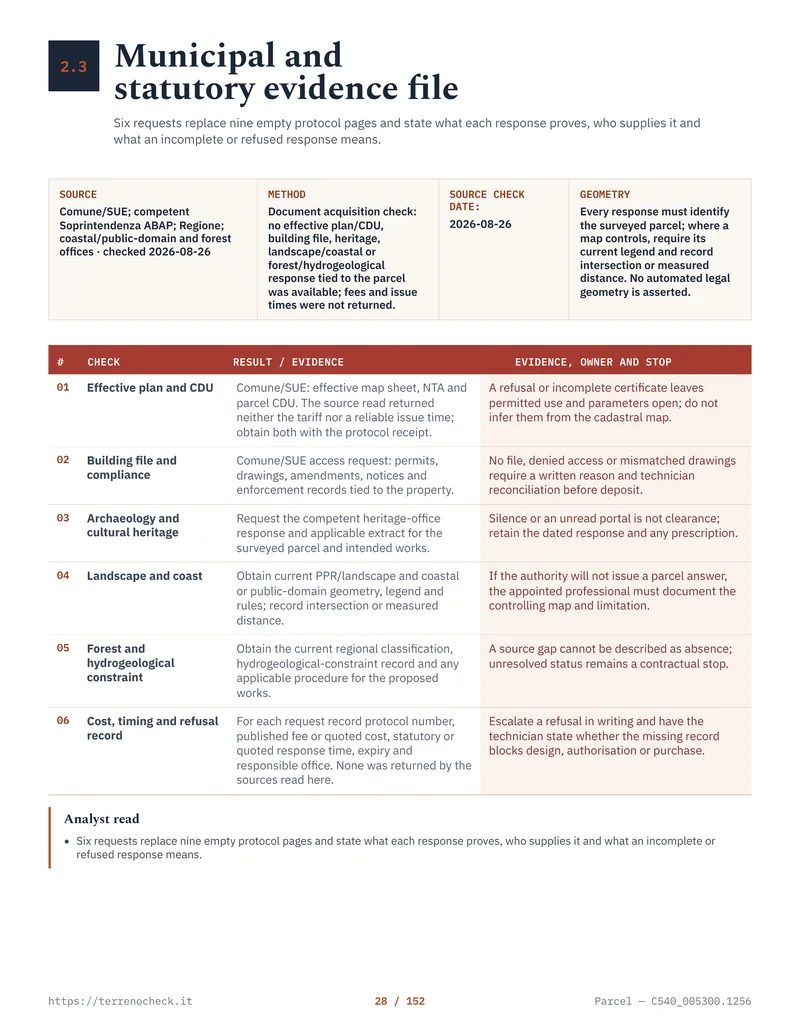 Open the full page
The consequences are practical, not theoretical
An enforcement order can require removal or demolition at the responsible party’s expense. Under Article 31 of DPR 380/2001, the standard period after an ingiunzione di demolizione is 90 days. Non-compliance can lead to free acquisition by the Comune of the property and necessary area, capped at ten times the abusive useful surface. Article 31 also provides a €2,000–€20,000 penalty, with the maximum applying to certain high or very high hydrogeological-risk areas.
Statutory consequences and figures
| Statutory figure | Unit | Why it matters to a buyer |
|---|---|---|
| 90 | days | The normal compliance period after the demolition injunction in Article 31(3) |
| 10 | times | Maximum ratio for the area acquired under Article 31(3), measured against the abusive useful surface |
| €2,000–€20,000 | administrative penalty | Article 31(4-bis) penalty for non-compliance; some high-risk cases use the maximum |
| €77–€464 | administrative penalty | Article 24(3) penalty for failing to submit the agibilità notification where required |
Source: DPR 380/2001 Articles 24 and 31
Source for these statutory figures: DPR 380/2001 Articles 24 and 31.
These are national statutory figures. A region may increase certain Article 31 penalties under Article 31(4-quater), and local enforcement, technical conditions and protected-area rules can add more complications. The figures do not estimate demolition cost. Nobody can tell you that from a desk without seeing the building, the order and the access conditions.
Agibilità is not a retroactive planning permit. Article 24 links it to safety, hygiene, salubrity, energy saving, plant conditions and conformity to the submitted project. An unauthorised or materially different building may have no valid route to agibilità until the underlying problem is resolved. “It is inhabited” proves nothing.
A bank is not obliged to lend against a property because the seller can name a cadastral category. The Bank of Italy explains that the lender orders a technical appraisal and uses the property as mortgage security. An unresolved abuse can reduce the value, stop the appraisal or make the lender refuse the property as security. Keep the financing risk alongside the tax and closing costs covered in the cost of buying property in Italy. “The bank will sort it out” is a warning.
The market consequence is harsher than the legal vocabulary. A future buyer, notary or lender may reject the property, demand a reduction, require a completed sanatoria or insist on demolition. You can own an asset that is technically transferable in one narrow formal sense and still be unable to sell it on sensible terms. That is “unsellable” in practice.
What to demand from the seller
Before paying a non-refundable deposit, request:
- the current visura and planimetria catastale, plus historic cadastral documents where the building has changed;
- every permit, concession, DIA, SCIA, CILA, variant, end-of-work filing and structural filing the seller has;
- the complete Comune access-to-acts result, including a written statement of missing files if the archive cannot locate them;
- any condono application, every receipt, integration request, opinion, final concession or written refusal;
- the agibilità record or the reason it was never filed;
- landscape, hydrogeological, seismic or heritage approvals where the site requires them;
- written answers identifying who will pay, file and carry the risk if the technician finds a discrepancy.
Then commission an independent geometra, architect or engineer with a written scope. Ask for a comparison between the physical survey, cadastral plan, Comune titles, approved drawings, planning rules and the date of each work. Each finding should be labelled: cadastral correction, tolerance, ordinary sanatoria, Article 36-bis possibility, pending condono, demolition/removal risk or unresolved. “Compliant” without the documents is not a useful report.
Make the preliminary contract conditional on the result if the check is not finished. Set a deadline for the seller to provide the archive file. State who holds the deposit if the file reveals an abuse that cannot be regularised. Your notary handles the deed and legal drafting; your technician checks the building. One professional does not silently replace the other.
Sources
- Normattiva, DPR 6 June 2001, no. 380, consolidated text
- Normattiva, DPR 380/2001, Article 31
- Normattiva, DPR 380/2001, Article 34
- Normattiva, DPR 380/2001, Article 34-bis
- Normattiva, DPR 380/2001, Articles 36, 36-bis and 37
- Normattiva, DPR 380/2001, Article 46
- Normattiva, DPR 445/2000, Article 76
- Normattiva, Law 28 February 1985, no. 47, Article 40
- Normattiva, Law 28 February 1985, no. 47, Article 31
- Normattiva, Law 23 December 1994, no. 724, Article 39
- Normattiva, Decree-Law 30 September 2003, no. 269, Article 32
- Normattiva, Law 24 July 2024, no. 105 (Salva Casa conversion law)
- Ministero delle infrastrutture e dei trasporti, Salva Casa guidelines, 30 January 2025
- Regione Lazio, Article 36-bis and landscape compatibility procedure
- Agenzia delle Entrate, Agenzia informa: buying a home
- Agenzia del Territorio, national check for undeclared buildings, 16 December 2009
- Comune di Milano, access to building files
- Comune di Milano, access to condono files
- Banca d’Italia, mortgage appraisal and property documents
- Corte di cassazione, Sezioni Unite civil judgment no. 8230/2019