
Cost of buying property in Italy: taxes and fees
Source: Agenzia delle Entrate, L’acquisto della casa: le imposte e le agevolazioni fiscali
The asking price is the easy number. This guide breaks down the Italian taxes, professional fees and recurring bills that turn a property price into the cash you actually need.
Contents
- Start with the seller and the tax base
- Prezzo-valore: the calculation foreigners often miss
- Registration, mortgage and cadastral taxes
- Land is a different tax problem
- The costs outside the tax table
- Notary
- Agency commission
- Geometra, engineer and lawyer
- Translation and the interpreter
- A worked purchase total, with the missing lines shown honestly
- When each payment happens
- The bills after the keys
- IMU
- TARI
- Condominium
The purchase budget must cover the price, transfer taxes, professional and registration costs, and the property’s first-year expenses. Which amounts apply depends on the seller, the property, the buyer’s reliefs and the work required.
For a €200,000 resale home, the tax bill can be about €2,179 with valid prima casa relief and a low cadastral income, or €10,306 without it when prezzo-valore applies. A builder’s VAT sale differs again. Add agency, notary, survey, legal and language costs. They are not one national percentage.
Use this guide to set a budget, not as tax, legal or notarial advice. Before a binding deposit, have the notary confirm the tax regime and a technician check the property. The wrong categoria catastale, seller status or planning designation becomes a future bill.
Start with the seller and the tax base
Italian home-purchase tax begins with two questions: is the seller private or a business, and is the transaction exempt from VAT or subject to it? “Company” does not automatically mean VAT. A residential sale is generally exempt, but a builder or restoration company can have a VAT sale within five years of completion or opt for VAT later. The deed and seller’s history decide the branch.
Home-purchase tax branches on a €200,000 example
| Purchase branch | Tax base | Registration tax or VAT | Mortgage tax | Cadastral tax | Example total on €200,000, where relevant |
|---|---|---|---|---|---|
| Private seller or VAT-exempt company, ordinary home | Cadastral value if prezzo-valore is requested | 9% | €50 | €50 | €10,306 with cadastral value €113,400 |
| Private seller or VAT-exempt company, prima casa | Cadastral value if prezzo-valore is requested | 2%, minimum €1,000 | €50 | €50 | €2,179 with cadastral value €103,950 |
| Company, VAT sale, ordinary home other than A/1, A/8 or A/9 | Sale price | VAT 10% plus €200 fixed registration tax | €200 | €200 | €20,600 |
| Company, VAT sale, qualifying prima casa | Sale price | VAT 4% plus €200 fixed registration tax | €200 | €200 | €8,600 |
Source: D.P.R. 131/1986, Tariff Part I, Article 1 with Note II-bis for the 9% and 2% rates (in force to 31.12.2026); D.Lgs. 123/2025, Annex 1, Tariff Part I, Article 1 (consolidated successor); D.Lgs. 23/2011, Article 10, the €1,000 minimum and the €50 fixed taxes; D.P.R. 131/1986, Article 40(1) with D.L. 104/2013, Article 26(2), the €200 fixed registration tax in a VAT sale; DPR 633/1972, Article 16 with Table A, Part II, no. 21 and Part III, no. 127-undecies, the 4% and 10% VAT rates; cadastral values worked from Agenzia delle Entrate, L’acquisto della casa: le imposte e le agevolazioni fiscali
The fixed amounts above are the common home-purchase cases in the Agenzia guide. The €1,000 minimum applies to proportional registration tax in the private/VAT-exempt branches. It is not a VAT minimum and cannot create prima casa eligibility. The Agenzia guide explains the separate A/1, A/8 and A/9 treatment. The VAT rates come from Article 16 of DPR 633/1972, which points to Table A: no. 21 of Part II carries 4% for a qualifying prima casa, no. 127-undecies of Part III carries 10% for other dwellings.
Source: Normattiva, DPR 131/1986, Article 52(4) and (5) on the multipliers, with Tariff Part I, Article 1 on the 9% and 2% rates (in force to 31.12.2026); Gazzetta Ufficiale, D.Lgs. 123/2025, Annex 1, Tariff Part I, Article 1 (consolidated successor); Normattiva, Law 662/1996, Article 3(48), the 5% revaluation of the rendita; Normattiva, Law 350/2003, Article 2(63), multipliers revalued by 10% and so 110; Normattiva, D.L. 168/2004, Article 1-bis(7), the 20% revaluation for property other than a prima casa and so 120; Normattiva, D.Lgs. 23/2011, Article 10, the €1,000 minimum and the €50 fixed taxes; Normattiva, DPR 131/1986, Article 40(1), registration tax in a fixed amount in a VAT sale; Normattiva, D.L. 104/2013, Article 26(2), the €200 fixed taxes; Normattiva, DPR 633/1972, Article 16 with Table A, Part II, no. 21, and Part III, no. 127-undecies, the 4% and 10% VAT rates; Agenzia delle Entrate, L’acquisto della casa: le imposte e le agevolazioni fiscali. The two non-VAT bars use the official example rendita catastale of €900.
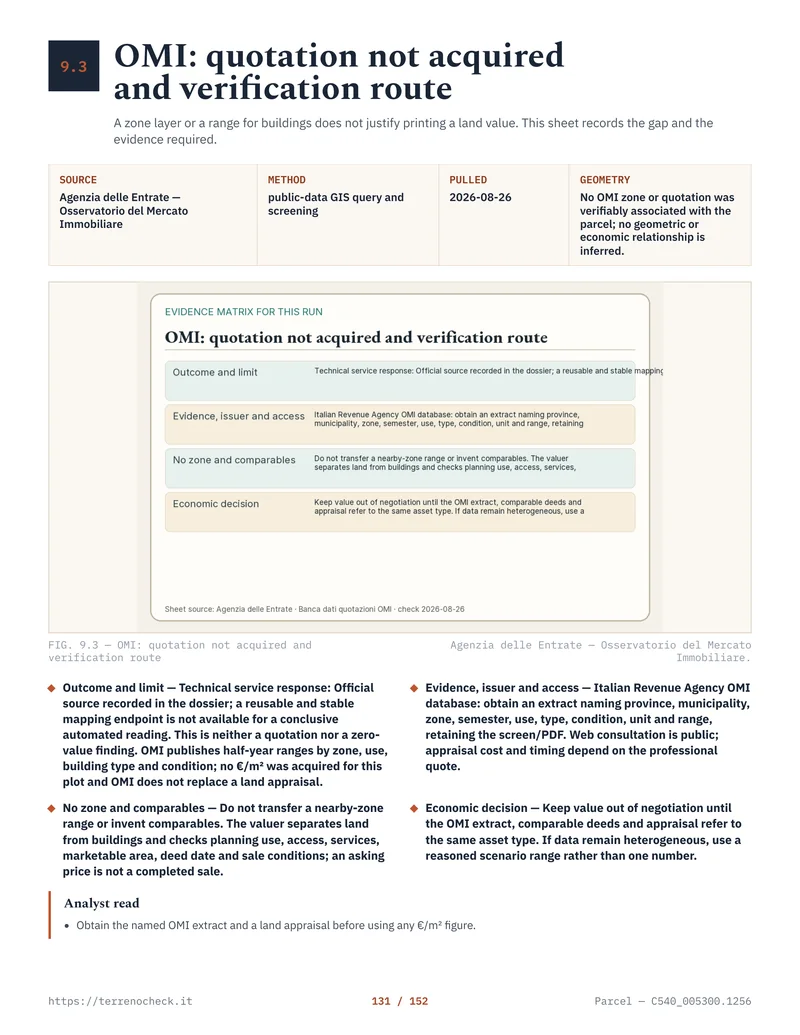
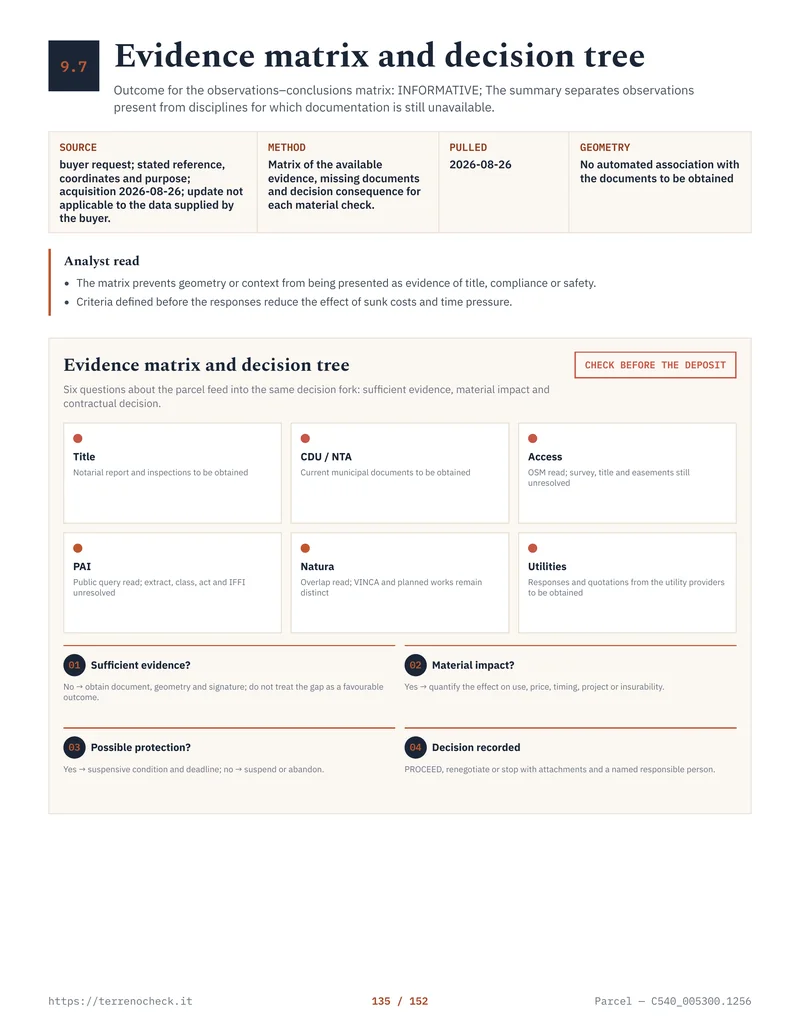
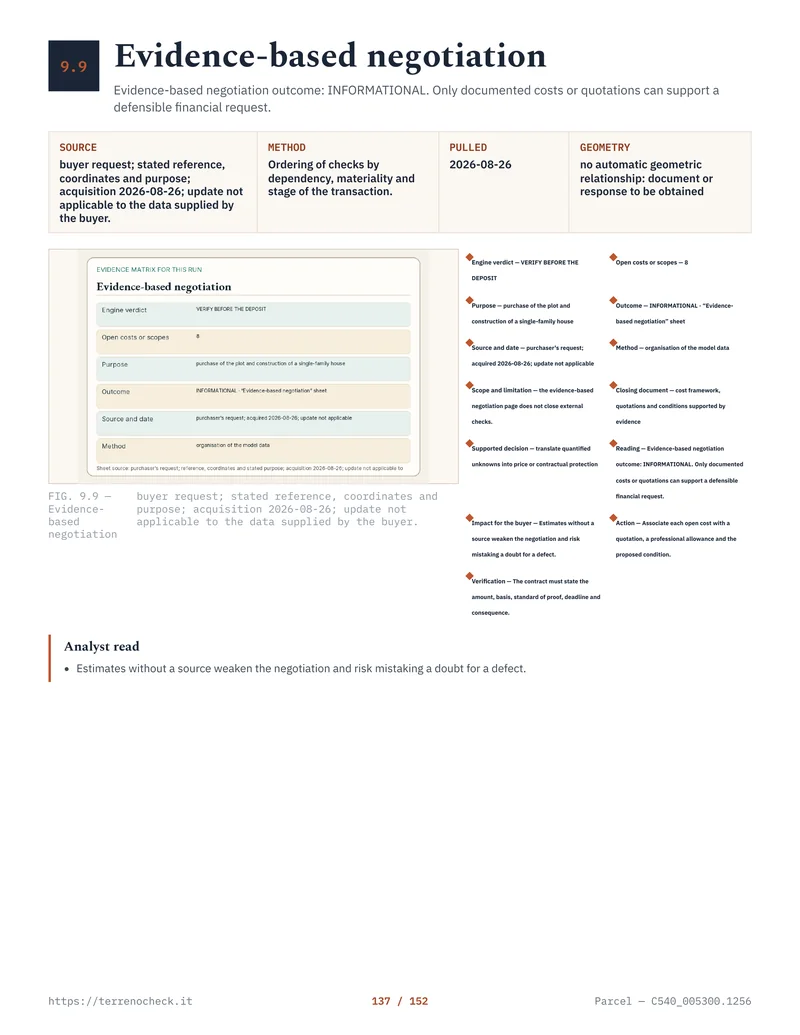
Pages from the delivered dossier
 Open the full page
Prezzo-valore: the calculation foreigners often miss
Prezzo-valore is a statutory tax-base method for an individual buying a home and relevant pertinenze in a non-VAT sale. It is set by Article 1(497) of Law 266/2005, which substitutes the value determined under Article 52(4) and (5) of DPR 131/1986 for the agreed price. The buyer must request it in the deed, and the parties must still state the real price.
Take the cadastral rendita catastale, increase it by 5%, then apply the statutory multiplier:
Ordinary home: rendita catastale × 1.05 × 120 Qualifying prima casa: rendita catastale × 1.05 × 110
Each number in the formula has its own provision. The 5% is the revaluation of urban rendite catastali required by Article 3(48) of Law 662/1996, which applies “ai fini dell’applicazione dell’imposta comunale sugli immobili e di ogni altra imposta”. The starting multiplier is one hundred times the building’s rendita, under Article 52(4) of DPR 131/1986, and Article 52(5) allows it to be changed. On that base, Article 2(63) of Law 350/2003 revalued the multipliers by 10% from 1 January 2004, which gives the 110 that still applies to a qualifying prima casa. For property other than a prima casa, Article 1-bis(7) of D.L. 168/2004, converted by Law 191/2004, takes the revaluation to 20% “in luogo del 10 per cento”, which gives 120. Article 1-bis(8) defines property other than a prima casa as property that does not meet the Note II-bis conditions to Article 1 of Tariff Part I.
With a rendita of €900, the ordinary taxable value is €900 × 1.05 × 120 = €113,400. Nine per cent is €10,206. With prima casa, €900 × 1.05 × 110 = €103,950, and 2% is €2,079. The purchase price can be €200,000 in both examples. The difference is the tax base, not an unexplained magic reduction.
The request has to be in the deed. The real consideration must be stated; concealed consideration can remove the protection and bring sanctions. This is a notary question before signing.
The formula is residential. It is not a general method for agricultural land, building land or commercial units. The cadastral extract guide explains why a cadastral record is evidence, not a title deed or planning decision.
Registration, mortgage and cadastral taxes
The imposta di registro is the main transfer tax in a non-VAT home sale. The 9% ordinary rate and the 2% prima casa rate are set by Article 1 of Tariff Part I annexed to DPR 131/1986 (in force to 31.12.2026), in the wording substituted by Article 10(1) of D.Lgs. 23/2011, whose Article 10(2) also fixes the €1,000 minimum. The prima casa eligibility conditions about the property, buyer and municipality are in Note II-bis to that tariff article. D.Lgs. 123/2025 restates the same rates as the consolidated successor, at Article 1 and Note I of its Annex 1, Tariff Part I.
The imposta ipotecaria records the transfer in the mortgage registers under Article 1 and the annexed tariff of D.Lgs. 347/1990; the imposta catastale concerns the cadastral transfer under Article 10 of the same decree. In the common home cases they are fixed: €50 each for a private or VAT-exempt purchase, under Article 10(3) of D.Lgs. 23/2011, and €200 each for a VAT sale, the earlier €168 figure having been raised to €200 by Article 26(2) of D.L. 104/2013. In a VAT sale the registration tax is not proportional: it applies in a fixed amount under Article 40(1) of DPR 131/1986, and the fixed amount is the one in Article 11 of Tariff Part I, raised to €200 by that same Article 26(2) of D.L. 104/2013. That is the €200 of registration tax the first table adds to the mortgage and cadastral taxes. Other assets can differ. D.Lgs. 123/2025 is the consolidated successor here too, at Articles 71 and 79 with the tariff in its Annex 2. The notary collects and pays the purchase taxes when registering the deed, so the money must be available at closing.
 Open the full page
Land is a different tax problem
An agricultural parcel is not a cheap house. For a purchase by someone who is not a qualifying registered coltivatore diretto or imprenditore agricolo professionale, national registration tax is 15% under the third rate line of Article 1 of Tariff Part I annexed to DPR 131/1986 (in force to 31.12.2026), with mortgage and cadastral taxes normally €50 each and a €1,000 minimum under Article 10(3) and Article 10(2) of D.Lgs. 23/2011. D.Lgs. 123/2025 carries the same 15% line forward as the consolidated successor, at Article 1 of its Annex 1, Tariff Part I. This is in the national tariff, not regional planning law.
The piccola proprietà contadina regime is narrower than an estate agent’s “farmer”. For qualifying agricultural land bought by a registered CD or IAP, D.L. 194/2009, Article 2(4-bis), converted by Law 25/2010, provides €200 fixed registration tax, €200 fixed mortgage tax and cadastral tax at 1%. Voluntary sale or stopping direct cultivation within five years can cause loss of relief. A non-farmer cannot use it.
The planning label “agricultural” comes from the applicable PRG, PUC, PGT or other municipal instrument, sometimes shaped by regional law. It is not decided by the cadastral crop description alone. If an advert says “agricultural” or “buildable”, request the CDU and read the local NTA.
Transfer-tax examples for land on €200,000
| Land type and buyer | Tax base used in this illustration | Registration tax | Mortgage tax | Cadastral tax | Transfer-tax total on €200,000 |
|---|---|---|---|---|---|
| Agricultural land, non-farmer | €200,000 | 15% = €30,000 | €50 | €50 | €30,100 |
| Agricultural land, qualifying CD/IAP under PPC | €200,000 | €200 fixed | €200 fixed | 1% = €2,000 | €2,400 |
| Building land bought from a private seller | €200,000 | 9% = €18,000 | €50 | €50 | €18,100 |
| Building land in a VAT-taxable business sale | €200,000 | VAT 22% = €44,000 | €200 | €200 | €44,400 |
Source: DPR 131/1986, Tariff Part I, Article 1 (in force to 31.12.2026) and D.Lgs. 123/2025, Annex 1 (consolidated successor), with D.L. 194/2009 and DPR 633/1972, as cited in the article
These are national calculations on a stated €200,000 base. They do not decide whether land is agricultural or edificabile. That answer belongs to current municipal planning documents, within regional planning law. The building-rights guide covers that question. A VAT-taxable sale of building land is generally subject to ordinary VAT because Article 10(1)(8-bis) of DPR 633/1972 covers residential buildings, not building land. Confirm seller status and deed wording.
- Agricultural + buyer not registered CD/IAP15% registration, minimum €1,000 + €50 mortgage + €50 cadastral; €30,100 on €200,000
- Agricultural + registered CD/IAP and PPC conditions€200 registration + €200 mortgage + 1% cadastral; €2,400 on €200,000
- Building land + private seller9% registration + €50 mortgage + €50 cadastral; €18,100 on €200,000
- Building land + VAT-taxable business sale22% VAT + €200 registration + €200 mortgage + €200 cadastral; €44,400 on €200,000
Source: Normattiva, DPR 131/1986, Tariff Part I, Article 1 (in force to 31.12.2026); Gazzetta Ufficiale, D.Lgs. 123/2025, Annex 1, Tariff Part I, Article 1 (consolidated successor); D.L. 194/2009, Article 2(4-bis); DPR 633/1972.
The costs outside the tax table
Notary
The notary receives the public deed, checks identity and legal capacity, investigates registered title, handles tax declarations and registers the transaction. The notary is not the building surveyor. Ask for a written preventivo separating taxes, honorarium, VAT, registration expenses and mortgage or preliminary-contract work. The Notariato’s foreign-buyer guide treats a detailed estimate as a client right.
There is no national “notary fee of 1%”. The charge varies with the deed, title history, mortgage, parties and documents. D.M. 140/2012 supplies parameters for court-ordered liquidation, not a retail tariff. If prezzo-valore applies, the Agenzia guide states that the honorarium is reduced by 30%; PPC transfers receive a half reduction. A euro amount still comes from your notary.
Agency commission
Under Civil Code Article 1755, a mediator earns a commission when the deal is concluded through the mediator’s intervention. It can fall due at the signed preliminary contract. The amount is contractual and local uses differ. In Padua’s 2021 collection, the usual buyer-side rate for €100,000–€500,000 is 2%. On €200,000, that is €4,000 before VAT, or €4,880 with ordinary 22% VAT.
That Padua figure is local, not a national tariff. Another province or the written terms can produce a different number. Ask whether you pay one side or two, whether VAT is included and when it is due.
Geometra, engineer and lawyer
Budget a geometra, architect or engineer when the property includes a building, boundary, access route, renovation history, retaining wall, septic system or claimed building right. The scope might include a site visit, cadastral comparison, municipal file, planning conformity, structural records and a written report. A cadastral correction is not the same job as reconstructing a rural building file.
There is no reliable national figure. Ask for scope, fee, VAT, professional pension contribution and travel or archive costs. A lawyer is sensible with a company seller, inheritance, co-ownership, debt, easement, pre-emption risk or a complicated preliminary contract. The fee is quote-based. The abuse and condono guide explains why a cadastral match is not planning clearance.
Translation and the interpreter
If a buyer does not understand Italian and the notary does not know the buyer’s language, Article 55 of Law 89/1913 requires an interpreter. The act is normally in Italian with a translation into the buyer’s language. Foreign-language documents attached to the act can need translation separately.
Interpreter and certified-translation costs are quoted separately. Arrange them before signing and ask the notary what qualification, oath and format the file requires.
 Open the full page
A worked purchase total, with the missing lines shown honestly
Here is a concrete subtotal, not a fake all-in promise. Assume a €200,000 apartment in Padua, private seller, ordinary purchase, rendita catastale €900, prezzo-valore requested, and a Padua agency charging the published 2% buyer-side use. The buyer speaks Italian, has no mortgage, and pays no lawyer or technician in this narrow example.
Worked Padua purchase subtotal
| Line | Arithmetic | Amount |
|---|---|---|
| Purchase price | Stated transaction price | €200,000 |
| Registration tax | €900 × 1.05 × 120 = €113,400; 9% | €10,206 |
| Mortgage tax | Fixed, non-VAT home sale | €50 |
| Cadastral tax | Fixed, non-VAT home sale | €50 |
| Buyer-side agency commission | €200,000 × 2% | €4,000 |
| VAT on agency commission | €4,000 × 22% | €880 |
| Sourced subtotal before variable professional quotes | €200,000 + €10,206 + €50 + €50 + €4,000 + €880 | €215,186 |
Source: D.P.R. 131/1986, Tariff Part I, Article 1 with Note II-bis for the 9% and 2% rates (in force to 31.12.2026); D.Lgs. 123/2025, Annex 1, Tariff Part I, Article 1 (consolidated successor); the €113,400 tax base follows D.P.R. 131/1986, Article 52(4) and (5), the 5% revaluation of Law 662/1996, Article 3(48) and the 120 multiplier of D.L. 168/2004, Article 1-bis(7); agency use from Camera di Commercio di Padova, Collection of local uses, 2021
The tax figures come from the Agenzia guide; the agency figure comes from the Padua Chamber document; €880 is ordinary 22% VAT. The subtotal excludes notary, technician, lawyer, interpreter, translation, bank charges, insurance, renovation, utilities, condominium arrears and first-year bills. Nobody can quote those variable figures from a desk.
“The house costs €200,000” is not a budget. Get the missing quotes before the preliminary contract. If land is advertised as buildable, pay for the planning check before valuing it as a future home. The utility-connection guide covers another cost listings wave away.
When each payment happens
The purchase is a sequence of payments, not one final invoice.
- Offer and preliminary contract. A preliminary does not transfer ownership. The current Agenzia RAP service says to register it within 30 days; an older March 2024 Agenzia guide says 20 days for a private written preliminary and 30 days for a notarial one. That conflict belongs in your file: ask the notary which current procedure applies. The non-VAT case adds €200, plus 0.50% on the sum classified as a caparra confirmatoria or as a price advance: since 1 January 2025 one rate covers both labels (D.Lgs. 139/2024). That amount is credited against final registration tax. A transcribed notarial preliminary adds its own charges.
- Agent. The commission is generally due when the deal is concluded through the agent, often at the preliminary. The written terms control the payment date.
- Final deed. At the rogito, pay the price balance, quoted professional costs and registration taxes. The notary pays registration, mortgage and cadastral taxes when registering the deed.
- After closing. IMU is normally due 16 June and 16 December. TARI dates and rates are municipal. Condominium charges follow the approved budget and administrator’s requests.
- Preliminary registrationCurrent RAP: within 30 days; older guide: 20 days private written, 30 days notarial; €200 + 0.50% on deposit or non-VAT advance since 1.1.2025
- Final deedNotary pays taxes when registering the deed
- IMU first instalment16 June
- IMU balance16 December
- TARIDate set by the competent Comune
- Condominium chargesDates set by the approved budget or administrator’s requests
Source: Agenzia delle Entrate, RAP service; Normattiva, D.Lgs. 139/2024, Article 2(1)(ff)(2), replacing the note to Article 10 of Tariff Part I with effect from 1 January 2025; Normattiva, DPR 131/1986, Tariff Part I (in force to 31.12.2026); Gazzetta Ufficiale, D.Lgs. 123/2025, Annex 1, Tariff Part I (consolidated successor); Agenzia delle Entrate, March 2024 L’acquisto della casa; Ministero dell’Economia e delle Finanze, IMU 2026 information under Law 160/2019; Law 147/2013 and local TARI rules.
The bills after the keys
IMU
IMU is a municipal property tax under Law 160/2019. A second home usually pays it because the exemption is tied to the abitazione principale: the unit where the owner and family habitually reside and have registered residence, subject to statutory exceptions. A weekend property is not made a main home by ownership.
The amount requires the Comune’s rate, cadastral category and value, plus the possession period. Law 160/2019 sets the framework; the Comune’s rate determines the bill. Check the Finance Ministry database and Comune before paying.
TARI
TARI is the waste tax under Law 147/2013. It concerns possession or occupation of premises capable of producing municipal waste, with tariffs and procedures set locally. Ask the Comune for its regulation, surface rules, seasonal treatment and payment calendar.
Condominium
In an apartment, condominio is a real operating cost. Cleaning, lift, insurance, common electricity, administrator fees and maintenance follow the condominium tables and Civil Code Article 1123 rules. Extraordinary works can dwarf a year of ordinary charges. Ask for the administrator’s payment statement, approved budget, recent minutes and resolutions for roof, façade, lift, heating, seismic or energy works. A low listing price does not protect you from a façade invoice voted before your deed.
Sources
- Normattiva, D.Lgs. 18 September 2024 no. 139, Article 2(1)(ff)(2)
- Agenzia delle Entrate, L’acquisto della casa: le imposte e le agevolazioni fiscali
- Agenzia delle Entrate, RAP registration service and preliminary-contract deadline
- Normattiva, D.Lgs. 1 August 2025, no. 123, consolidated indirect-tax text, Article 205 on when it applies
- Gazzetta Ufficiale, D.Lgs. 123/2025, Annex 1, Tariff Part I, Article 1 and Note I, registration-tax rates (consolidated successor)
- Normattiva, DPR 26 April 1986, no. 131, Tariff Part I, Article 1 with Note II-bis, and Article 10 with its Note (in force to 31.12.2026)
- Normattiva, DPR 26 April 1986, no. 131, Article 52(4) and (5), the multipliers of one hundred times a building’s rendita and seventy-five times the land’s reddito dominicale (in force to 31.12.2026)
- Normattiva, DPR 26 April 1986, no. 131, Article 40(1), registration tax in a fixed amount on acts subject to VAT (in force to 31.12.2026)
- Normattiva, Law 23 December 1996, no. 662, Article 3(48), the 5 per cent revaluation of urban rendite catastali
- Normattiva, Law 24 December 2003, no. 350, Article 2(63), multipliers revalued by 10 per cent from 1 January 2004
- Normattiva, D.L. 12 July 2004, no. 168, Article 1-bis(7) and (8), the 20 per cent revaluation for property other than a prima casa
- Normattiva, DPR 26 October 1972, no. 633, Article 16 with Table A, Part II, no. 21, and Part III, no. 127-undecies, the 4 and 10 per cent VAT rates
- Normattiva, D.Lgs. 14 March 2011, no. 23, Article 10(1)-(3), the 9% and 2% rates, the €1,000 minimum and the €50 fixed taxes
- Normattiva, D.L. 12 September 2013, no. 104, Article 26(2), fixed indirect taxes raised from €168 to €200
- Normattiva, Law 23 December 2005, no. 266, Article 1(497), the prezzo-valore tax base
- Normattiva, D.Lgs. 31 October 1990, no. 347, Article 1 with its annexed tariff and Article 10, mortgage and cadastral taxes
- Normattiva, DPR 26 October 1972, no. 633, VAT rules
- Normattiva, D.L. 30 December 2009, no. 194, Article 2(4-bis), piccola proprietà contadina
- Consiglio Nazionale del Notariato, Abitare e fare impresa in Italia
- Consiglio Nazionale del Notariato, notarial services for foreigners
- Normattiva, Law 16 February 1913, no. 89, Articles 54–55
- Camera di Commercio di Padova, Collection of local uses, 2021
- Normattiva, Civil Code, Article 1755 and Article 1123
- Normattiva, Law 27 December 2019, no. 160, IMU
- Ministero dell’Economia e delle Finanze, IMU 2026 payment information
- Agenzia delle Entrate, TARI tax code and Law 147/2013 reference
- Normattiva, Ministerial Decree 20 July 2012, no. 140, professional fee parameters