
Access rights in Italy: servitù di passaggio
setback
Source: Civil Code Articles 1027, 1031, 1051, 1061, 1062, 1158 and 2643
A dirt track is not proof that your Italian plot has a legal right of way. Learn how servitù di passaggio, landlocked land, public roads and planning access fit together before you pay.
Contents
- A track is evidence of a track. It is not evidence of a right
- What a servitù prediale actually is
- 1. Contract
- 2. Destinazione del padre di famiglia
- 3. Usucapion
- Fondo intercluso: the right exists in law, but the route may still be a fight
- How to verify access before you make an offer
- Read the deed, not the agent’s summary
- Order an ispezione ipotecaria
- Compare the estratto di mappa with the ground
- Ask the neighbour in writing
- Vicinali, consortili and comunali roads
- Access is also a planning question
- What it costs to get this wrong, and how people usually settle it
You can drive to the plot today and still have no right to drive there tomorrow. Access rests on the title and the registered records, read against the route as it actually runs, and it has to be settled before the purchase or a building application.
I have seen buyers drive a clear farm track to the parcel, hear a neighbour say “of course”, and then discover that the route crosses three owners’ land. The track had been there for decades. A gate, a sale or a planning application exposed the gap.
Use this before purchase, not as a title opinion or legal advice. Your notary, surveyor and lawyer must apply the documents to the particular parcels.
If the parcel is not identified, start with the Italian land-buying checklist.
A track is evidence of a track. It is not evidence of a right
Agents often flatten several different things into “road access”. A public road is intended for public circulation. A private driveway may belong to another owner. A servitù di passaggio is a real right attached to land: one parcel, the fondo dominante, benefits from passage over another, the fondo servente. A neighbour’s permission this year is something else.
The distinction affects sale, fencing, maintenance, vehicle access and a building application. If a route crosses parcels A, B and C, one friendly owner cannot grant passage over B and C.
The cadastral map is a starting picture. Agenzia delle Entrate describes its map extract as the representation of a land parcel. It does not turn a path into a title. The ispezione ipotecaria searches registers, notes and deposited titles.
The cadastral extract guide explains why a map is identification evidence, not proof of ownership or access. For this question, use the deed, registers, map, ground inspection, then written confirmation from the people who use the route.
- Transcribed contract, Article 2643Verify route and terms; all servient owners sign; make transcription a purchase condition
- Compulsory passage for an enclosed fund, Article 1051Claim with indemnity; await agreement or judgment before relying on access
- Usucapion: Article 1061 apparent works + Article 1158 periodCollect dated evidence and permanent works; otherwise treat the right as unproven
- Used track + neighbour goodwillPermission only; do not value legal access; renegotiate or condition purchase
Source: Civil Code.
Pages from the delivered dossier
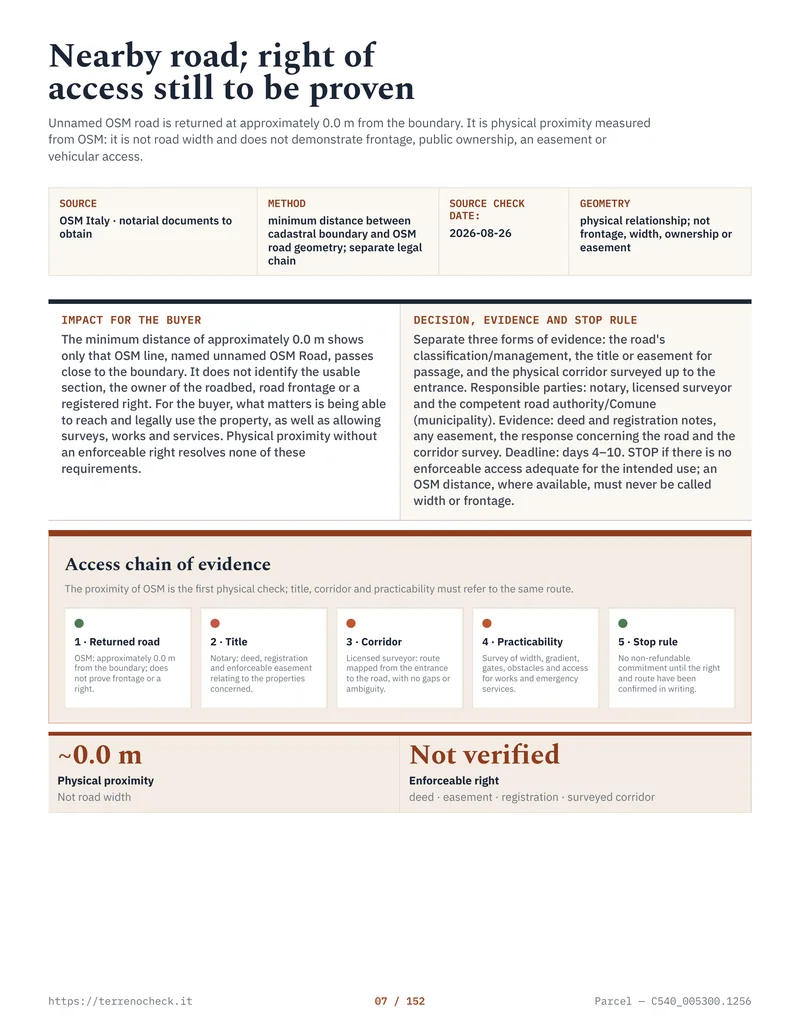 Open the full page
What a servitù prediale actually is
Article 1027 of the Italian Civil Code describes a predial servitude as a charge on one fund for the utility of another fund belonging to a different owner. It is tied to the land, not to today’s neighbour. A properly constituted right can survive a sale.
Article 1031 of the same Code gives the main routes of constitution: contract, destinazione del padre di famiglia, usucapion, or a compulsory route where the Code gives the owner a right to demand one. The route, width, permitted vehicles and maintenance terms depend on the title and facts.
1. Contract
For a buyer, I prefer this route. The parties identify the parcels, draw the route, state whether it is pedestrian, agricultural or vehicular, and allocate maintenance. A contract creating or modifying a real servitude should be made in the proper form and transcribed under Civil Code Article 2643.
Do not accept “the seller will sort it out after completion”. Make the signed and transcribed easement a condition of the preliminary contract. If there are several servient owners, every relevant title holder must be dealt with.
2. Destinazione del padre di famiglia
Article 1062 concerns a specific history. Two or more parcels were once held by one owner, who placed or left visible arrangements serving one part from another. When the parcels were divided and the deed says nothing else, the arrangement can operate as a servitude.
Old subdivision files matter. The route may not be described in the latest deed, yet the division deed or earlier title may show it. “The former owner always used the lane” is a clue, not proof.
Article 1061 still controls. A non-apparent servitude cannot be acquired by usucapion or by this destination mechanism. Visible, permanent works intended for the right matter. Whether a worn strip of soil is sufficiently specific and permanent is factual.
3. Usucapion
Ordinary usucapion of immovable property requires 20 years under Civil Code Article 1158. For a passage servitude, counting old footsteps is not enough. Article 1061 excludes non-apparent servitudes. Corte di Cassazione case law focuses on visible, permanent works objectively revealing a route intended to serve the dominant land.
There is a second trap. Passage usually requires a human act each time someone walks or drives, so it is generally discontinuous in civil-law terminology. A visible route can still be apparente; continuity is not a substitute for visible works. “Continuous use” proves nothing by itself. Get the dates and route reviewed before anyone says “twenty years means we are covered”.
The 20-year figure belongs to the ordinary usucapion rule; it is not a shortcut that converts every old track into a right, and it is not the timetable for a negotiated deed or a court case.
| Legal route | Published number or rule | Buyer’s implication |
|---|---|---|
| Contract | Article 1031; transcription Article 2643 | Contract and transcription; route and terms must be checked |
| Destinazione del padre di famiglia | Articles 1031 and 1062 | Division history and visible permanent works matter |
| Usucapion | Articles 1031, 1061 and 1158; 20 years | 20 years is not enough without apparent works and proof |
| Compulsory passage | Articles 1031, 1032 and 1051; indemnity | Route fixed by agreement or judgment |
Fondo intercluso: the right exists in law, but the route may still be a fight
Civil Code Article 1051 deals with the fondo intercluso, an urban or rural fund surrounded by other land and without an outlet to the public road, or unable to obtain one without excessive expense or inconvenience. The owner can seek passage over a neighbouring fund for cultivation and proper use, subject to the article’s conditions.
The route is not “where the buyer’s phone map draws the shortest line”. Article 1051 directs it to the part giving access to the public road that is shorter and causes the least damage to the servient fund. The assessment can involve old divisions, alternatives, topography and proposed use.
An indemnity is owed to the servient owner. It is not a national price per metre. Article 1051 links it to damage caused by passage. Article 1032 says that, where a compulsory servitude is not agreed, a judgment establishes it, sets its method and determines the indemnity; the servient owner can oppose exercise before payment.
That is the blunt version: a landlocked plot may have a route to court, not a driveway you can use tomorrow. A buyer needing a loan or delivery should not treat this as harmless.
Passage rights: number versus legal meaning
| Legal figure or route | Published number | What the number means | What it does not mean |
|---|---|---|---|
| Ordinary immovable-property usucapion, Civil Code Article 1158 | 20 years | The statutory period stated for acquiring ownership of immovables by usucapion | It does not prove a passage servitude without the Article 1061 apparent-works requirement and evidence of the relevant possession |
| Municipality contribution for public-use vicinal roads, D.L.Lgt. 1446/1918 Article 3 | 1/5 to 1/2, or 20% to 50% | A statutory contribution range toward maintenance, arrangement or reconstruction under the law’s conditions | It is not a promise to repair a private driveway or pay your access works |
| Optional municipal contribution for vicinal roads without public use, D.L.Lgt. 1446/1918, Article 3 | Up to 1/5, or 20% | The maximum stated municipal contribution for the specified works | It does not create public access or a private easement |
Source: Normattiva Civil Code and D.L.Lgt. 1446/1918, as cited in the table
The percentages are statutory contribution ranges, not a quotation for a particular road.
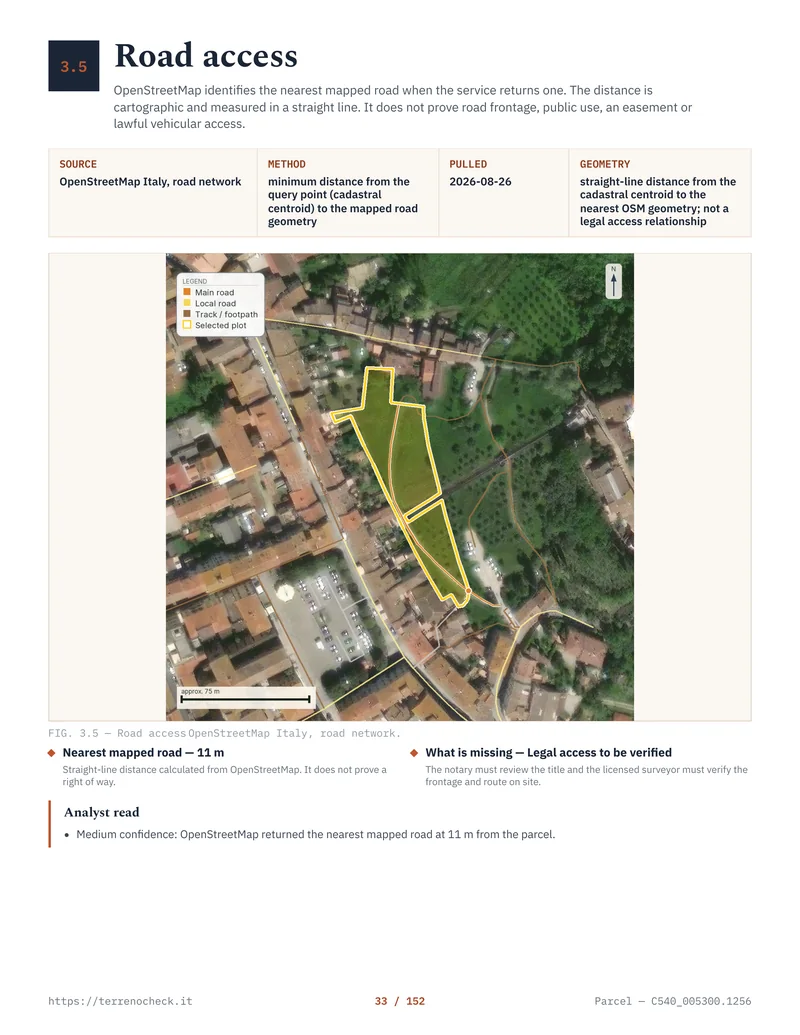 Open the full page
How to verify access before you make an offer
Read the deed, not the agent’s summary
Request the seller’s full atto di provenienza, preceding deeds and subdivision or inheritance documents. Search for servitù di passaggio, pedonale, carrabile, a favore, a carico, fondo dominante and fondo servente. Read attached plans. “With all rights and burdens apparent and non-apparent” is not a route plan.
Order an ispezione ipotecaria
Agenzia delle Entrate says the ispezione ipotecaria lets the user consult transcriptions, registrations and annotations, including notes and, where available, deposited titles. Search the parcel and relevant owners, including prior owners. A missing easement is not the end if it is old, untranscribed, under another parcel or claimed by another route.
The official guide gives these published online figures:
Agenzia online cadastral service figures
| Agenzia online service | Published figure | What it buys you |
|---|---|---|
| Personal consultation for property where you hold a real right | Free | Cadastral and property-register information for your own property |
| Cadastral property extract, current or historical | €1.35 | One property extract |
| Cadastral map extract | €1.35 | The map representation of one land parcel |
| Subject search | €1.35 per 10 units or fraction | A subject-based cadastral search, not a title opinion |
These fees are small. Skipping the register search is the expensive choice.
Compare the estratto di mappa with the ground
Obtain the estratto di mappa for the target and every parcel on the proposed route. Mark the public road, gates, walls, culverts, bridges and narrowings. It is not a topographical survey.
Walk the route with someone who can measure it properly. A passage for a small car is not automatically a route for a cement truck or fire appliance. If a new entrance is needed, ask the road owner about the passo carrabile or other authorisation. A servitude does not authorise cutting a kerb, crossing a ditch or joining a provincial road.
Ask the neighbour in writing
Send a written request identifying the parcels and attaching the map. Ask:
- Do you assert that the buyer may pass over your land to reach the parcel?
- On what deed, transcription, court decision or other document?
- Is the route pedestrian, vehicular or agricultural, and what width is accepted?
- Who maintains the surface, drainage, gates, bridges and retaining works?
- Are there other owners, a road consortium, restrictions, annual contributions or disputes?
An email or signed letter records the practical position. It is not a deed or judgment. Silence is transaction risk.
Vicinali, consortili and comunali roads
The Italian Road Code defines a strada vicinale as a private road outside built-up areas used by the public. Article 2(7) of D.Lgs. 30 April 1992, no. 285 assimilates vicinal roads to municipal roads for the Code’s purposes, and Article 14(4) places its owner powers with the Comune. That does not make every lane marked “vicinale” public. Confirm classification and actual public use with the municipality.
The Decree-Law Lieutenant of 1 September 1918, no. 1446 allows vicinal-road users, even without public transit, to form a consortium for maintenance, arrangement or reconstruction. For public-use vicinal roads, Article 3 states a Comune contribution between one-fifth and one-half of the relevant expenditure. Without public use, participation is optional and capped at one-fifth for the specified works.
A strada consortile is not a separate national Road Code definition. It usually points to a private road managed through a consortium, with membership and rules in deeds or statutes. The entitled users are determined by those instruments, not the sign at the entrance. Maintenance is normally charged through the consortium or owners/users. Public use can bring municipal powers, but does not erase private title.
A strada comunale is owned by the Comune in the Road Code’s administrative classification. The Comune has maintenance, management and authorisation duties under Article 14(1) and (2) of D.Lgs. 285/1992. A private entrance may still need a permit or works approval. “It meets a municipal road” is not “I can open a driveway here.”
Overlapping ranges, not a stack or quotation: this says nothing about whether your parcel has a private right of way, who owns the road, or whether the Comune will fund your works.
| Road status | Comune share | Frontagers’ share | Municipal contribution |
|---|---|---|---|
| Vicinal road of public use | 20%–50% | 50%–80% | Mandatory within Article 3 conditions |
| Vicinal road without public use | 0%–20% | 80%–100% | Optional, capped at 20% |
Source: D.L.Lgt. 1446/1918, Article 3.
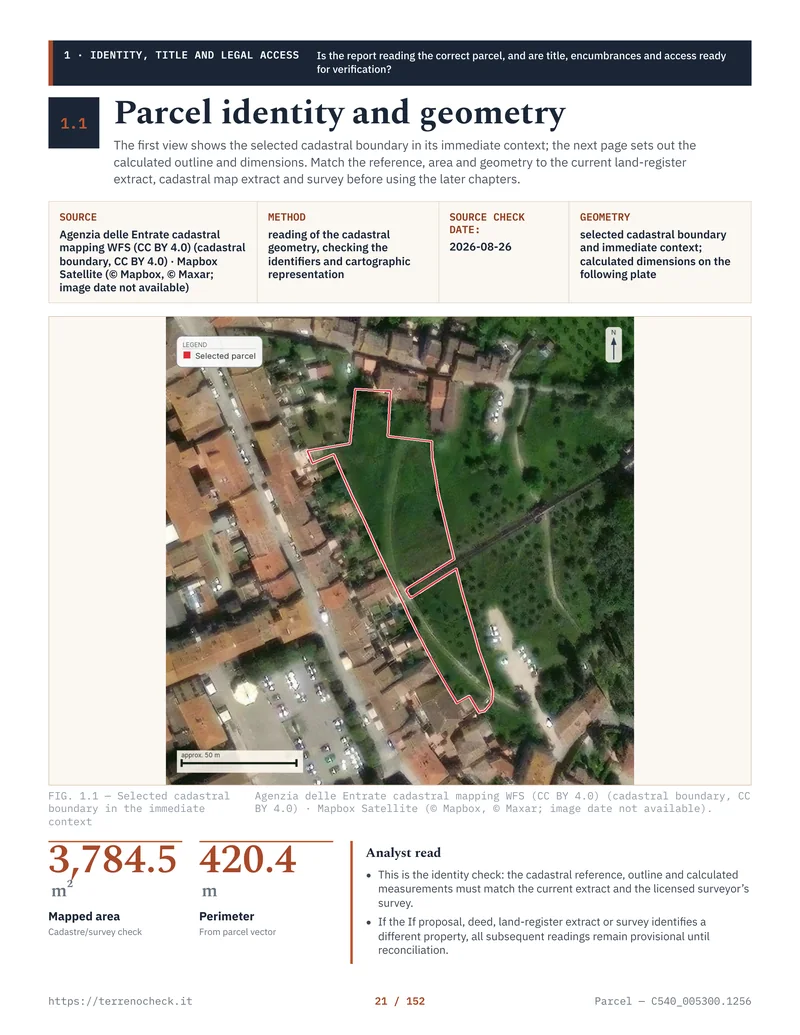 Open the full page
Access is also a planning question
Zoning is not the same thing as buildability. Under Article 12 of DPR 380/2001, a permesso di costruire must conform to the planning instruments, building regulations and current urban-building rules. It is also subject to primary urbanisation being present, planned by the Comune within the next three years, or undertaken by the interested parties at the same time as the project.
That is a national rule. Access standards, road width, turning area, visibility, drainage and entrance permission may come from regional rules, the municipal PRG/PUC/PGT, NTA, building regulations and the road authority. The Regione Toscana planning catalogue illustrates the local-instrument problem; it is not a national access rule.
The practical result is harsh. A plot can sit in a zone described as buildable and still be unable to obtain the intended permit because the only route is legally unavailable, physically inadequate or not authorised for a new entrance. A compulsory passage remedy may establish access in civil law, but it does not automatically satisfy the municipal or road authority’s requirements for the proposed building.
Before you price a plot as a building site, ask the Sportello Unico per l’Edilizia for the current planning documents and ask an architect or surveyor to test the actual route and entrance against the project. The PRG article covers the zoning side. Read it together with the CDU guide, not instead of the access documents.
What it costs to get this wrong, and how people usually settle it
There is no honest national price list for a servitù di passaggio. The money is usually in the consequences: a survey, notarial deed, indemnity, surface and drainage works, entrance permit, technical studies, negotiation and, if agreement fails, litigation. On a building plot, delay can kill financing or a sale.
The usual negotiation is concrete. The buyer supplies a route plan and intended use. The seller obtains every necessary signature. The deed states route, width, pedestrian and vehicle rights, gates, maintenance, drainage, utility corridors and the price or indemnity. It is signed and transcribed before the buyer relies on it. Do not pay for “permission” if the document does not create the right needed.
If the seller will not make access a condition of the preliminary contract, treat the price as an unresolved legal and planning problem. That may suit a specialist buyer. It is poor value for someone who needs a house, a lender and a road on a fixed timetable. See the cost-of-buying-property guide when pricing the rest of the transaction.
Sources
- Normattiva, Civil Code, Royal Decree 16 March 1942, no. 262
- Normattiva, Civil Code Article 2643, transcription of real-property rights
- Normattiva, Road Code, Legislative Decree 30 April 1992, no. 285
- Normattiva, Decree-Law Lieutenant 1 September 1918, no. 1446, vicinal roads
- Normattiva, Law 12 February 1958, no. 126, classification of public-use roads
- Normattiva, DPR 6 June 2001, no. 380, Article 12
- Agenzia delle Entrate, buying a home and inspecting the property registers
- Agenzia delle Entrate, The new cadastral extract
- Regione Toscana, catalogue of municipal planning instruments
- Corte Suprema di Cassazione, Civil Section, monthly case-law materials