
Well water rights in Italy: what buyers must check
A well can look like free water on a rural property. It is really a regulated use of public water, with regional paperwork, testing and costs that can follow the land after completion.
Contents
- The water under your land is not yours to sell
- Small and large derivations are not two kinds of well
- “Uso domestico” is narrower than the advert suggests
- Existing wells: look for the register, not just the pump
- Drilling is a separate permission question
- Water that looks clear is not automatically potable
- A pipe across the neighbour’s land can be a legal issue
- What to ask before paying a deposit
The well is often presented as a saving: no water bill, plenty for the garden, perhaps enough for a house. A buyer should read it as an unresolved file until the documents, the water quality and the regional rules line up.
This pre-purchase guide does not provide legal, engineering or health advice. A notaio can examine the title and a qualified geologist or engineer can assess the well. The local Provincia, Regione, Genio Civile and health authority decide which public procedures apply. TerrenoCheck does not verify a water right, ownership or a right to build.
The water under your land is not yours to sell
Law 5 January 1994, no. 36, Article 1 says that all surface and underground water, even before it is extracted, is public. The current framework sits with that principle and the Testo Unico approved by Royal Decree 11 December 1933, no. 1775, usually called the T.U. acque. Owning the parcel gives you the land and the well structure. It does not give you an unqualified private property right in the aquifer.
That distinction matters at the offer stage. A seller may have a pump, an old electricity connection and forty years of stories about the spring. Ask for the legal basis of the withdrawal: a concessione di derivazione, a domestic-use communication, an old recognition or riconoscimento, an attingimento licence, or nothing that can be produced. “The well is on the cadastral map” answers none of those questions. The cadastral extract guide explains the narrower evidential role of cadastral records. Add the result to your land-buying checklist before making the offer conditional on a file that nobody has seen.
The national default is blunt. Article 17(1) of R.D. 1775/1933 prohibits deriving or using public water without an authorization or concession from the competent authority, subject to Article 93 for domestic use and to Article 17(2) for the collection of rainwater. The fact that the pump is low-powered does not turn a commercial irrigation or holiday-rental supply into domestic use.
Pages from the delivered dossier
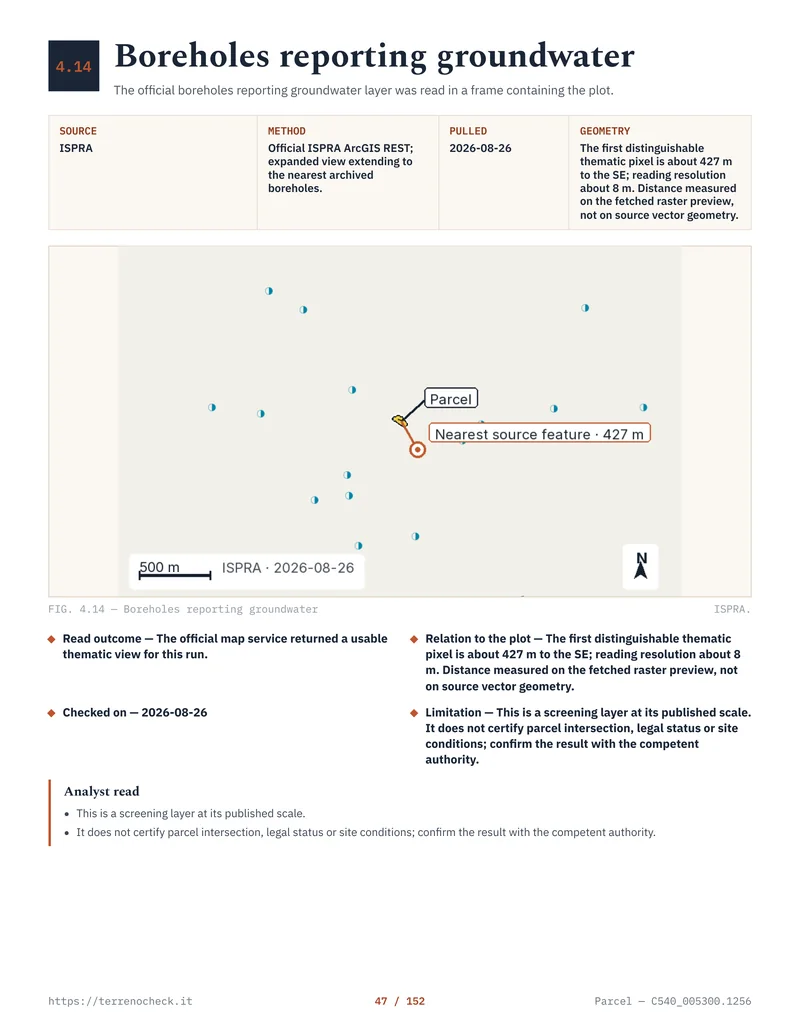 Open the full page
Small and large derivations are not two kinds of well
Piccola derivazione and grande derivazione describe the scale of the public-water use. They do not decide whether a drilling machine may enter your field, whether the water is drinkable, or whether a domestic exemption applies.
Article 6 of R.D. 1775/1933 uses different thresholds according to the use. The national figures are 100 litres per second for drinking water, 1,000 litres per second for irrigation, with the irrigation threshold also affected by a surface above 500 hectares, and 5,000 litres per second for land reclamation by filling. For hydroelectric force, letter a) of that article set 220 kW; Article 1(1) of Law 24 January 1977, no. 7 raised that limit to 3,000 kW of average nominal power. A derivation above the relevant threshold is large; one at or below it is small for that classification.
For an ordinary house well, the flow will usually be far below those figures. That is not a permission slip. A small derivation can still require a concession, a fee, a meter, annual measurement reports and a technical application. The authority also looks at the water balance, the intended volume, the aquifer and other users.
The administrative split is regional. In Lombardia, the official rule sends large derivations to the Regione and small derivations to the Provincia or Città Metropolitana; the Province also issue licenze di attingimento. In Friuli Venezia Giulia, the Regione says it issues both small and large derivation measures, including underground water. Emilia-Romagna identifies the provincial Servizi Autorizzazioni e Concessioni, or SAC, as the territorial offices for new practices. Those are examples, not a national routing rule. Start with the office for the location of the well, not the office where you live.
- Private-family underground water, Article 93Check the regional communication, well register and health requirements; exemption is conditional
- Business, productive, rental or commercial useAsk for the regional or provincial concession and its disciplinary document
- Temporary surface-water takingCheck the regional licenza di attingimento, including flow, annual-volume and duration limits
- No document or only cadastral evidenceTreat the withdrawal as unresolved and make the seller regularise it before relying on the water
Source: R.D. 1775/1933, Articles 17, 56 and 93; Regione Lombardia, Regional Regulation 2/2006, Articles 7 and 32 and normelombardia.consiglio.regione.lombardia.it · source document.
“Uso domestico” is narrower than the advert suggests
Article 93 gives the owner of a fund the faculty to extract underground water for domestic uses, even with mechanical means, while observing the statutory distances and precautions. It expressly includes watering gardens and vegetable plots serving the owner and family, and watering livestock. It also requires that the extraction not compromise the water-balance rule applied by later water legislation.
The words directly to the owner and family do work. A vineyard, olive business, agritourism, campsite, pool open to guests, workshop, car wash or irrigation service is not rescued by calling the property “private”. Nor is a house supplied through a company’s production process. Mixed use is the danger: a pipe that serves the family kitchen and a paid holiday unit should not be filed mentally as a domestic well.
Regional rules add their own limits and forms. Lombardia’s Regional Regulation 24 March 2006, no. 2, Article 4 includes potable and hygienic use, gardens, livestock and heat exchange, but only for the user’s family nucleus and only where the use is not economic or profit-making. Emilia-Romagna describes domestic underground withdrawal as a communication-only category when it serves the family’s hygienic, potable, garden and livestock needs and does not constitute an economic activity. Other regions can require a different notice, a permit for the bore, a meter or a separate sanitary communication.
This is why the seller’s sentence “domestic wells are free” is incomplete. It may mean no concession for a defined use. It does not mean no drilling procedure, no registration, no water testing, no meter, no regional filing and no risk of closure if the facts differ. The utilities guide covers the public network and connection feasibility; it does not replace the well file.
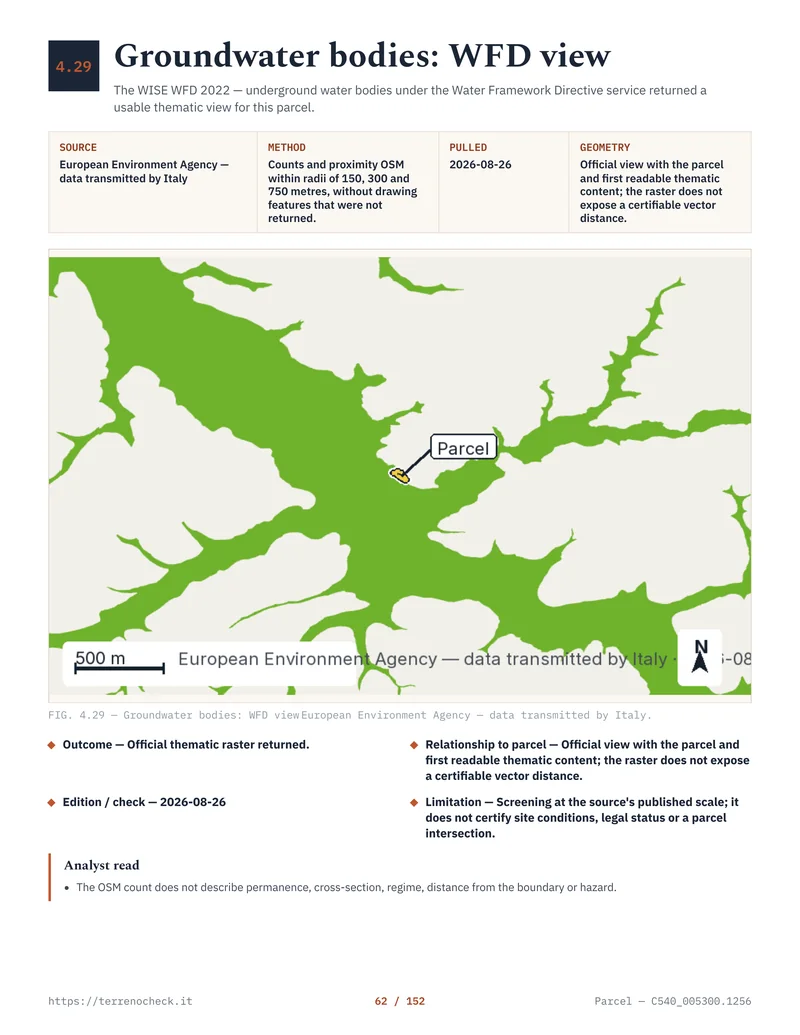 Open the full page
Existing wells: look for the register, not just the pump
Several regions have built well censuses or required rounds of declarations, sometimes with deadlines that have long since passed. Lazio’s Regional Law 19 November 1983, no. 70, created a regional, provincial and municipal well register and required holders of existing wells to file within six months of that law entering into force. The same law required a new-well application, a cadastral plan and a geologist’s technical report. It is a useful warning about the kind of historical paperwork a buyer may need, not a current national deadline.
Friuli Venezia Giulia’s current water page says that all existing wells, whether used or not, must be reported by owners, possessors or users to the Regione and the territorially competent Provincia. Article 30 of Regional Law 29 April 2015, no. 11 puts the register of domestic wells in the hands of the Comuni (subsection 1) and requires, for wells made after the law took effect, a report to the Comune within thirty days of completion giving the volumetrically measured withdrawal, the stratigraphy, the depth, the diameter and the filter location (subsection 2). A later owner inherits the practical problem of an old missing filing.
The destination changes by region. “Denuncia to the province” may mean the provincial water office, while a domestic-well register may sit with the Comune or Regione. In Sicily, the Genio Civile’s official forms list a communication for a new domestic well, a discovery notice under Article 103, a volumetric-meter installation notice and domestic meter-reading forms. That list tells a buyer something valuable: the regional authority expects a paper trail even where Article 93 removes the ordinary concession route.
Meters are just as uneven. Article 4(6) of Lombardia Regional Regulation 24 March 2006, no. 2 says that domestic use carries no obligation to install flow meters unless the Province provides otherwise. Article 33(1) of the same regulation requires everyone who draws and uses public water, apart from the withdrawals covered by Article 4, to install meters and file an annual return of the flows and volumes drawn; subsection 3 sets that deadline at 31 March each year. Friuli Venezia Giulia’s domestic-well form asks whether a volume meter exists, while its rules require volumetric measurement information for new domestic-well reports. Do not infer a national meter exemption from one region’s page.
Ask the seller for the complete file: protocol number, application or communication, concession decree, disciplinare, annual declarations, meter readings, fee receipts, final-well data and any order to close or regularise. Then ask the authority to confirm the status against the parcel and the well coordinates. A missing file is not cured by the fact that the previous owner paid an electrician.
These are classification thresholds, not domestic-use limits. A small household well can still need a regional filing, a meter or a concession when the use falls outside Article 93.
| Water use | Classification threshold | Unit of measure | Legal source |
|---|---|---|---|
| Drinking water | 100 | litres per second (l/s) | R.D. 1775/1933, Article 6 |
| Irrigation | 1,000, or lower where a surface above 500 hectares can be irrigated | litres per second (l/s) | R.D. 1775/1933, Article 6 |
| Land reclamation by filling | 5,000 | litres per second (l/s) | R.D. 1775/1933, Article 6 |
| Hydroelectric force | 3,000 | average nominal power (kW) | R.D. 1775/1933, Article 6 |
Source: R.D. 1775/1933, Article 6; Regione Lombardia, Derivazioni e usi delle acque.
Drilling is a separate permission question
Do not buy a bare plot on the promise that “we can drill later”. Article 95 of R.D. 1775/1933 requires authorization from the ufficio del Genio Civile for underground-water research or well excavation in areas subject to public-administration protection, unless the Article 93 owner’s faculty applies. The application includes a plan of the proposed extraction and use, and the procedure can involve notice, municipal publication, a site visit, precautions, a time limit, security and compensation.
Regional law can make the practical route wider than that national wording. Lazio’s well law, for example, required an application for any underground-water research, municipal authorization or no-objection, a cadastral plan and a geologist-signed technical report on the geology and precautions protecting public safety and the underground water system. In Emilia-Romagna, the concession procedure can require an autorizzazione alla perforazione where the intake is a well. In Sicily, the Genio Civile publishes separate document lists for water research and domestic wells, and the research material identifies a hydrogeological report among the application documents.
The document you want to see is not just a contractor’s invoice. It is the authorization or communication that covers the bore, the technical report, the location and cadastral parcel, the intended use, the final stratigraphy and the notice after water is found. Article 103 requires the Genio Civile to be notified when underground water is discovered following research, including outside protected areas, so it can ascertain the quantity. The discovery notice is not the same as a concession. Check the planning designation certificate as well: a well permit does not establish that the surrounding land can be used for the building or business in the advert.
There is no national published price per metre that I can responsibly put in front of a buyer. The official national and regional sources cited here explain permissions, documents, meters and charges; they do not publish a national €/m schedule for drilling a private bore. A quote depends on geology, access for the rig, casing and sealing, diameter, pump, testing, disposal of drilling material and whether the first bore succeeds. Anyone who gives you a national per-metre number without those inputs is selling reassurance, not a budget.
- Before drillingArticle 95 application; in Lazio the law required municipal authorization/no-objection, cadastral plan and a geologist report
- After a discoveryArticle 103 notice to the Genio Civile
- New domestic well in Friuli Venezia GiuliaReport to the Comune within 30 days of construction under the regional domestic-well rule
- Existing-well census example in LazioSix months from the 1983 regional law’s entry into force
- Lombardia public-water annual report31 March each year, excluding the domestic category under the regional rule
Source: Consiglio regionale del Lazio, Regional Law 70/1983, Articles 3 and 4; R.D. 1775/1933, Articles 95 and 103; Friuli Venezia Giulia, Law 11/2015, Article 30; Regione Lombardia, Regional Regulation 2/2006 and water-derivations page, Gazzetta Ufficiale · official document, regione.fvg.it · source document and regione.lombardia.it · source document.
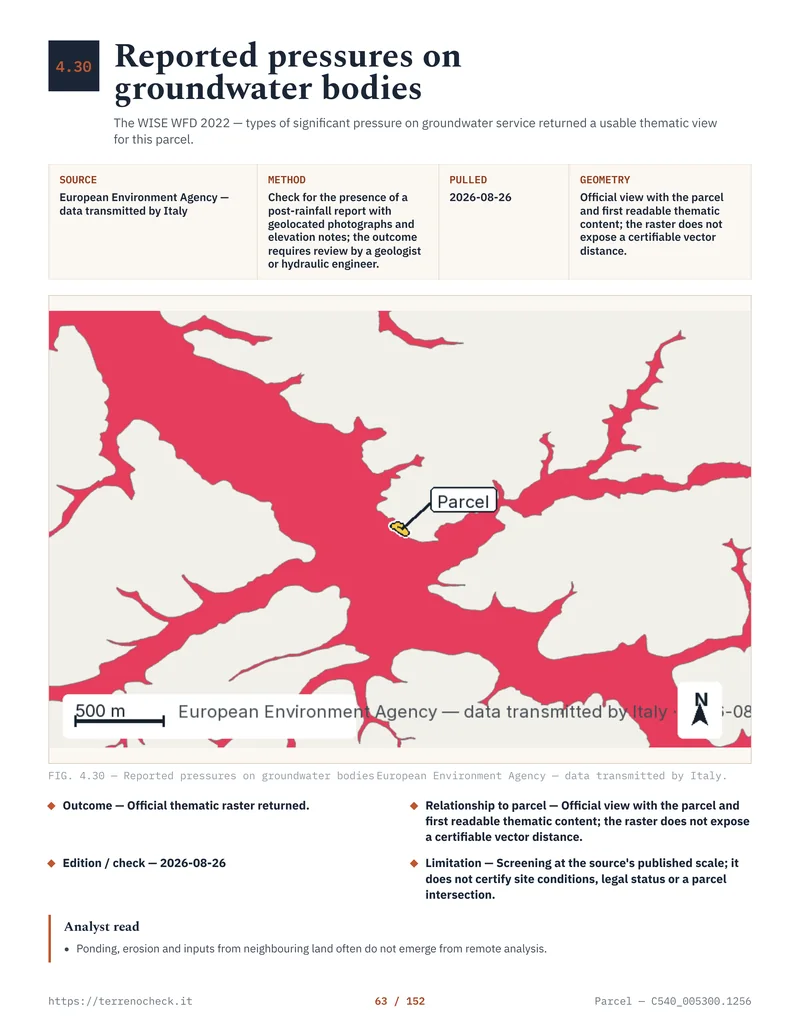 Open the full page
Water that looks clear is not automatically potable
Drinking-water quality is a health question, separate from the water right. Article 2(1)(a) of Legislative Decree 23 February 2023, no. 18 defines water intended for human consumption broadly: drinking, preparing food and other domestic uses in public or private premises, regardless of its origin. A private well can therefore feed a drinking-water system that needs scrutiny even though no water company owns the source.
Before a buyer connects a well to kitchen taps, take a properly collected sample to a laboratory accredited for the relevant drinking-water tests under UNI CEI EN ISO/IEC 17025. Accredia’s official service page identifies accredited laboratories and the accreditation requirement for the relevant tests. Ask the laboratory and the local ASL, usually through its Servizio Igiene degli Alimenti e della Nutrizione or equivalent, what panel and procedure apply locally. The sanitary authority, not the drilling contractor, decides whether the water is suitable for the intended human use under the applicable procedure.
Test at the source and at the point of use where the pipework or treatment system could change the result. A sensible buyer asks for microbiological and chemical results, the sampling date, the sampling point, the laboratory accreditation scope, treatment records and any sanitary judgment or communication. One favourable result from a dry month is not a permanent warranty. Nitrates, bacteria, salinity, iron, manganese, pesticides and naturally occurring contaminants depend on the aquifer and the surroundings.
Keep the well line separate from the public drinking-water line unless the system has been designed and approved for that arrangement. Backflow can contaminate a network. A water softener or ultraviolet unit is not a legal certificate and does not make an untested source safe. If the property hosts paying guests or runs an agricultural or food business, the operator’s food-safety duties are higher; the Ministry of Health materials identify local health authorities and accredited laboratories in that setting.
The environmental liabilities guide is relevant when the well sits near tanks, landfills, intensive agriculture, workshops or a former industrial use. A clean-looking pump house says nothing about the land around the recharge area.
A pipe across the neighbour’s land can be a legal issue
Civil Code Article 1033 is the servitù coattiva di acquedotto. It requires a landowner to allow water of any kind to pass across the land for someone who has the right to use it for life needs or agricultural or industrial uses. Houses, courtyards, gardens and their attached yards are exempt from that servitude. Article 1032 says that, where the law gives a right to obtain a servitude and there is no contract, a judgment establishes the route and the indemnity; the servient owner can oppose exercise before payment.
This is not a free pass to bury a pipe wherever the excavator finds soft soil. The water user still needs the underlying right to use the water, the route and technical works must be established, and the neighbour’s land may carry buildings or protected features. A deeded servitù di acquedotto should identify the parcels, route, pipe, access for inspection and repair, restoration, maintenance, indemnity and whether the right benefits the land or only a person. The access rights guide explains why a visible track or friendly permission is not the same as a recorded real right.
If the seller says “the pipe has always crossed next door”, inspect the titles of every parcel, the route on the ground and the ispezione ipotecaria. Make a written easement, or the necessary court or administrative outcome, a condition of the preliminary contract if the water supply depends on it. A water concession without a pipe route is not a working supply.
What to ask before paying a deposit
Put the well into the transaction checklist as an asset with a file, not as a decorative feature.
- Use: What exactly will the water serve: one family, a garden, livestock, a pool, guests, crops or a business? Write each use separately.
- Authority: Which Regione, Provincia, Città Metropolitana, Comune, Genio Civile or ASL holds the record? Ask for written confirmation using the parcel and well coordinates.
- Well: What are the depth, diameter, screen or filter intervals, pump, yield, static level, final stratigraphy and year of construction? Have a geologist assess the technical evidence.
- Paper trail: Is there a concession, disciplinare, domestic communication, drilling authorization, discovery notice, meter record, annual declaration or closure order? Are fees and canons paid?
- Water: When was the last accredited laboratory test? Was it taken at the source and the tap? Is there a sanitary judgment for potable use, and are treatments maintained?
- Route: Does a pipe cross another parcel? Is there a transcribed servitù di acquedotto, and does it cover access, repair and the intended volume?
- Price: What will the technician, application, survey, meter, pump, treatment, pipe route and possible second bore cost? There is no reliable national €/m drilling figure.
If the answers are verbal, value the property as if the well were unavailable until the relevant professionals and authorities close the gap. Rural water is useful. It is not automatically legal, drinkable or cheap.
Sources
- Normattiva, Law 5 January 1994, no. 36, Article 1, public ownership of water
- Gazzetta Ufficiale, R.D. 11 December 1933, no. 1775, Article 6, large and small derivations
- Gazzetta Ufficiale, R.D. 1775/1933, Article 17, authorization or concession for public water
- Gazzetta Ufficiale, R.D. 1775/1933, Article 56, licence for temporary drawing
- Gazzetta Ufficiale, R.D. 1775/1933, Articles 93, 95 and 103, domestic use, drilling and discovery notice
- Regione Lombardia, derivations and uses of public water
- Regione Lombardia, concession for surface or underground public water
- Consiglio regionale della Lombardia, Regional Regulation 24 March 2006, no. 2
- Regione Emilia-Romagna, concessions for water and public water domain
- Regione Autonoma Friuli Venezia Giulia, water derivations and well register
- Regione Autonoma Friuli Venezia Giulia, Law 29 April 2015, no. 11, Article 30, domestic wells
- Consiglio regionale del Lazio, Regional Law 19 November 1983, no. 70, well census and drilling
- Regione Siciliana, Genio Civile Palermo, public-water procedures and forms
- Normattiva, Legislative Decree 23 February 2023, no. 18, drinking-water quality
- Accredia, drinking water tests and ISO/IEC 17025 laboratories
- Gazzetta Ufficiale, Civil Code Article 1032, compulsory servitude procedure
- Gazzetta Ufficiale, Civil Code Article 1033, obligation to allow water conduits
- Normattiva, Law 24 January 1977, no. 7, Article 1, hydroelectric threshold raised to 3,000 kW
- Normattiva, Legislative Decree 23 February 2023, no. 18, Article 2(1)(a), water intended for human consumption