
Buying agricultural land in Italy: pre-emption rights
Source: DPR 131/1986, Tariff Part I, Article 1 (in force to 31.12.2026) and D.Lgs. 123/2025, Annex 1 (consolidated successor); D.L. 194/2009 Article 2(4-bis)
A tenant farmer or qualifying neighbour can sometimes take Italian farmland from the buyer after completion. Here is the order of rights, the deadlines and the paperwork that keeps the risk visible.
Contents
Before buying agricultural land, establish whether a qualifying tenant farmer or neighbouring direct farmer has a statutory right of pre-emption. If the right applies, the prescribed notice and terms must be dealt with before the deed.
That is not a cinematic plot. It is prelazione agraria, agrarian pre-emption. In the right circumstances, the farmer can exercise riscatto, step into the buyer’s position and take the land on the same terms. The buyer is left fighting about money after losing the parcel.
Foreign buyers of Italian farmland most often lose the land this way after paying for it. It is more common than the exotic problems people ask about first. Start with the person cultivating the field.
If you are still assembling the basics, use the Italian land-buying checklist, then identify the exact parcel through the visura catastale. Pre-emption is a separate check. A clean cadastral extract does not answer it.
Two rights, and the order matters
The first right belongs to a qualifying occupier of the land. Article 8 of Law 590/1965 covers an affittuario coltivatore diretto, together with the older statutory categories of mezzadro, colono and compartecipante, when the land is transferred for value. The tenant must cultivate that land for the required period and satisfy the other statutory conditions. Article 7 of Law 817/1971 reduced the four-year period in Article 8 to two years.
The second right is different. It can belong to a coltivatore diretto who owns land adjoining the parcel for sale, and to an adjoining IAP (imprenditore agricolo professionale) registered in agricultural social security. Article 7 expressly excludes this adjoining-owner right where the offered land is occupied by the listed tenant-type cultivators. The neighbour does not jump over a protected tenant because he owns the next field.
In practical order:
Agrarian pre-emption screening
| Check | Possible holder | What decides priority | Immediate result |
|---|---|---|---|
| 1 | Qualifying tenant farmer or other listed direct cultivator | Actual qualifying cultivation and the Article 8 conditions | Seller must serve the sale proposal before completion |
| 2 | Adjoining coltivatore diretto | Adjoining ownership plus the Article 7 conditions, only where the listed occupiers are absent | Seller must investigate and notify the right holder |
| 3 | Adjoining IAP registered in agricultural social security | Adjoining ownership, IAP status and the Article 7 conditions | Same statutory risk, even though the neighbour is not a direct cultivator |
| 4 | No qualifying holder | No person satisfies the national statutory conditions | These two statutory pre-emption rights do not arise |
Source: Law 590/1965 Article 8 and Law 817/1971 Article 7
The right is national legislation; cultivation evidence and planning status still have to be checked locally.
If several adjoining claimants qualify, distance is not enough. Since 10 April 2024, Article 8 of Law 36/2024 gives preference among multiple adjoining claimants to a young agricultural entrepreneur in the Article 2 categories, built around agricultural entrepreneurs aged 18 to under 41. The order is an individual young agricultural entrepreneur first, then a qualifying partnership or co-operative, then a qualifying capital company; where conditions are otherwise equal, adequate agricultural knowledge and competence break the tie. For a buyer negotiating with several neighbouring farmers, “closest neighbour wins” is therefore not the rule: apply this order to adjoining-owner pre-emption, redemption and pre-emption in public agricultural land sales and leases, and treat sources published before 10 April 2024 with care because they may quote the now-abrogated Article 7 of Legislative Decree 228/2001.
Pages from the delivered dossier
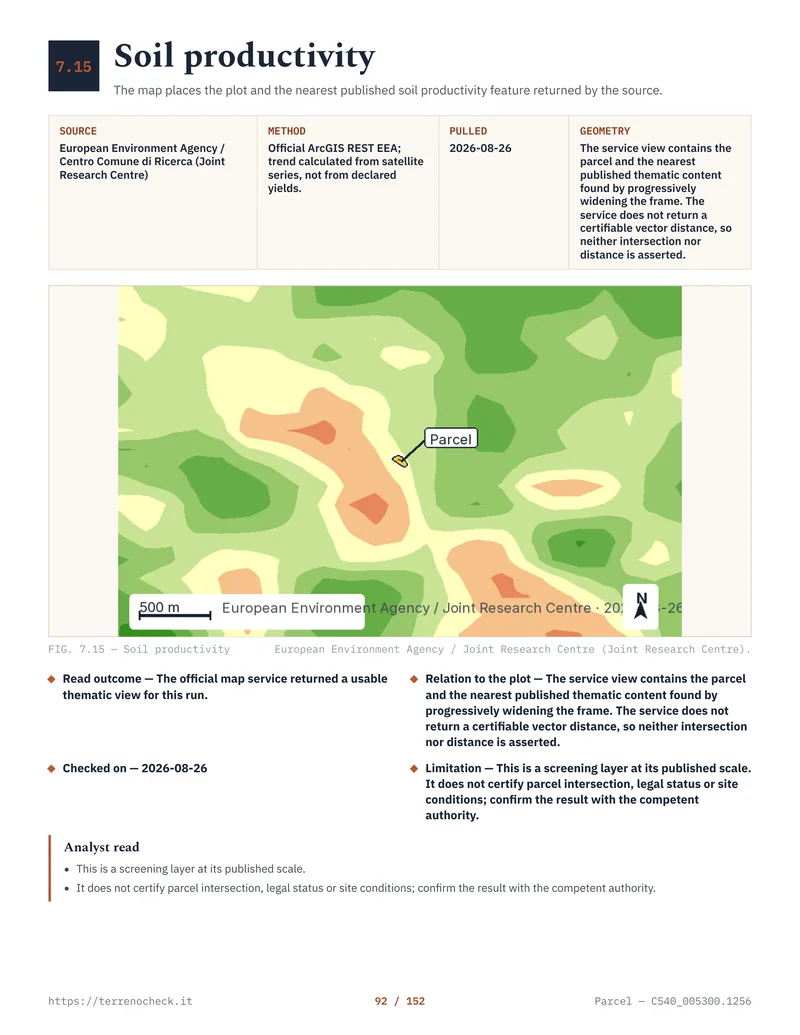 Open the full page
The procedure: denuntiatio, thirty days, then the danger does not disappear
The seller’s notice is called denuntiatio. Article 8 of Law 590/1965 says the owner must notify the cultivator by registered letter and transmit the preliminary sale contract. It must state the buyer’s name, price, other agreed terms and the clause dealing with pre-emption. An agent’s email saying “the farmer knows about the sale” is not the statutory package.
The holder has 30 days to exercise the right. The clock is not a vague cooling-off period. It starts from a legally effective notification of the proposal and its terms. The notary or lawyer should be able to show when each notification was received, what was enclosed and what price and conditions were offered.
If the holder accepts, the price is normally payable within six months, counted from the thirtieth day after the owner’s notification, unless the parties agree another arrangement. That is one reason an agricultural transaction can remain unsettled after the buyer thought the deal was done.
The more dangerous case is a defective or missing notice. Article 8 gives the person entitled to pre-emption a right of riscatto against the buyer and later buyers within one year from transcription of the sale contract in the land registers. In English discussions this is often called “one year after registration”. The statute means trascrizione, not the key handover or cadastral update.
The risk has two triggers. The seller did not notify the right holder, or the price in the notice was higher than the price written in the sale contract. The second trigger matters when a seller tries to flush out a farmer with an inflated figure and then closes at a lower one. The buyer inherits that mistake.
- Tenant condition2 years: reduced cultivation period under Article 7 of Law 817/1971
- Election30 days after statutory notice
- Payment6 months after the 30-day point when pre-emption is exercised
- Riscatto1 year from transcription if notice was omitted or notified price exceeded the contract price
Source: Normattiva, Law 590/1965, Article 8; Normattiva, Law 817/1971, Article 7.
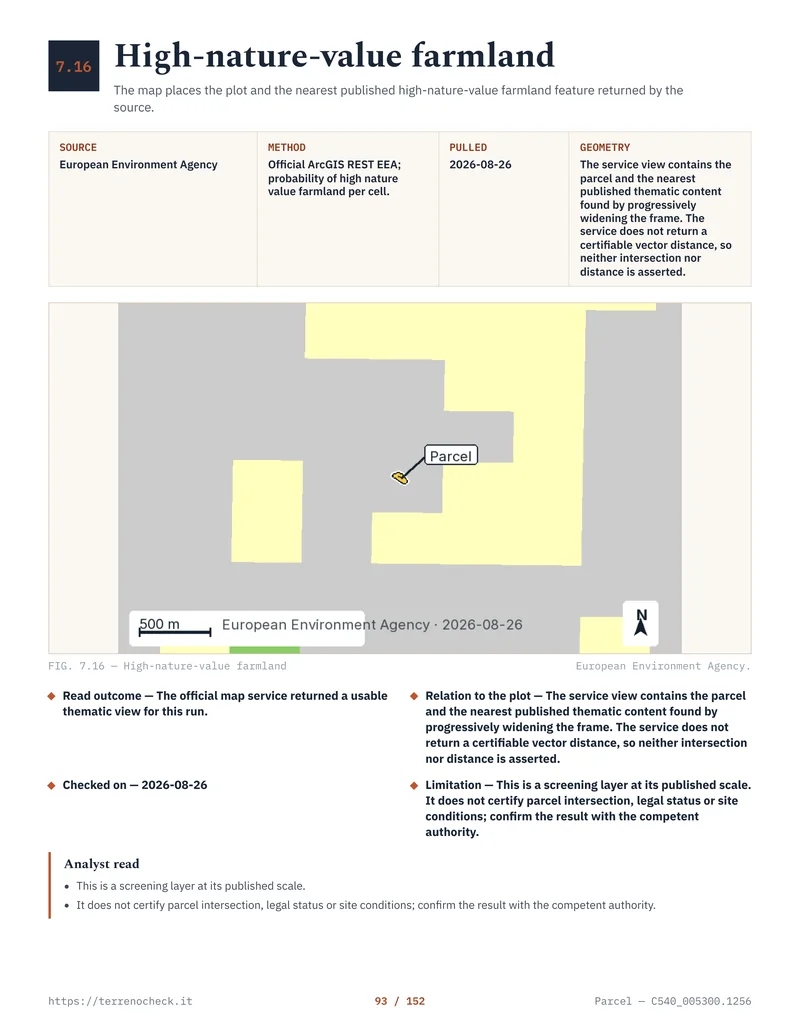 Open the full page
When prelazione does not apply
Article 8 of Law 590/1965 lists important exclusions. The statutory right is not available in a permuta (exchange), a forced sale, liquidazione coatta, bankruptcy, or expropriation for public utility. It also does not apply where the land is destined, under a planning instrument, for building, industrial or tourist use, even if the plan has not yet been approved.
That last rule needs care. “The cadastral category says agricultural” is not enough. The CDU, or certificato di destinazione urbanistica, records the planning prescriptions relevant to the parcel. Under Article 30 of DPR 380/2001, the competent municipal office issues it; it is generally valid for one year if the seller declares that planning instruments have not changed. Read the CDU, PRG/PUC and applicable regional rules. A national pre-emption rule is not a promise about local zoning.
The tenant’s right also fails if the claimant does not meet the personal and farming conditions. A seasonal arrangement is expressly outside Article 8. Two years on paper is not enough if the person is not the qualifying cultivator, the land is not the land actually cultivated, or the other statutory limits fail. Article 8 also addresses recent sales of rural land and the relationship between the land acquired and the family’s working capacity.
The neighbour’s right fails when there is no qualifying adjoining owner, when the neighbour is not a coltivatore diretto or qualifying IAP, or when a listed cultivator is installed on the offered land. A neighbour who keeps a vegetable garden at weekends is not automatically a holder. Neither is a foreign buyer who says he plans to start farming after completion.
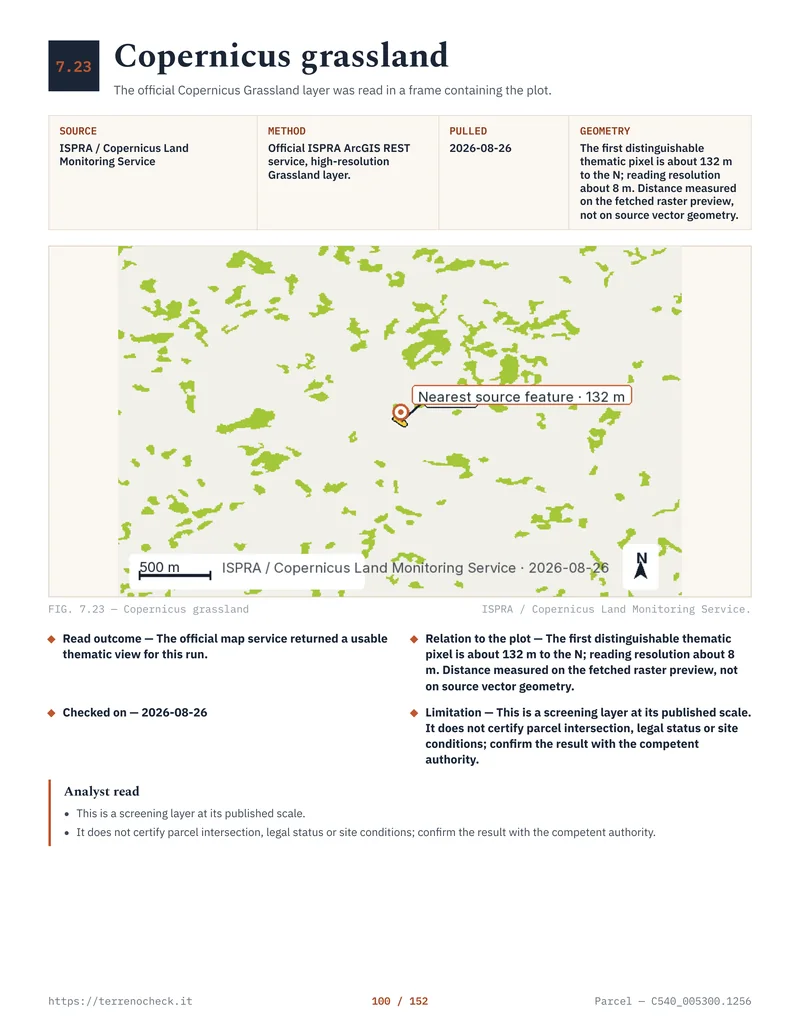 Open the full page
Coltivatore diretto and IAP: the labels change the price
These terms are not decorative Italian. They affect who can take the land and what tax position a genuine agricultural buyer may have. INPS describes coltivatori diretti as small agricultural entrepreneurs who carry out agricultural work exclusively and prevalently, with manual cultivation, livestock and connected activities. The status is tied to the real business and agricultural social-security scheme. It is not created by typing “farmer” into an estate listing.
An IAP is a different national status. Under Article 1 of Legislative Decree 99/2004, the person must have the required professional knowledge and devote at least 50% of total working time to agriculture, deriving at least 50% of global employment income from it. In disadvantaged areas, the percentages are reduced to 25%. The Region assesses the IAP requirements, and the assessment has effect throughout Italy. That regional assessment is not the same thing as a Comune’s planning decision.
For tax relief, the distinction is sharp. For prelazione, the holder conditions and actual cultivation must be checked. For the “small rural property” regime (piccola proprietà contadina), the buyer must be a CD or IAP registered in agricultural social security, and the land must be agricultural under current planning instruments. The rule gives fixed registration and mortgage taxes and a 1% cadastral tax, normally with a five-year hold-and-direct-cultivation condition. The tax authority’s Circular 18/E explains the regime. Article 1(4) of Legislative Decree 99/2004 extends the relevant indirect-tax advantages to a registered IAP individual.
For a simple illustration on a EUR 100,000 agricultural land transfer, the difference is not small:
Agricultural-land tax comparison on EUR 100,000
| Buyer and regime | Registration tax | Mortgage tax | Cadastral tax | Tax on EUR 100,000, before fees and other charges |
|---|---|---|---|---|
| Buyer without the agricultural relief | 15% = EUR 15,000 | EUR 50 fixed | EUR 50 fixed | EUR 15,100 |
| Registered CD or IAP using the small-rural-property regime | EUR 200 fixed | EUR 200 fixed | 1% = EUR 1,000 | EUR 1,400 |
Source: DPR 131/1986, Tariff Part I, Article 1 (in force to 31.12.2026) and D.Lgs. 123/2025, Annex 1 (consolidated successor); D.L. 194/2009 Article 2(4-bis)
The 15% transfer rate is the agricultural-land rate in Article 1 of the registration-tax tariff for buyers outside the protected agricultural category. The EUR 50 fixed mortgage and cadastral amounts are confirmed in published tax guidance. The PPC figures and five-year condition come from the relief rule and Circular 18/E. The EUR 100,000 example is not a deed quote. The 15% line alone is EUR 15,000; the PPC line is EUR 1,400, so a qualified agricultural buyer can bid differently.
Source: Normattiva, DPR 131/1986, Tariff Part I, Article 1 (in force to 31.12.2026); Gazzetta Ufficiale, D.Lgs. 123/2025, Annex 1, Tariff Part I, Article 1 (consolidated successor); Agenzia delle Entrate, Circular 18/E of 29 May 2013; Agenzia delle Entrate, Circular 2/E of 21 February 2014; Ministero dell’Economia e delle Finanze, published guidance confirming EUR 50 fixed mortgage and cadastral taxes.
For tax year 2025, the Agenzia’s 730/2026 guidance includes registered CD/IAP land income at 0% up to EUR 10,000, 50% over EUR 10,000 to EUR 15,000, and 100% above EUR 15,000, subject to its conditions. That is income tax, not a purchase-price reduction or a route to IAP status.
- Qualifying non-seasonal tenant cultivator, at least 2 yearsFirst claimant; prepare Article 8 notice. After valid notice: 30 days to elect, then 6 months to pay; omitted/incorrect notice can allow riscatto within 1 year from transcription.
- No tenant; adjoining CD or IAP with Article 7 conditionsPrepare Article 7 notice. If several adjoining applicants qualify, use Law 36/2024 Article 8 preference order, not closest neighbour; 30 days, 6 months and possible 1-year riscatto apply.
- No qualifying tenant or adjoining holder on checked factsThese two national pre-emption routes do not arise; keep the documents showing the screen and check any other applicable route.
Source: Normattiva, Law 590/1965 Article 8; Law 817/1971 Article 7; Law 36/2024 Article 8; INPS, agricultural self-employed registration.
What the seller should produce before the deed
Ask for a document pack before you become committed to the view, the olive trees or the price.
First, require every current and historic occupation document: registered lease, comodato, share-farming agreement, mezzadria, colonia, compartecipazione and any other arrangement the seller knows about. Ask who cultivates each cadastral parcel.
Second, obtain the denuntiatio package if a qualifying claimant exists: the signed preliminary contract, the exact price and terms, the registered-letter receipts, delivery evidence, the date of receipt, the holder’s response and proof of payment if the right was exercised. If the seller says there is no claimant, put that statement in writing and ask what evidence supports it. A bare declaration is not a substitute for checking the field.
Third, obtain the current visura catastale, title history and parcel map, the CDU and planning extracts showing whether the land is classified for agricultural use. The seller must give the notary the information needed for the deed. The CDU is municipal; a missing or stale CDU does not make the pre-emption analysis safe.
The deed should identify the land precisely and record the seller’s declarations about occupation and the handling of statutory pre-emption. If the buyer relies on CD/IAP tax status, the deed also needs the buyer’s evidence and declarations. Do not confuse that tax declaration with proof that the seller served the farmer.
How a foreign buyer protects the purchase
Make the offer conditional. Cover the land’s planning destination, full occupation disclosure, every possible holder, valid notifications, the expiry or legally correct handling of any right, and the notary’s acceptance of the evidence before completion. Put the clause in the Italian preliminary contract, not an English email to the agent.
Do not pay the full price while saying, “we will sort the farmer question at the deed”. If notification is required, build the 30-day period into the timetable. If the deal must close sooner, have the notary explain the residual risk in writing. A seller indemnity may help recover money. It does not keep the land in your hands if riscatto is exercised.
Have the notary or agricultural lawyer check the alleged farmer’s status, not just the seller’s wording. Ask for evidence of cultivation, the lease and its duration, parcel identifiers, CD or IAP documents, INPS registration where required, and competing adjoining claimants. For IAP status, ask which Region certified it and whether the certificate covers the relevant date. For a company, check its legal form and ownership or management requirements.
Price the tax and legal risk separately. The cost of buying property in Italy article covers the wider budget; the PRG/PUC planning check cannot prove that no tenant has a pre-emption right. If access matters, check servitù di passaggio separately. These are different failure points.
The blunt version is simple: no verified occupation history, no safe closing date. If the seller will not name the cultivator, show the lease or explain why Article 8 does not apply, stop. A view of the land is not title insurance.
Sources
- Normattiva, Law 26 May 1965, no. 590, Article 8
- Normattiva, Law 14 August 1971, no. 817, Article 7
- Normattiva, Law 15 March 2024, no. 36, Article 8
- Normattiva, Legislative Decree 29 March 2004, no. 99, Article 1
- INPS, registration in the agricultural self-employed scheme
- Agenzia delle Entrate, 730/2026 pre-filled return, agricultural land
- Agenzia delle Entrate, Circular 18/E of 29 May 2013, small rural property relief
- Normattiva, DPR 26 April 1986, no. 131, registration tax
- Normattiva, Legislative Decree 31 October 1990, no. 347, mortgage and cadastral taxes
- Normattiva, DPR 6 June 2001, no. 380, Article 30, certificate of urban destination
- Normattiva, Legislative Decree 18 May 2001, no. 228, Article 1, agricultural activity
- Normattiva, Decree-Law 30 December 2009, no. 194, Article 2(4-bis), small rural property relief
- Ministero dell’Economia e delle Finanze, published guidance on EUR 50 fixed mortgage and cadastral taxes
- Agenzia delle Entrate, Circular 2/E of 21 February 2014, PPC taxes of EUR 200 and 1%
- Comune of Milan, certificate of urban destination service