
Usi civici in Italy: why a sale can stop dead
Source: D.Lgs. 42/2004, Article 142(1)(a)–(d)
A parcel can look privately owned, sit in the seller’s name and still carry a collective right that changes what can be sold. Here is the check I want before any deposit is paid.
Contents
- What usi civici actually are
- How a parcel gets caught, and why maps do not settle it
- The four checks I want before a deposit
- Liquidazione and affrancazione: the route to a clean position
- The 2017 landscape consequence
- Demanio is not the same thing
- What if the problem appears after the sale?
- Buyer’s file: what to request in writing
Before treating land as freely transferable private property, verify whether it is affected by usi civici or belongs to a public domain. The listing, cadastral holder and age of a fence do not determine that legal status.
I have seen foreign buyers spend money on a survey, a preliminary contract and a trip to Italy before anyone opened the verifica demaniale, the historical investigation into civic rights. By then the price is psychologically committed. The seller wants the deposit. The buyer wants the dream. The old communal right is still there, quietly waiting in a regional file.
Check this separately from the Italian land-buying checklist, the cadastral extract and the certificate of urban destination. Do all three. None replaces it.
What usi civici actually are
An uso civico is a collective right held by the inhabitants of a municipality or a frazione, traditionally rights such as grazing, collecting firewood, gathering products or cultivating land. Under Law 1766/1927, the right can sit on land owned by the collective, a municipality or an agrarian association. It can also sit on land that has a private owner. That second situation is the one that catches buyers who assume “private owner” means “unburdened land”.
The 1927 statute was a national liquidation and reorganisation law. Article 1 covers the assessment and liquidation of civic uses; Article 4 divides them into essential and useful classes; Articles 5–7 set out the mechanisms for replacing the collective right with land or a canon. The implementing regulation is Royal Decree 332/1928.
Then came Law 168/2017. Article 3 recognises domini collettivi, whatever their local name, and identifies the collective assets that form the civic patrimony, or demanio civico. For that collective-domain patrimony, paragraph 3 preserves the regime of inalienability, indivisibility, non-acquisability by usucapion and permanent agro-silvo-pastoral destination.
That is the accurate reason people say civic land is “imprescriptible”. Time does not turn a resident’s collective right into a private right through ordinary possession. The statutory word is often inusucapibilità, not a magic rule that every historical allegation survives forever. Proof, boundaries and the legal category still matter.
There is a correction every current article should make. In judgment no. 119/2023, the Constitutional Court struck down the 2017 rule insofar as it made privately owned land with an unliquidated civic use inalienable. A private owner can transfer that land, but the civic right and the landscape constraint travel with it. Collective-domain land is different. A seller cannot turn demanio civico into ordinary private stock by writing a persuasive clause in a contract.
The first question is not ‘is there a civic use?’ but ‘which legal category is this parcel in?’ because the answer changes whether private circulation is possible.
| Legal category | Published numbers | Effect on private circulation |
|---|---|---|
| Collective assets, Law 168/2017 Article 3(1)(a–f) | 6 categories; 5 (a, b, c, e, f) in civic patrimony | Civic-patrimony goods are inalienable under the 2017 rule |
| Privately owned land with unliquidated civic use, Article 3(1)(d) | 1 private-land category | Constitutional Court judgment 119/2023 excludes it from the 2017 inalienability rule; the burden remains |
| Public-domain goods, Civil Code Articles 822–823 | 2 articles | Public-domain goods are inalienable |
Source: Normattiva, Law 20 November 2017, no. 168, Article 3; Corte costituzionale, judgment no. 119/2023; Normattiva, Civil Code, Royal Decree 16 March 1942, no. 262.
Pages from the delivered dossier
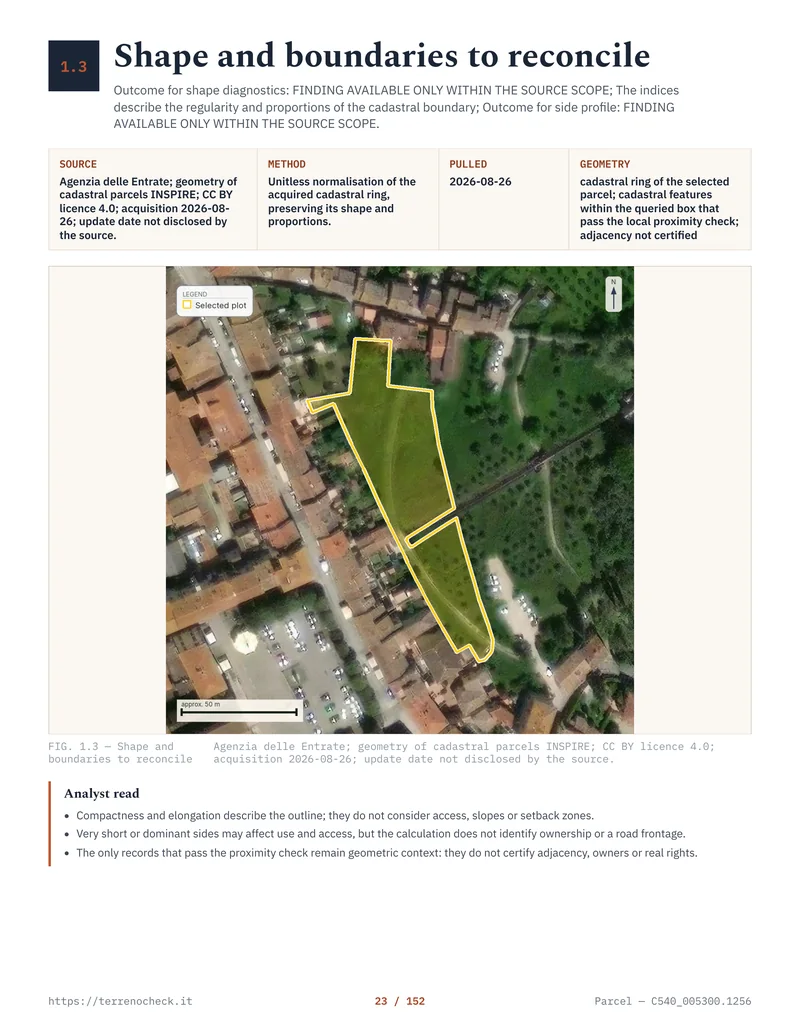 Open the full page
How a parcel gets caught, and why maps do not settle it
The burden may come from an old communal or agrarian holding, a historic allocation of land, an incomplete liquidation, or a right exercised over land that later passed into private hands. The chain is often older than the modern cadastral parcel. Municipal boundaries changed. A large estate was divided. A road or stream moved. A twentieth-century map was copied into a later planning file without anyone reconciling it to the current foglio and particella.
That last mismatch is sconfinamento. It does not mean a map is fraudulent. It means the line in an old verifica may not coincide neatly with today’s parcel line. The civic area can cross part of your parcel, a neighbouring parcel or several parcels. A cadastral polygon is evidence of cadastral mapping, not a ruling on the qualitas soli.
In a municipality or village with an ASBUC, the Amministrazione Separata dei Beni di Uso Civico, the committee manages the separated civic assets for the local community. Law 278/1957 is the national reference for village committees. Depending on the region and local structure, the managing body may instead be the comune, a università agraria, an agrarian association or another recognised collective body. The current Lazio service describes the same practical division: collective assets are managed by representative entities and, where there is no such entity, by the municipality in separate administration.
Do not assume the ASBUC is a public counter with a complete title register. Ask who actually holds the records, which historical act established the right and whether an approved verifica demaniale covers the exact parcel.
The four checks I want before a deposit
Start with the comune. Ask the planning or land office for every document that identifies civic rights over the foglio and particella: verifica demaniale, inventory, commissioner decision, legittimazione, liquidation, affrancazione, sclassificazione, exchange or other final act. Ask for the map, not just an email saying “nothing is known”. In Lazio, the current regional page says an application for liquidation of civic rights on private land is presented by the owner to the comune. That is a regional procedure, not a national form for every Italian municipality.
Then check the regional register or geoportal. Search under usi civici, demanio civico, inventario and ricognizione demaniale. The public material is uneven, and many regional registers are incomplete, provisional or still being updated. Puglia’s official portal says it is publishing outcomes from a demanial survey that is still in progress, alongside documents being digitised from the regional archive. Calabria’s official 2026 list still contains municipal procedures for a general assessment of whether civic burdens exist. Sardinia published a 2026 determination approving a new assessment and an inventory update for Villacidro. These are useful warnings, not reasons to distrust a particular office. They show why a blank web map is not a national clearance certificate and is not proof that a parcel is free.
Find the perito demaniale or istruttore demaniale. The task differs from a standard boundary survey. The historical-legal investigation identifies whether the collective right exists; the technical-economic work reconciles land, use, area and value. Lazio maintains a regional register of these professionals and says administrative assessment and settlement proposals are carried out by instructors and demanial surveyors. Other regions use different registers and appointment rules.
Finally, give the file to the notary before the preliminary contract. The notary checks title and public records, but the notary is not a substitute for a missing regional investigation. Give the notary the regional map, the municipality’s written response and any perito report. If the seller says the issue is “only cadastral”, ask for the legal act that extinguished or transferred the right.
The CDU article is still useful. In Lazio, Regional Law 1/1986 says municipalities attest the presence or absence of civic-right burdens when issuing the CDU. That sentence cannot be exported to Tuscany, Puglia or Sardinia without checking their own law and form.
 Open the full page
Liquidazione and affrancazione: the route to a clean position
Liquidazione is the legal settlement of the collective right. Under Articles 5 and 6 of Law 1766/1927, one route is scorporo: a portion of the burdened land is assigned to the municipality for the community, with the remaining portion left in private ownership. Article 5 gives a real scale, not a negotiator’s estimate: for first-class essential rights, the portion starts at one eighth and can rise to one third or one half depending on the circumstances and the value of the land.
Affrancazione is different. Where Article 7 applies, the land is left undivided and carries an annual emphyteutic canon corresponding to the value of the civic rights. Affrancazione redeems that canon by paying the capitalised amount set in the relevant act or regional procedure. In a private-land transaction, the owner seeking free circulation normally funds the appraisal, filing and redemption amount. The exact person liable for each fee, the valuation method and the competent signatory come from the region and the managing entity.
The Italian word legittimazione is another trap. It generally concerns an occupation of collective land and can lead to a new title only under its own statutory conditions. It is not a synonym for affrancazione, and neither word should appear in a draft deed without the actual approved measure behind it.
There is no national “usi civici clearance in thirty days” service. A regional example shows why. In a Lazio liquidation published in 2020, the owner and the municipality had 30 days to oppose the proposal after notification or publication; the determination also stated 60 days for a TAR appeal and 120 days for an extraordinary appeal to the President of the Republic. Those are procedural periods in that act, not a promise about the total duration. A historic investigation, a missing map, an opposition or a required landscape step can stretch the matter well beyond a property transaction timetable.
Lazio’s regional law also gives a useful warning about money: Article 4(3) of Regional Law 3 January 1986, no. 1 sets the annual canon at not less than 2% of the corresponding affrancazione capital, and Article 4(4) permits a reduction of up to 60% in a defined first-home situation. Those are Lazio rules. They are not an Italian tariff.
Published figures and their legal scope
| Published figure | What it measures | Legal scope |
|---|---|---|
| 1/8, 1/3, 1/2 | Possible portion of the fund assigned for liquidation of first-class essential civic rights | National Law 1766/1927, Article 5 |
| 2% | Minimum annual emphyteutic canon as a percentage of affrancazione capital | Regione Lazio, Regional Law 1/1986, Article 4(3) |
| 60% | Maximum reduction of the Lazio liquidation amount in the defined first-home case | Regione Lazio, Regional Law 1/1986, Article 4(4) |
| 30 days | Period stated for opposition to the published Lazio liquidation proposal | Regione Lazio, Determination no. 310/2020 |
| 60 days / 120 days | TAR appeal / extraordinary presidential appeal periods stated in that Lazio determination | Regional administrative procedure in the published act, not a national deadline |
Source: Law 1766/1927 Article 5; Regione Lazio Law 1/1986; Determination no. 310/2020
The following distances come from the national landscape code. They are useful screening measurements, not proof of ownership or of a maritime or river boundary.
Landscape-protection screening distances
| Protected feature | Statutory distance or height | National source |
|---|---|---|
| Coastal territory from the shoreline | 300 m | D.Lgs. 42/2004, Article 142(1)(a) |
| Territory beside a lake from the shoreline | 300 m | D.Lgs. 42/2004, Article 142(1)(b) |
| Each side of a listed river or watercourse | 150 m | D.Lgs. 42/2004, Article 142(1)(c) |
| Mountain territory above sea level, Alps | 1,600 m | D.Lgs. 42/2004, Article 142(1)(d) |
| Mountain territory above sea level, Apennines and islands | 1,200 m | D.Lgs. 42/2004, Article 142(1)(d) |
Source: D.Lgs. 42/2004 Article 142(1)(a)–(d)
The 2017 landscape consequence
Article 3(6) of Law 168/2017 ties civic rights to the public interest in conserving land and landscape. The national landscape code, Legislative Decree 42/2004, Article 142(1)(h), includes areas assigned to università agrarie and zones burdened by civic uses among the areas protected by law. Law 168/2017 says that protection is maintained on the land even after liquidation of the civic use.
That does not mean a liquidated parcel is frozen forever. It means liquidation and landscape authorisation are separate questions. A buyer who wants to build must still read the PRG or PUC, the landscape constraint article and the applicable regional landscape plan. A prior liquidation is not a building permit, and a cadastral owner is not a planning entitlement.
300 m
Source: Normattiva, Legislative Decree 22 January 2004, no. 42, Article 142(1)(a)–(d).
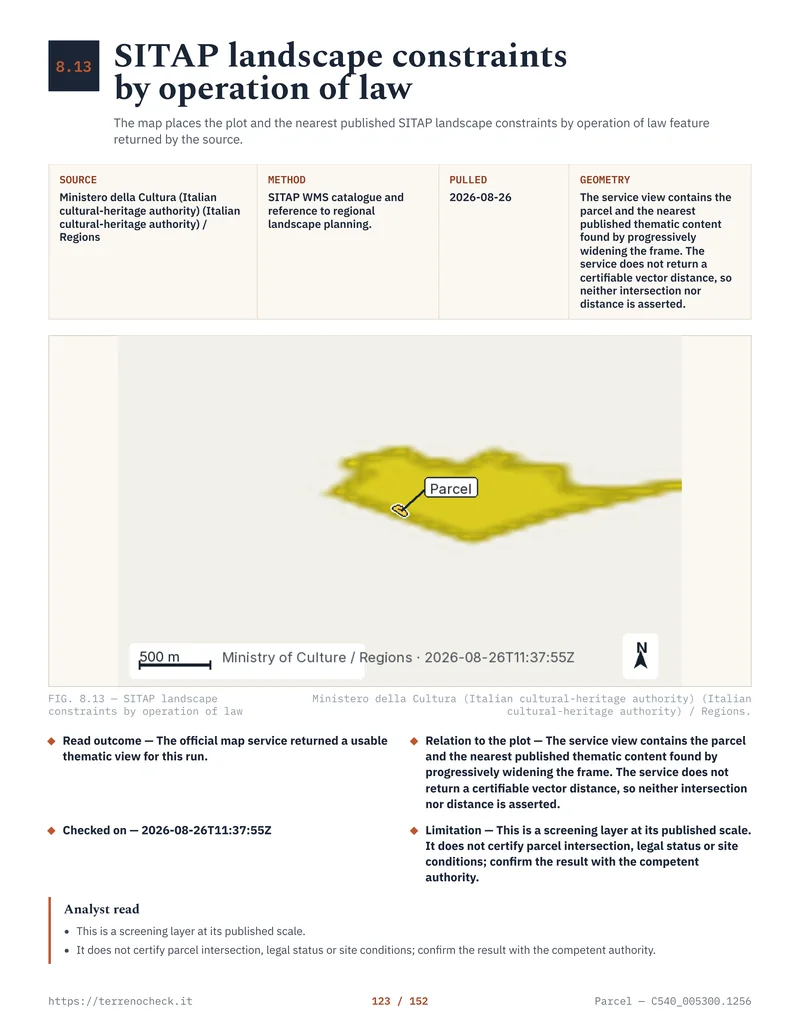 Open the full page
Demanio is not the same thing
The word demanio gets used loosely in estate listings. It should not.
Under Civil Code Article 822, the public demanio includes the sea shore, beach, ports, rivers, torrents, lakes and other public waters. Article 823 makes public-domain goods inalienable except through the legal mechanisms governing them. The Navigation Code, Article 28, separately lists the maritime demanio: lido, beach, ports, roadsteads, lagoons, river mouths entering the sea, salt or brackish basins communicating with the sea, and channels for public maritime use. Article 824 applies the relevant regime to certain municipal and provincial goods, including roads, cemeteries and markets.
Three mistakes recur:
- A parcel is near a beach, so the buyer assumes it includes the beach or has a private right to it. It does not. The coastal and island property article deals with the separate coastal checks.
- A stream is shown as a thin blue line, so the buyer assumes the bank is private. Public-water classification and the authorised boundary matter; the cadastral line is not the answer.
- A road has no sign and the seller has driven on it for years, so the buyer assumes it is a private access way. A public road, a private road, a servitude and a tolerated track are four different things.
The Agenzia del Demanio and maritime authorities can deal with demanial boundaries, concessions, demanialisation or sdemanializzazione. The Agenzia delle Entrate’s published maritime-domain circular describes how boundary and status measures can lead to cadastral updates. That is why “it is in the cadastre” is not a defence against an administrative demanio claim.
What if the problem appears after the sale?
First identify the category. If the parcel is collective demanio civico, the private sale may be legally impossible. The current Lazio guidance calls private dispositions of collective assets void for legal impossibility of the object. The buyer is then in a dispute about recovery, costs and responsibility, not in possession of a clean investment.
If it is privately owned land with a civic use, the Constitutional Court’s 2023 ruling means the property can circulate. The buyer takes the land with the civic right and the landscape protection. The community’s right does not disappear because the deed changed hands, and the buyer cannot clear it by waiting.
If the burden was non-apparent, not declared in the contract and unknown to the buyer, Civil Code Article 1489 may support a claim for termination or a price reduction. That is a remedy question, not an automatic refund button. Evidence matters: what the seller disclosed, what the contract said, what the buyer knew, and whether the burden actually limits enjoyment.
The safest contract position is simple: make the preliminary contract conditional on a written clearance or final liquidation/affrancazione act, name the exact foglio and particella, allocate perito and administrative costs, and hold back the deposit until the competent authority has answered. If the seller refuses that condition, believe the refusal. Do not let a cheap parcel teach you public-law property procedure.
Buyer’s file: what to request in writing
Before signing, I want one folder containing:
- the current and historical cadastral extracts, parcel map and title-chain documents;
- the comune’s written response, including the CDU where the regional law makes it relevant;
- the regional register or geoportal result, saved with the search date;
- any verifica demaniale, commissioner judgment, inventory map and ASBUC or agrarian-association resolution;
- the perito demaniale’s report, with the historic source, modern parcel overlay, area affected and proposed remedy;
- the final act proving liquidation, affrancazione, legittimazione, exchange or sclassificazione, if the seller says the burden is gone;
- the notary’s view on title circulation and the contract condition dealing with the unresolved risk.
If one of those documents does not exist, the correct conclusion is “not verified”. It is not “no civic rights”.
Sources
- Normattiva, Law 16 June 1927, no. 1766, Articles 1, 4–7, 11–12 and 27–29
- Normattiva, Royal Decree 26 February 1928, no. 332
- Normattiva, Law 20 November 2017, no. 168, Article 3
- Corte costituzionale, judgment no. 119/2023
- Normattiva, Legislative Decree 22 January 2004, no. 42, Article 142
- Regione Lazio, Usi Civici service and current procedures
- Consiglio regionale del Lazio, Regional Law 3 January 1986, no. 1
- Regione Lazio, Determination no. 310 of 18 July 2020
- Regione Puglia, Usi Civici public archive and ongoing survey
- Regione Calabria, Usi Civici decrees for 2026
- Regione Sardegna, 2026 determination updating the Villacidro civic-land inventory
- MASAF, rules referring to ASBUC committees under Law 17 April 1957, no. 278
- Agenzia delle Entrate, The new cadastral search
- Normattiva, Royal Decree 16 March 1942, no. 262, Civil Code, Articles 822–824 and 1489
- Normattiva, Royal Decree 30 March 1942, no. 327, Navigation Code, Article 28
- Agenzia delle Entrate, Circular on maritime-domain boundaries and cadastral updates