
Preliminary contract and deposit in Italy
A signed offer can put real money at risk before you own the land. This guide explains the compromesso, deposit labels, transcription, tax, conditions and agency commission a buyer should settle before signing.
Contents
- The compromesso binds you before it transfers the land
- Caparra confirmatoria, penitenziale and acconto are not synonyms
- Transcription protects the gap before the deed
- Registration tax and stamp duty: pay now, credit later
- Conditions a land buyer should put in the contract
- A purchase proposal through an agent is already a commitment
- Who checks what before you risk the deposit
A signed proposal or preliminary contract can bind the buyer before the rogito. Identify whether a payment is a deposit, advance or withdrawal payment, and write the required conditions into the document before signing.
For a foreign buyer or an Italian buying outside their own comune, the compromesso is the bridge between an attractive parcel and a legally structured purchase. It can reserve time for a mortgage, a planning check or a missing document. It can also leave you with a dispute, a lost deposit and an agency invoice if its wording is loose.
This buyer guide does not provide legal, tax, notarial, surveying, engineering or investment advice. A TerrenoCheck report does not verify ownership, title, planning compliance or the right to build. Before transferring a serious sum, have an Italian notary and the appropriate technical professional read the actual parcel documents and the proposed contract.
The compromesso binds you before it transfers the land
Under Article 1351 of the Italian Civil Code, a preliminary contract must use the form required for the final contract. For an ordinary land sale, that means a written scrittura privata, authenticated private deed or public deed. The rule is about form. It does not make the document harmless.
The contratto preliminare is a real contract. Seller and buyer undertake to sign the later sale, with the price, parcel identity, completion date and obligations between them. Ownership still transfers at the final deed. The Agenzia delle Entrate and Notariato describe the same separation.
The preliminary can set a timetable and allocate risk. It can require a €20,000 payment on signing, a current certificato di destinazione urbanistica (CDU, the municipal planning certificate), and resolution of a mortgage or access issue by a stated date. It should identify the foglio, particella, boundaries and buildings.
It does not prove that the seller owns what the advert describes, make agricultural land buildable, create a road right, remove usi civici or guarantee a loan. Those promises still need document review.
The land-buying checklist belongs before the signature, not after it. A buyer who signs first and asks for the CDU later has changed the bargaining position.
“Double” means twice the stated caparra, not twice the purchase price. An acconto is not silently converted into a caparra because the transaction becomes difficult.
| Payment label | What it is | Buyer default | Seller default or withdrawal | Preliminary tax |
|---|---|---|---|---|
| Caparra confirmatoria | Security for performance under Civil Code Article 1385 | Seller may retain 100% of the caparra if buyer defaults and seller withdraws | Buyer may withdraw and demand 200% of the caparra if seller defaults | 0.50% of the caparra |
| Caparra penitenziale | Agreed price of an expressly granted right to withdraw under Article 1386 | Withdrawing buyer loses the caparra | Withdrawing seller returns 200% of the received caparra | The legal and tax treatment must be written precisely |
| Acconto prezzo | Advance payment of the price | No automatic 100%/200% caparra remedy; contract and ordinary remedies govern | Return depends on the contract and the legal reason the sale failed | 0.50% of the advance in the non-VAT case, the same rate as the caparra since 1.1.2025 |
Source: Normattiva, Italian Civil Code Articles 1351, 1385 and 1386; Agenzia delle Entrate, L’acquisto della casa; Normattiva, D.Lgs. 139/2024, Article 2(1)(ff)(2), replacing the note to Article 10 of Tariff Part I with effect from 1 January 2025; Normattiva, DPR 131/1986, Tariff Part I (in force to 31.12.2026); Gazzetta Ufficiale, D.Lgs. 123/2025, Annex 1, Tariff Part I (consolidated successor).
Pages from the delivered dossier
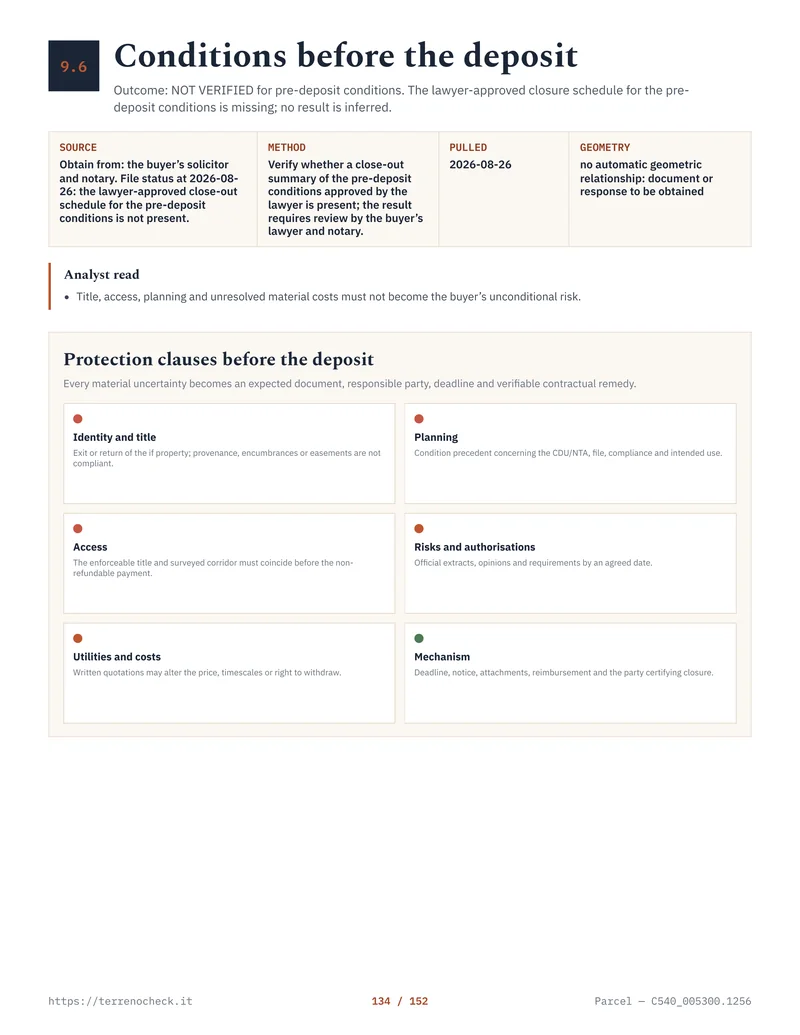 Open the full page
Caparra confirmatoria, penitenziale and acconto are not synonyms
The label has two lives: civil law and tax. Get it right in the contract and in the payment receipt.
With a caparra confirmatoria, Article 1385 of the Civil Code gives the sum a performance-security function. If the contract is completed, the amount is returned or credited to the price. If the buyer who paid it is in default, the seller can withdraw and keep the caparra. That is the 100% outcome: the buyer loses the amount paid as caparra, not the whole purchase price. If the seller received the caparra and is in default, the buyer can withdraw and demand twice that caparra, the 200% outcome.
Those are withdrawal remedies. If the non-defaulting party instead asks for performance or dissolution, damages follow the ordinary rules under Article 1385(3). A buyer cannot treat the label as a guaranteed refund in every disagreement, and a seller cannot call every payment theirs because a deed was delayed.
The caparra penitenziale is different. Article 1386 applies where the contract grants a right of withdrawal and the caparra is its price. The withdrawing party loses the caparra given, or returns twice the caparra received. It is not a penalty for breach. If a buyer should walk away when a document is not delivered, use a suspensive condition or an expressly drafted mechanism, not a vague label.
An acconto prezzo is an advance against the price, not a statutory 100% or 200% exit button. If a suspensive condition fails, the contract should say that the advance is returned and how the parties notify failure. If the seller is in breach, return and damages depend on the text and facts. A buyer who refuses to complete without a contractual excuse does not create caparra remedies unless the payment was agreed as that caparra.
Until 31 December 2024 the label moved the tax as well: 0.50% on a caparra, 3% on an acconto, and a blank payment line was read as an acconto. Since 1 January 2025 the rate is the same 0.50% either way. The stronger reason to write the label is still there: the Civil Code attaches the 100%/200% remedy to a caparra confirmatoria, and an acconto prezzo does not have it. On a non-VAT preliminary the ordinary registration tax is €200, the fixed amount under Article 10 of Tariff Part I of DPR 131/1986 as raised to that figure by Article 26(2) of D.L. 104/2013, then 0.50% of the sum classified as a confirmatory deposit or as a price advance, or the lower tax due on the final contract. A VAT-taxable sale has a separate treatment: an acconto is invoiced with VAT and attracts fixed €200 registration tax, while a confirmatory caparra is not payment for the sale and attracts 0.50% registration tax.
For a rural parcel, a large acconto may be hard to recover quickly if planning or access fails. A caparra confirmatoria has a clearer breach mechanism, but it does not substitute for a written condition. Ask the notary to show each payment in the draft, receipt and tax calculation.
- Buyer defaults and payment is caparra confirmatoriaSeller may withdraw and retain 100% of the stated caparra under Article 1385
- Seller defaults and payment is caparra confirmatoriaBuyer may withdraw and demand 200% of the stated caparra
- Express suspensive condition failsApply the written condition: the contract should state release, notice and return of the payment
- Payment is acconto and no condition or remedy is writtenNo automatic multiple; recovery depends on the contract, breach and ordinary legal remedies
Source: Normattiva, Civil Code Articles 1385 and 1386; Agenzia delle Entrate, L’acquisto della casa.
Transcription protects the gap before the deed
Ordinary registration with the Agenzia delle Entrate records the contract for tax purposes. Trascrizione of a notarial preliminary puts it in the Registri Immobiliari, where it can protect the buyer against later acts by the seller.
Civil Code Article 2645-bis, introduced by Article 3 of D.L. 669/1996 and its conversion into Law 30/1997, applies to preliminaries for the real-property rights listed through Article 2643. The document must be a public deed or an authenticated private writing, or have signatures judicially verified. A casual signed agency form cannot be transcribed just because the buyer wishes it.
If the final deed, an act executing the preliminary or the qualifying court application is transcribed in time, that transcription has priority over later transcriptions and registrations against the seller after the preliminary was transcribed. The practical threats include a seller’s later mortgage, a seizure or another transfer. A normal preliminary does not by itself stop those events. The Agenzia guide says that, without transcription, the buyer may be left pursuing damages rather than undoing a later sale or mortgage.
The three-year rule needs precision. Article 2645-bis says the effects cease and are treated as never produced if the final deed, executing act or relevant court application is not transcribed within one year from the agreed final date, and in any event within three years of the preliminary’s transcription.
The official Agenzia guide lists €155 stamp duty, €200 mortgage tax and €35 mortgage-register charges for a transcribed notarial preliminary, added to ordinary registration taxes. The fixed mortgage tax on transcribing a preliminary comes from Article 4 of the Tariff annexed to D.Lgs. 347/1990, raised to €200 by Article 26(2) of D.L. 104/2013; the €35 is the charge due for each transcription note under point 1.1 of the table annexed to the same decree, which its Article 19 makes payable. The notary’s fee, searches, copies, VAT and technical or legal work remain quote-based. Ask for a written preventivo separating them.
Discuss transcription where the deposit is large, the period to the deed is long, the seller is a company or a complicated inheritance is being resolved. There is no universal safe threshold. Nobody can tell you that from a desk without the price, title records, timing and seller profile.
The mortgage-and-liens guide explains why a register search is separate from the cadastral record. Transcription is a protection against later registered events. It is not proof that the property was clean before you signed.
Source: Agenzia delle Entrate, L’acquisto della casa, sections on preliminary registration and transcription; Normattiva, D.Lgs. 139/2024, Article 2(1)(ff)(2), replacing the note to Article 10 of Tariff Part I with effect from 1 January 2025; Normattiva, DPR 131/1986, Tariff Part I (in force to 31.12.2026); Gazzetta Ufficiale, D.Lgs. 123/2025, Annex 1, Tariff Part I (consolidated successor).
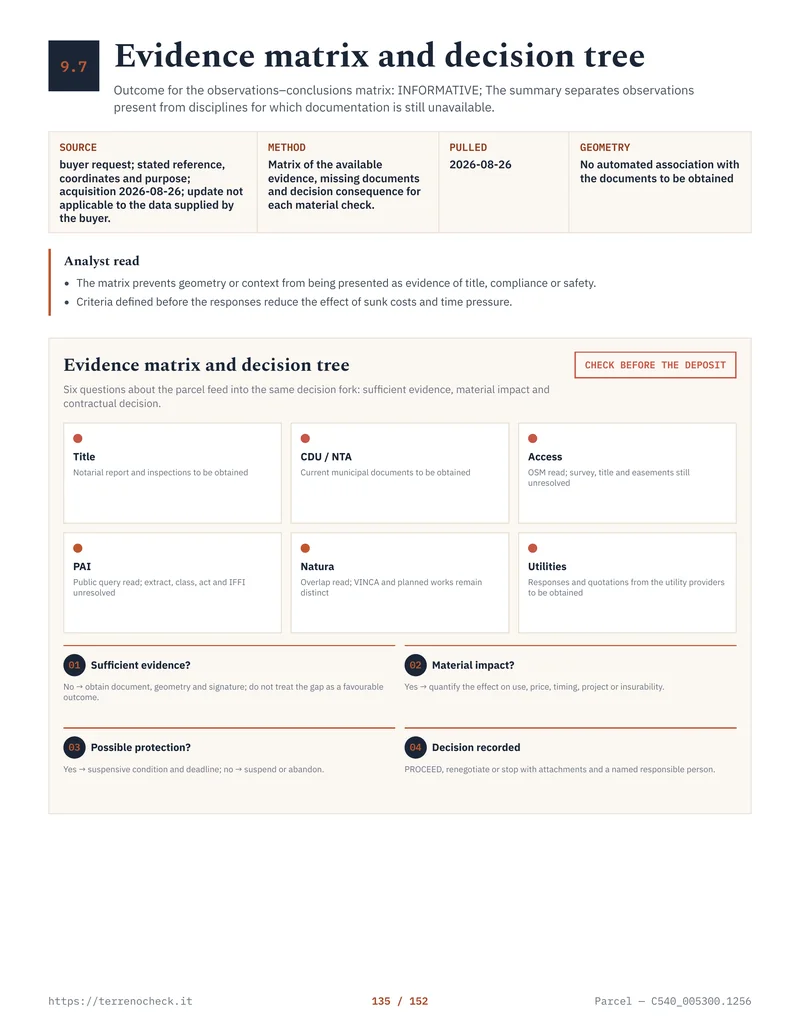 Open the full page
Registration tax and stamp duty: pay now, credit later
The live Agenzia RAP service says a preliminary sale contract must be registered within 30 days of signing. The statutory deadline is set by Article 13(1) of DPR 131/1986: thirty days from the date of the deed if it is drawn up in Italy, sixty if drawn up abroad. The public house guide still displays 20 days for a private writing and 30 days where the notary signs it. Because the official material differs, confirm the route for your document with the filing office, agent or notary and keep the receipt.
For the ordinary non-VAT case, the Agenzia guide lists €200 fixed registration tax and stamp duty of €16 for every four pages or 100 lines. A public deed or authenticated private writing carries €155 stamp duty in that guide. Add 0.50% of the sum classified as a caparra confirmatoria or as a non-VAT acconto prezzo, or the lower tax due on the final contract: since 1 January 2025 the rate is the same for both labels, because D.Lgs. 139/2024 replaced the note to Article 10 of Tariff Part I of DPR 131/1986. The amount paid on the deposit or advance is credited against the registration tax due when the final sale is registered. If the proportional tax paid at the preliminary exceeds the tax due at the deed, the Agenzia says a refund can be claimed from the registering office within three years from registration of the final deed. The statutory cut-off is Article 77(1) of DPR 131/1986: three years from the day of payment or, if later, from the day the right to restitution arose.
This is a credit against the later registration tax, not a promise that every euro comes back when the sale collapses. If the deal fails, the tax result can depend on the legal reason, the payment label and the procedure used. Have the notary or tax professional calculate the position instead of netting the deposit informally.
For a VAT-taxable transfer, an advance is part of the price and is invoiced with VAT; the preliminary registration tax is fixed at €200. A confirmatory caparra is not consideration for the sale, so it is not subject to VAT and attracts the 0.50% registration tax. The seller’s status and the tax treatment of the final transfer need to be settled before the preliminary, especially where a developer, company or building project is involved.
Conditions a land buyer should put in the contract
“Subject to checks” is not a condition until the contract says which check, by whom, by what date and with what consequence. The buyer should hand the draft to the notary and the technical professional before paying, then have the final wording identify the parcel and the documents that must arrive.
Conditions a land buyer should put in the contract
| Condition to discuss | Evidence to name | Who should check it | What failure should do |
|---|---|---|---|
| Current CDU and planning designation | CDU issued by the Comune, current PRG/PUC/PGT and relevant NTA clauses | Geometra, architect or engineer, with notary checking the deed package | Suspend or release the buyer if the stated designation or intended use is not confirmed |
| No unresolved usi civici | Comune and regional records, historical titles and any required specialist opinion | Notary and lawyer; a technician can map the parcel but cannot decide the legal right | Stop completion or require documented resolution before the deed |
| Lawful access | Seller’s title, ispezione ipotecaria, route plan and any public-road or entrance permission | Notary for titles; geometra or engineer for route and intended works | Return the payment or extend only under a written, signed condition |
| Utility feasibility | Written responses or quotes from water, electricity, sewer or approved private systems | Utility provider, Comune and technical professional | Do not let “connections available nearby” count as feasibility |
| Mortgage approval | Lender’s written approval for the identified purchase, amount and deadline | Bank and buyer’s finance adviser | Release the buyer if the suspensive condition is not met on time |
| Clean urbanistic declarations | Seller’s declarations, permits, amnesties, municipal file and technical conformity report where appropriate | Notary plus geometra, architect or engineer | Make the seller cure the issue or end the deal under the agreed wording |
Source: The contract conditions must be checked against the cited documents by the notary and technical professional.
The CDU is not a building permit. Under Article 30 of DPR 380/2001, land-transfer acts generally need the municipal certificate, subject to the article’s exceptions. The document reports planning prescriptions from the local plan. It does not convert an agricultural label into permission for a house. Read the CDU with the planning-rights guide, because regional planning law and municipal instruments determine what the designation means in practice.
For usi civici, ask the relevant Comune and region for a written answer and have the notary examine the title history. The collective-rights guide explains why a cadastral description or seller assurance is not enough. A missing public record is a gap.
Access needs the deed and the ground. A mapped track, neighbour’s permission or OSM road line is not automatically a servitude, a public road or an authorised entrance. The access-rights guide covers the evidence chain. Put the route, width, vehicle use, maintenance and all necessary owners into the condition if access is part of the land’s value.
Utility feasibility is site-specific. A pole at the boundary does not show spare capacity, a legal route, a connection quote or sewer availability. Ask the provider and Comune for written confirmation, then have the technical professional price the works. The utility-connections guide is the right follow-up.
“Clean urbanistic declarations” means a document package, not a magic phrase. For a bare parcel, confirm the designation and any structures, walls, wells, sheds or access works. For land with a house or ruin, compare permits, cadastral data, municipal files and the site. A cadastral match does not prove planning conformity. If the seller will not identify the declarations and the consequence of a false or missing one, the condition is not useful.
- 1. Draft the proposalName parcel, price, payment label and agent commission
- 2. Set conditionsCDU, usi civici, access, utilities, mortgage and urbanistic documents
- 3. Fix the filing clockAgenzia RAP currently states 30 days from preliminary signing; official house guide also displays a 20-day private-writing rule
- 4. Choose registration or transcriptionTranscription protection ends if the final deed or qualifying court filing is not transcribed within one year of the agreed final date and in any event within three years of preliminary transcription
- 5. Sign only when the release wording is usableThe final deed transfers ownership; preliminary tax paid is credited against final registration tax
Source: Agenzia delle Entrate RAP; Agenzia delle Entrate, L’acquisto della casa; Normattiva, Civil Code Article 2645-bis.
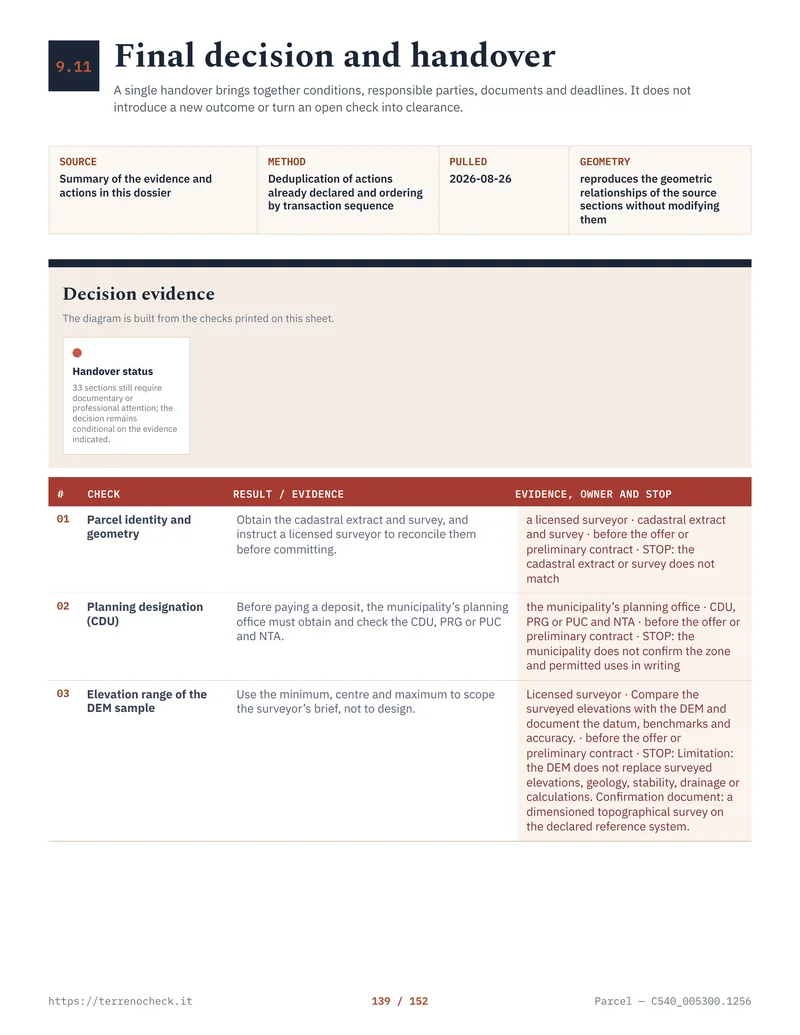 Open the full page
A purchase proposal through an agent is already a commitment
The proposta di acquisto is usually the buyer’s signed statement offering a particular property at a particular price, often with a cheque or transfer described as caparra. The Notariato warns that the signed proposal contains binding commitments for the buyer while the seller remains free to consider other offers until acceptance.
Once the seller accepts, the proposal can become a preliminary contract automatically when its clauses contain the terms necessary to conclude one. The Agenzia guide distinguishes a proposal that is merely an offer from an acceptance that already contains a preliminary. The heading on the agency form does not decide the legal effect. Read the parcel description, acceptance method, expiry, payment label, conditions and date of the final deed.
Before signing, ask for the blank form and written commission terms. A mortgage condition should identify the lender decision, amount and deadline. If value depends on a CDU, access or utilities, attach the document or write a precise suspensive condition. “Buyer may withdraw if not satisfied” is not an objective refund condition.
Under Civil Code Article 1755, a mediator generally earns commission when the deal is concluded through the mediator’s intervention. Article 1757 deals with conditions: where a transaction is subject to a suspensive condition, commission is tied to the condition occurring; a resolutory condition does not have the same effect. The written agency agreement, the accepted proposal, the condition and the reason the deal died must be read together.
If the seller rejects the offer, the proposal normally does not become the sale, and the payment should be returned under its terms. If the seller accepts, it is already a binding step before a longer compromesso. If a mortgage condition fails before it becomes effective, commission may not be due under Article 1757, but the actual clause controls. If the condition has occurred and the buyer later walks away, the agent may have a claim even though the deed never happens.
The agent is not your title examiner, planning technician or lender. Use the notary’s role guide to separate the public official’s work from the geometra’s or architect’s work. Agency commission is a transaction cost, not proof that the property passed those checks.
Who checks what before you risk the deposit
Give the notary the seller’s identity, atto di provenienza, cadastral identifiers, prior deeds, draft proposal, receipt and any inheritance or company papers. Ask what title and mortgage-register work is needed and whether the preliminary should be notarised and transcribed.
Give the technical professional the cadastral map, CDU, planning instruments, municipal file, site photographs and intended use. “I only want a small rural building” is not a technical specification. The actual project must be tested against local rules, access and utilities.
Give the bank the real property and contract timetable. A generic borrowing estimate is not approval for this parcel. Give the utility providers a route and connection question, not a listing screenshot.
The sequence is simple: identify the land, obtain documents, draft conditions, price the tax and professional work, then sign. If the seller refuses that order, the refusal is information. Do not pay extra to make uncertainty look like progress.
Sources
- Normattiva, Civil Code, Articles 1351, 1385, 1386, 1755, 1757 and 2645-bis
- Normattiva, D.L. 31 December 1996, no. 669, Article 3, coordinated text
- Normattiva, D.Lgs. 18 September 2024 no. 139, Article 2(1)(ff)(2)
- Agenzia delle Entrate, L’acquisto della casa: le imposte e le agevolazioni fiscali
- Agenzia delle Entrate, Registrazione Atti Privati (RAP)
- Consiglio Nazionale del Notariato, The preliminary contract
- Consiglio Nazionale del Notariato, La proposta d’acquisto
- Consiglio Nazionale del Notariato, Garanzia preliminare
- Normattiva, DPR 6 June 2001, no. 380, Article 30, planning certificate
- Normattiva, DPR 26 April 1986 no. 131, Article 13, deadlines for requesting registration
- Normattiva, DPR 26 April 1986 no. 131, Article 77, time limit for a refund claim
- Normattiva, D.L. 31 August 2013 no. 104, Article 26(2), fixed taxes raised to 200 euro
- Normattiva, D.Lgs. 31 October 1990 no. 347, Article 19, Tariff Article 4 and the mortgage-register charge table