
Italian notary checks before a property purchase
An Italian notaio protects the legal transfer, not your building project. This guide explains the checks before the rogito, the gaps that hurt land buyers, and the bill you should ask to see.
Contents
- The notaio is a public official, not the seller’s lawyer
- What is normally checked before the rogito
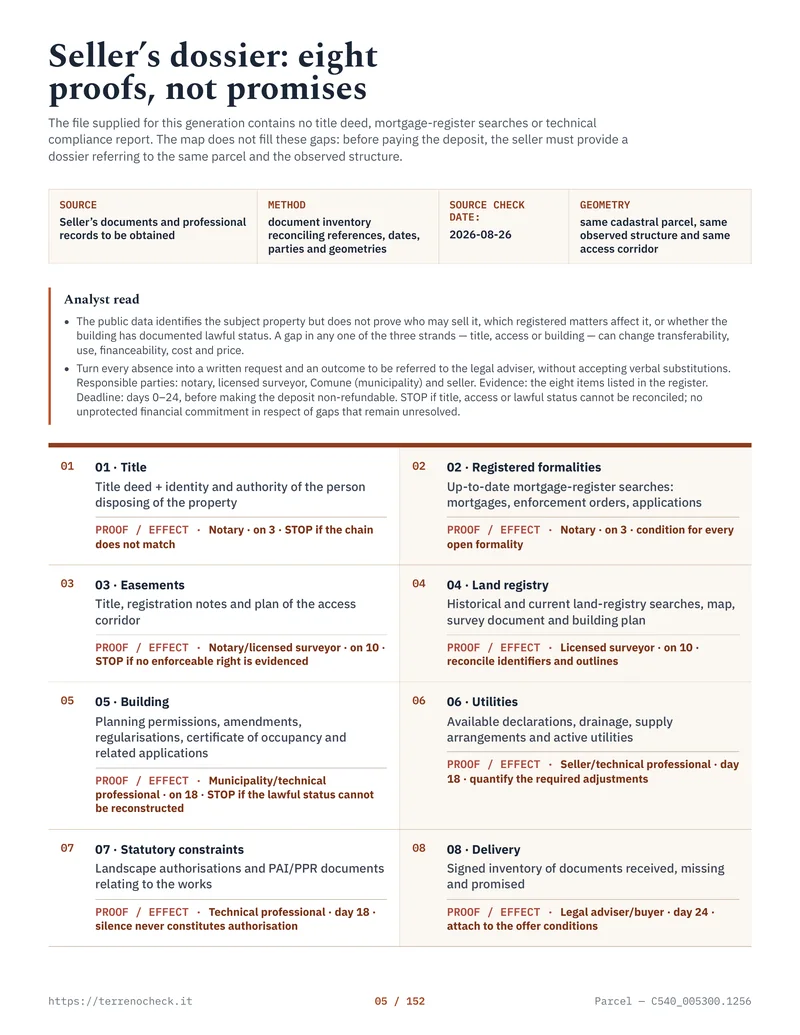
- 1. Ipotecarie records and cadastral identification
- 2. The provenienza chain
- 3. Identity, capacity and marital regime
- 4. Urbanistica declarations in the deed
- 5. Cadastral conformity
- The checks a notary does not perform for you
- Sostituto d’imposta and deposito prezzo
- Fees: taxes, onorario and the number you should request
- A buyer’s last meeting before signing
The rogito is the visible ten minutes at the end of a much longer file. Before it, the notaio checks who can sell, what the public registers show, which declarations must appear in the deed, and whether the transfer can legally be recorded.
For a house, that work catches mortgages, missing title steps and formal defects. For land, it can leave the buyer with a perfectly transferable parcel that cannot take the house, road, well or business they had in mind. This buyer guide does not provide legal, tax, notarial, surveying or planning advice. Have the notary and the right technical professional review the actual parcel before money becomes binding.
The notaio is a public official, not the seller’s lawyer
Law 89/1913 organises the Italian notarial profession. A notary is a public official who receives and authenticates deeds, gives them public evidentiary force, and carries out a preventive legality check. The notary must refuse the act when it is contrary to law or public order. The Consiglio Nazionale del Notariato describes this as a control that happens before the deed, not as a rubber stamp after the parties have made their private bargain.
That is why the choice normally belongs to the buyer. The official Notariato explanation says the choice is free and up to the purchaser. The buyer is the person who needs an independent check of the seller’s title, the transfer’s formal validity and the tax treatment. In a local purchase, an agent may suggest a familiar office. A suggestion is not an appointment. You can choose another notary, including one outside the Comune where the land sits, provided the practical arrangements work.
The choice should happen before the proposta or compromesso, not on the morning of the deed. Send the proposed property identifiers, the seller’s title, any advert promising development and your intended use. A notary can then say what belongs in the deed file and what needs a surveyor, architect, engineer, lawyer or municipal office. The Italian land-buying checklist is a sensible first pass, not a substitute for that conversation.
- 1913Law 89/1913, notarial profession and public-official function
- 1985Law 47/1985, Article 40, urban-planning particulars for transfers of buildings
- 2001DPR 380/2001, Article 46, permit or permit-in-sanatoria particulars for post-17 March 1985 buildings
- 2010D.L. 78/2010, Article 19(14), converted by Law 122/2010, cadastral identification, plans and conformity declaration
- 2012D.L. 1/2012, Article 9, regulated-profession tariffs abolished and written estimate required
- 2013Law 147/2013, Article 1(63), dedicated account for taxes and entrusted sums
- 2017Law 124/2017, Article 1(63) and following, price-deposit option, effective 29 August 2017
Source: Normattiva, Law 89/1913, Law 47/1985, DPR 380/2001, D.L. 78/2010, D.L. 1/2012, Law 147/2013 and Law 124/2017, URLs in the source list above.
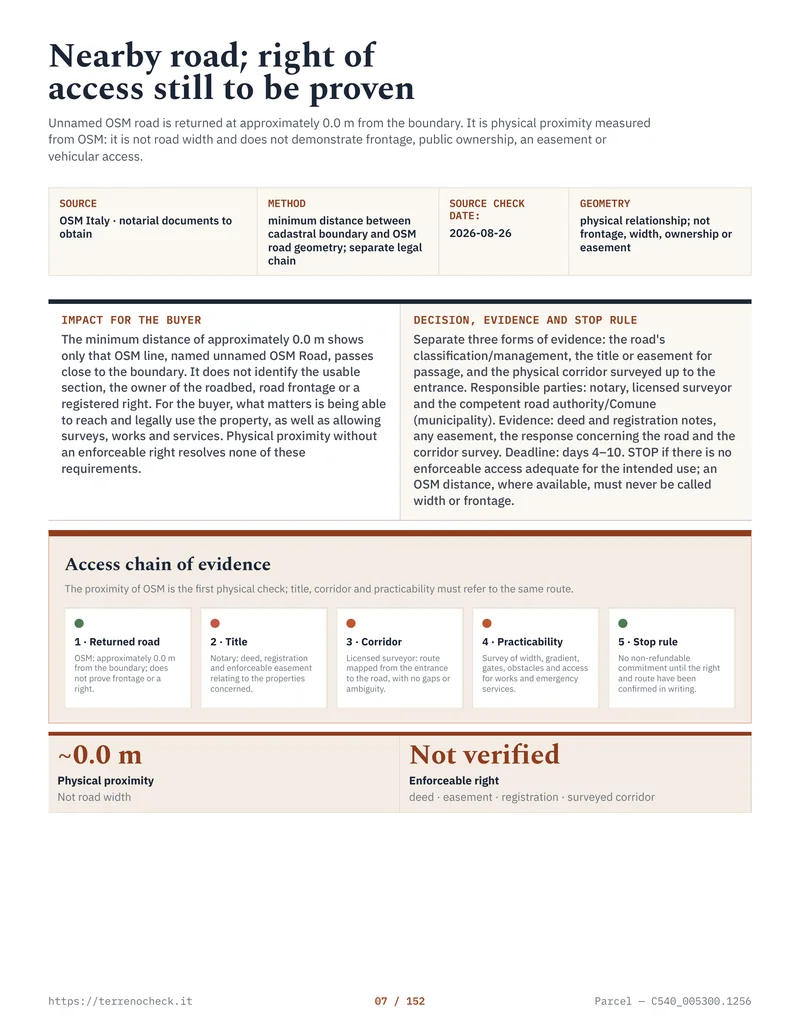
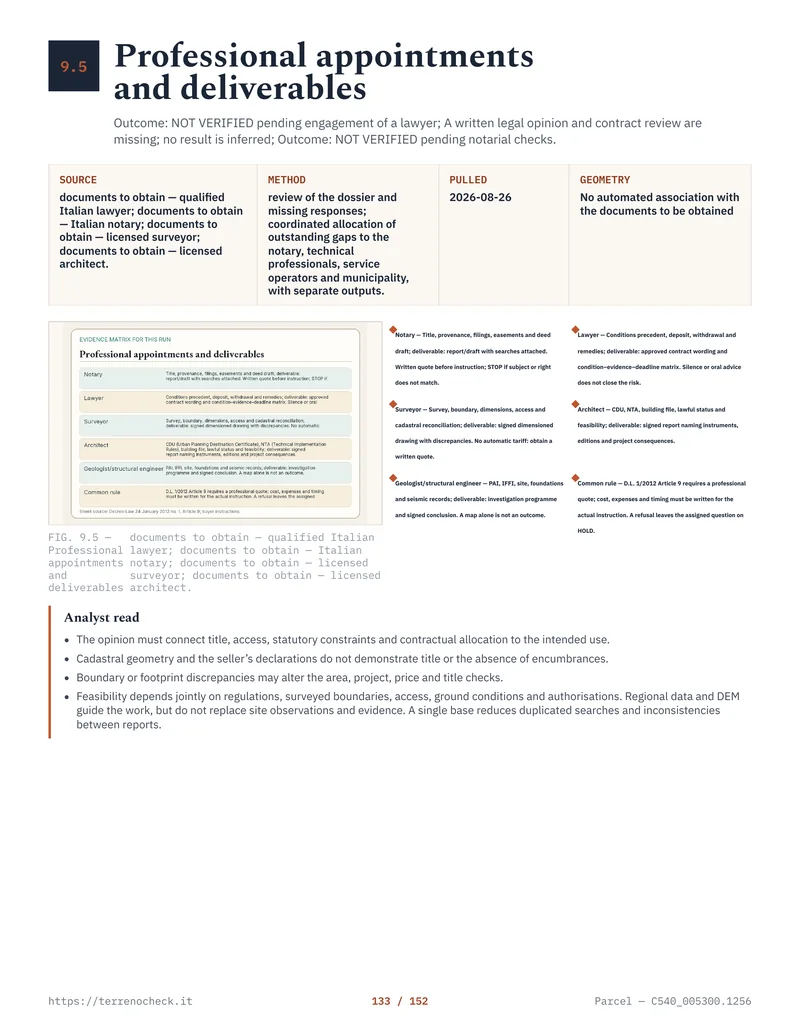
Pages from the delivered dossier
 Open the full page
What is normally checked before the rogito
The exact file changes with the property and the seller. An inherited rural parcel needs different papers from a newly built apartment. The usual checks still have a recognisable order.
1. Ipotecarie records and cadastral identification
The ispezione ipotecaria looks at the registers, notes and deposited titles held by the Agenzia delle Entrate’s Servizi di pubblicità immobiliare. Transcriptions can show transfers, successions, divisions and attachments. Inscriptions can show mortgages. Annotations can show cancellations or changes. The search is what lets the notary compare the seller’s claimed ownership with the public record and identify registered burdens.
The cadastral side identifies Comune catastale, foglio, particella and, for a building, subalterno, along with the cadastral holder and plan references where relevant. A visura catastale is not a title deed. The cadastral extract guide explains the difference. The notary uses cadastral information in the statutory deed checks, but the map is not a boundary survey and the tax description is not a planning permission.
2. The provenienza chain
The notary reads the seller’s atto di provenienza, the document showing how the seller acquired the property, then follows earlier transfers, succession documents, division deeds, donations, court orders or other relevant steps far enough to establish the chain used for the act. A succession can require an acceptance of inheritance to be transcribed. A company seller brings company-register and representation documents. A power of attorney brings its own validity questions.
This is where a missing link can stop the closing. The seller may possess the land and pay its taxes, yet the deed may reveal that a deceased co-owner, an unrecorded acceptance or a prior division still needs attention. The notary will ask for the document that cures the gap. That can mean delay, a corrective deed, a court procedure or a different seller. It is not a minor typo to be waved through because everyone in the village knows the family.
3. Identity, capacity and marital regime
The file normally includes identity documents, tax codes, civil-status information and, where relevant, a marriage or registered-partnership certificate, matrimonial conventions, a separation-of-property regime, residence information and a residence permit for a non-EU buyer or seller. The Notariato checklist names these documents for natural persons and asks for corporate authority documents for legal persons.
The point is not merely to spell a name correctly. The notary must know who is signing, in what capacity, with what power, and whether a spouse or other person has rights that affect the transfer. A seller who says “the land is mine” may be describing possession, family arrangement or a tax record rather than the legal ownership that the deed requires. A foreign buyer should send the documents early and ask which need an apostille, legalisation or sworn translation.
4. Urbanistica declarations in the deed
For buildings, the deed must contain the planning particulars required by national law. Article 46 of DPR 380/2001 concerns acts transferring or creating real rights in buildings whose construction began after 17 March 1985. The alienator’s declaration must state the details of the permesso di costruire or permesso in sanatoria, with the article’s rules for the relevant cases. Law 47/1985 Article 40 contains the older framework, including the declaration or documents connected with a licence, concession or amnesty and the special treatment of works begun before 1 September 1967.
These are formal validity rules. They do not turn the seller’s declaration into a technical certificate that every wall, extension and retaining structure conforms to the municipal file. A deed can contain the required planning particulars while the buyer still needs a technician to compare the building on the ground with the titoli edilizi, approved drawings and current planning position. The unauthorised-building guide deals with the painful difference between a cadastral match and planning regularity.
For bare land, the paperwork is different. A certificato di destinazione urbanistica may be required for a transfer of land under the relevant national rules, and its contents reflect the planning instruments in force or adopted. It does not promise that your planned home, agritourism business or warehouse is permitted. The current PRG, PUC, PGT or other municipal instrument, together with regional planning law and local NTA, answers that question. Read the PRG guide before treating “edificabile” in an advert as a bankable fact.
5. Cadastral conformity
Article 19(14) of D.L. 78/2010, converted by Law 122/2010, added a specific rule for existing urban buildings. The public deed or authenticated private writing must contain the cadastral identification, refer to the plans deposited with the Catasto, and include the declaration by the registered holders that the cadastral data and plans conform to the state of fact. A qualified technician’s conformity statement can replace the owners’ declaration. Before signing, the notary identifies the cadastral holders and checks their correspondence with the land-register results.
This is a serious check, with a narrow object. It concerns cadastral data and plans. It is not a statement that the building has the right urban-planning title, that the structure is safe, that the soil can support an extension or that a room can legally be used as a bedroom. On a land purchase with an old shed, ruin or rural building, ask what exactly is being transferred and which professional will verify it.
“Checked before the deed” does not mean “verified for every future use.” The last column names the legal reference, not a guarantee about a particular parcel.
| Buyer question | Notarial check before the deed | Separate technical or public-office check | National reference |
|---|---|---|---|
| Who owns it and are registered liens present? | Provenienza chain, ispezioni ipotecarie, transcriptions, inscriptions and annotations | Investigate unregistered or disputed facts separately | Law 89/1913; Agenzia delle Entrate register guidance |
| Are the cadastral identifiers and building plan aligned? | Cadastral holders and conformity declaration or technician statement | Measure and compare the whole property and municipal file | D.L. 78/2010, Article 19(14), Law 122/2010 |
| Can the existing building be transferred formally? | Urbanistica particulars and declarations required by Article 46 or Article 40 | Technical urban-building conformity and remedies | DPR 380/2001, Article 46; Law 47/1985, Article 40 |
| Can I build what I want on the land? | No general promise in the title check | PRG/PUC/PGT, NTA, regional rules and municipal response | DPR 380/2001 planning framework and local instruments |
| Is the boundary, soil, utility route or use-civic status safe? | Only if relevant documents or a specific issue enters the file | Survey, soil or environmental investigation, utility feasibility and the competent Comune or Regione | Scope varies by fact and locality. |
Source: Agenzia delle Entrate, L’acquisto della casa; Normattiva, Law 47/1985 Article 40, DPR 380/2001 Article 46 and D.L. 78/2010 Article 19(14); Consiglio Nazionale del Notariato, Real Estate Law Checklist.
 Open the full page
The checks a notary does not perform for you
This is where land buyers lose money. The notary’s public-office role is powerful, but it has a boundary.
The notary does not survey the boundary. A cadastral line can help identify a parcel and still fail to match a fence, wall, stream or historic occupation. A confine dispute belongs with a surveyor and, if necessary, a lawyer. Do not ask the notary to certify that the neighbour’s hedge sits on the correct side of the line.
The notary does not visit the site as a substitute for a technical inspection. The deed file can contain photographs, plans and declarations without anyone having checked the slope, access, drainage, retaining wall, abandoned tank or actual footprint. Nobody can tell you the condition of the soil from a desk. A geologist or engineer must define the investigation needed for the intended work.
The notary does not decide that the PRG allows your project. A cadastral category, a CDU phrase or a seller’s statement that land is “buildable” is not a permit. The municipality’s current instrument, implementation rules, restrictions, landscape or hydrogeological controls and the project itself determine what can be proposed. A technician should test the intended project against them before you price the plot as a future home.
The notary does not confirm utility feasibility. Electricity at the neighbouring house does not prove a connection at your boundary. A public water main may be too far away, a sewer connection may be unavailable, and a private road may block trenching. Ask the utility operators, Comune and a technician for a route and connection assessment. The utility connections guide explains why “nearby” is not a cost estimate.
The notary does not automatically clear usi civici just because the seller has a deed and the parcel has a cadastral identifier. These collective rights can concern land owned by a Comune or third party, and the competent history is regional and local. The Ministry of Justice describes the Commissari per la liquidazione degli usi civici as deciding disputes about the existence, nature or extent of collective rights. The Notariato’s recent study also shows why private land burdened by unliquidated rights can become a circulation problem. If the title, municipal records, regional mapping, historical documents or local knowledge flags the issue, commission the specific investigation. The usi civici guide is a warning to investigate, not a national clearance certificate.
This does not mean the notary ignores a problem that appears in the file. A registered burden, a missing declaration, a contradiction in the chain or a known public restriction may stop the act or require a remedy. It means the notary’s ordinary title investigation is not a substitute for asking the land questions that the public registers cannot answer.
- Title, seller capacity or registered mortgageNotaio; Law 89/1913, public registers and the deed file
- Cadastral data or plan conformityNotary plus qualified technician where needed; D.L. 78/2010, Article 19(14), Law 122/2010
- Boundary, site condition or soilSurveyor, engineer or geologist; no notarial site survey is created by Articles 40 or 46
- Buildability, access, utilities or usi civiciTechnician plus Comune, utility or competent local/regional office; do not treat the rogito as a project approval
Source: Normattiva, Law 89/1913, Law 47/1985 Article 40, DPR 380/2001 Article 46 and D.L. 78/2010 Article 19(14); Ministry of Justice, Commissari agli usi civici.
 Open the full page
Sostituto d’imposta and deposito prezzo
The money paid through the notary’s office is not all a professional fee. In the tax part of the transaction, the notary acts as sostituto d’imposta or responsabile d’imposta for the taxes connected with the deed and pays them to the State. Law 147/2013 Article 1(63) also requires the notary to place taxes and certain entrusted sums for eligible acts into a dedicated account. The notary is handling public money and transaction money under separate legal rules, not adding an unexplained surcharge.
Law 124/2017 introduced the deposito prezzo option for property transfers. At least one party can request that the balance due to the seller be deposited with the notary until the deed has been transcribed and the relevant publicity formalities have been completed. The rule is in Article 1(63) of that law and has applied since 29 August 2017. The deposited money is held on a dedicated account and is released under the agreed instructions once the transfer is protected against a later seller’s mortgage, seizure or other prejudicial registration identified in the procedure.
It is an option, not an automatic part of every closing. Raise it before the preliminare, because the seller may need to plan for receiving the balance after transcription rather than at the instant of signature. Ask the notary what the deposit covers, what happens with an existing mortgage or unpaid condominium costs, which bank instructions are needed and what extra line appears in the written estimate. If the price is paid before the deed is recorded, the buyer carries a different timing risk. The preliminary-contract guide explains why the timing of a promise to sell is not the same as completion of the transfer.
Fees: taxes, onorario and the number you should request
Italy no longer has a binding retail tariff that lets a buyer calculate a notary’s bill as a fixed percentage of the purchase price. Article 9 of D.L. 1/2012 abolished the tariffs of regulated professions. It preserved ministerial parameters for judicial liquidation, and it requires the professional fee to be agreed when the assignment is given, with a written or digital estimate that sets out the individual cost items, expenses, charges and contributions.
The practical consequence is straightforward: ask two or three offices for a written preventivo based on the same facts, then compare like with like. A deed for a clean private sale is not the same assignment as an inherited farm with a mortgage to cancel, an interpreter, a company seller, a preliminary transcription and a requested price deposit. A low headline number may exclude archive searches, mortgage work, additional parties, translations, VAT, professional contributions or the taxes that the notary collects.
Separate the bill into at least these lines: imposta di registro or VAT where applicable; imposte ipotecaria e catastale; land-register and cadastral charges; the onorario for the notary’s professional work; VAT on the professional service where applicable; and other quoted expenses. The cost of buying property guide explains why the taxes can dwarf the honorarium and why a land purchase follows a different tax branch from a home.
The onorario is what pays for the notary’s professional work. The taxes are collected at the same desk but belong to the State or another public authority. The Consiglio Nazionale del Notariato publishes buyer checklists and explanatory material to help parties understand the process; it does not turn those guides into a binding retail quote for a particular notary and deed. Ask the office to show the subtotal before taxes, the taxes collected on your behalf, the VAT calculation and any deposit-account or transcription expense. If the estimate says “notary costs” without separating these categories, ask for a revised one. You are about to sign a deed, not buy a mystery package.
A buyer’s last meeting before signing
Send the notary the complete seller file, rather than just the advert and a cadastral screenshot. Confirm the exact Comune, foglio, particella and subalterno where relevant. Ask whether the chain of title is complete, whether the register search found mortgages, seizures or other entries, and what must be cancelled or corrected before the deed.
Then ask the questions the notary cannot answer alone. Who will check the boundary? Has anyone visited the site? What document shows the current planning designation? Does the intended project fit the PRG or PUC? Is a new road entrance authorised? Can electricity, water and wastewater reach the parcel? Is there any signal of usi civici, a public-domain issue, an easement or an unrecorded occupation? Put the answers, the responsible professional and the deadline into the offer or preliminary contract where appropriate.
Make unresolved checks conditions of payment rather than hopes attached to the rogito date. A notary can stop an invalid transfer. A notary cannot turn a legal transfer into a buildable site. That distinction is the part worth carrying into every viewing, especially when the land looks simple.
Sources
- Normattiva, Law 16 February 1913, no. 89, organisation of the notarial profession
- Consiglio Nazionale del Notariato, Functions and competences
- Consiglio Nazionale del Notariato, Real Estate Law Checklist
- Consiglio Nazionale del Notariato, Purchase and sale of real estate
- Agenzia delle Entrate, L’acquisto della casa
- Normattiva, DPR 6 June 2001, no. 380, Article 46
- Normattiva, Law 28 February 1985, no. 47, Article 40
- Normattiva, D.L. 31 May 2010, no. 78, Article 19
- Normattiva, D.L. 24 January 2012, no. 1, Article 9
- Normattiva, Law 27 December 2013, no. 147, Article 1, paragraph 63
- Normattiva, Law 4 August 2017, no. 124, Article 1, paragraphs 63 and following
- Consiglio Nazionale del Notariato, Il deposito del prezzo
- Ministry of Justice, Commissioners for usi civici
- Consiglio Nazionale del Notariato, Study no. 51-2024/P on private land burdened by usi civici