
Buying property in Italy as a foreigner: codice fiscale
A foreign passport does not decide the whole purchase. This guide explains reciprocity, the Italian tax code, payment evidence, signing arrangements and the tax consequences that arrive after the keys.
Contents
- Can you buy? Start with reciprocity
- Switzerland is not a simple EU answer
- UK buyers after Brexit
- US and other non-EU buyers
- Get the codice fiscale before you commit money
- The Italian bank account: practical, not magical
- Payment traceability belongs in the deed
- Signing through a procura speciale
- Interpreter and witnesses at the deed
- Resident, non-resident and the two different “home” questions
- What to check before the deposit
A foreign buyer needs the legal capacity, identity documents, Italian tax code and traceable payment evidence required for the deed. Nationality and residence can also require a reciprocity check before a binding commitment.
This pre-purchase guide does not provide legal, tax or notarial advice. A notary must clear the buyer’s capacity and the transaction. A bank must complete its own checks. A technician still has to inspect the property. TerrenoCheck does not verify ownership, title, planning compliance or tax eligibility.
Can you buy? Start with reciprocity
Article 16 of the preliminary provisions to the Civil Code says that a foreigner enjoys the civil rights given to an Italian citizen on condition of reciprocity, subject to special laws. The question is practical: would an Italian in the same position be allowed to acquire the same kind of right in the buyer’s country?
The rule has important exceptions. The Ministero degli Affari Esteri reciprocity page lists nationals and legal persons from EU Member States and the EEA countries, Iceland, Liechtenstein and Norway, as treated like Italian citizens for this purpose. A non-EU citizen who is regularly resident in Italy with a residence card or qualifying permit for work, self-employment, business, family, humanitarian or study reasons is also listed as exempt from a reciprocity check. The page also mentions stateless persons and refugees resident in Italy for at least three years.
An EU buyer normally does not bring a separate reciprocity opinion to the rogito. The notary still checks identity, capacity, tax information and the property.
Switzerland is not a simple EU answer
Switzerland has free-movement arrangements with the EU, but it is not an EU Member State and it is not in the EEA list quoted above. A Swiss buyer who is regularly resident in Italy may fall within the Italian residence-permit exception. A Swiss citizen living in Switzerland, buying a holiday home or another Italian property, needs the Italy-Switzerland reciprocity analysis for the actual transaction.
The Swiss side is not uniform either. The Swiss Federal Office of Justice says foreign non-resident acquisition is governed by Lex Koller and cantonal authorities. The Italian notary needs the buyer’s residence, permit, property use and relevant facts. Ask for the written conclusion before paying a hard-to-recover deposit.
UK buyers after Brexit
The United Kingdom is no longer in the EU list. A UK national protected by the Withdrawal Agreement may retain acquired property rights, but the buyer must prove that status. The UK Government’s Italy guidance concerns nationals settled in Italy before 1 January 2021. It is not a general post-Brexit clearance for every British buyer.
A UK national who is regularly resident in Italy with a qualifying permit is considered under the Italian residence rules. A non-resident buyer is in the third-country group: the notary checks the current reciprocity position and any applicable international instrument. Show the notary the passport, residence evidence and any Withdrawal Agreement document early. A British address on an estate-agent form is not enough.
US and other non-EU buyers
US citizens do not get the automatic EU/EEA route. Nor does a tourist visa, an Italian tax code or an Italian bank account prove civil capacity to buy. The notary checks the MAECI material for the country and the transaction, then considers treaties and the buyer’s circumstances.
The same applies to Canadian, Australian, New Zealand, Asian, African and Latin American buyers. Some countries may be covered by an investment-protection treaty or another agreement. Some arrangements cover investment in a way that affects reciprocity; others do not answer the particular property question. A tax treaty is not automatically a property-rights treaty.
The MAECI page links to its country and territory material and to ATRIO, the Ministry’s International Treaties Archive. MAECI says its country information is general guidance with no legal value. The database is a starting point for the notary, not a clearance certificate. The notary records the nationality, residence, legal form, property and applicable rule. If the answer is unclear, the deal pauses.
This is a screening table, not a legal opinion. MAECI says its country information is general guidance; the Italian notary applies the current rule to the named buyer and property.
| Buyer position | Starting position | What the notary still needs |
|---|---|---|
| EU national or legal person | No reciprocity check under the MAECI summary | Identity, capacity, tax code and ordinary deed checks |
| EEA national: Iceland, Liechtenstein or Norway | No reciprocity check under the MAECI summary | Identity, capacity, tax code and ordinary deed checks |
| Swiss national | Not in the EU/EEA exemption list; transaction-specific Italy-Switzerland analysis | Residence/permit, property use and current reciprocity position |
| UK Withdrawal Agreement beneficiary | Acquired rights may be preserved, subject to evidence | Status document and current notarial review |
| US or other non-EU national | Country-specific Article 16 and treaty analysis | Nationality, residence, legal form, property and current MAECI/ATRIO research |
| Non-EU national regularly resident in Italy with a qualifying permit | Exempt from reciprocity verification in the MAECI summary | Permit, identity, capacity and tax checks |
Source: Ministero degli Affari Esteri e della Cooperazione Internazionale, Rights and reciprocity; Swiss Federal Office of Justice; UK Government.
Pages from the delivered dossier
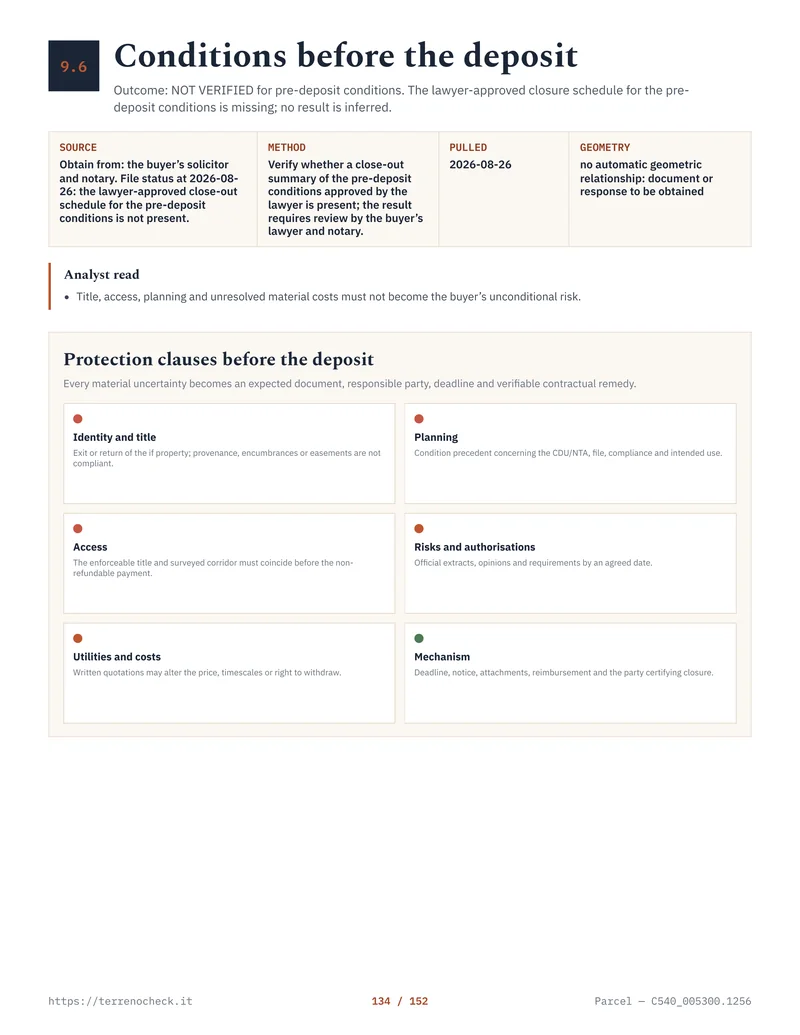 Open the full page
Get the codice fiscale before you commit money
The codice fiscale is the Italian tax identifier. It is normally a 16-character code generated from personal data and a control character. It is not proof of residence, citizenship, title or the right to buy. It is the identifier that lets the tax administration, notary, bank and other professionals connect the purchase to the correct person.
A non-resident can request it from an Italian consulate responsible for the place of residence or from an office of the Agenzia delle Entrate in Italy. The Agenzia’s consular procedure uses the request form and an identity document; the consulate sends the data to the tax registry and can provide the assigned code. The Agenzia also says that a person without a tax code can submit the AA4/8 form and valid identity document to any Agenzia office, including by email or certified email where the office accepts that channel.
Consular practice varies. The code may be sent as an attribution certificate rather than a plastic card. Keep it and check every name, birth date and place of birth against the passport. A wrong code can create a second delay when the bank prepares its file.
Why do people say that nothing proceeds without it? Because every serious branch asks for it. The preliminary contract and its registration need party data; the bank uses it in its customer file; the notary puts it in the deed and tax file. A proposal can be signed without it, but if the preliminary contract becomes binding while the code is missing, the cure is usually a delay and corrected documents.
Put the codice fiscale on the buyer’s first document checklist. The Italian property checklist is useful here because it places identity, cadastral and planning documents beside the money questions instead of leaving them to the last week.
- 1. Before an offerConfirm nationality, Italian residence or permit, and whether Article 16 reciprocity is relevant
- 2. Before a binding preliminaryRequest the codice fiscale and give the notary the draft terms
- 3. Before the bank transferOpen or prepare the payment route and document source of funds
- 4. Before the rogitoDeliver identity, tax-code, marital-status, power-of-attorney and language documents
- 5. At the rogitoDeclare payment methods and any mediator details under Article 35(22) of D.L. 223/2006
- 6. After the deedTrack Comune tax obligations and the 18-month prima casa residence deadline if that relief was claimed
Source: Ministero degli Affari Esteri e della Cooperazione Internazionale, Rights and reciprocity; Agenzia delle Entrate, codice fiscale information; Agenzia delle Entrate, purchase of a home; D.L. 223/2006, Article 35(22).
The Italian bank account: practical, not magical
Italian law does not say that every foreign buyer must hold an Italian current account. A euro transfer from a foreign bank can be possible, subject to the receiving bank, the notary’s instructions and the time needed for cleared funds. A local IBAN is still useful. It makes the transfer of the balance, notary taxes and professional costs easier to coordinate, and it avoids a last-minute question about an international payment that has not arrived.
Opening the account is its own compliance exercise. The bank may ask for the passport, codice fiscale, address, residence or permit, expected account use and evidence of the source of funds. A US or UK bank statement may need explanation or translation. A bank account does not replace the notary’s checks.
The notary is an obliged professional under Italy’s anti-money-laundering rules. Article 18 of D.Lgs. 231/2007 requires customer due diligence that includes identifying the client and representative, identifying and verifying the beneficial owner, and obtaining information about the purpose and nature of the professional service. For a company or trust structure, “I own the company” is not the end of the file. The notary needs the chain of control and the person who ultimately benefits.
Expect questions about the price, deposit, lender, gift, sale of another asset and the account from which the money comes. Answer them in documents, not with a screenshot five minutes before signing. If the identity or source-of-funds file cannot be completed, the notary may have to stop. The seller’s deadline does not cancel an anti-money-laundering duty.
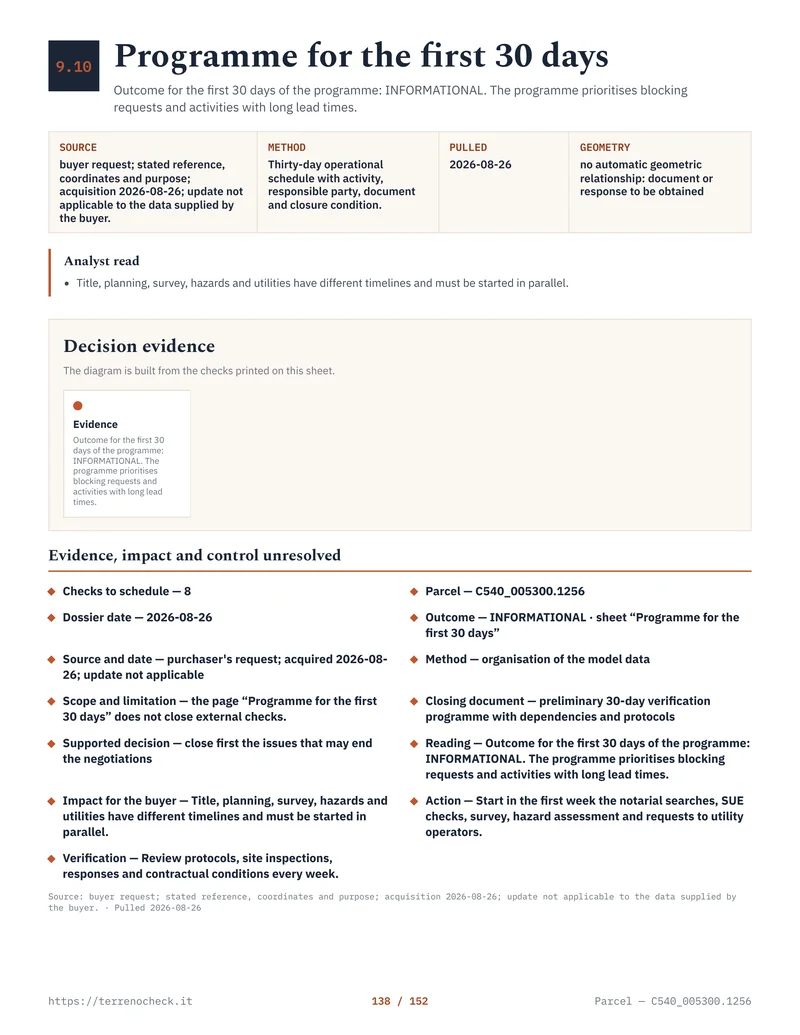 Open the full page
Payment traceability belongs in the deed
Article 35(22) of D.L. 223/2006 requires the parties to give a substitute declaration at the property transfer stating the payment methods in analytical form. “Paid by bank” is thinner than the file usually needs. The notary will want the relevant transfer dates, amounts, account or instrument details and the relationship between deposits, advances and the final balance.
If an estate agent mediated the transaction, the deed also records the mediator’s identifying information, tax or VAT number, registration information and the amount and payment method of the commission. Article 35(22.1) of the same decree sets an administrative fine from €500 to €10,000 for omission, incompleteness or a false declaration, and exposes the transfer to a value assessment. Those are statutory consequences, not a bargaining range for an agent’s fee.
Give the notary the signed offer, caparra receipt, preliminary contract, transfer confirmations and commission invoices. If a parent or company supplied funds, disclose the legal relationship and source before the deed. Do not ask the seller to describe part of the price as a loan.
The dedicated notary account is a separate choice. Under Law 147/2013, Article 1(63)(c), the whole price or balance can be deposited with the notary if at least one party requests it and gives the required instruction. The notary then releases it after the deed is registered and the relevant searches show no additional prejudicial formalities, subject to the agreed terms. It is not an automatic condition of every purchase and it is not a substitute for the ordinary payment declaration.
The rows marked “if relevant” or “where” are conditional. The table is a preparation checklist, not a universal list of documents or a ruling on whether a foreign document will be accepted.
| Document | Where it comes from | Apostille or sworn translation? | Legal reference |
|---|---|---|---|
| Passport or identity document | Buyer and the competent issuing authority | Normally neither for the identity check; the notary decides what form is acceptable | Law 16 February 1913, no. 89, notarial identity and language rules |
| Codice fiscale certificate | Agenzia delle Entrate or the Italian consulate, after an AA4/8 request | No apostille or sworn translation is stated for the Italian-issued certificate | Agenzia delle Entrate, AA4/8 and codice fiscale attribution procedure |
| Valid Italian residence permit, where the buyer relies on the residence exception | Italian immigration authorities | No apostille or sworn translation for the Italian permit; show it to the notary before the act | D.Lgs. 25 July 1998, no. 286; Consiglio Nazionale del Notariato, notarial services for foreigners |
| Special power of attorney, if signing remotely | Foreign notary or consular authority | Apostille for a public document from a Hague Convention country, or legalisation where applicable; Italian translation in the form the notary accepts | Civil Code Articles 1387–1400; Law 16 February 1913, no. 89, Article 51; Hague Apostille Convention Articles 1–5 |
| Civil-status document, if relevant to the deed | Competent foreign registry or authority | Apostille or legalisation may apply to a foreign public document; an Italian translation may be needed in the form the notary accepts | Law 16 February 1913, no. 89, Articles 54–55; Hague Apostille Convention Articles 1–5 |
| Payment and commission evidence | Buyer, bank and estate agent | No apostille; translate foreign bank evidence if the notary requires it | D.L. 4 July 2006, no. 223, Article 35(22); D.Lgs. 21 November 2007, no. 231, Article 18 |
Source: Agenzia delle Entrate, codice fiscale request and AA4/8 information; Agenzia delle Entrate, codice fiscale attribution procedure for consulates; Consiglio Nazionale del Notariato, notarial services for foreigners; Ministero degli Affari Esteri e della Cooperazione Internazionale, general and special powers of attorney; Hague Conference on Private International Law, Apostille Convention of 5 October 1961; Law 16 February 1913, no. 89; D.L. 4 July 2006, no. 223, Article 35(22); D.Lgs. 21 November 2007, no. 231, Article 18.
Signing through a procura speciale
If you cannot attend the rogito, a procura speciale can appoint a representative for the specific purchase. It should be drafted for this transaction, with the buyer’s full identity, the procurator’s details, the property description, authority to agree the price and payment method, and any mortgage or tax declarations the representative must make. A vague authority to “buy property in Italy” creates an avoidable argument about scope.
The MAECI guidance explains that a special power of attorney is for a specific matter and may be a public deed or a private document with an authenticated signature. In practice, ask the Italian notary to prepare the draft. That notary knows the deed wording and can tell you whether a foreign notarial form will be accepted.
When the power is signed before a notary in a Hague Convention country, the foreign public document normally needs an Apostille under the 1961 Convention before it is used in Italy. The Apostille authenticates the signature, official capacity and seal or stamp. It does not confirm that the purchase instructions are correct. A country outside the Convention may require diplomatic or consular legalisation instead.
The document must be in Italian or accompanied by an Italian translation in the format the receiving notary accepts. A sworn or officially certified translation may be required. The Italian diplomatic guidance says a foreign notarial power must be translated and legalised, or apostilled where applicable, and then accompanied by a certified translation. Ask about the translation of the Apostille too. A foreign-language document that arrives on the morning of the deed is a late document.
The same chain applies to civil-status documents, company extracts and certificates of authority. The Apostille does not remove the need for a translation, and the translation does not remove the need for an Apostille. Budget these charges from written quotes. There is no honest national fixed price.
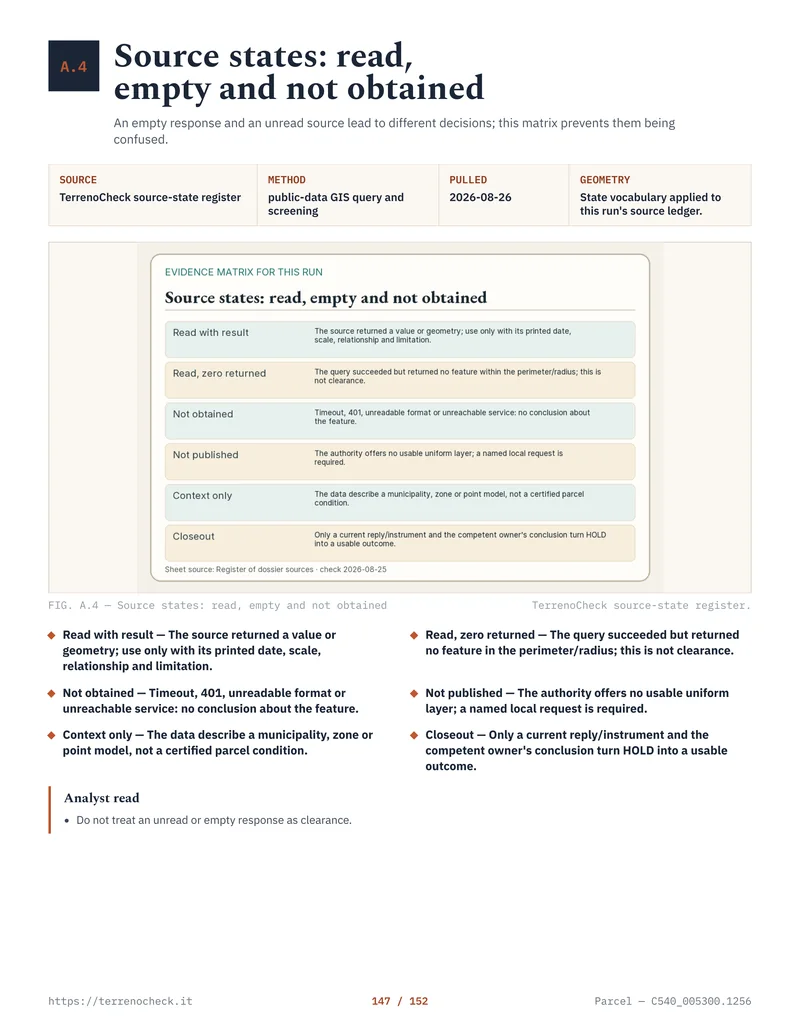 Open the full page
Interpreter and witnesses at the deed
Article 55 of Law 89/1913 addresses the case in which the notary does not know the foreign language. The act can be received with an interpreter chosen by the parties. The interpreter must have the qualifications required for a witness, cannot also be a witness or fidefaciente in that act, and must swear before the notary to perform the role faithfully. The deed is written in Italian and a translation is placed alongside or below it; the interpreter signs as required.
The article also distinguishes the witness-language requirement according to whether the parties can sign. Where witnesses are present or required, at least one must know the foreign language if the parties can sign; two must know it if the parties cannot sign. That does not mean every foreign buyer automatically needs two witnesses. The notary first decides whether witnesses are required for the deed and then applies the language rules.
Do not use a selling agent, the seller’s representative or a person with an interest in the transaction as the interpreter without the notary’s approval. The interpreter carries the buyer’s words and the notary’s explanation across the language gap. Arrange the language, identity documents and quoted cost before the final draft is approved.
The notary’s role in an Italian purchase includes legal checks, identity work and formalities, but it does not make a building survey or an independent translation review unnecessary. If the property itself is the risk, read the cadastral record guide, the mortgage and liens guide and the habitability guide, then appoint the right technician.
Resident, non-resident and the two different “home” questions
Buying a house does not by itself make you an Italian tax resident. Tax residence is separate from the Italian address, habitual residence and registered residence shown in the transaction file.
IMU is the municipal property tax. The exemption for an abitazione principale is tied to the property where the owner and family habitually live and have registered residence, with special rules and the familiar A/1, A/8 and A/9 luxury-category exception. A non-resident buying a holiday apartment normally owns a second home for IMU purposes. The Comune’s approved rate, cadastral data, possession period and any statutory exception determine the bill. Ask the Comune or use the Ministry of Economy and Finance information before choosing a budget.
The prima casa purchase relief is different. It is an acquisition-tax regime, not an IMU exemption. A buyer resident in another Italian Comune can generally claim it only by declaring the required move and transferring registered residence to the Comune where the property is located within 18 months, unless a specific statutory alternative applies. A foreign buyer may be able to use the relief if the buyer can satisfy the residence and other conditions. A non-resident who plans to visit for holidays has not satisfied that promise merely by buying a home.
The Agenzia guide also lists conditions about another home in the same Comune and a previous purchase made with prima casa relief. The details and the tax base are covered in the cost of buying property guide, so this article does not repeat its rates. Have the notary confirm the exact declarations in the deed. If the 18-month commitment fails, the reduced tax can be reassessed with interest and, depending on the route taken, a sanction.
An Italian buying outside their own Comune faces the same distinction. Ownership alone does not create the main-home IMU exemption; for prima casa, the residence declaration and 18-month clock matter.
- IMU: no Italian registered residence and holiday/second-home useUsually treated as a second home; check the Comune rate, cadastral data and any statutory exception
- IMU: habitual and registered residence in the propertyApply the abitazione principale rules; A/1, A/8 and A/9 remain subject to their specific IMU treatment
- Prima casa: resident in another Comune at signingThe deed normally needs the commitment to transfer residence to the property’s Comune within 18 months, unless a specific alternative applies
- Prima casa: the 18-month commitment is not metReduced acquisition tax is at risk; ask the Agenzia or notary about timely revocation or reassessment rather than waiting
Source: Agenzia delle Entrate, L’acquisto della casa; Law 27 December 2019, no. 160; Ministero dell’Economia e delle Finanze, local IMU information.
What to check before the deposit
Ask for the notary’s reciprocity view before you sign a proposal with an immediately forfeitable deposit. Send the notary the passport, nationality details, Italian residence or permit, and any second citizenship. Document any EU, EEA, Swiss or UK status.
Request the codice fiscale early and check it. Open the bank file early enough for its source-of-funds questions. Give the notary the payment schedule and transfer receipts. If an agent is involved, keep the signed commission terms and invoices.
If you need a representative, have the Italian notary draft the procura speciale before you sign abroad. Confirm the Apostille authority, translation format and revocation wording. Ask whether witnesses or an interpreter are needed for the power as well as the final deed.
The usual failure is not a dramatic prohibition. It is a buyer reaching the appointment with the wrong tax code, an unsigned translation, an unverified UK status document, an uncleared transfer or a power of attorney that does not describe the property. The result can be a postponed deed, a second trip, fresh professional fees and a seller claiming breach. Nobody can quote the exact cost from a desk.
Sources
- Ministero degli Affari Esteri e della Cooperazione Internazionale, Rights and reciprocity
- Ministero degli Affari Esteri e della Cooperazione Internazionale, International Treaties Archive ATRIO
- Normattiva, Royal Decree 16 March 1942, no. 262, Civil Code and preliminary provisions
- Normattiva, Legislative Decree 25 July 1998, no. 286, immigration and foreign nationals
- Agenzia delle Entrate, codice fiscale request and AA4/8 information
- Agenzia delle Entrate, codice fiscale attribution procedure for consulates
- Normattiva, Legislative Decree 21 November 2007, no. 231, anti-money laundering
- Normattiva, Decree-Law 4 July 2006, no. 223, Article 35(22), payment declarations
- Normattiva, Law 27 December 2013, no. 147, Article 1(63), dedicated notary account
- Normattiva, Law 16 February 1913, no. 89, notarial language rules
- Ministero degli Affari Esteri e della Cooperazione Internazionale, general and special powers of attorney
- Hague Conference on Private International Law, Apostille Convention of 5 October 1961
- Consiglio Nazionale del Notariato, notarial services for foreigners
- Agenzia delle Entrate, purchase of a home and prima casa relief
- Normattiva, Law 27 December 2019, no. 160, IMU framework
- Swiss Federal Office of Justice, acquisition of property by foreign non-residents
- UK Government, property rights for Withdrawal Agreement beneficiaries in Italy