
APE energy certificate in Italy: what buyers need
An APE is about a building, not a parcel of soil. Here is how to tell when a rural purchase needs one, how to read the class, and what to verify before signing.
Contents
- First question: are you buying land, or a building as well?
- What A4 to G means, and what the kWh number does not mean
- The advert and the deed are two separate checks
- Which regional register should contain it?
- Ten years is the maximum, not a promise
- Who may sign it, and what independence means
- What an APE costs
- What the 2024 EPBD changes today
- Buyer’s file before the offer becomes binding
An APE (Attestato di prestazione energetica) is a building document. It describes the calculated energy performance of a building or unit, gives it a class, and records recommendations for improvement. It does not certify that the seller owns the land, that the extension is lawful, or that a plot can be built on.
That distinction matters when an advert calls a rural parcel “land with a house”, “a ruin”, or “a small warehouse”. A parcel sold on its own is not a building and does not have an APE. A roof, walls and a cadastral building unit can change the question. This guide is a pre-purchase explanation, not legal, notarial, architectural or energy advice. Have the notary and a qualified technician examine the actual property before a binding deposit.
First question: are you buying land, or a building as well?
The national framework comes from D.Lgs. 19 August 2005, no. 192, as amended in the energy-performance changes introduced by D.L. 4 June 2013, no. 63, converted by Law 3 August 2013, no. 90. The Ministerial Decree of 26 June 2015 supplies the national APE guidelines, calculation framework, document format, classes and administrative minimums.
The trigger is an edificio or unità immobiliare, especially a new building, a building undergoing the relevant major renovation, a building or unit being sold, and a unit being let under a new registrable lease. Bare agricultural land, woodland, a building plot with no building, and a field with an open pergola are not APE objects merely because an advert describes a future project. The Italian land-buying checklist is the better starting point for those parcels.
Then comes the trap. A roofed structure may be a building even if the seller calls it a tettoia, annesso agricolo, deposito, rudere or “just four walls”. The APE guidelines define an excluded case for a manufactured object that is not an edificio, but a permanent enclosure with a defined volume and stable technical systems is a different proposition. A cadastral label is evidence to inspect, not the final answer.
There are specific exclusions. The national Appendix A excludes an isolated building under 50 square metres of useful floor area, certain industrial or craft buildings whose heating or cooling serves the production process, non-residential agricultural or rural buildings without climate-control systems, places of worship, and structures whose standard use has no technical systems, such as some boxes, garages, depots and parking structures. The same appendix deals with ruins and properties sold “at shell” or “rough” stage, but the state must be expressly declared in the notarial deed. “No APE because it is old” is not an exclusion.
For a plot with any structure, ask for four things before you value it as land: the full deed description, the cadastral records for land and buildings, the municipal planning file, and the seller’s reason for saying an APE is unnecessary. If the structure is a ruin, ask the notary whether the deed will state the precise excluded condition. If it is a usable building, ask a certifier to determine the scope. The energy question follows the object being transferred; it does not follow the estate agent’s shorthand.
- Bare land onlyno building or building unit to certify
- A roofed structureapply D.Lgs. 192/2005 Articles 3 and 6 and the 26 June 2015 Appendix A
- Isolated building under 50 m² useful floor arealisted exclusion
- Ruin or “rough” propertyexclusion only where the condition is expressly declared in the deed
Source: D.Lgs. 192/2005, Articles 3, 6 and 15; Decree 26 June 2015, Appendix A.
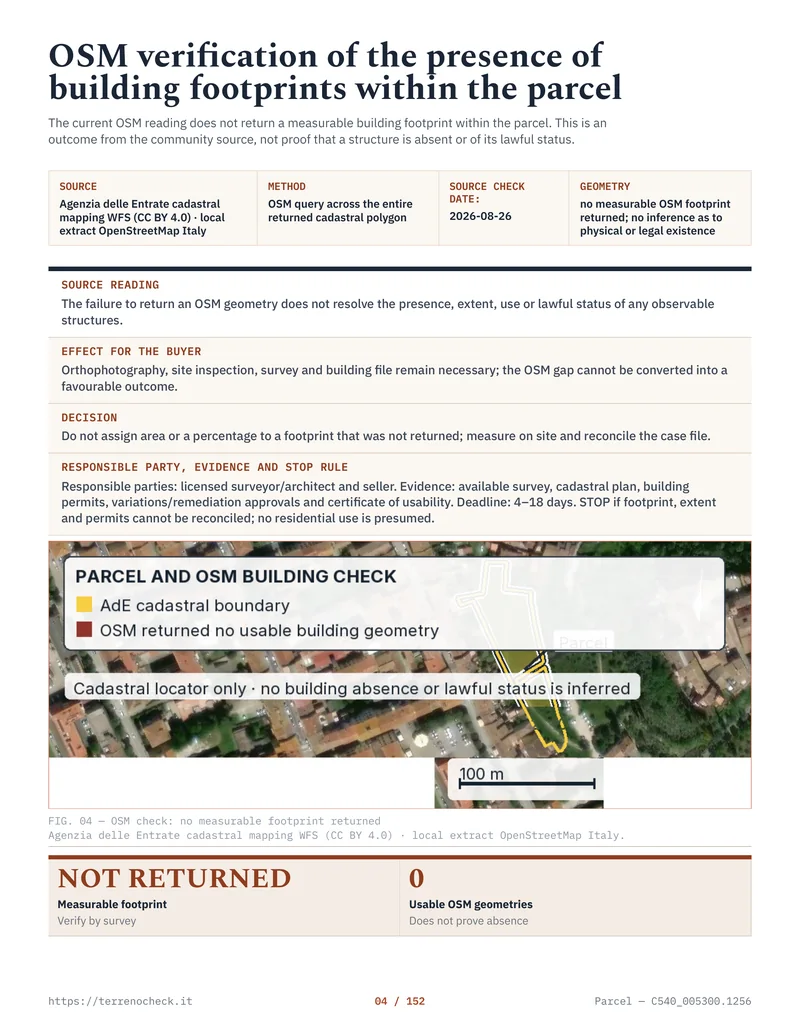
Pages from the delivered dossier
 Open the full page
What A4 to G means, and what the kWh number does not mean
The certificate’s headline class is based on EPgl,nren, the global non-renewable primary energy performance index. It is expressed in kWh per square metre per year. The calculation includes the relevant energy services, such as winter and summer climate control and domestic hot water; non-residential buildings can also include ventilation, lighting and transport services.
The letters run in the intuitive direction. G has the highest index and the greatest calculated non-renewable demand. A is better, and A4 is the highest level within the A group. The number printed on the APE is not a meter reading from the previous owner’s bills. It is a standard-use calculation based on the building, systems, climate and assumptions in the method.
The part buyers often miss is the unit of comparison. Italy does not set one national rule saying that every A4 building is below a fixed number such as 20 kWh/m²/year. The class uses a reference building. If the reference index is called R, A4 is at or below 0.40R; A3 is above 0.40R and at or below 0.60R; the bands then run through G above 3.50R. The APE should show the EPgl,nren value in kWh/m²/year as well as the class.
As a simple illustration, if R happened to be 100 kWh/m²/year, the A4 boundary would be 40 and the A3 band would run above 40 to 60. That is arithmetic, not a national cutoff. A small, well-insulated mountain house and a large apartment in a different climate zone can have different reference values. Compare the actual index, the energy services included and the building’s floor area before treating two letters as a precise running-cost forecast.
Also read the “quality of the envelope” indicators and the recommendations. A good class can reflect efficient systems; it does not tell you that the roof is dry, the walls are free from damp, or the heating installation is legally documented. Energy performance is one line in a wider property investigation. The building-rights guide explains why it cannot answer the planning question.
A4–G is a relative scale anchored to the reference building; the actual APE index, not the letter alone, is the number to compare.
| Class | EPgl,nren compared with reference R | Illustrative band if R = 100 kWh/m²/year | Reading |
|---|---|---|---|
| A4 | ≤ 0.40R | ≤ 40 | best class |
| A3 | 0.40R < index ≤ 0.60R | >40–60 | A class |
| A2 | 0.60R < index ≤ 0.80R | >60–80 | A class |
| A1 | 0.80R < index ≤ 1.00R | >80–100 | A class |
| B | 1.00R < index ≤ 1.20R | >100–120 | above the reference threshold |
| C | 1.20R < index ≤ 1.50R | >120–150 | moderate |
| D | 1.50R < index ≤ 2.00R | >150–200 | higher |
| E | 2.00R < index ≤ 2.60R | >200–260 | high |
| F | 2.60R < index ≤ 3.50R | >260–350 | very high |
| G | >3.50R | >350 | highest index |
Source: Decree 26 June 2015, national guidelines, section 5.1 and Table 2. The R = 100 column is a labelled mathematical illustration, not a claimed national threshold.
The advert and the deed are two separate checks
For an offer to sell a building or unit, commercial advertisements must report the envelope performance indices, the global performance index for renewable and non-renewable primary energy, and the corresponding energy class. The obligation comes from Article 6 and the 2015 guidelines. It applies to commercial communication, not just to a glossy agency listing. A land-only advert has no APE class to print, unless the transaction also includes an in-scope building.
At the sale, the buyer’s deed contains a clause declaring that the buyer received the information and documentation about energy performance, including the APE. A copy is attached to the contract. In practical terms, the class and indices should be in the deed package through the attached certificate. Do not let anyone wave away a missing annex by saying that the class appeared in the advert. An advert is not the deed.
The owner carries the main risk when a building being sold is not equipped with the required APE. Article 15 sets an administrative sanction of €3,000 to €18,000 for the sale case. If the required declaration or attachment is missing, the parties can be liable in equal shares for the same €3,000–€18,000 range, and payment does not remove the obligation to file the declaration or APE with the competent region or autonomous province within 45 days. The exact procedural position belongs with the notary.
The person responsible for a sale or letting advert that omits the required energy parameters faces a separate €500 to €3,000 administrative sanction under Article 15(10) of D.Lgs. 192/2005. These are not a reason to panic over a stale listing; they are a reason to make the document check part of the offer. Save the listing, ask for the APE identifier, and compare the address, cadastral data, floor area and class in the PDF with the building you are actually buying.
An APE does not cure an unauthorised extension. If the PDF describes 120 square metres but the visible property has an enclosed veranda and a second outbuilding, ask whether they were included in the assessment and whether the municipal file matches. The abuse and condono guide covers the separate planning and building-law risk.
 Open the full page
Which regional register should contain it?
The national decree deliberately leaves an administrative role to regions and autonomous provinces. They use the common national elements but run their own accreditation, software, filing and quality-control routes where their own systems are in place. The 2015 guidelines also provide for the national SIAPE data system, fed from regional records.
That is why a Lombardy APE is normally found through CENED, a Piemonte APE through SIPEE, and an Emilia-Romagna APE through SACE. The building’s location controls the filing route. It is not a contradiction for a certifier who lives in another comune, or for a foreign buyer who is unfamiliar with Italian regional boundaries, to see a different portal name. The relevant question is whether the APE was issued and registered in the system responsible for the building’s region.
In Lombardia, CENED offers certification, certifier search and APE consultation; its official accreditation page also identifies a €10 contribution for closing a certification declaration. That is a regional filing charge, not the total price of an APE. Piemonte’s SIPEE manages the regional list of authorised subjects, the data inserted in APEs and the certificates transmitted by professionals. Emilia-Romagna’s SACE manages the APE registry and quality controls, and its regional guidance requires an accredited certifier on the SACE list.
Ask the seller for the regional protocol or unique code, rather than a PDF attachment alone. Use the portal’s public verification function where available. If the code cannot be found, the address is wrong, the cadastral identifiers do not match, or the PDF shows a different unit, stop the transaction timetable and have the certifier or notary resolve it. A screenshot of an energy class is weak evidence.
One national framework can sit above different regional filing systems; verify the portal for the building’s location.
| Building region | Regional system | Buyer’s first check | Published validity reference |
|---|---|---|---|
| Lombardia | CENED / CEER | APE identifier, PDF and certifier status | 10 years, subject to national and regional conditions |
| Piemonte | SIPEE | regional certificate record and authorised-subject route | 10 years under the national framework |
| Emilia-Romagna | SACE | unique code and validity search | 10 years from issue and registration |
| National data layer | SIAPE | not a substitute for the region’s property-level verification | regional filing remains the practical record |
Source: Decree 26 June 2015, Articles 3–5 and section 8.1.2; Regione Lombardia CENED; Regione Piemonte SIPEE; Regione Emilia-Romagna SACE.
Ten years is the maximum, not a promise
An APE has a maximum validity of ten years from release under the national guidelines. The certificate must be updated after a renovation or energy requalification affecting building elements or technical systems in a way that changes the energy class. An updated APE does not restart the original ten-year clock under the national rule.
The less obvious expiry is connected to plant checks. Validity is conditional on compliance with the required energy-efficiency checks for technical systems, especially thermal systems, including required adjustments. If the first required check is missed, the APE expires on 31 December of the year after the year in which that missed deadline fell. The plant booklet is part of the APE file. Ask for it.
Do not treat “issued in 2019” as enough. Check the registration date, the code, whether a class-changing boiler, heat pump, insulation, window or other intervention happened later, and the dates of the required system checks. A regional portal can also record an early cancellation after a quality-control nonconformity or incorrect cadastral data. Emilia-Romagna publishes those cancellation routes; that is a useful regional example, not a new national penalty.
- Issue and regional registrationmaximum validity: 10 years
- class-changing renovation or requalificationupdate the APE
- first missed required plant-efficiency checkexpiry on 31 December of the following year
- salecheck code, annex, class and current validity before the deed
Source: Decree 26 June 2015, Article 4(3) and section 7; Regione Emilia-Romagna, APE validity FAQ.
 Open the full page
Who may sign it, and what independence means
The APE must be prepared by an authorised certifying subject under DPR 16 April 2013, no. 75. That can be a qualified technical professional with the prescribed education, professional qualification and registration, within the technical scope covered by the person’s training. The system can also recognise public bodies, inspection organisations and companies operating through qualified technical staff, subject to the regulation’s requirements. In regional systems, the authorised person may also need accreditation or listing in that region’s register.
The certifier must carry out at least one inspection at the building or unit. A remote form filled from an estate agent’s description is a warning sign, especially for a rural property with mixed construction, missing systems or several structures. Give the certifier the plans, prior APE, plant booklet, renovation records and information about actual systems. A missing document should be recorded as missing, not silently replaced with an optimistic assumption.
Independence is not a decorative signature. Under Article 3 of DPR 75/2013, the certifier declares the absence of a conflict of interest. The regulation addresses direct or indirect involvement in designing, constructing, administering, supplying energy to, managing or maintaining systems in the building, and related roles such as safety responsibility. The rule was designed to separate the person assessing performance from people whose work or commercial interest could influence the result. A public technical employee can fall under the regulation’s specific public-interest exception, so do not generalise from a private appointment.
Ask the proposed certifier three blunt questions: are you listed or accredited for this building’s region, will you inspect the property, and can you sign the independence declaration? If the seller’s contractor offers to prepare the APE after designing the retrofit, ask the notary or regional authority whether that appointment satisfies the applicable independence rule. Do not choose a class first and look for a signature later.
What an APE costs
There is no single national retail price in D.Lgs. 192/2005 or the 2015 guidelines. The official rules set the owner’s responsibility, the certifier’s qualifications, the inspection and filing requirements; they do not publish a nationwide fee for a standard apartment, a farmhouse or a building with several units. A regional charge may be added. For example, the CENED material identifies €10 for closing a certification declaration in Lombardia. That is not a quote for the professional work.
Get a written quote that separates the professional fee, VAT, professional pension contribution, regional filing contribution, travel, archive retrieval, extra units, missing plans, plant reconstruction and any separate planning or cadastral work. A “cheap APE” that excludes the visit or treats an outbuilding as invisible is not cheap if the notary rejects it or the certificate describes the wrong object.
The quote should state what will be delivered: signed PDF, regional registration code, plant-booklet treatment, inspection date, assumptions, recommendations and the method for correcting an input error. It should not promise a class. The certifier calculates the result from the property. Nobody can tell you the right APE price from a desk without the location, size, documents and number of units; a national estimate would be made up.
For a buyer outside the seller’s comune, use the cost-of-buying guide to budget the APE alongside the notary, survey and translation, but keep it as a separate technical line. APE is not the same service as the planning, title or condition checks in a property-purchase checklist.
What the 2024 EPBD changes today
Directive (EU) 2024/1275 is the recast Energy Performance of Buildings Directive. It entered into force on 28 May 2024, with the main transposition deadline on 29 May 2026 and an earlier deadline for the fossil-boiler financial-incentive provision. It sets a direction for renovation, minimum performance standards, solar energy, renovation passports, databases and energy-performance certificates across the EU.
As at 6 August 2026, Italy had not fully transposed the recast directive into national law. On 15 July 2026 the European Commission announced infringement procedures against all 27 Member States for failing to fully transpose the reinforced rules. That is the accurate current position. It does not mean that an Italian buyer can apply a predicted future class system to today’s deed, or that the existing APE is automatically void.
For a purchase now, use D.Lgs. 192/2005, the 2013 amendments, the 2015 guidelines and the regional system in force for the property. Watch for a later national transposition measure, but do not let a seller turn an EU directive into a promise that a G-rated building must be renovated before your deed. The directive’s future implementation may affect renovation costs and information duties; it does not answer whether this particular structure is lawful or buildable.
Buyer’s file before the offer becomes binding
Ask for the full APE, regional identifier, registration date, plant booklet, inspection details and any updated certificate after works. Match the address, cadastral identifiers, unit, floor area, systems and photographs. Then ask the notary how the certificate and its declarations will appear in the deed.
If the seller says the parcel is “land only”, confirm there is no building being transferred. If there is a roofed structure, obtain the exclusion reason in writing and have the relevant technician test it. If the structure is a ruin, confirm that the deed will state its condition. If the certificate is old, check the ten-year clock and plant checks. If the code is missing, do not price the uncertainty as though the APE were already valid.
An APE can tell you something useful about calculated energy performance. It cannot tell you everything that can go wrong with Italian property. Keep the energy certificate in its lane, and make the other checks before your deposit is difficult to recover.
Sources
- Normattiva, D.Lgs. 19 August 2005, no. 192, consolidated text
- Gazzetta Ufficiale, D.L. 4 June 2013, no. 63, converted by Law 3 August 2013, no. 90
- Gazzetta Ufficiale, Decree 26 June 2015, national APE guidelines and formats
- Gazzetta Ufficiale, DPR 16 April 2013, no. 75, certifier requirements
- Regione Lombardia, CENED energy certification portal
- ARIA Lombardia, CENED accreditation and regional contribution
- Regione Piemonte, SIPEE information system
- Regione Emilia-Romagna, SACE energy-certificate registry
- EUR-Lex, Directive (EU) 2024/1275, recast Energy Performance of Buildings Directive
- European Commission, 15 July 2026 infringement procedures for incomplete EPBD transposition