
Agibilità in Italy: what it proves
An agibilità document says a building can be used under a defined set of safety, health, energy and systems rules. It does not prove that every alteration is lawful or that the land can take another building.
Contents
- What agibilità means now
- What the SCA actually certifies
- Three construction dates a buyer must read correctly
- Before 27 July 1934
- Before 1 September 1967
- Before the 2016 reform
- Rural buildings and the two cadastral registers
- What happens if agibilità is missing?
- Mortgage finance
- Renting the property
- Is the sale void?
- Agibilità, urban planning and cadastral conformity are three checks
- Can you obtain agibilità after the fact?
- What to request before the preliminary contract
The estate agent says “the house has no agibilità”. That sentence can describe a missing paper, an old municipal file, an unfiled SCA, an unregistered rural building, or a building whose current condition no longer matches the papers.
For a buyer arriving from abroad, ask what document exists, which unit and use it covers, what work happened afterwards, and who will compare the building with the approved project.
This pre-purchase guide does not provide legal, surveying, engineering or notarial advice. A geometra, architect or engineer must inspect the building and municipal file; the notary must assess the deed and the parties’ contractual position. TerrenoCheck does not verify ownership, agibilità, planning compliance or a right to build.
What agibilità means now
Since 11 December 2016, Article 24 of DPR 380/2001 uses the segnalazione certificata di agibilità, usually shortened to SCA. The owner or successor files it at the Comune’s Sportello Unico per l’Edilizia after the relevant work. The system is an attestation supported by a qualified professional and documents, rather than the old process in which the Comune issued a certificato di agibilità.
The change came through Article 3 of D.Lgs. 25 November 2016, no. 222. The SCA is required for a new construction, a total or partial reconstruction or raising, and work to an existing building that can affect the conditions in Article 24(1). Article 24(2) requires the filing within 15 days of completion of the finishing work, and subsection 3 punishes a failure to file, in the cases subsection 2 lists, with an administrative penalty of €77 to €464. That fine is not a budget for making a neglected building usable.
The old words still appear in deeds and municipal archives. Abitabilità was commonly used for dwellings, while agibilità covered the broader idea of a building’s suitability for use. Older certificates remain relevant, but a buyer needs to know whether the document relates to the present unit, its present use and later alterations.
- Before 27 July 1934No national R.D. 1265 Articles 220–221 framework yet in force
- 27 July 1934R.D. 1265 introduces the national health and habitation authorisation framework
- 1 September 1967Law 765/1967, Article 10, enters into force and extends the building-licence rule across the Comune
- 11 December 2016D.Lgs. 222/2016 enters into force and Article 24 moves to the SCA filing regime
- 15 dayscurrent Article 24 deadline after finishing works
Source: R.D. 1265/1934, Articles 220–221; Law 765/1967, Article 10; D.Lgs. 222/2016, Article 3.
Pages from the delivered dossier
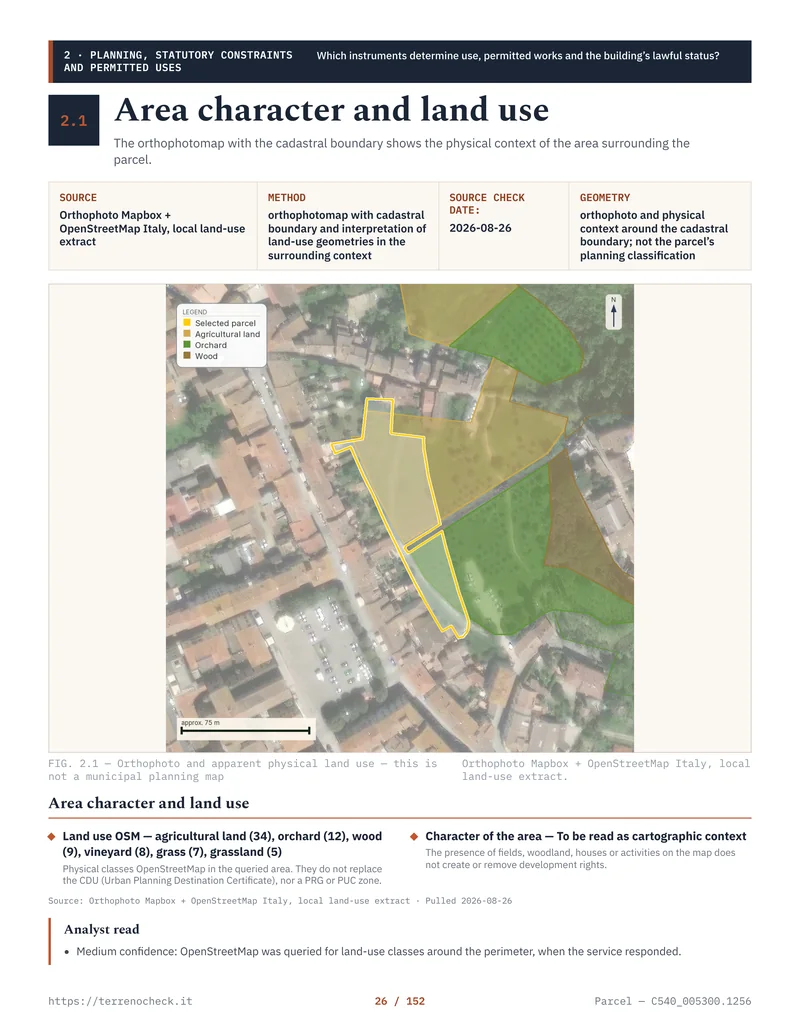 Open the full page
What the SCA actually certifies
Article 24(1) names four groups of conditions: safety, hygiene and healthiness, energy saving, and the conformity of installed systems with the rules that apply to them. It also covers the conformity of the completed work to the project presented and the building’s agibilità. The professional does not sign a casual opinion. The attestation is made under professional responsibility.
The supporting file under Article 24(5) includes:
- the director of works’ attestation, or an attestation by another qualified professional where there was no director of works;
- the static test certificate, or the permitted declaration of regular execution for the limited structural works described in Article 67(8-bis);
- the declaration that the work meets the rules on accessibility and removal of architectural barriers;
- the details of the cadastral update; and
- the installer’s declaration of conformity for the systems, or a systems test certificate where the rules provide for one.
For an older property, the file can be patchy. A professional may have to locate the original permit, compare drawings with the rooms on site, check structural records, reconstruct plant documentation and update the cadastral position. The Notariato notes that, for systems installed before 27 March 2008, a dichiarazione di rispondenza can replace an unavailable declaration of conformity in the cases allowed by the plant rules. That is a technical route for the systems file. It is not an amnesty for an illegal extension.
The SCA is also narrower than buyers often assume. It does not prove that the seller owns the property, that mortgages and liens are absent, that every building alteration has planning permission, or that the land can support another house, pool or annex. It does not replace a title search, a cadastral comparison, a planning-file review or a current local planning check. Use the cadastral extract guide for the limits of cadastral evidence and the building-rights guide for the separate question of what the land may take.
The same distinction matters after an SCA has been filed. The Court of Cassation, Second Civil Section, held in Ordinance no. 25830 of 5 September 2023 that a later agibilità does not cure an urban-planning nonconformity and does not stop the Comune from exercising its enforcement powers. An SCA is evidence about use-related conditions. It is not a regularisation order.
Three construction dates a buyer must read correctly
Construction dates are clues, not shortcuts. The date in an advert may describe the original farmhouse, the last extension, or a renovation that changed the applicable file. Ask for evidence of each phase.
Periods tell you which records to request. They do not supply a national “pre-date” exemption from planning, health or cadastral checks.
| Period | Agibilità evidence to look for | Planning evidence to look for | Buyer’s next check |
|---|---|---|---|
| Before 27 July 1934 | No document created under R.D. 1265 Articles 220–221; old municipal or private records may exist | Evidence of age, historic municipal records and later titles | Do not call the building exempt; have the Comune archive and current use checked |
| 27 July 1934–31 August 1967 | Certificato di abitabilità/agibilità, municipal inspection record or later valid evidence | The permit regime depends on the location and rule in force at the time; check old licence and approved plans | Test the building against the papers, not the date alone |
| 1 September 1967–10 December 2016 | Old certificate, application, or evidence of the former procedure and any later works | Licence, concession or permit and subsequent amendments | Check every extension, change of use and cadastral update |
| From 11 December 2016 | SCA filed with Article 24(5) documents | The title and project for the work that triggered the SCA | Check the filing receipt, attached documents and present condition |
Source: R.D. 1265/1934, Articles 220–221; Law 765/1967, Article 10; D.Lgs. 222/2016, Article 3.
Before 27 July 1934
For a building genuinely completed before the R.D. 27 July 1934, no national Article 220–221 certificate existed yet. That does not mean “anything goes”. A pre-1934 building may have municipal hygiene records, an old authorisation, a later certificate, a reconstruction title, or no surviving paper at all. The Comune’s archive and the evidence of the building’s age matter.
The useful question is whether the building’s present use can be demonstrated and whether later work was authorised. A 1933 stone house with a 1998 bathroom extension is not assessed as a single 1933 object. Get the technician to separate the original volume from later interventions.
Before 1 September 1967
Law 765/1967 came into force on 1 September 1967. Article 10 replaced Article 31 of Law 1150/1942 and required a licence from the mayor for new construction, enlargement, alteration or demolition within the municipal territory. Older buildings sit in a more complicated period: the licence rules before that date depended on the applicable urban-planning law and the location, while the 1934 health and habitation rules were already relevant to the buildings covered by them.
So “built before 1967” is not a clearance certificate. Expect a search for the original licence or other title where one was required, a municipal archive response, old plans, an abitabilità or agibilità record if one was issued, and proof of later alterations. If the seller offers only a cadastral plan, the file is incomplete. The abuse and condono guide explains why the Catasto cannot make an unauthorised room lawful.
Before the 2016 reform
For work completed before 11 December 2016, expect the older certificate-based record. Under the former regime, the Comune issued a certificato di agibilità and the procedure could involve municipal review and, in specified circumstances, silence-assent. A later SCA is not required merely because a building is old. It is required for work that falls within the current Article 24 triggers, including later intervention affecting the stated conditions.
The practical file can therefore contain an old certificate, a municipal application, a silence-assent record, or a later SCA for a renovated unit. Read the dates against the work. An old certificate for the original layout does not automatically cover a loft conversion, closed veranda, split apartment or change from storage to dwelling.
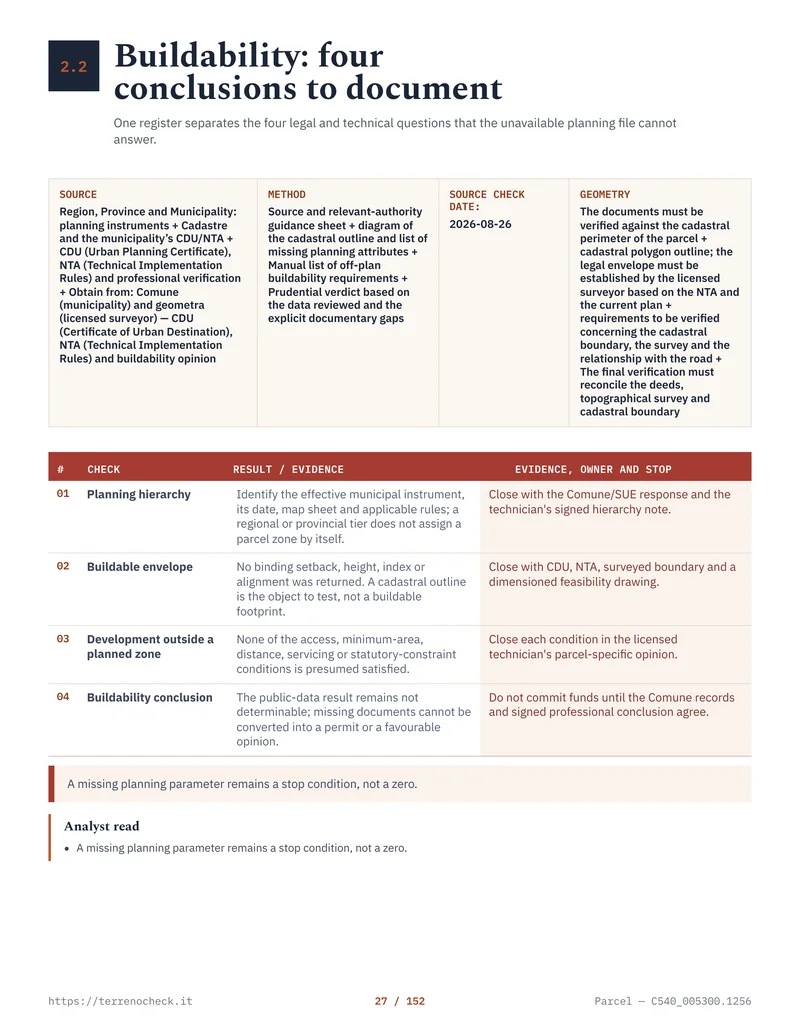 Open the full page
Rural buildings and the two cadastral registers
Rural properties create a common trap because the building and the land may have travelled through different cadastral systems. The Catasto Terreni records land parcels. The Catasto Fabbricati, also called the urban building cadastre, records building units and their cadastral data.
Historically, some fabbricati rurali were recorded in the Catasto Terreni because their rural income treatment was tied to the agricultural land. Article 13(14-ter) of D.L. 6 December 2011, no. 201 required inventory-able rural buildings still registered there to be declared in the urban building cadastre by 30 November 2012, excluding structures not subject to inventory under the cited cadastral rule. The date is real; the legal classification of a particular structure still needs checking.
A building shown on the Catasto Terreni is therefore a question, not an answer. Ask why it remains there, whether an exception applies, whether it should have been transferred to the Catasto Fabbricati, and whether the cadastral data match the visible building. A later change from agricultural store to dwelling may need planning permission, a cadastral update and evidence of habitability-related conditions.
Fiscal rurality is separate too. A building can be rural for tax purposes without being a legal dwelling. A hay store is not a house because it has four walls and a kitchen installed by a previous owner. Check the permitted use, the municipal planning instrument and the actual building. The Italian land-buying checklist is a useful first pass before you value a rural property as a home.
What happens if agibilità is missing?
Mortgage finance
There is no national rule saying that every bank must reject a mortgage without agibilità. Banks set their own underwriting and security requirements. In practice, a lender may refuse, delay valuation, require the seller to file the SCA, or lend only after a condition is satisfied. A foreign buyer who has already booked a survey, currency conversion and completion date has little room for that delay.
Ask the broker or bank in writing whether the missing document is acceptable, whether an old certificate or SCA receipt will do, and whether the valuation must confirm the present use. Do this before making the offer binding. A pre-approval based on the listing price is not confirmation that the specific building will pass the lender’s property checks.
Renting the property
The statement “you cannot rent without agibilità” is too absolute. In a 2018 case, the Court of Cassation held that the absence of the certificate, where the property’s usability was established, was not by itself an obstacle to a valid lease or a basis for damages measured as lost rent. That does not make an unfit or unauthorised dwelling safe to rent.
A missing document can still damage the commercial plan. A tenant may refuse, an insurer or platform may require evidence, a local accommodation process may ask for it, and a mismatch between the declared use and the actual rooms can expose a deeper planning problem. For short lets, check the separate short-let rules. For energy paperwork, the APE is a separate document and is covered in the energy certificate guide.
Is the sale void?
Usually, do not treat the answer as a simple yes or no. The absence of agibilità is not the same as the statutory nullity rules for certain missing planning titles or land documents. The Consiglio Nazionale del Notariato has described the prevailing view as one in which agibilità affects the property’s economic marketability and can support contractual remedies, rather than automatically invalidating the transfer. Its study also records a minority argument for nullity, which is why a buyer should not rely on a slogan from an agent or forum.
Cassation case law has recognised serious consequences where a home was sold without the required habitability evidence. Its Civil Section has described the certificate as an essential legal requirement for the property’s intended social and economic function, with possible non-performance and aliud pro alio consequences unless the buyer expressly accepted the risk. Other decisions focus on price reduction, damages or resolution. The result turns on the documents, the agreed use, the buyer’s knowledge, the wording of the contract and whether the problem is a missing certificate or an underlying illegality.
The safe transaction position is practical: disclose the gap, have the technician identify its cause, make filing or delivery a written condition if appropriate, and have the notary draft the preliminary and final deed around the known risk. The preliminary contract guide covers why the first signed document deserves the same care as the rogito.
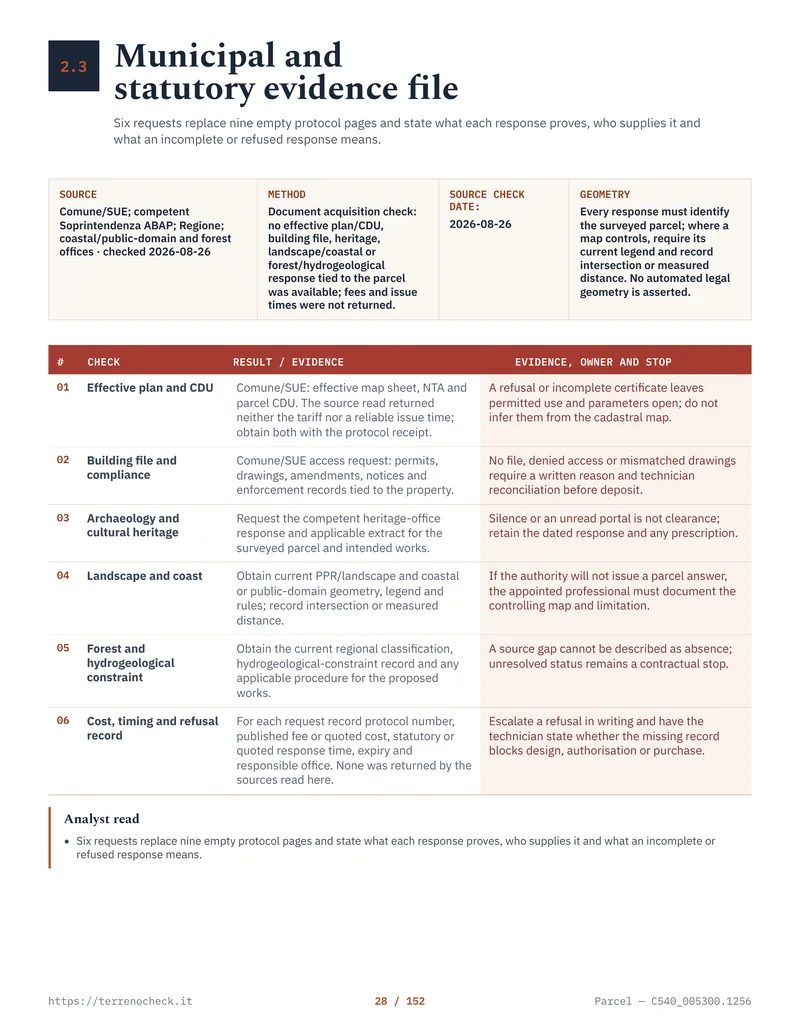 Open the full page
Agibilità, urban planning and cadastral conformity are three checks
These phrases are often mixed together in listings, even though they answer different questions.
Agibilità: can the completed building or unit be used under the safety, health, energy and system conditions attested for it? The SCA and its supporting records answer this question.
Urban-planning conformity: does the building on site match the lawful municipal titles and the planning rules applicable to the work and use? This requires the accesso agli atti at the Comune, comparison of approved drawings with the site, and review of later works. Regional and municipal rules affect how the check is performed.
Cadastral conformity: do the cadastral identifiers and plan reflect the actual unit? The cadastral plan matters for the deed, tax and identification record, but it is not a planning permit and does not prove title. An SCA file includes cadastral-update details, yet that inclusion does not merge the three checks into one.
- Current SCA + Article 24(5) documentsCheck the filed unit, use, plans and present condition
- Old abitabilità/agibilità certificateCheck date, unit, use and every later alteration
- Rural building in Catasto Terreni or no certificateCheck the 30 November 2012 cadastral rule, municipal archive and technician’s report
- Mismatch or no reliable recordPause the price decision; resolve urban-planning, cadastral and use questions before signing
Source: DPR 380/2001, Article 24 as amended by D.Lgs. 222/2016; D.L. 201/2011, Article 13(14-ter).
Can you obtain agibilità after the fact?
Often, if the building is lawful enough for the professional to make the statutory attestations and the required evidence can be assembled. The owner or successor engages a qualified technician. The technician reviews the municipal title and plans, inspects the actual building, checks structural and accessibility records, identifies the installed systems, compares the cadastral record and prepares the SCA with the Article 24(5) attachments. The filing goes to the Comune’s SUE. Under the current regime, use can begin from the date of a complete filing, subject to the controls and powers provided by law.
That sequence is not a shortcut around an abuse. If the inspection finds an unauthorised extension, a changed use, missing structural approval or an unsafe system, the technician may be unable to sign. The owner may need a separate conformity or regularisation procedure, a corrective work, a cadastral update, or a combination. The 2025 MIT guidance on the Salva Casa rules discusses limited tolerance and historic inspection cases, but it does not turn an SCA into a general amnesty.
How much does retroactive agibilità cost? There is no national published total or national retail tariff that can honestly answer that question. The unavailable figure is the point. A straightforward archive-and-filing job is a different assignment from one involving a measured survey, structural testing, plant declarations, rural cadastral history, an unauthorised room or a change of use. Comune charges, professional fees, pension contribution, VAT, travel and remedial works need separate quotes. Ask for them as separate lines before you treat the missing paper as a €500 problem.
The only clear national amount in current Article 24 is the €77–€464 administrative penalty for failing to file when the provision applies. It does not include professional work, municipal charges, tests or construction. A local quote is more useful than an unsourced national average.
What to request before the preliminary contract
Ask the seller for the complete agibilità or abitabilità file, not a photograph of the first page. Request the filing receipt or municipal release, attachments, plans, static test, systems declarations, cadastral update details and any later SCA. Ask which subalterno and use the document covers.
Then request the planning file: original licence, concession or permit; amendments; completion notice; any condono or regularisation; and the municipality’s response to an archive request. Compare approved drawings with the building room by room. If the building is rural, identify the parcel in the Catasto Terreni and the unit, if any, in the Catasto Fabbricati. A notary role guide explains which parts belong to the notary and which need a technical professional.
Put the unresolved point in the commercial documents. The offer or preliminare should not quietly describe a missing SCA as “seller will provide documents” if nobody has said which documents or by when. State the deliverable, the professional report required, the deadline and what happens if the result is not acceptable. Have the notary and your own adviser write the clause.
Finally, price the risk. The cost-of-buying guide helps with the wider transaction budget, but no spreadsheet can tell you whether an old farmhouse has a lawful dwelling use. If the seller cannot produce a coherent file, the price is not the only thing at stake. Your financing, rental plan, insurance and exit sale may all depend on a document that proves less than the listing implies, but still matters a great deal.
Sources
- Normattiva, DPR 6 June 2001, no. 380, Article 24 as amended
- Normattiva, D.Lgs. 25 November 2016, no. 222, Article 3
- Normattiva, R.D. 27 July 1934, no. 1265, Articles 220–222
- Normattiva, Law 6 August 1967, no. 765, Article 10
- Normattiva, D.L. 6 December 2011, no. 201, Article 13(14-ter)
- Consiglio Nazionale del Notariato, La nuova agibilità e la modulazione delle clausole contrattuali
- Consiglio Nazionale del Notariato, Il certificato di agibilità, Studio 4512
- Consiglio Nazionale del Notariato, Acquisto certificato
- Corte Suprema di Cassazione, Civil Section, August–September 2019 case-law review
- Corte Suprema di Cassazione, Civil Section, May 2018 case-law review
- Corte Suprema di Cassazione, SentenzeWeb, Sez. 2, Ordinanza n. 25830 of 5 September 2023
- Ministero delle infrastrutture e dei trasporti, Salva Casa guidance