
Short lets in Italy: CIN and regional rules
A short-let income forecast is useless if the property cannot be advertised legally. This guide shows a buyer what the CIN, local filings, safety kit, tax and condominium documents mean before signing.
Contents
- The CIN is a legal identifier, not a quality badge
- What the CIN failure can cost
- Safety equipment belongs inside the unit
- Locazione breve means 30 days, not “holiday” in general
- Alloggiati Web is a Questura obligation
- Tourist tax is a Comune calculation
- Regional codes survive beside the CIN
- The condominium can change the business case
- A buyer’s file before the deposit
Before valuing a property for short lets, verify the usable CIN, any regional code, the condominium rules and the applicable tax treatment. The nightly rate does not show whether the proposed operation is lawful or what net income remains.
This pre-purchase guide does not provide tax, legal, notarial or business advice. A CIN does not prove ownership, planning compliance, building legality or the right to operate. Before a binding deposit, ask the notary, an Italian tax professional and the relevant Comune, SUAP and Questura to check the facts for that address.
If you are buying a property rather than an income story, start with the Italian land-buying checklist. Short letting sits on top of title, planning, access, building and condominium questions. It does not replace them.
The CIN is a legal identifier, not a quality badge
Article 13-ter of D.L. 18 October 2023, no. 145, converted by Law 15 December 2023, no. 191, created the codice identificativo nazionale, or CIN. The Ministry of Tourism assigns it to residential units used for tourist leases or locazioni brevi, and to hotel and non-hotel tourist accommodation defined under the applicable regional rules. The same article gives the Ministry the national database function.
The practical doorway is the Banca Dati Strutture Ricettive, usually called BDSR. The Ministry describes it as the national database for accommodation structures and homes used for short or tourist letting. A proprietor or other entitled operator enters the property data through the BDSR procedure and makes the declarations the application requires. Where a region already has a code, the national system is designed to receive and recode that information. A seller’s old regional number is not a substitute for checking whether the CIN was actually issued.
The buyer should ask for the CIN in writing, then compare the address, cadastral identifiers and unit description with the proposed purchase. Do not rely on a screenshot cropped from a platform listing. Ask who applied, on what date, and whether the application concerns the whole apartment or one portion. A room, an apartment and a structure can have different administrative descriptions.
The code has two visibility obligations. It must be displayed outside the building where the property is located, subject to the practical placement rules for the site, and it must appear in every advertisement, notice, communication or commercial offer for the hospitality. That includes a listing placed by an agent or platform.
- 18 October 2023D.L. 145/2023 enacted, Article 13-ter introduces the CIN and national database
- 15 December 2023Law 191/2023 converts the decree
- 6 June 2024Ministerial decree sets the interoperability and allocation framework
- 3 September 2024The BDSR enters operation and the Ministry announces CIN allocation through the national platform
Source: Normattiva, D.L. 145/2023 Article 13-ter; Ministero del Turismo, BDSR; Ministero del Turismo, BDSR FAQ
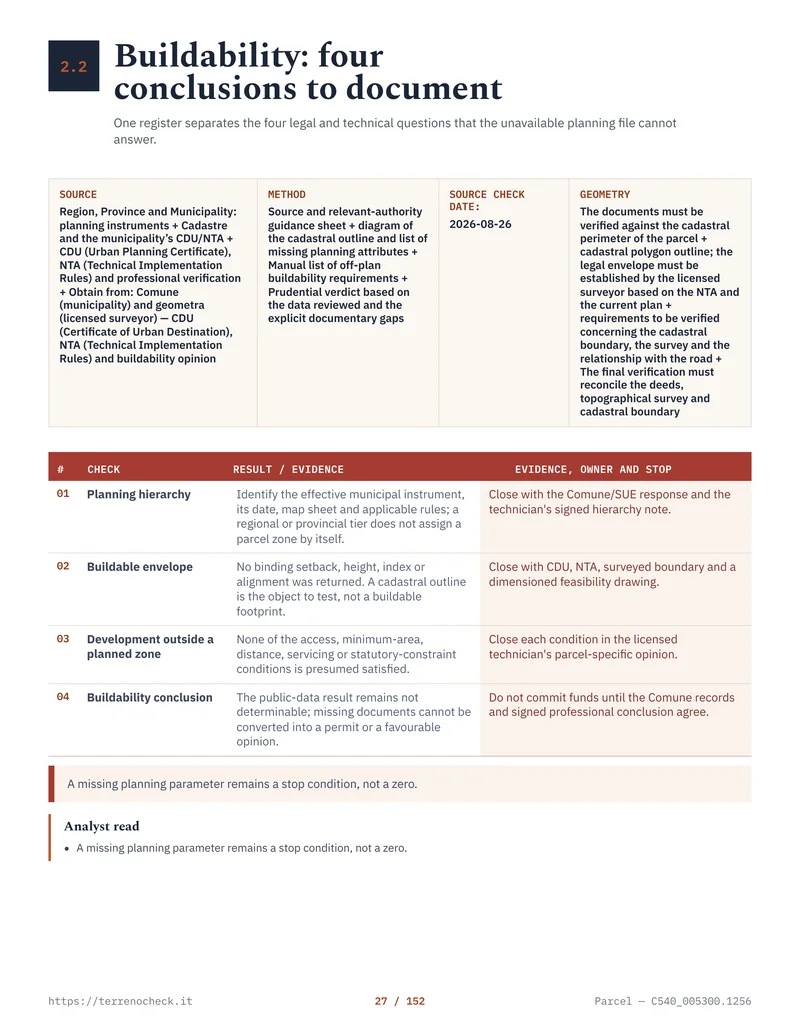
Pages from the delivered dossier
 Open the full page
What the CIN failure can cost
The Ministry’s BDSR FAQ separates the main offences. Operating without a CIN attracts an administrative fine from €800 to €8,000. Failing to display or state it attracts €500 to €5,000 for each structure or unit where the violation is found, plus immediate removal of the irregular advertisement. These are not estimates from a property website. They are the ranges published by the Ministry for Article 13-ter, paragraph 9.
The same FAQ gives a €600 to €6,000 fine for each violation involving missing or non-functioning gas or carbon-monoxide detectors, or missing compliant portable extinguishers. That sanction is directed at the lessor and applies to short or tourist leases in entrepreneurial and non-entrepreneurial form. Other breaches can bring sanctions under the applicable national or regional rules. A removed advert can interrupt bookings, and a buyer may inherit an apartment that cannot be marketed on the seller’s timetable.
These are national ranges published for the stated breaches. They are not a forecast of the amount a particular Comune or authority will impose.
| Issue | Published administrative range | Immediate consequence |
|---|---|---|
| No CIN | €800–€8,000 | The property is being offered without the required national code |
| CIN not displayed or included in the advert | €500–€5,000 per unit or structure | Immediate removal of the irregular advert |
| Missing or non-functioning detectors or extinguishers | €600–€6,000 per violation | Correct the safety equipment and expect the applicable enforcement process |
Source: Ministero del Turismo, BDSR FAQ, section 1.7 and section 4
The sensible request is simple: make delivery of the current CIN, the BDSR record and the right to advertise a condition of the preliminary contract if the rental plan matters to the price. A notary can deal with a contractual condition; a platform listing cannot cure a missing document after completion. The notary’s role in an Italian purchase is different from a technician’s planning inspection, so assign each question to the right person.
Safety equipment belongs inside the unit
The national CIN regime adds a minimum safety package to every residential unit used for a short or tourist lease without additional hospitality services. It includes functioning detectors for combustible gas and carbon monoxide, and compliant portable fire extinguishers. The Ministry’s FAQ says this applies whether the letting is entrepreneurial or not, and whether the activity began before the current CIN process.
There is a narrow detector exception. The Ministry says a detector for combustible gas and carbon monoxide is not mandatory where the unit has no gas installation and the risk of an uncontrolled release of combustible gas or formation of carbon monoxide is certainly excluded. “There is no gas cooker” is not automatically the same as that legal conclusion. Ask the technician to record the fuel systems, appliances, flues and heating equipment.
Extinguisher count is tied to the unit’s area and floors. Below 200 square metres, at least one is required. From 200 to 400 square metres, at least two are required. An apartment on two or more floors must have at least one per floor even if the total area is below 200 square metres. Common-area extinguishers do not replace the devices inside the apartment.
For an entrepreneurial short or tourist lease, the unit must also meet the safety requirements for installations imposed by current national and regional law. That is a wider check than buying two extinguishers online. Have a qualified technician examine the gas, electrical and heating installations and identify the documents available. If the seller cannot produce them, record the gap. The habitability and agibilità guide helps explain why an occupancy document is not a substitute for every installation record.
There is no national price list for installing, positioning, servicing or replacing this equipment. The Ministry publishes the requirement, not a single country-wide contractor price. That cost is therefore unavailable as a reliable national figure. Obtain a written local quote, including any inspection, certificates and recurring maintenance, before treating the rental yield as net income.
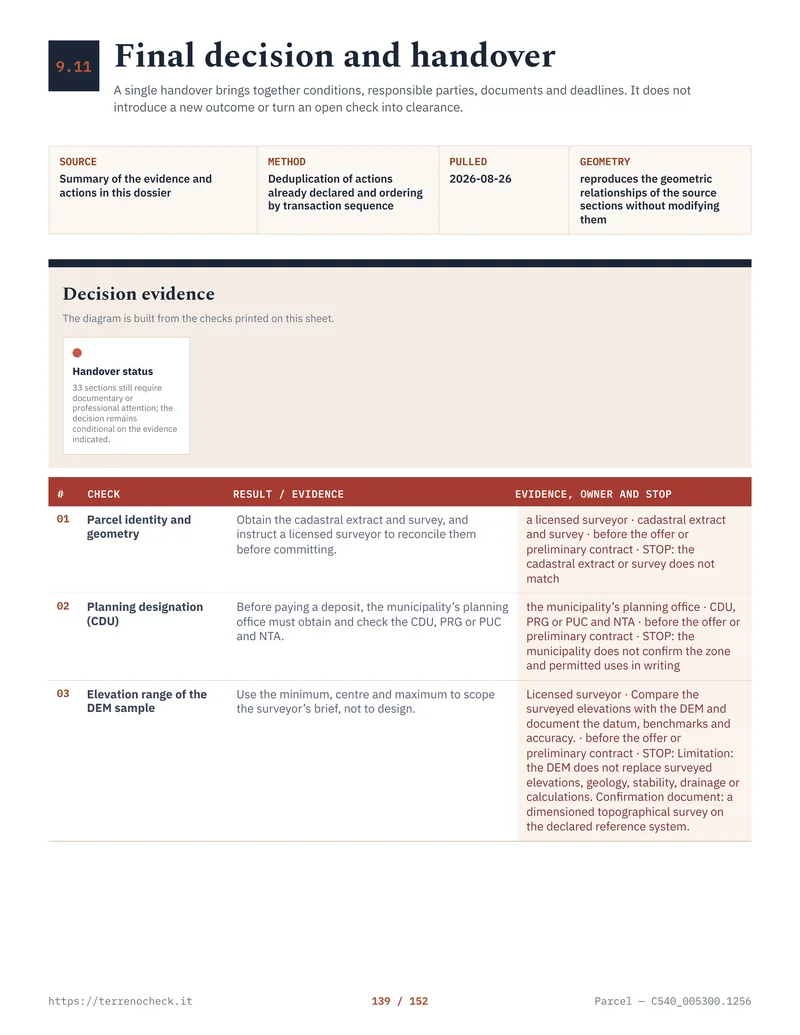 Open the full page
Locazione breve means 30 days, not “holiday” in general
Article 4 of D.L. 24 April 2017, no. 50 defines a locazione breve as a residential lease of no more than 30 days, entered into by individuals outside a business activity. The 30-day test applies to leases between the same parties in the same year. Several short contracts with the same guest are not a safe way to turn a longer stay into a series of artificial short lets.
The tax category allows limited services closely connected with use of the home, such as linen, cleaning, utilities, Wi-Fi and air conditioning. It is not a general permission to run a hotel from an apartment. Meals, daily reception, organised excursions or a package of hospitality services can point toward a different activity and different regional obligations.
For income tax, Article 1(63) of Law 213/2023 changed the cedolare secca treatment from the 2024 tax year. The rate is 21% for one short-let residential unit chosen by the taxpayer. If more than one unit is used for short letting, the remaining units are taxed at 26% when this substitute regime is chosen. Model the choice with the taxpayer’s adviser, not the seller’s spreadsheet.
Source: Agenzia delle Entrate, ‘Cosa si intende per locazione breve?’; Law 30 December 2023, no. 213, Article 1(63)
The next threshold is more consequential than the tax rate. For the 2026 tax year, Law 30 December 2025, no. 199, Article 1(17), changed the statutory limit to no more than two apartments. If three or more apartments are dedicated to short letting, the activity is presumed entrepreneurial, wherever those apartments are located. The four-apartment rule still repeated in older guides is not the current 2026 threshold, and the count is not limited to units in one building or one Comune.
Article 13-ter, paragraph 8, of D.L. 145/2023 requires anyone carrying on tourist or short letting in entrepreneurial form to submit a Segnalazione certificata di inizio attività, or SCIA, to the SUAP of the Comune where the activity is carried on. A three-apartment plan should therefore be costed as a business setup, not as three casual listings. Opening a VAT position (partita IVA) is part of operating the activity as a business, with the correct classification and tax regime confirmed by a commercialista. The national CIN does not open the VAT position for you.
- Up to 30 days, one or two apartmentsLocazione breve: CIN, safety devices, Alloggiati Web and Comune tax or filings still need checking; cedolare secca is 21% for one chosen unit and 26% for the others
- Three or more apartments in one 2026 tax yearActivity presumed entrepreneurial: plan for SCIA at the SUAP and a partita IVA, then check regional and local business rules
- A stay over 30 daysNot a locazione breve under Article 4; check registration, tax and any regional tourist-lease rules separately
- Apartment in a condominioRead the registered or contractual regulation, minutes and house rules before pricing the rental use
Source: D.L. 50/2017 Article 4; D.L. 145/2023 Article 13-ter; Law 199/2025 Article 1(17); Agenzia delle Entrate, locazioni brevi FAQ.
Alloggiati Web is a Questura obligation
The Testo Unico delle leggi di pubblica sicurezza, Article 109, requires the people providing accommodation to communicate guest details to the competent Questura through the Servizio Alloggiati. The same article sets the ordinary deadline plainly: within 24 hours after arrival. For a stay lasting less than 24 hours, the details must be sent at the time of arrival.
The obligation reaches private short lets, not just hotels. A manager or agency may transmit the data on the owner’s behalf, but the buyer should ask who holds the Questura credentials, who checks identity documents, who sends the record and who retains the transmission receipt. “The platform has guest details” is not the same as “the Questura received the required file”.
The security history is older than the CIN. The 2005 anti-terrorism decree, D.L. 27 July 2005, no. 144, is historical context, but its public-security rules should not be confused with the current accommodation deadline. The operational route for guest reporting is Article 109 TULPS and the Interior Ministry’s 7 January 2013 decree, delivered through Alloggiati Web. Keep those authorities separate in the file; a regional tourist-flow report is not the Questura report.
Ask the local Questura about registration and credentials before you complete the purchase. A foreign buyer living abroad needs a dependable person or manager who can perform the task on time. A missing transmission is a compliance failure.
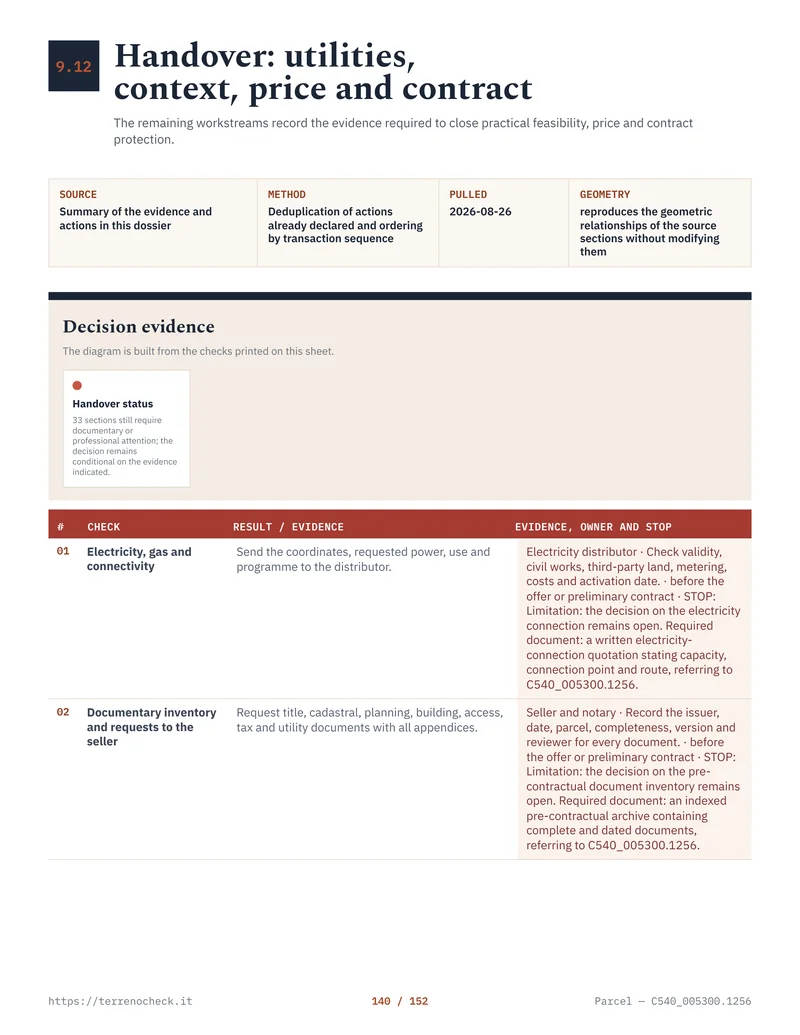 Open the full page
Tourist tax is a Comune calculation
Under Article 4 of D.Lgs. 14 March 2011, no. 23, eligible comuni can establish an imposta di soggiorno by council resolution. The national framework allows the tax to be graduated by price and sets a general ceiling of €5 per night, with statutory exceptions for certain high-tourism provincial capitals and local rules on exemptions or reductions. The amount, covered guests, age exemptions, declarations and payment dates belong to the Comune’s regulation.
Do not enter “tourist tax: €5” in a forecast without naming the Comune and the year of the regulation. Some comuni charge less; some use different brackets, exemptions or collection procedures. Ask whether the host collects from the guest, files periodic declarations, pays through a municipal portal and keeps records. The tax is usually a pass-through amount, but errors can still create arrears and penalties.
The cost of buying property in Italy covers purchase taxes and ownership costs. It does not turn a Comune’s tourist-tax regulation into a national rate. For the property under offer, save the municipal regulation and tariff in the same folder as the CIN.
Regional codes survive beside the CIN
The CIN is national. It does not erase every regional database, communication or code. Article 13-ter was designed to interoperate with regional and provincial systems, and the buyer must still follow the rules of the region where the apartment sits.
Lazio is a clear example. The Regione Lazio says its CIR, the Codice Identificativo Regionale, is mandatory for structures and tourist-use accommodation and is a prerequisite for the national CIN procedure. The regional page also states that the CIR must be used in communications about promotion and supply, with regional sanctions for omissions.
Lombardy uses a CIR, the Codice Identificativo di Riferimento. The Regione Lombardia says it covers accommodation structures under regional Law 27/2015, including homes or portions let for tourist purposes, and that the code remains part of the regional system alongside the CIN. Its route runs through the SUAP communication and the regional ROSS1000 flow-management system.
Tuscany also assigns a regional identifier through its local tourism administration. The regional guidance describes the CIN as the code to show outside the property and in every advertisement, while the regional code remains part of the local process and the prerequisite data for the national record. These examples show the problem: “Italy requires CIN” is true, but “CIN is the only code” is not safe.
Before signing, ask the seller for the regional code, the Comune or SUAP communication, the regional tourist-flow account and proof that the regional identifier matches the same cadastral unit as the CIN. The answer will vary by region, and sometimes by category of accommodation. A buyer outside their own Comune should not assume that a property manager’s practice in Rome applies in Tuscany or Lombardy.
The condominium can change the business case
A private apartment is not an island. Read the condominium regulation, the registered deed, recent assembly minutes, the administrator’s correspondence and any litigation or formal complaints. Ask specifically about guest access, key boxes, noise, waste, lift use, common-area damage and whether the building has already voted on short lets.
The distinction between a standard assembly regulation and a contractual regulation matters. Article 1138 of the Civil Code limits what an assembly regulation can do to exclusive property rights. A regulation accepted contractually by all owners can impose restrictions that a majority assembly cannot simply invent, provided the clause is valid, clear and binding on the buyer. The notary should check how a restriction was adopted and whether it was properly attached or transcribed for the purchase.
A condominium may enforce ordinary duties of conduct, protect common parts and allocate costs under the Civil Code. It may not solve every dispute by calling a rental a nuisance. Conversely, a buyer should not assume that a majority vote can never affect the practical operation of a rental: house rules, access arrangements, safety and court orders can make guest turnover difficult even if no outright ban exists.
The condominium shared-costs guide explains the financial side. For short letting, also ask for ordinary and extraordinary expense statements, planned façade or lift work, insurance claims and the administrator’s written view of any existing restriction. No desk review can tell you how a particular building will react to guests. The minutes and the registered documents are the evidence.
A buyer’s file before the deposit
Put the rental plan through a document check before you compare yields. Ask the seller or manager for the current CIN and BDSR details, the regional code, the Comune or SUAP filing, the Alloggiati Web arrangement, the latest tourist-tax rules, installation and safety records, and the condominium regulation with recent minutes.
Then ask independent questions. Is the apartment described in the CIN the unit in the deed? Is the advertised capacity consistent with the actual layout and regional category? Does the region require a tourist-flow report separate from Alloggiati Web? Is the owner counting this unit among two for 2026, or has a related portfolio already crossed the business threshold? Who will file the return and who will keep guest records when the owner is abroad?
If the seller says “the code is coming”, put a deadline and a consequence in the preliminary contract. If the seller says “the condominium cannot stop me”, ask for the exact regulation and the legal basis, not a promise. If the numbers work only at 21%, recalculate the second and later units at 26%. If a three-unit plan is being presented as private income in 2026, price the SCIA, partita IVA, accounting and professional administration before you pay.
What goes wrong is usually ordinary: the national code is missing, the regional code was never requested, a detector is absent, the Questura account belongs to a departing agency, or the condominium papers were not read. None of those defects is glamorous. Any one of them can change the use you are buying.
Sources
- Normattiva, D.L. 18 October 2023, no. 145, Article 13-ter
- Ministero del Turismo, Banca Dati Strutture Ricettive (BDSR)
- Ministero del Turismo, BDSR FAQ on CIN, safety devices and sanctions
- Normattiva, D.L. 24 April 2017, no. 50, Article 4
- Agenzia delle Entrate, definition and tax treatment of locazioni brevi
- Legge 30 December 2023, no. 213, Article 1(63)
- Normattiva, Legge 30 December 2025, no. 199, Article 1(17)
- Polizia di Stato, Servizio Alloggiati
- Normattiva, TULPS Article 109
- Gazzetta Ufficiale, D.L. 27 July 2005, no. 144, anti-terrorism decree
- Normattiva, D.Lgs. 14 March 2011, no. 23, Article 4
- Regione Lazio, Codice Identificativo Regionale (CIR)
- Regione Lombardia, Codice Identificativo di Riferimento (CIR)
- Regione Toscana, CIN for tourist rentals and tourist accommodation
- Normattiva, Civil Code, Articles 1102 and 1138
- Consiglio Nazionale del Notariato, Study no. 37-2025C on contractual condominium regulations