
Condominio and shared costs in Italy
An apartment purchase includes a second property: your share of the building's common parts, decisions and debts. Here is what to check before you sign.
Contents
- The building can create a condominio without paperwork
- Parti comuni: what Article 1117 presumes
- Tabelle millesimali: useful, but not magic
- What the assembly can approve
- The amministratore and the accounts
- The debt that can follow the buyer
- Condominio minimo: small does not mean informal
- A shared road or well may be comunione instead
- A practical file for the buyer
An apartment purchase includes a second property: your share of the building's common parts, decisions and debts. Here is what to check before you sign.
The word condominio can sound like an organised club with a membership form. It is not. It is a legal arrangement attached to the building. If separate owners hold separate units and common parts exist, it arises by law. Nothing has to be signed.
For a buyer, the immediate question is not “How much are the monthly fees?” It is “What has already been approved, what has not been paid, and which costs can follow me after the deed?” The answer sits in the atto di provenienza, the regolamento di condominio, the tabelle millesimali, assembly minutes and the administrator's payment certificate. A property search that stops at the cadastral extract has stopped too early.
This buyer's guide does not provide legal, notarial, accounting or technical advice. A notary should examine the title and transaction documents. An amministratore can confirm the building's accounts. A lawyer is the person to ask about a disputed debt or an agreement that departs from the statutory rules.
The building can create a condominio without paperwork
The usual trigger is the first division of ownership. A builder owns the whole building, sells one apartment and keeps the others. From that point, there are separate exclusive units and common parts linked to them. The condominio exists even if nobody has appointed an administrator, adopted a house rule or prepared a polished folder for the estate agent.
There is no minimum number of apartments for the basic relationship. A two-owner building is a condominio minimo. If one person owns every unit, there is no condominium relationship between separate owners yet.
The deed can change the practical picture. It may identify a private courtyard, reserve exclusive use of a roof terrace, or establish a contractual allocation of expenses. Read it. A plan in an advertisement is not a title, and “there are no condominium fees” may mean only that owners have been paying informally.
Pages from the delivered dossier
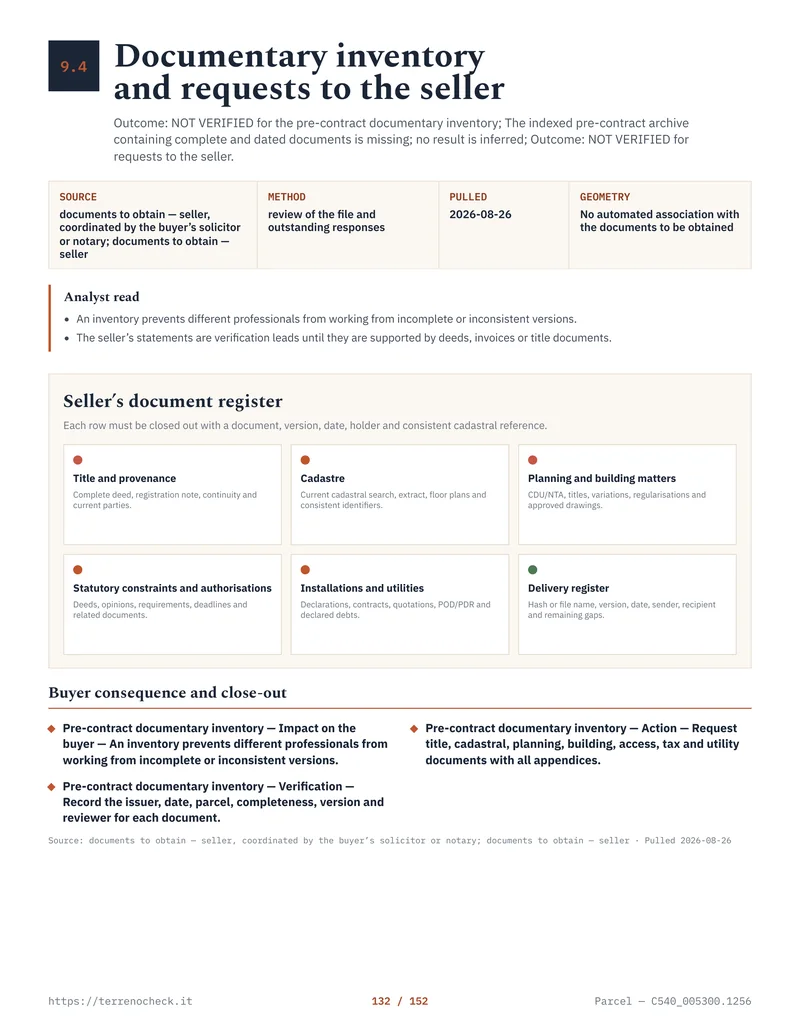 Open the full page
Parti comuni: what Article 1117 presumes
Civil Code Article 1117 creates a presumption of common ownership, “unless the title provides otherwise.” The list is long because the law is trying to catch the parts that make separate units usable as one building.
It includes the ground on which the building stands, foundations, load-bearing walls, pillars, beams, roofs and roof slabs. Entrances, corridors, porticoes, courtyards and façades are included too, as are parking areas and rooms for common services.
The third group covers common installations: lifts, wells, cisterns, water and sewage systems, central gas and electricity distribution, central heating and cooling, reception systems and other information networks, generally up to the point where they branch to an individual unit. Article 1117 is a presumption, not a universal answer to every argument about a terrace, a garden or a pipe. The title, the physical arrangement and the intended use can rebut it.
That is why a rural apartment can have an old well that is a condominium common part, while an independent farmhouse sharing a well with neighbouring parcels may be in ordinary comunione. The label in a sale listing does not decide the legal category.
- Separate units in one building with more than 1 ownerCondominio under Civil Code Articles 1117–1139; common parts are presumed and assembly rules apply. If there are more than 8 condominium participants, administrator appointment becomes compulsory under Article 1129; at 8 or fewer, appointment is optional
- Two owners of separate unitsCondominio minimo under Civil Code Articles 1117–1139, with 2 participants; no Article 1129 administrator threshold is triggered, but condominium rules still govern common-building decisions
- Shared rural road or well held in undivided shares, without condominium unitsComunione under Article 1100; ordinary administration uses Article 1105, while innovations and extraordinary acts use Article 1108
Source: Normattiva, Civil Code Articles 1100, 1105, 1108, 1117 and 1129; Corte Suprema di Cassazione, Rassegna civile 2012
Tabelle millesimali: useful, but not magic
The tabelle millesimali express each unit's proportional value in thousandths. They are used for voting and for allocating expenses under the relevant Civil Code provisions. A table might give an apartment 84.50, another 116.20 and a shop 241.30. Those figures are not square metres, a tax valuation or a promise about resale value. They are a calculation of the unit's relationship to the building for condominium purposes.
Article 68(1) of the implementing provisions says that, unless the title specifies otherwise, the proportional values are expressed in a table attached to the condominium regulation for the purposes identified by the Code. Article 69 allows correction or modification unanimously, and also by the Article 1136(2) majority where the values result from an error or where changed conditions alter a unit's proportional value by more than one fifth. The cost of a correction caused by a physical change is charged to the person who caused it.
Do not accept a loose spreadsheet as binding merely because it has the word millesimi at the top. Ask who prepared it, whether the assembly approved it, whether it is attached to the regulation, and whether the deed contains a different convention. A table attached to a deed can have contractual significance. A table approved as a technical statement of existing proportions is a different thing.
The Cassazione position is often misunderstood. In Sezioni Unite judgment no. 18477/2010, the Court describes approval and revision of a merely technical table as an evaluative act. It records a pre-existing relationship rather than changing ownership value, so the qualified Article 1136(2) majority can be enough. Unanimity still matters where owners deliberately depart from statutory expense criteria.
A challenge needs a reason: an incorrect area, ignored structural feature, later extension, changed unit count or contractual allocation in the title. If your purchase depends on a lower share, have a surveyor read the approved table and title before pricing the apartment.
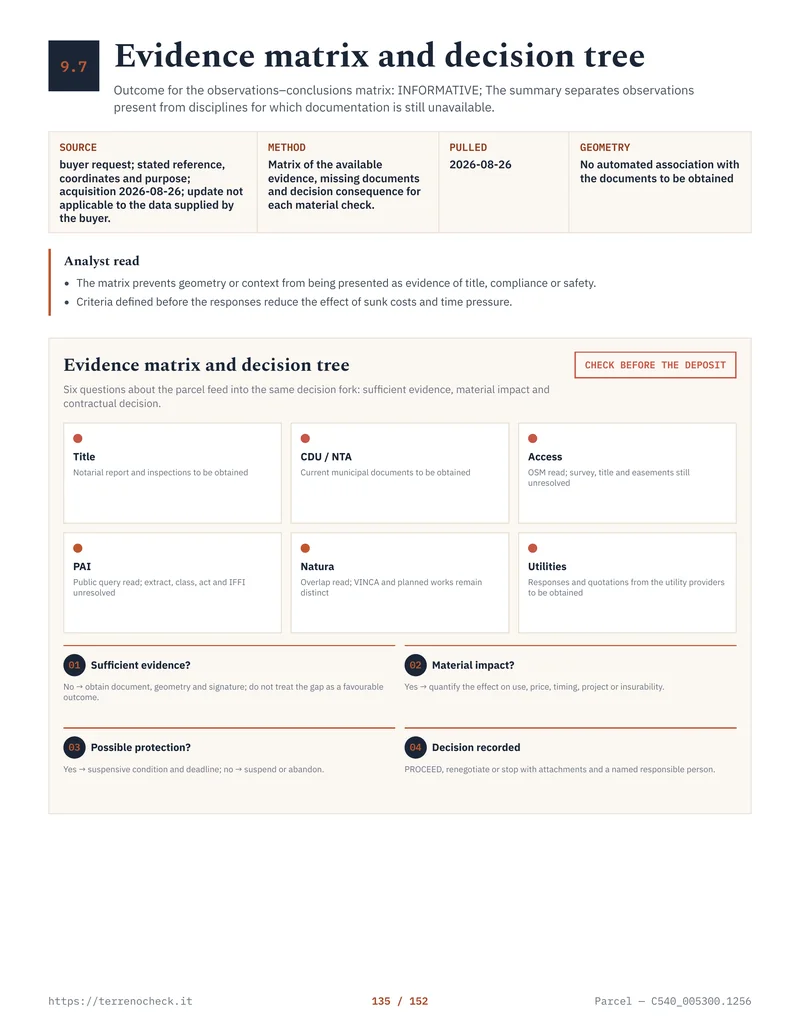 Open the full page
What the assembly can approve
The assembly is where annual budgets, repairs, administrators and many expensive choices are made. Article 1136 does not use one universal percentage. It separates the quorum needed to constitute the meeting from the votes needed to approve a resolution, and it distinguishes an ordinary matter from subjects reserved for a stronger majority.
In first convocation, participants representing two-thirds of the building's value and a majority of participants must attend. A standard resolution then needs a majority of those present representing at least half the value. In second convocation, the thresholds are one-third of participants and one-third of the value, with approval by a majority of those present representing at least one-third of the value.
The second-convocation shortcut does not apply to every serious decision. Appointment or removal of the administrator, litigation outside the administrator's normal powers, reconstruction, extraordinary repairs of considerable size and the other subjects named in Article 1136(4) use the Article 1136(2) approval majority. In practical terms, the vote must be a majority of those present representing at least half the building's value. “It passed in the second meeting” is not enough information.
Innovations have a further rule. Article 1120(1) covers works intended to improve or make more useful or productive the common parts. Article 1136(5) requires votes representing a majority of all condominium participants and at least two-thirds of the building's value. Article 1120(2) prohibits innovations that harm structural stability or safety, alter architectural decorum, or make a common part unusable to even one owner. A high percentage cannot cure a prohibited work.
The minutes should identify the notice, attendees, proxies, millesimi, agenda item, vote and resolution. A feasibility study is not necessarily approval for the works, and a reserve fund can signal a large cost approaching.
‘Ordinary’ and ‘extraordinary’ are not enough to read a vote; the convocation, subject and two separate measures, participants and building value, all matter.
| Matter | Legal reference | Required vote |
|---|---|---|
| Standard decision, first convocation | Constitution: majority of participants + 2/3 of building value | Approval: majority of attendees + at least 1/2 of building value |
| Standard decision, second convocation | Constitution: at least 1/3 of participants + 1/3 of value | Approval: majority of attendees + at least 1/3 of value |
| Administrator, major extraordinary repair or reconstruction | Approval uses Article 1136(2) | Majority of attendees + at least 1/2 of building value |
| Innovation under Article 1120(1) | Article 1136(5) | Majority of all condominium participants + at least 2/3 of building value |
The amministratore and the accounts
An administrator is mandatory when the condominium has more than eight participants: Civil Code Article 1129(1) hands the appointment to the court in that case if the assembly fails to act. At eight or fewer, the owners can still appoint one, but that subsection does not force them to do so. In a small building, one owner may perform the practical work, yet the absence of a professional administrator does not erase the building's duties or its common debts.
Article 1130 gives the administrator a working list: execute assembly resolutions, call the annual meeting to approve the accounts, regulate use of common things and services, collect contributions, pay ordinary maintenance and service expenses, preserve common parts, complete tax obligations, keep the condominium register, keep minutes and accounting registers, preserve management documents, issue the payment-and-litigation certificate requested by a condominium owner (item 9), and prepare the annual account within 180 days of the end of the financial year (item 10).
Article 1130-bis describes what that account must show: income and expenditure, assets, available funds and reserves in a form that permits immediate checking. It consists of the accounting register, a financial summary and a short explanatory note identifying current relationships and pending matters. Owners and holders of real rights or rights of enjoyment over units can inspect supporting expenditure documents at any time and take copies at their own expense. The records and supporting documents must be kept for 10 years from registration, under Article 1130-bis(1).
Article 1129(7) also requires the administrator to use a dedicated condominium bank account. An owner can ask, through the administrator, to see and copy periodic statements at their own expense. These are not privileges reserved for a committee. After the deed, the buyer is a condomino and can use them. Before the deed, the buyer should obtain the documents through the seller and put any unresolved point into the preliminary contract or closing conditions.
There is no national annual “condominium fee.” A building with a lift, central heating, caretaker, insurance, garden and planned façade work will not resemble a two-unit building. The administrator's compensation is specified in the appointment. Ask for the fee proposal and approved budgets, not the listing's monthly estimate.
The buyer needs the payment certificate for the deed, but the annual account and underlying records show whether a clean certificate hides a larger future decision.
| Document or account | Legal reference or timing | What it should reveal |
|---|---|---|
| Payment and litigation certificate | Article 1130(9) | The administrator provides the condominium owner with the payment position and pending litigation |
| Annual account | Within 180 days of financial-year end | Income, expenditure, assets, funds, reserves, financial summary, accounting register and explanatory note |
| Supporting invoices and records | 10-year retention | Owners and qualifying rights-holders may inspect and copy at their own expense |
| Periodic bank statements | Dedicated condominium account | An owner may request inspection and copies through the administrator at their own expense |
Source: Normattiva, Civil Code Articles 1129, 1130 and 1130-bis
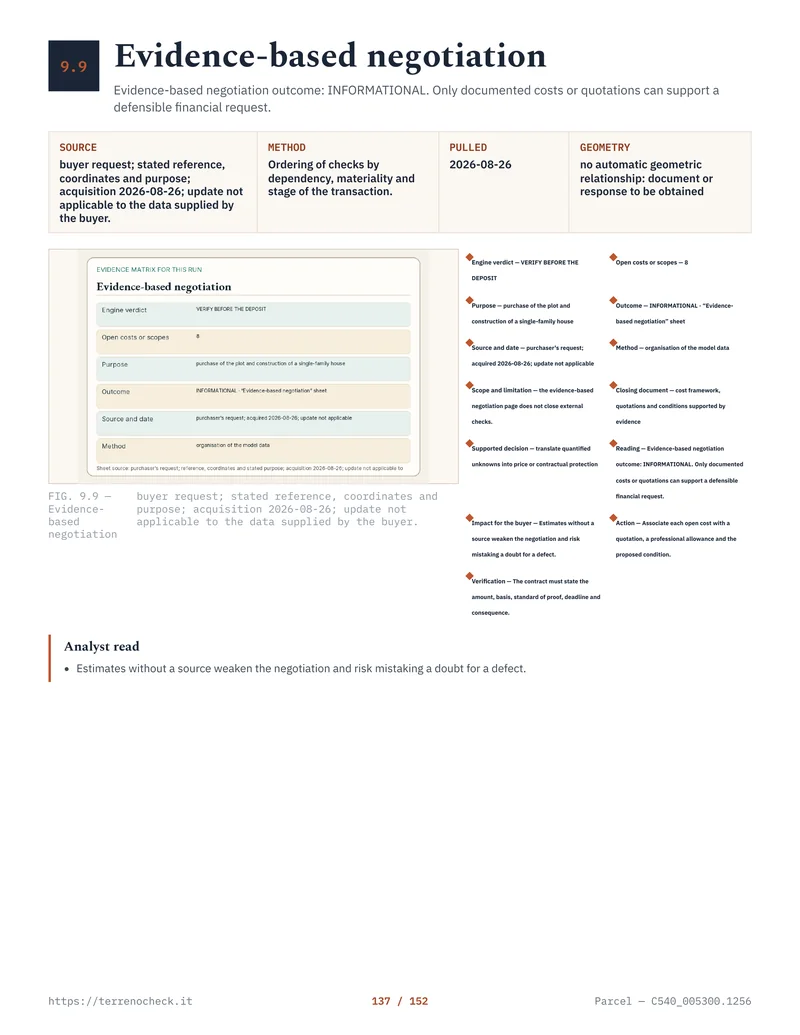 Open the full page
The debt that can follow the buyer
Article 63(4) of the provisions implementing the Civil Code (R.D. 30 March 1942, no. 318) is the unpleasant part of an apartment purchase: a person who succeeds to a condominium owner's rights is jointly liable with that owner for contributions relating to the current year and the preceding year. The seller's private promise to pay does not bind the condominium if the condominium can pursue the buyer under the statutory rule.
The exposure is not limited to ordinary monthly cleaning. It can include a contribution approved for extraordinary works if the amount falls within the relevant period or remains unpaid. The Consiglio Nazionale del Notariato tells buyers to ask about extraordinary expenses already resolved and to obtain the administrator's certificate. It also notes that the seller remains jointly liable for charges until an authentic copy of the transfer deed is sent to the administrator.
This is why a signed allocation in the sale contract is not enough. It may give the buyer a claim against the seller, but it does not turn the condominium's statutory claim off. The expensive surprise is often the unpaid roof, lift, façade or heating contribution discussed in minutes but not cleared before the deed.
Before signing the rogito, demand a recent, signed attestazione dell'amministratore under Article 1130(9). It should state the payment position and any litigation. Ask for the current budget and approved rendiconto, the applicable millesimal tables and regulation, the assembly minutes that record extraordinary works, the list of payments already made for those works, and the administrator's contact and bank details. The Notariato sale-document checklist specifically lists the regulation and the administrator's declaration on paid expenses, extraordinary expenses and pending disputes.
Compare the certificate with the minutes. If it says “paid” but the minutes show a call for funds, ask which instalments cleared and which are merely due. If the administrator will not answer, tell the seller and notary before the preliminary contract becomes binding. The purchase checklist is a useful place to organise these requests alongside the title and planning file.
The preliminary-contract guide explains why a condition, retention or seller payment mechanism belongs in the transaction documents. It does not replace the administrator's certificate.
Condominio minimo: small does not mean informal
With two owners of two separate units, the building is a condominio minimo. There may be no mandatory administrator and no large annual report, but there are still common parts, contributions and decisions. The Cassazione has stated that condominium rules can operate in a two-participant building and that a simple warning to the other owner is not a substitute for properly convening the assembly or approving expenses.
That point matters in a divided rural house. One owner may have repaired a roof and send the other a bill. The invoice proves that money was spent; it does not automatically prove that the other owner approved the work or owes the proposed share. Keep written notice, an agenda, a resolution and the supporting invoice. If the two owners cannot form a majority in practice, the Cassazione material recognises recourse to the court through the linked Article 1105 and Article 1139 provisions. That is a dispute, not a DIY accounting shortcut.
Ask the seller of a two-unit building for titles, any regulation or tables, minutes, receipts, insurance, planned works and correspondence about common parts. “There is no administrator” should lead to more questions, not fewer.
A shared road or well may be comunione instead
A country property often shares an access road, a spring or a well with neighbouring parcels. If the asset is owned in undivided shares and is not a common part accessory to separate units in one building, the starting point is comunione under Civil Code Article 1100. The road may be recorded in several deeds. The well may be on one parcel but owned or used in shares. These facts need the titles and a local check.
The voting rules then change. Under Article 1105, every participant can take part in administration, and ordinary-administration decisions bind the dissenting minority when approved by the majority of participants calculated according to the value of their shares. If no majority forms or a necessary measure is not taken, a participant can ask the judicial authority to intervene.
Article 1108 permits innovations and other acts beyond ordinary administration with a majority of participants representing at least two-thirds of the common asset's value, provided the act does not harm a participant's interest. Sale of the common asset, creation of real rights over it and leases longer than nine years need everyone's consent. Those are not the Article 1136 condominium thresholds.
For the access route, ask for deeds creating or transferring the right, a route plan, maintenance agreements, road-consortium records and disputes. A shared road is not automatically the servitù di passaggio needed by a buyer. The access-rights guide covers title, route, road status and landlocked parcels.
For a well, check who owns the structure, who can draw water, whether pumps and electricity are shared, who repairs the pipe and whether a public or regional water rule affects extraction. Article 1117(3) can point to condominium ownership when the well serves separate units in the building. Article 1100 is the more natural starting point for a well held between independent rural parcels. Do not copy a condominium expense schedule onto the latter without reading the deeds.
A shared rural road or well has a different decision rule from a condominium stairwell or roof; the title and the asset's relationship to the building come first.
| Shared asset or act | Legal reference | Required decision |
|---|---|---|
| Ordinary administration of a shared road or well | Article 1105 | Majority of participants calculated by the value of their shares |
| Innovation or other act beyond ordinary administration | Article 1108 | Majority of participants + at least 2/3 of the common asset's value |
| Sale or creation of a real right over the common asset | Article 1108 | Consent of all participants |
| Lease longer than 9 years | Article 1108 | Consent of all participants |
A practical file for the buyer
Start with the seller's title. Ask whether it refers to a regulation, millesimal tables, partial condominium, road consortium, well agreement or right of use. Then identify the administrator, if there is one, and request the documents. An estate agent can coordinate, but cannot certify the building's debts.
Have the notary review the title and transfer documents, and have a technician look at the physical parts that determine use and expense: roof, terrace, cellar, external walls, heating plant, access route, drainage and well. The notary's role is distinct from a technical inspection. If a table seems wrong, commission a targeted check. If a large work appears in the minutes, ask what was approved, paid, outstanding and allocated.
There is no reliable national price for this package. Quotes vary with deeds, languages, archive work, travel, technical complexity and disputes. Ask for a written scope and separate quotes for translation, inspection, technical calculation or legal opinion. Nobody can price a leaking roof, an unapproved table or a neighbour's unpaid share from a desk. Allow for these variable lines alongside the purchase-cost guide.
The point of the checks is simple: purchase the apartment with a clear view of the common parts, the voting history and the debt exposure. If the seller cannot produce the documents, price that uncertainty as a real transaction problem. Do not call it “just condominium paperwork.”
Sources
- Normattiva, Civil Code, condominium and co-ownership provisions, Articles 1100–1139
- Normattiva, R.D. 30 March 1942, no. 318, implementing and transitional provisions, Articles 63 and 68–69
- Corte Suprema di Cassazione, Rassegna civile 2020, approval and revision of millesimal tables
- Corte Suprema di Cassazione, Rassegna civile 2012, condominio minimo
- Consiglio Nazionale del Notariato, documents for a property sale
- Consiglio Nazionale del Notariato, Vivere in condominio
- Normattiva, Law 11 December 2012, no. 220, Article 1, which replaced Civil Code Article 1117
- Normattiva, Law 220/2012, Article 5, subsections inserted into Civil Code Article 1120
- Normattiva, Law 220/2012, Article 9, which replaced Civil Code Article 1129
- Normattiva, Law 220/2012, Articles 10 and 11, which replaced Civil Code Article 1130 and inserted Article 1130-bis
- Normattiva, Law 220/2012, Article 14, which replaced Civil Code Article 1136
- Normattiva, Law 220/2012, Article 18, which replaced Article 63 of the implementing provisions
- Normattiva, Law 220/2012, Articles 22 and 23, which replaced Articles 68 and 69 of the implementing provisions
- Gazzetta Ufficiale, Civil Code Article 1100, rules governing co-ownership
- Gazzetta Ufficiale, Civil Code Article 1105, administration of the common thing
- Gazzetta Ufficiale, Civil Code Article 1108, improvements and acts beyond ordinary administration