
One-euro houses in Italy: the real cost
A one-euro house is a renovation obligation wrapped around a symbolic transfer price. Here is how the published comune schemes work, what stone buildings cost to repair, and what a buyer must check before committing.
Contents
A one-euro house scheme sets a nominal purchase price but leaves the buyer responsible for the costs and obligations stated in the municipal notice. Budget separately for the transfer, taxes, notary, technical work, permits, construction and utilities.
The obligations are not national rules. They are terms written by a comune, and the terms can change from one call for applications to the next. A buyer from abroad, or an Italian buying outside their home municipality, should read the actual bando before arranging a viewing or sending money. This preflight guide does not provide legal, tax, architectural, surveying or investment advice.
The €1 is a transfer price, not a house price
There are two arrangements hiding under the same label.
In the first, the house is privately owned. The owner tells the municipality that they are willing to sell, often at a symbolic price, and the municipality collects expressions of interest, publishes a listing or makes a match, and monitors the recovery promise. Cantiano’s published page describes a private owner making the property available for three years and an acquirer declaring interest through the Comune. Pietramelara says the same thing in plainer terms: owners of empty historic-centre properties notify the Comune, while the buyer separately declares an interest in acquiring and restoring the house. The Comune is a broker and a keeper of public conditions. It is not automatically the seller.
Ollolai’s 2016 avviso is a clean example. The notice says owners have made, or are making, properties available for transfer, then asks private citizens, including Italian, EU and non-EU citizens, to submit a recovery proposal. It describes the transfer as free from the owner, with the buyer carrying the transfer expenses. That is not the same transaction as buying a municipal asset at auction.
In the second arrangement, the Comune owns the property. Zungoli’s February 2025 notice identifies 11 properties inside the historic centre as municipal properties and asks interested buyers to submit a manifestation of interest with a recovery proposal. This is a public-asset sale process, even though the advertising language still says “one euro”. The one-page notice does not state a bond or a completion deadline. Do not import Cantiano’s terms into Zungoli’s call because the names sound alike.
Sambuca di Sicilia shows a third practical distinction. Its published bando for the “3 euro” properties says the selection is a secret offer, only upward from the price placed as the auction base. The best offer for the administration wins. The base is a starting point, not a promise that the property will be yours for three euros. A second lot can require another EUR 5,000 deposit. The same bando says that, after the works are completed, the successful bidder can sign the sale contract. That is a different risk profile from a private owner signing a normal sale deed at the start.
The question to ask is not “Is it one euro?” It is “Who owns this unit today, who signs my deed, and what event releases me from the Comune’s conditions?” Your property checklist should record the owner, the sale mechanism, the lot number, the deposit, the deadline and the documents attached to that particular notice.
A symbolic price does not create a standard product. The missing term in a notice is a missing fact, not permission to assume the most favourable version.
| Comune and property route | Published price or base | Bond or deposit | Project deadline | Works deadline | What the notice says about failure |
|---|---|---|---|---|---|
| Cantiano, private owner | €1 symbolic price | €4,000 fideiussoria within 2 months of assignment | 6 months after the sale deed | Start within 12 months of the permit; finish within 3 years of starting | Terms are buyer obligations |
| Pietramelara, private owners | €1 symbolic price | €5,000 fideiussoria within 3 months of assignment | 1 year after the sale deed | Start within 2 years of purchase; completion date not stated on the page | Published page states the bond and obligations |
| Ollolai, owner transfer | Free transfer in the 2016 notice | €1,000 policy valid for 3 years | Project and required opinions within 1 year of purchase | Start within 2 months of the building permit; the notice ties the policy to concrete completion | Comune may take the policy and buy the property at the symbolic price |
| Sambuca di Sicilia, municipal auction | Secret offer above the auction base | €5,000 deposit | Technical documentation within 90 days | Renovate within 36 months of award | Revocation and loss of deposit if the stated terms are missed |
| Zungoli, municipal properties | €1 notice; 11 public units in the 2025 call | Not stated in the one-page notice | Recovery proposal required | Not stated in the one-page notice | Read the linked deliberation and lot documents |
Source: Comune di Cantiano; Comune di Pietramelara; Comune di Ollolai; Città di Sambuca di Sicilia; Comune di Zungoli.
Pages from the delivered dossier
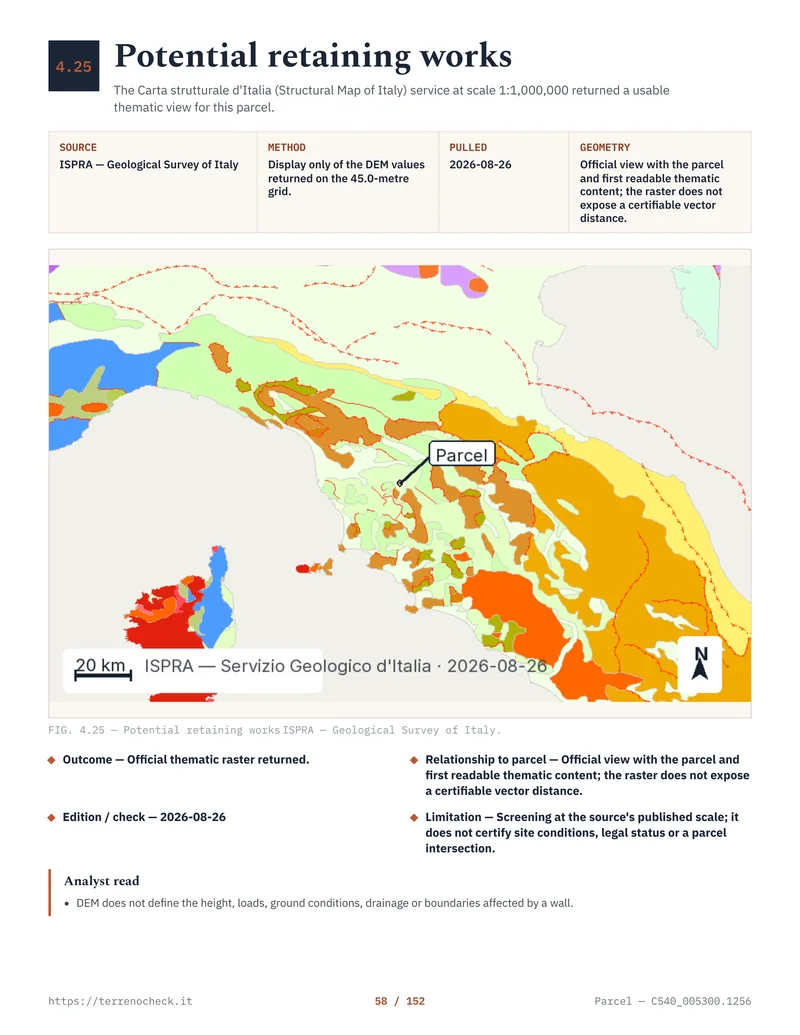 Open the full page
The bond, the project and the three-year clock
The familiar pattern is a performance guarantee, a design deadline and a works deadline. The amounts are local.
Cantiano publishes a EUR 4,000 polizza fideiussoria. The buyer must constitute it within two months of approval of the assignment acts, lodge the restoration project within six months of the sale, start within 12 months after the building permit or equivalent act, and finish within three years from the start. Pietramelara publishes EUR 5,000, a project within one year of the purchase contract and a start within two years of purchase. Its page does not give a final completion date. Ollolai publishes a EUR 1,000 policy valid for three years, so no EUR 2,000–5,000 range is universal.
Sambuca’s bando calls its EUR 5,000 payment a deposit. The buyer submits the technical documentation within 90 days and must renovate within 36 months of the award. The bando says the deposit is lost if the money, documents or works are not delivered on time. In a municipal auction, “deposit” may also be tied to the bid procedure and later purchase contract, so ask the Comune exactly when it is returned, applied to the price or forfeited.
These are not harmless administration dates. A project that misses the deadline can leave you with an unfinished building and a claim against the guarantee. A bond is not a renovation budget; it is money or credit capacity locked behind a compliance condition. Ask the bank or insurer what security, duration, renewal and cancellation wording it requires. Ask the Comune for the draft deed and the exact release event before you sign an offer.
Source: the four municipal notices linked in Figure 1.
- Assignment approved
- Within 2 months: constitute EUR 4,000 fideiussoria
- Sale deed
- Within 6 months: lodge the project
- After the permit: start within 12 months
- Finish within 3 years from starting
Source: Comune di Cantiano, Case a 1 euro.
What the building may cost
A stone shell in a historic centre is not a normal empty room. It can need structural stitching, roof work, floors, damp treatment, windows, stairs, electrical and water systems, drainage, fire measures, design, permits and a route for every delivery. The floor area in the advert is a poor proxy for the amount of wall, roof and temporary works.
The official way to start pricing is a computo metrico estimativo built from the applicable regional prezzario. The Region of Abruzzo’s 2025 building price list gives, among other items, EUR 272.80 per cubic metre for elevated calcareous-stone masonry with supplied stone and a rustic face, EUR 23.41 per square metre for recessed pointing of stone masonry, and EUR 12.91 per square metre for the second rustic face. Those are work-item prices, not a promise that a builder will renovate a house for EUR 272.80 per cubic metre.
Here is a deliberately narrow calculation. Suppose a 60 m² house needs 10 m³ of new or rebuilt stone wall, 40 m² of recessed pointing and 40 m² of second-face finishing. The three published items total EUR 2,728 + EUR 936.40 + EUR 516.40 = EUR 4,180.80, or EUR 69.68 per m² of floor area. That sounds cheap because it excludes nearly everything else. It has not priced a roof, slab, damp course, windows, internal finishes, services, structural engineer, architect, surveyor, scaffolding, waste charges, VAT or the cost of carrying materials through a lane.
The useful conclusion is not “stone restoration costs EUR 70 per m²”. It is that a price list lets you expose the first layers of the budget, while a technician must measure the actual building. If a seller or listing offers a single all-in renovation number without a survey and a scope, treat it as a marketing figure. Ask for the quantities, the price-list edition, exclusions and contingency logic. Nobody can tell you the real total from a desk.
Source: Regione Abruzzo, Prezzario opere edili 2025, section ABR25_E.05.10. Quantities and the 60 m² floor area are an editorial illustration; they are not a survey of a particular house.
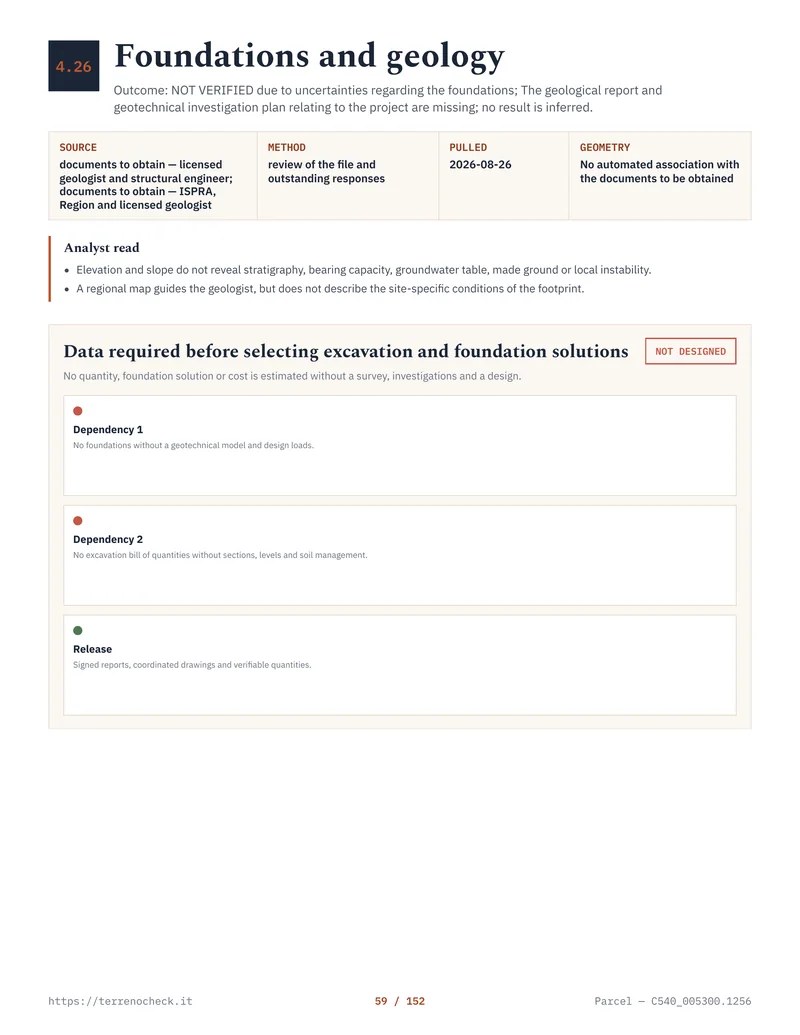 Open the full page
Historic-centre rules and landscape protection
The phrase “historic centre” usually means the municipal planning system will care about the building’s relationship with the street. D.M. 1444/1968 identifies Zone A as areas containing historic, artistic or environmental-value urban agglomerations. The operative rules, however, are in the current PRG, PUC, PSC, PGT or equivalent plan, its NTA and the building regulations of that Comune. The planning designation guide explains why the label in an advert is only the start of that check.
Expect the technician to check whether the project can change the roof form, external openings, shutters, balconies, render, exposed stone, gutters, colours, height, internal layout or use. A small opening onto a narrow lane can be a planning issue. An external heat pump can be a façade issue. A roof replacement can become a structural and visual issue. “It is already there” does not answer whether the existing work is lawful or whether a proposed change is permitted.
Landscape protection is a separate question. A Zone A label does not, by itself, prove a vincolo paesaggistico, and a landscape vincolo does not mean every intervention follows the same procedure. D.Lgs. 42/2004, Article 146(1) and (2) restricts modifications that harm protected landscape values and provides the authorisation route. DPR 31/2017 identifies interventions excluded from authorisation and those eligible for the simplified procedure. The competent regional or delegated authority, with the Soprintendenza where required, decides how the project is classified.
Before bidding, obtain the map or plan extract showing the constraint, the relevant landscape-plan prescription and a written view from the architect on the authorisation route. Read the landscape safeguards article with the Comune’s NTA. A bando’s promise that the Comune will help with paperwork is not a prior authorisation, and it is not a guarantee that your preferred windows, solar panels or roof will be approved.
The medieval alley is a cost line
Photographs conceal access. A stone house may face a lane too narrow for a van, have steps at the entrance, sit below the road, or require a neighbour’s permission for scaffolding. The contractor may need a small tracked machine, a hoist, hand carts, temporary storage and a plan for rubble removal. A crane or concrete pump may be impossible, or possible only for a short closure under local permission.
The same Abruzzo 2025 prezzario has a specific line for removal of hand-excavated or awkward-location debris to a licensed tip within 10 km at EUR 80.40 per m³, and a line for hand-cart movement in difficult areas for up to 50 metres at EUR 45.17 per m³. These are useful evidence that constrained access is priced work. They are not a fixed medieval-alley surcharge. Add the actual route, distance, lifts, road occupation, disposal and waiting time to the contractor’s computo.
Walk the route with the geometra or architect and the builder who would actually quote the works. Measure the narrowest point. Photograph gates, stairs, overhead cables and adjoining façades. Ask who obtains any occupazione suolo pubblico, traffic restriction or scaffold permission, and who pays for protection and repairs. Check whether a vehicle can reach the building, not merely whether Google Maps can reach the street. The access rights guide explains why a visible track or neighbour’s kindness is not automatically a vehicle right.
Source: Regione Abruzzo, Prezzario opere edili 2025, section ABR25_E.01.200.
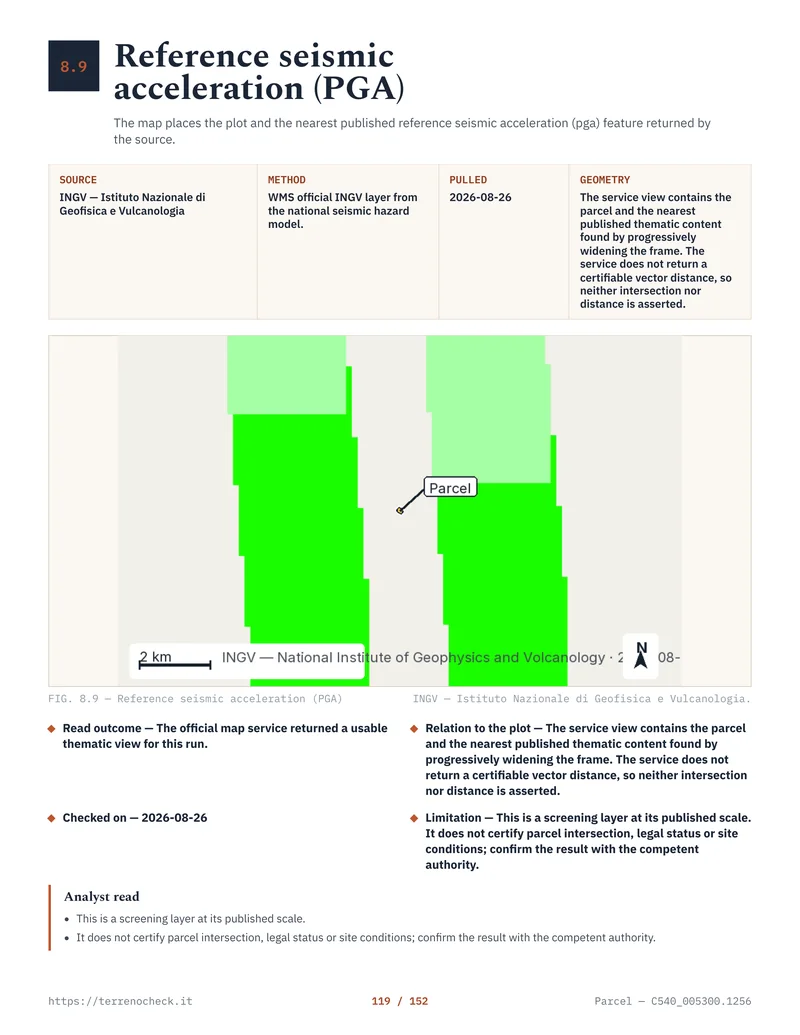 Open the full page
Utilities: the Comune is not your supplier
An empty house may have a meter, a disconnected service, an old internal installation, or no connection at all. Those are four different problems. The seller or Comune may provide a meter number and a past bill, but that does not prove that the internal installation is safe, that the service is active, or that the line has the capacity your renovated house needs.
ARERA’s electricity guidance distinguishes a new electricity connection from activation where the connection already exists. The distributor’s estimate must state the connection cost, which depends on factors such as distance, power and the fixed administrative contribution. For water, ARERA’s water guidance directs the applicant to the local integrated-water-service operator. The operator’s rules and published price list govern the connection, and the estimate must state the charge.
In practical terms, the buyer should ask the seller, the Comune and the local operators three separate questions: Is there a physical connection at the property boundary? Is there a meter and an account history? Is the internal installation certifiable after the proposed works? Ask for written connection estimates before treating the house as habitable. If the lane needs excavation, the quote may also depend on road ownership, pavement reinstatement and permission.
The end state matters. DPR 380/2001, Article 24 requires, in subsection 1, that the agibilità filing address safety, hygiene, energy saving and the installed systems, with the documents specified by the article. A utility connection alone does not create agibilità, and an old meter does not repair an unsafe installation. Compare the service plan with the agibilità requirements and the utility connections guide.
Who should buy one, and who should walk away
This can suit a buyer who wants a long project, has cash beyond the symbolic price, can visit regularly, accepts a local professional team and is comfortable with a house that may not be usable for years. It can suit someone who wants a permanent home or a carefully planned small hospitality project in a centre they have actually visited. The programme may open access to a building that ordinary listings would never package for an overseas buyer.
It does not suit a buyer who needs a finished holiday home next summer, plans to manage the work from another country without an Italian-speaking representative, or is relying on a mortgage based on the one-euro price. It does not suit someone who cannot fund the first technical studies, the guarantee, the taxes and the first construction stage before knowing whether a permit will be obtained. It is a bad fit for a buyer who dislikes binding deadlines.
Walk away, or pause the offer, if the owner, title route or sale contract is unclear; if the house cannot be reached with the proposed construction method; if the Comune has not given you the current bando and lot documents; if the project depends on a landscape approval nobody has checked; or if the seller says utilities are “nearby” without a written operator estimate. A one-euro house with no lawful route, no workable project and no service plan is not a bargain. It is an unpaid investigation.
Before you commit, have the notary examine the proposed transfer and the technician compare the cadastral extract with the building, title history and municipal file. Price the taxes, notary, translations and other purchase expenses in the purchase costs guide. Then ask the Comune one final question in writing: which exact document releases the bond and confirms that every programme obligation has been met?
Sources
- Comune di Cantiano, Case a 1 euro: published buyer obligations and timetable
- Comune di Pietramelara, Case ad un euro nel Borgo
- Comune di Ollolai, Avviso pubblico Case ad un euro
- Città di Sambuca di Sicilia, Bando case a 3 euro
- Comune di Zungoli, Case a un euro IV bando
- Regione Abruzzo, Prezzario opere edili 2025
- Normattiva, D.Lgs. 22 January 2004, no. 42, Article 146
- Normattiva, DPR 13 February 2017, no. 31
- Gazzetta Ufficiale, D.M. 2 April 1968, no. 1444
- ARERA, electricity connections and activation
- ARERA, water-service connections and activation
- Normattiva, DPR 6 June 2001, no. 380, Article 24
- Normattiva, D.Lgs. 42/2004, Article 146(1) and (2), current text
- Normattiva, DPR 380/2001, Article 24(1), current text