
Seismic zones in Italy: what they cost buyers
The zone printed beside an Italian comune is a starting label, not a structural verdict. Here is what it changes, what it does not, and which documents can stop an expensive mistake.
Contents
- The national framework, and the part regions actually decide
- What changes when you build
- What it adds to the budget
- Why the comune map is not enough
- How to read an INGV PGA number without fooling yourself
- Existing buildings: the zone is the beginning of the problem
- What “Sismabonus class” actually means
- Insurance: ask about the contract, not the colour on the map
- What to request before signing
A municipal seismic zone classifies the whole comune, not the plot. It tells you nothing about what the ground under this building will do, nor whether an eighty-year-old structure has a defensible load path. Both are separate checks, and both belong before the offer.
Italy’s seismic zone is useful and easy to misuse. It is assigned at comune level, maintained through regional classification, and is not the design acceleration for your parcel. The cost appears later, in investigation, design, filing and sometimes work on the building.
Use this buyer’s explanation for screening, not as a structural assessment, tax opinion or buildability guarantee. Start with the Italy land-buying checklist. Seismic screening belongs beside planning and cadastral checks.
The national framework, and the part regions actually decide
The modern four-zone system began with Ordinanza del Presidente del Consiglio dei Ministri n. 3274 of 20 March 2003, published in the Official Gazette in May 2003. Its national criteria replaced the older three-category approach and required the regions to identify, form and update the lists of seismic zones. Article 2 of the ordinance expressly preserves regional competence and leaves each region discretion over whether to impose antiseismic design in Zone 4. The Protezione Civile text of OPCM 3274 says this plainly.
The later OPCM 3519 of 28 April 2006 updated the hazard study and tied the zones to bands of peak ground acceleration, ag, with a 10% probability of exceedance in 50 years. The labels are national shorthand; the municipal list is regional. Some regions use the four proposed zones, others use three zones or sub-zones. The DPC’s current page links the regional acts updated to 31 May 2025 and the municipal CSV. Do not copy a zone from an old estate brochure.
The four municipal seismic bands
| Zone | DPC / OPCM 3519 acceleration band, ag | Conventional rock anchor | Plain reading |
|---|---|---|---|
| 1 | 0.25 < ag ≤ 0.35 g | 0.35 g | Highest classification band |
| 2 | 0.15 < ag ≤ 0.25 g | 0.25 g | Strong earthquakes are possible |
| 3 | 0.05 < ag ≤ 0.15 g | 0.15 g | Lower municipal classification than Zones 1–2 |
| 4 | ag ≤ 0.05 g | 0.05 g | Lowest classification band; regional rules still matter |
Source: Dipartimento della Protezione Civile, Classificazione sismica
Source: Dipartimento della Protezione Civile, Classificazione sismica. The bands describe the classification framework, not a soil test or a building’s probability of collapse.
Source: Dipartimento della Protezione Civile, Classificazione sismica, table based on OPCM 3519/2006
The crucial correction came with the 2008 technical rules, now updated by Ministerial Decree 17 January 2018, NTC 2018. Since 1 July 2009, the project uses reference acceleration tied to project coordinates and the building’s nominal life. DPC describes a national grid with 5 km spacing. The municipal class is not a number to paste into a calculation.
Pages from the delivered dossier
 Open the full page
What changes when you build
For a new building, the earthquake is one input in a chain. The structural engineer chooses the building type, use class, nominal life, structural system and analysis method. The geologist and geotechnical engineer establish what sits below the foundations and whether amplification, slope instability or liquefaction requires further work.
The paperwork follows the structure. DPR 380/2001, Article 93 requires notice and project presentation for construction, repair and raising works in seismic areas. Article 94 governs starting works without the required authorisation. Article 94-bis distinguishes interventions by their relevance to public safety for regional implementation.
In practice you will hear two phrases: deposito sismico, a seismic project filing, and autorizzazione sismica, prior approval. They are not interchangeable across Italy. The region sets the procedure, lists the interventions, identifies the competent Genio Civile office and may sample some deposits.
Lazio is a useful example of the danger. Its current public guidance says authorisation is issued by the competent Genio Civile area under Articles 94 and 94-bis, and reports a 30-day period for the stated authorisation and deposit procedures. Its Regulation 26/2020 classifies interventions as relevant, of lesser relevance or without relevance: the first require prior authorisation, the second follow a different filing route, and the third do not require a seismic authorisation request under that regional regulation. That is Lazio law and procedure, not a national 30-day promise. Tuscany, Emilia-Romagna, Sicily and other regions have their own forms, thresholds and portals.
Ask the professional handling the permit to name the regional act and the exact procedure before you sign a construction contract. “We will sort the Genio Civile later” is not a harmless sentence. It can mean a redesign, a delayed start or a building that cannot be lawfully occupied.
What it adds to the budget
There is no national euro tariff that turns “Zone 2” into a predictable surcharge. The zone itself does not add a fixed percentage to the concrete bill. The spend comes from the site and the design:
- a geological and geotechnical investigation, with tests chosen for the site and proposed structure;
- structural design under NTC 2018, including calculations, drawings and construction details;
- regional filing, review or authorisation charges, where applicable;
- additional excavation, foundations, retaining structures, reinforcement or sequencing if the ground or building demands it.
For a small house, these are separate professional and construction packages, not one Italy-wide percentage. A builder’s square-metre quote made before the ground model exists is preliminary. Budget investigation and structural design first, then ask what the price includes. A report that does not answer the engineer’s questions is not a saving.
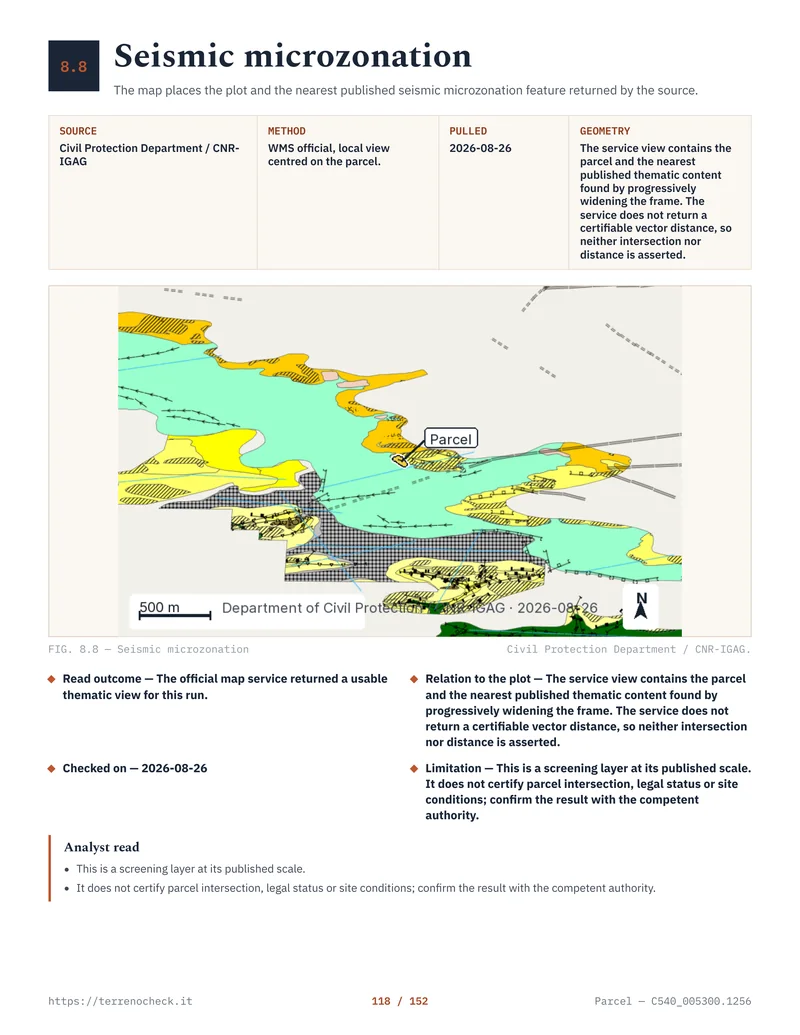
Microzonation can change the answer again. The DPC microzonation guide describes Level 1 as a preparatory collection of existing data, Level 2 as the quantitative map stage, and Level 3 as deeper work on particular areas or issues. Two streets in one comune may not be the same site.
- Municipal classification4 zones assigned by the comune · planning/control
- Coordinate hazardDPC reference grid with 5 km spacing · base hazard reference
- Microzonation3 MS levels: 1, 2 and 3 · local amplification/instability knowledge
- Project modelParcel coordinates and nominal life · design decision
Source: DPC, Classificazione sismica; DPC, Microzonazione sismica.
Why the comune map is not enough
The national zone has hard administrative edges. The ground does not. Soft alluvial deposits, filled ground, a terrace, a steep slope or a shallow rock contact can change shaking locally. A Zone 3 plot is not automatically less troublesome than a Zone 2 plot, and Zone 4 is not a clean bill of health.
Before paying the price asked for buildable land, ask the comune or regional geoportal for the adopted study and approval status. Check the exact parcel, not merely the historic centre. Read the legend and report. “Microzonazione available” is incomplete without the level, date and coverage.
Keep this separate from hydrogeology. A steep site may have a seismic slope problem and a PAI landslide classification. A valley floor may have liquefaction questions and flood restrictions. The PAI and flood-landslide guide covers the other hazard layer. A seismic map will not answer it.
 Open the full page
How to read an INGV PGA number without fooling yourself
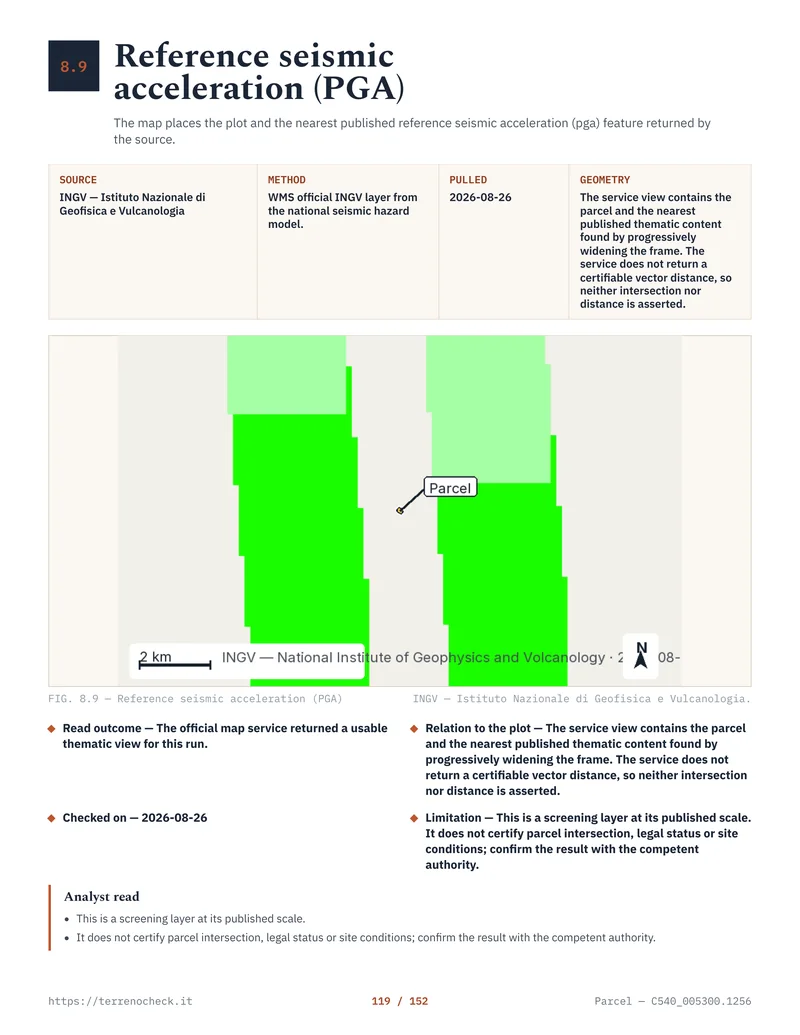
INGV’s MPS04-S1 model provides PGA maps for different probabilities of exceedance in 50 years. Its help page lists 9 probabilities, from 2% to 81%, and offers the 50th percentile plus the 16th and 84th percentiles for estimate variability.
PGA means peak ground acceleration, commonly shown as a fraction of g. It is not earthquake magnitude, felt intensity, building damage or structural vulnerability. Record the model, probability or return period, percentile and site condition. A rock-site PGA is not the motion at foundations on soft soil.
The NTC design process also uses the building’s nominal life and use class. An ordinary private house is not checked in the same way as a hospital or emergency facility. The engineer may need the response spectrum, soil category, topographic factor and local response analysis, not one attractive colour from an INGV screenshot.
- No 50-year exceedance probabilityDo not compare it with a zone band
- Probability stated, percentile missingReport uncertainty as incomplete
- Probability and percentile stated, but no site/reference condition or soil/topographic modelBase hazard context only
- Probability, percentile, site/reference condition and soil/topographic model statedEngineer may use it with the NTC 2018 site model
Source: INGV, Seismic hazard model MPS04-S1; DPC, Classificazione sismica
Existing buildings: the zone is the beginning of the problem
With an old house, vulnerability often matters more than the municipal label. Masonry quality, irregular additions, weak connections, soft ground floor, poor roof-to-wall ties, corrosion, foundation movement and undocumented alterations are physical facts. The cadastral file will not tell you most of them. A visura catastale identifies recorded property data; it is not a structural survey.
NTC 2018 Chapter 8 treats an existing building as one whose structure is complete at the time of assessment or intervention. The engineer works from its history, geometry, details, materials and soil information, with investigation quality affecting confidence factors. The result may be continued use, restrictions or intervention. A buyer cannot infer it from a Zone 2 pin.
The NTC also defines three intervention families: local repair, improvement and adaptation. Adaptation is mandatory for specific changes. The following thresholds are the ones buyers should recognise in a scope of works.
NTC 2018 triggers for mandatory adaptation
| Trigger for mandatory adaptation, DM 17 January 2018 (NTC 2018), § 8.4.3 | Sourced figure | What to ask for |
|---|---|---|
| Raising the building, letter a) | Yes | Full structural project and verification, not a cosmetic roof plan |
| Structurally connected extension that significantly changes response, letter b) | Yes | The post-work model for the whole relevant structure |
| Change of use increasing global vertical foundation loads, letter c) | More than 10% | The calculation behind the load increase and local checks |
| New vertical structural elements carry at least half of total gravity loads, letter d) | ≥ 50% | Proof that the “renovation” has not become a new structural system |
| Change to a Class III school or Class IV use, letter e) | Yes | The use-class change and the required safety level |
| Required post-intervention seismic ratio, cases a), b) and d) | ζE ≥ 1.0 | Engineer’s stated capacity-to-demand result |
| Required post-intervention seismic ratio, cases c) and e) | ζE ≥ 0.80 | Engineer’s stated result and why that case applies |
Source: Gazzetta Ufficiale, NTC 2018, Chapter 8, §§8.3–8.4.3
Source: Gazzetta Ufficiale, NTC 2018, Chapter 8, §§8.3–8.4.3. The table extracts the stated cases; read the full chapter for application.
What “Sismabonus class” actually means
The Sismabonus risk class is a classification method for existing buildings under the MIT’s DM 58 of 28 February 2017, adopted under Article 16(1-quater) of D.L. 63/2013 and amended by DM 65 of 7 March 2017 and later acts. The guidelines identify eight risk classes, from A+ through G, using a method that combines expected safety and economic loss. A qualified professional must attest the pre-intervention and achievable post-intervention class for the relevant incentive route.
That class is not the municipal seismic zone. It is not an earthquake-resistance certificate. It is not proof that the house has no cracks, no illegal work or no foundation problem. The tax incentive has its own eligibility dates, percentages, spending limits and taxpayer conditions. The current text of D.L. 63/2013, Article 16(1-bis) shows the specific 50% seismic route for documented expenses through 31 December 2024 in Zones 1 and 2, and Article 16(1-ter) extends it to Zone 3 for the stated period. Article 16(1) of the same act sets a separate 2025–2027 renovation deduction framework. Old webpages still advertising 70%, 80%, 85% or 110% as if they were automatically available in 2026 are not a purchase budget.
Ask to see the professional’s risk-class asseverazione, the method used, the structural reports and the tax basis for the exact works and year. If the seller says “Sismabonus class A” but cannot produce the signed technical file, you have a sales phrase, not evidence.
 Open the full page
Insurance: ask about the contract, not the colour on the map
IVASS’s June 2026 survey found that catastrophe policies vary by location, insured value, clauses, deductibles, excesses and exclusions. Its report says earthquake cover has defined insured assets and conditions. A house can be in a low municipal zone and still be difficult or expensive to insure because of age, condition, previous damage or construction type.
Ask the insurer in writing:
- Is earthquake damage covered, or only fire and ordinary building damage?
- What are the deductible, excess, maximum payment and exclusions?
- Is the building required to be legal, habitable and in good static condition?
- Are contents, temporary accommodation, demolition and debris removal included?
- Does the policy follow the building, the policyholder or neither on sale?
IVASS publishes actual cat-nat policy data by province and insured value, but warns that policy prices vary significantly inside the same group. An online quote is not evidence of insurability at the address you are buying. The landscape-constraint guide is relevant too: a protected building may face repair permissions that affect reinstatement.
What to request before signing
For land, request the current regional classification for the comune, source date and any sub-zone; the adopted microzonation map and report for the parcel; any slope, liquefaction or ground-instability note; and the regional Genio Civile procedure for the proposed work. Ask a local engineer or geologist to state what remains unknown.
For an existing building, ask for the original structural project, seismic deposit or authorisation, test reports, completion and static-testing documents, later structural permits, earthquake-damage records, risk-class asseverations and Genio Civile correspondence. Cross-check extensions against the planning file. The CDU guide helps with planning, but it will not replace the structural archive.
Before the contract becomes binding, write the uncertainty into the offer. Make the price or completion conditional on a named technical review. State who pays for supplementary drilling, opening-up, testing or redesign. A Zone 4 classification answers the municipality-level screening question only; site conditions, the structure and the intended use still have to be verified.
Nobody can tell you from a desk whether an old masonry house will pass a structural assessment, whether a hillside needs retaining works, or whether a foundation can carry your planned extension. The engineer needs the building, the ground, the drawings and the proposed use. Pay for that answer before you pay the price of buildable land.
Sources
- Dipartimento della Protezione Civile, Classificazione sismica
- Dipartimento della Protezione Civile, OPCM 3274 of 20 March 2003
- Normattiva, DPR 380/2001, Article 93
- Normattiva, DPR 380/2001, Article 94
- Normattiva, DPR 380/2001, Article 94-bis
- Gazzetta Ufficiale, DM 17 January 2018, NTC 2018
- Dipartimento della Protezione Civile, Microzonazione sismica
- INGV, Seismic hazard model MPS04-S1
- INGV, MPS04-S1 interactive model
- MIT, DM 58 of 28 February 2017 and seismic risk-class guidelines
- Normattiva, D.L. 63/2013, Article 16, current text
- IVASS, Second survey on catastrophe-risk policies, June 2026
- IVASS, actual prices for cat-nat policies
- Regione Lazio, seismic authorisations and deposits
- Regione Lazio, Regulation 26/2020, coordinated text