
Buying inherited property in Italy: succession checks
An inherited home can look straightforward and still fail a bank's title review. Here is what to check in the succession file, the land registers and the family history before you make an offer.
Contents
- Why a bank hesitates at provenienza successoria
- The declaration of succession and the cadastral update
- Acceptance: tacita, espressa and transcribed
- Reserved shares and the action of reduction
- Why provenienza donativa still gets extra scrutiny
- Comunione ereditaria: one property, several sellers
- Eredità giacente: the estate has a manager, not a convenient seller
- The buyer's practical checklist before an offer
The advert says “inherited property”. That tells you how the seller acquired it, not whether the seller can give you a clean, bankable title today.
In Italy, a succession file can contain a death, a will, several children, a surviving spouse, a declaration made for tax purposes, a cadastral update and no registered acceptance of the inheritance. Those are different facts. This pre-purchase checklist does not provide legal, notarial, tax or family-law advice. The notary must examine the title and the relevant professionals must deal with the people and documents in the particular estate.
Why a bank hesitates at provenienza successoria
Provenienza successoria means that the seller's title comes through a succession, rather than an ordinary sale. The chain may be perfectly regular. The bank still has to establish who inherited, who accepted, who can sell the property and whether anyone else can assert a superior or reserved right.
The hesitation is practical. A lender wants an enforceable mortgage over an asset conveyed by its owner. If the person signing the sale is only a chiamato all'eredità, a person called to inherit but not yet shown as an accepting heir, the file is unfinished. If three heirs appear in the cadastral record and only one signs, the bank cannot treat the missing two as a clerical detail. An old will or family arrangement can prompt further questions.
This is not a national rule that every bank refuses inherited property. Credit policy varies. Send the succession documents to the proposed notary's role in Italy and, if borrowing, to the lender before you commit to a non-refundable deposit.
Use the Italian land-buying checklist, then add the inheritance work below.
Pages from the delivered dossier
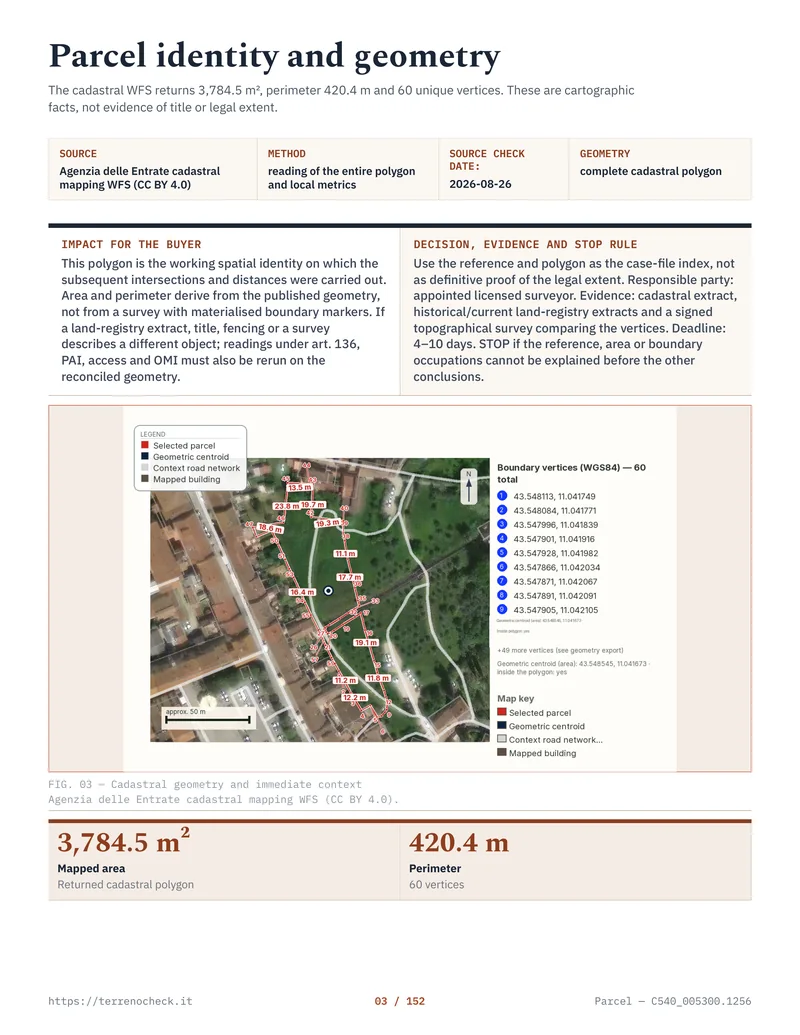 Open the full page
The declaration of succession and the cadastral update
The dichiarazione di successione is the filing made with the Agenzia delle Entrate. It reports the deceased person, the people to whom the estate is devolved, assets, liabilities where relevant and the tax information required by the form. Agenzia's SuccessioniWeb service says that, subject to exemptions, it must be presented within 12 months from the opening of the succession, generally the date of death. The deadline is set by Article 31(1) of D.Lgs. 346/1990: twelve months from the date the succession opens.
Ask the seller for the complete submitted declaration, the electronic receipt or certificate of presentation, the relevant attachments and any later corrective or supplementary filing. Check the deceased person's name and tax code, date of death, will reference if there is one, every heir named for the property, the municipality, sheet, parcel and subaltern, and the shares stated in the devoluzione. Do not read “filed” as “title proved”.
The voltura catastale changes the cadastral intestazione, the names recorded in the land register. In the online succession process, the cadastral volture request can be sent with the declaration. It is useful evidence that the tax and cadastral records were updated. It is not a conveyance deed, a judgment on ownership or proof that an heir accepted the inheritance.
Compare the paperwork with a current and historical visura catastale and the map. The cadastral extract guide explains the limit clearly: cadastral records help identify an asset, but the ownership chain is checked in the property registers. The buyer's notary should order an ispezione ipotecaria and read the transcriptions, annotations and the underlying deeds, including the deceased person's purchase and any later inheritance formalities.
The common failure is a mismatch. The declaration names parcel 214, the sale draft says parcel 241, or the house has been divided into subalterns since the death. A technician can compare the physical building and cadastral identity; the notary must decide how the title problem is cured.
A tax filing, a cadastral update and a registered acceptance answer different questions. A buyer needs the set, not one reassuring-looking document.
| Document or act | What it records | What it does not prove | Reference |
|---|---|---|---|
| Dichiarazione di successione | Tax and asset-devolution filing; normally within 12 months of death | Acceptance of the inheritance or clean ownership | Agenzia delle Entrate SuccessioniWeb |
| Voltura catastale | Cadastral intestazione after the succession filing | A title deed, acceptance or planning compliance | Agenzia delle Entrate SuccessioniWeb |
| Accettazione dell'eredità | The called person becomes heir, expressly or tacitly | That every co-heir has signed the sale | Civil Code Articles 459, 475 and 476 |
| Trascrizione dell'accettazione | Publicity of the acceptance in the property registers | A clean result if other heirs, claims or title defects remain | Civil Code Article 2648 |
Source: Agenzia delle Entrate, SuccessioniWeb; Normattiva, Civil Code.
Acceptance: tacita, espressa and transcribed
Under Civil Code Article 459, the inheritance is acquired by acceptance. Article 475 describes accettazione espressa: a declaration in a public deed or a private writing authenticated in which the called person says that they accept the inheritance or assumes the status of heir. Article 476 covers accettazione tacita. It occurs when the called person performs an act that necessarily presupposes the intention to accept and that they could not lawfully perform in another capacity.
That distinction matters because the family may say, accurately, “we have dealt with the estate for years”, while the register still does not show the act the buyer's lender wants. Paying a bill or submitting a tax form does not automatically answer the question. Some dealings with an inherited asset can amount to tacit acceptance; whether a particular act does so is a legal assessment, not an inference an agent should make from a conversation.
The title defect is not that the deceased's ownership vanished. It is that the intended seller's position between death and sale has not been documented in the form needed for the transaction. A called person can renounce; an accepting heir can sell. Those are different legal positions. Do not ask one heir to “sign for the family” unless the title and authority support it.
Civil Code Article 2648 provides for transcription of an acceptance, renunciation or acquisition of inheritance and of a legacy when the succession includes rights in immovable property. The buyer's notary checks the applicable formalities and the chain of transcriptions. Ask for the transcription details, or ask what act will create them before the purchase deed. If the cure is postponed until the day of closing, the bank needs to know that its own timetable allows it.
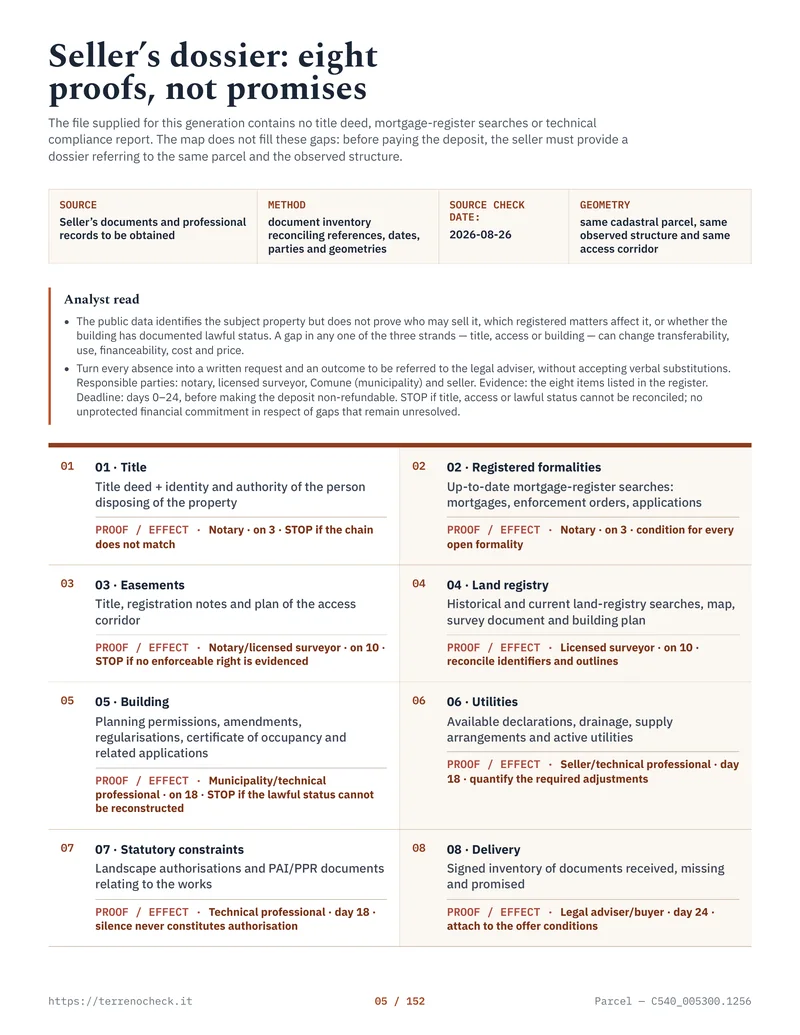 Open the full page
Reserved shares and the action of reduction
Italian succession law protects legittimari, people entitled to a reserved share even if a will or lifetime gift points elsewhere. Civil Code Article 536 names the surviving spouse, children and ascendants. Descendants can come into the position of a child by representation. The percentages vary with the family composition under the following articles of the Code; there is no single “family share” that fits every sale.
If a will or donation has reduced a protected share, the injured person can bring an azione di riduzione. It is not an automatic cancellation by the registry. It is an action that has to be brought, with the estate and previous gifts reconstructed. Civil Code Article 557 also matters because it governs who may seek reduction and the limits on renouncing that protection. The seller's statement that “everyone agreed in the family” is not a substitute for the documents.
Civil Code Article 2946 sets the ordinary ten-year prescription period unless a different rule applies. The action of reduction is commonly discussed as a ten-year claim linked to the opening of the succession, but the starting point and the calculation can depend on the disposition and the facts. The notary and succession lawyer must establish the relevant date. Do not turn a calendar count into a warranty.
The older concern for a buyer was the azione di restituzione. Under the former Article 563 regime, a successful reduction could, in the circumstances set by that article, lead to a claim against a third-party purchaser of the donated property. The familiar market marker was 20 years from transcription of the donation, subject to the former rules on opposition to the donation. This is why a donation in the chain could make a lender uncomfortable long after the deed looked regular.
There is now a major qualification. Article 44(1)(c) of Law 2 December 2025, no. 182 entered into force on 18 December 2025 and rewrote Article 563. The new Article 563 says that reduction does not prejudice third parties to whom the donee transferred the donated immovables. If the donee is wholly or partly insolvent, a transferee who acquired gratuitously must compensate the protected heirs in money up to the benefit received. The reform does not remove the protected heir's reduction claim against the donee; it removes the third-party restitution exposure.
For earlier successions, Article 44(2) preserved the old text only where a reduction claim was notified and transcribed, or an out-of-court act of opposition to the donation was notified and transcribed, within six months of entry into force. That window closed on 18 June 2026. Unless one of those acts was notified and transcribed by 18 June 2026, the amended Articles 561, 562, 563, 2652 and 2690 now apply to the earlier succession too. In practical terms, the buyer's question is no longer “how old is the donation?” but “does the register show a transcribed opposition or reduction claim against this donation?” The notary must apply the text to the actual facts and read the relevant transcriptions and annotations.
As of August 2026, the former 20-year restitution exposure against a purchaser is gone unless the old regime was preserved by a timely transcribed opposition or reduction claim. The mortgages and liens guide is useful for the register side, but it cannot resolve a family succession.
The date of death is the first question. A buyer who applies a pre-2026 explanation to every donated property can get the risk wrong in either direction.
| Reference | Number or date | Meaning |
|---|---|---|
| Article 2946, Civil Code | 10 years | Ordinary prescription rule used when no different period applies; the reduction claim needs a fact-specific calculation |
| Former Article 563 regime | 20 years | Former purchaser-restitution exposure only where Article 44 preserved the old regime through a timely transcribed opposition or reduction claim |
| Law 182/2025, Article 44 | 18 December 2025 | Entry into force of the reform; new Article 563 applies to later successions |
| Transitional Article 44 | 18 June 2026 | Cut-off six months after entry into force: for earlier successions, the amended articles apply unless a reduction claim or opposition was notified and transcribed by that date |
Source: Gazzetta Ufficiale, Law 2 December 2025, no. 182, Article 44; Normattiva, Civil Code.
Why provenienza donativa still gets extra scrutiny
Provenienza donativa means the seller's predecessor received the property by donation. It is different from a direct inheritance. In a succession chain, the buyer is usually checking acceptance, the heirs, the will and any reserved-share dispute. In a donation chain, the buyer may also have to ask whether a protected heir could challenge the donation and whether the applicable law still gives a remedy against a later purchaser.
The 2025 reform reduces the old third-party recovery risk for the new regime. It does not erase a prior transcribed claim or dictate a bank's underwriting policy. A lender may still ask for a notarial opinion, a release, insurance or a complete review of the transitional facts.
Some transactions use an insurance policy covering the defined donation risk. That is a commercial product, not a statutory clearance. Read the insured event, exclusions, term, beneficiary, insurer and whether the lender accepts it. In a case where the old regime was preserved by a timely transcription, the buyer may need a legal response or insurance; waiting for a 20-year period is not a substitute for checking the register. Waiting is not a universal cure, and it may be more expensive than the property looks once financing and delay are counted.
An inherited title can have several moving people; a donated title can add a historic reserved-share route. Neither label alone proves a defect or clears one.
Donation risk is date-sensitive. The remedies used in older transactions should not be copied into a new transaction without checking the governing text.
| Provenienza | Primary file to reconstruct | Buyer risk to test | Market response |
|---|---|---|---|
| Successoria | Death, will or intestacy, declaration, acceptance, transcription and every heir | Unaccepted inheritance, missing co-heir, reduction claim or incomplete register chain | Complete the chain, obtain all signatures or authority, and obtain lender/notary clearance |
| Donativa, new Article 563 applies | Donation deed, succession date and property-register search | Reduction claim against the donee remains possible; reduction does not prejudice third parties to whom the donee transferred the donated immovables; a gratuitous transferee may owe money if the donee is wholly or partly insolvent | Ask the notary whether the register shows a transcribed opposition or reduction claim against this donation |
| Donativa, old regime preserved by timely transcription by 18 June 2026 | Donation transcription, donor death, opposition or reduction claim and the relevant register annotations | Former third-party restitution exposure, including the 20-year framework, may remain relevant | Ask the notary to apply the old regime to the actual transcribed act; consider insurance or other fact-specific protection |
Source: Gazzetta Ufficiale, Law 182/2025, Article 44; Consiglio Nazionale del Notariato, Study no. 06-2026/C.
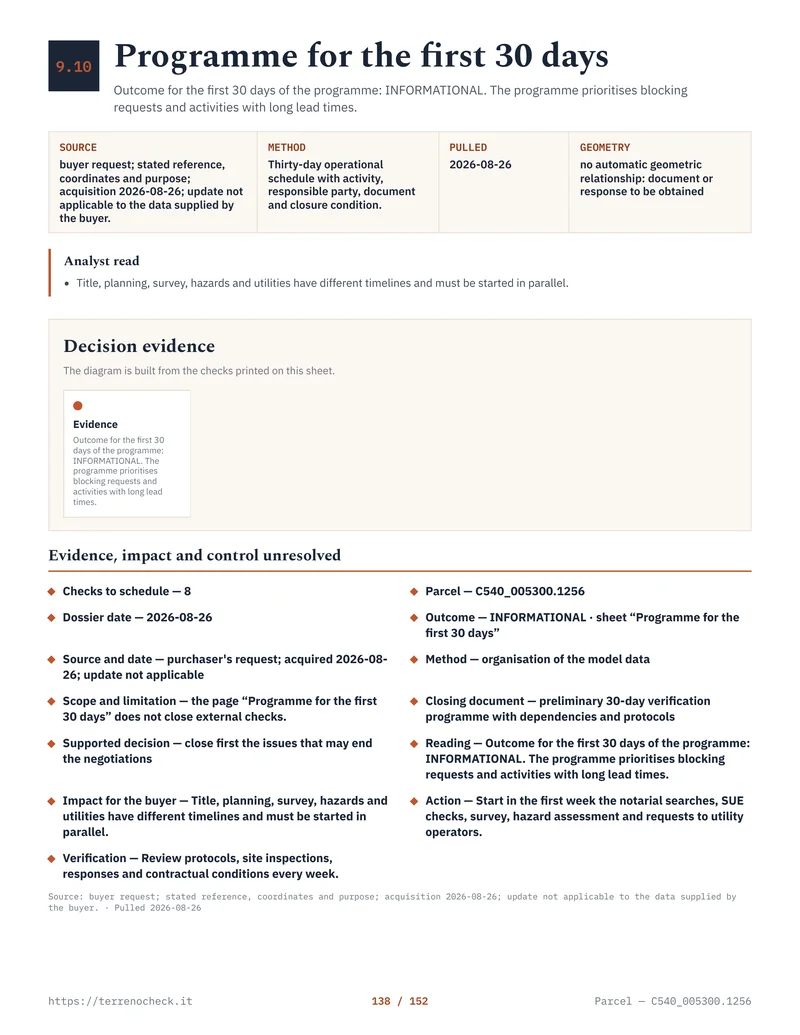 Open the full page
Comunione ereditaria: one property, several sellers
When several people inherit, they form a comunione ereditaria. The family may speak of “our house”, but the sale deed must deal with each person whose share is being transferred. To sell the whole property with ordinary title, every co-heir must sign or be represented by a valid, transaction-specific power of attorney. One heir can sometimes sell their own share, but that leaves the buyer in co-ownership and does not give the buyer the whole house.
Civil Code Article 732 gives co-heirs a diritto di prelazione when a co-heir intends to sell their share in the inheritance to an outsider. The selling co-heir must notify the others of the proposed sale and price. The Code gives the co-heirs two months from the notification to exercise the right; if proper notice was not made, the statutory redemption mechanism can create trouble after the outsider has paid. The exact application depends on whether the transaction concerns a share in the inheritance or a particular asset and on the documents. Have the notary classify it before signing.
The practical trap is an heir who lives abroad, has changed their name, is estranged from the family or cannot be found. Silence is not consent. A WhatsApp message is not a power of attorney. The seller may need a consular or notarial instrument, a corrected civil-status record, a judicial procedure or another route identified by the lawyer and notary. Do not pay a large deposit while assuming the absent person will appear at the rogito.
Check spouses, children and descendants, any renunciation, prior death of an heir, representation, incapacity and the existence of a will. A family tree supplied by the agent is a lead. The civil-status records and succession documents are the evidence.
Eredità giacente: the estate has a manager, not a convenient seller
An eredità giacente can arise where the inheritance has not been accepted and the called person is not in possession of the inherited assets. Under Civil Code Article 528, the court can appoint a curatore dell'eredità giacente. The curator inventories and administers the estate for the estate's interests while the succession position is resolved.
This is not a shortcut around a missing heir. The curator is appointed by the judicial authority and has a defined public function. A sale of an inherited building must fit the curator's powers and the applicable authorization process. The Consiglio Nazionale del Notariato's 2024 study explains the distinction between the curator's appointment by the court and authorization for extraordinary acts after the reforms on voluntary jurisdiction.
For a buyer, the file should contain the order appointing the curator, the inventory or relevant estate record, evidence that the property is the one being sold, the authorization required for that sale and the terms on which the transfer is made. Ask the notary who will sign, what authority is being relied on and how the sale will be transcribed. Expect extra procedure, professional fees and delay. A curator may protect the estate, but cannot manufacture an heir who never accepted.
The buyer's practical checklist before an offer
- Get the complete title chain. Obtain the deceased's purchase deed, prior deeds, any donation or division, will or certificate of publication, succession declaration, receipts and amendments.
- Check the property registers. Ask the notary for the ispezione ipotecaria, all relevant transcriptions and annotations, mortgages, seizures and claims. The liens guide covers the register questions that sit beside the inheritance review.
- Prove acceptance. Find the express acceptance or the act relied on as tacit acceptance, then confirm the required transcription. Do not substitute the declaration of succession or voltura for this step.
- List every person who must sign. Confirm each heir's identity, share, marital or representation position, capacity and power of attorney. If one is missing, stop the timetable and ask for the legal route.
- Test reserved-share exposure. Ask whether the deceased made donations, whether there are protected heirs, whether a reduction claim or opposition has been notified, and which Article 563 regime applies. This is where an inheritance lawyer earns their fee.
- Deal with co-heir pre-emption. If a share is being sold to an outsider, ask the notary to apply Civil Code Article 732 and document notice, waiver or expiry where relevant.
- Escalate a dormant estate. If nobody accepted and nobody possesses the assets, find out whether an eredità giacente exists and whether a curator and authorization are required.
- Write the conditions into the offer or preliminary. The preliminary contract guide explains why the document should match the title work. Put the unresolved succession documents, signatures, lender approval and closing authority on the written checklist agreed with the notary. Do not rely on a promise to tidy the file after payment.
The cost of buying property guide covers the wider budget. Here, budget for the notary's title work, an inheritance lawyer, a surveyor or geometra for parcel mismatches, translations or powers of attorney for overseas heirs, lender review, insurance if offered, and court or curator work where applicable. There is no honest national flat fee for difficult cases. Request written scopes and quotes.
Nobody can tell you from a desk whether an old act amounts to tacit acceptance, whether a relative was a valid heir under the applicable family facts, or whether a donation falls under the old or new restitution rules. Those are reasons to obtain the file early, not reasons to guess.
- All heirs identified, acceptance and transcription checked, all signProceed to the notary's title and planning review
- One heir has not accepted or acceptance is not transcribedCure the succession formalities before relying on the sale
- One co-heir is missing, unreachable or refusesDo not treat silence as consent; obtain valid authority or a judicial route
- No acceptance and no possession, with dormant estate factsCheck for an Article 528 curator and the authorization for any sale
Source: Normattiva, Civil Code Articles 475, 476, 528, 732 and 2648; Consiglio Nazionale del Notariato, Study no. 56-2024/PC.
Sources
- Normattiva, Civil Code, Royal Decree 16 March 1942, no. 262
- Agenzia delle Entrate, SuccessioniWeb
- Gazzetta Ufficiale, Law 2 December 2025, no. 182, Article 44
- Gazzetta Ufficiale, Law 2 December 2025, no. 182, full text PDF
- Consiglio Nazionale del Notariato, Donazioni
- Consiglio Nazionale del Notariato, Study no. 06-2026/C on Law 182/2025
- Consiglio Nazionale del Notariato, Study no. 56-2024/PC on dormant estates
- Normattiva, D.Lgs. 31 October 1990 no. 346, Article 31(1), deadline for the succession filing
- Normattiva, Law 2 December 2025 no. 182, Article 44, text in force