
Italian building tax bonuses in 2026: current rules
A building bonus can reduce the cost of work, but it can also leave a buyer with a missing file and an unusable deduction. Check the rate, claimant and paperwork before you price the property.
Contents
- The short answer for work paid in 2026
- Bonus ristrutturazioni: the familiar deduction with a moving rate
- Ecobonus: the rate is national, the technical test is specific
- Sismabonus and zones 1, 2 and 3
- Bonus mobili: it survives into 2026, but only as a linked deduction
- Superbonus: closed as a general 2026 route
- Sconto in fattura and cessione del credito: do not budget them as cash
- Who can claim?
- The documentary trail a buyer should inherit
- What happens to the deduction when the property is sold?
- A buyer’s order of work
The promise in an Italian property listing may be “renovate with a 50% bonus”. That sentence is incomplete. The percentage depends on the year of payment, the type of work, the home’s use, the person who paid and the documents that survive the work. A buyer can inherit a useful deduction, a defective claim, or nothing at all.
This guide states the national position on 6 August 2026. This pre-purchase guide does not provide tax, legal, technical or engineering advice. A commercialista should test the tax position, a qualified technician should inspect the building file, and the notary should deal with any transfer of residual deductions in the deed.
The short answer for work paid in 2026
For the ordinary renovation deduction under Article 16-bis of the Testo unico delle imposte sui redditi (TUIR), DPR 22 December 1986 no. 917, the 2026 rate is 36%, up to €96,000 per residential unit, as set by Article 16(1) of D.L. 4 June 2013 no. 63. The rate rises to 50% where the expense is borne by the owner or holder of a real right of enjoyment and the work concerns that person’s abitazione principale. Law 30 December 2025, no. 199, Article 1(22) moved the 2025 rates into 2026. The Agenzia delle Entrate’s current pre-filled-return information confirms the same 36% ordinary rate and 50% main-home rate for 2026.
That is a tax deduction from Italian personal income tax. It is not a cheque for half the invoice. If the claimant has too little Italian IRPEF to absorb the deduction, the unused part does not become a cash refund. A foreign buyer with no Italian taxable income should treat the advertised bonus as a conditional possibility, not as money already saved.
The €96,000 ceiling is a spending ceiling for the qualifying renovation category, not a promise of a €96,000 deduction. At 36%, the theoretical maximum deduction is €34,560. At 50%, it is €48,000, spread over the statutory annual instalments. Previous qualifying expenditure on the same unit can matter. Ask for the calculation, not just the slogan.
The table is a 2026 screening tool. It does not decide whether the work qualifies, whether the claimant has enough Italian tax, or whether the file can survive an audit.
| Bonus or route | Ordinary 2026 rate | Main-home rate | Published limit or qualification |
|---|---|---|---|
| Bonus ristrutturazioni, TUIR Article 16-bis via D.L. 63/2013 Article 16(1) | 36% | 50% | €96,000 per residential unit; owner or real-right holder, main home |
| Ecobonus, D.L. 63/2013 Article 14(3-quinquies) | 36% | 50% | Limit varies by intervention; fossil-fuel-only boilers excluded for 2025–2027 |
| Sismabonus categories, D.L. 63/2013 Article 16(1-septies.1) | 36% | 50% | 2026 extension covers the statutory seismic categories; zones 1, 2 and 3 are relevant to the underlying routes |
| Bonus mobili, Article 16(2) | 50% | No separate main-home uplift | €5,000 spending limit for purchases made in 2025 and 2026; linked renovation work required |
Source: Law 30 December 2025, no. 199, Article 1(22); Law 30 December 2024, no. 207, Article 1(55); Agenzia delle Entrate.
Pages from the delivered dossier
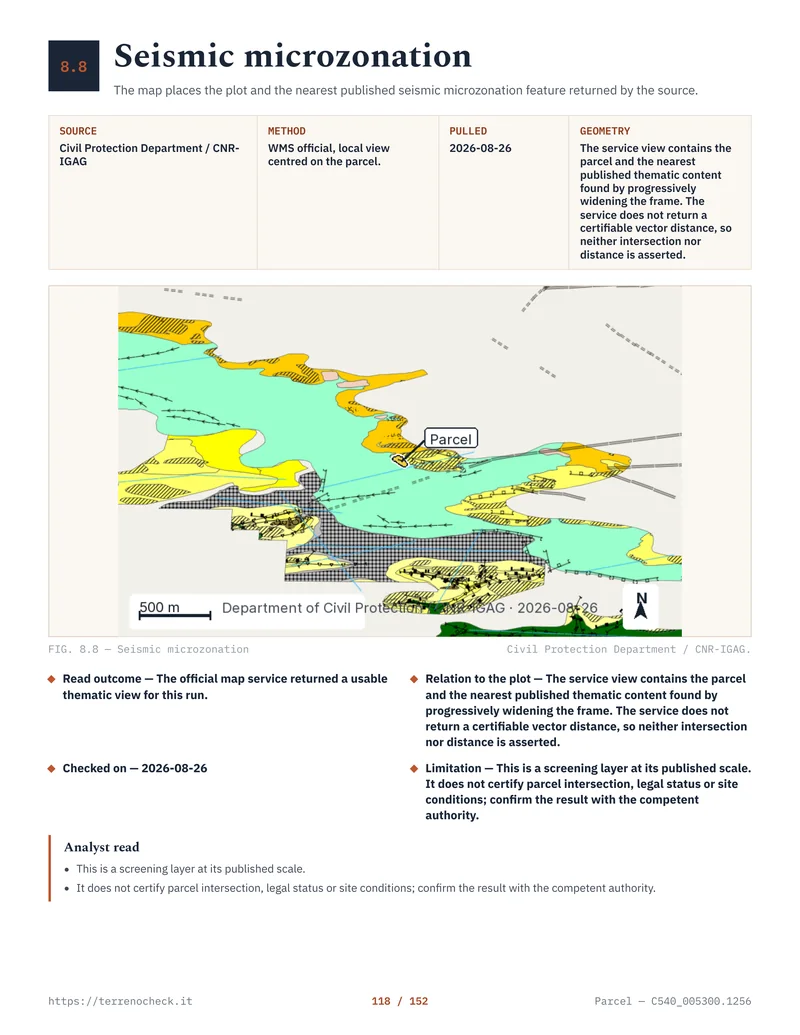 Open the full page
Bonus ristrutturazioni: the familiar deduction with a moving rate
Article 16-bis TUIR, that is of DPR 917/1986, is the underlying national provision for recovery work on existing buildings. Article 16(1) of D.L. 4 June 2013, no. 63, sets the temporary rate and ceiling for the years in question. The current 2026 extension covers qualifying work paid during 2026, with 36% as the ordinary rate and 50% for the narrower owner or real-right/main-home case.
The deduction can cover building work, necessary professional services and certain required compliance costs, but eligibility follows the legal description of the intervention. A new building is not turned into a renovation by calling it a rudere. A cadastral category does not prove that the municipal building file is regular. Compare the deeds and cadastral records with the planning file, using the cadastral extract guide and the building-rights guide as starting points.
The usual payment trail matters. Invoices should identify the work and the person claiming. Payments generally use the special bank transfer for tax deductions, the bonifico parlante, showing the tax code of the claimant, the VAT number or tax code of the supplier and the legal reference required by the bank form. A missing field is not a small clerical detail. Have a tax professional decide whether a correction is possible before assuming the deduction is safe.
The work may need a CILA, SCIA, building permit, municipal filing or a statement that no title is required. The exact permit is a technical and municipal question. A property with an unclosed CILA or an unauthorised change can leave the buyer paying for a regularisation before anyone can sensibly discuss a bonus. The abusive building work guide explains why cadastral conformity and planning legality are separate checks.
Ecobonus: the rate is national, the technical test is specific
The ecobonus under Article 14(3-quinquies) of D.L. 63/2013 covers qualifying energy-efficiency work on existing buildings. For expenses paid in 2026, the current national rates are 36% ordinarily and 50% when the statutory main-home condition is met by the owner or holder of a real right. Law 199/2025 Article 1(22) carried that subsection's 36% and 50% into 2026. The exclusion of expenses for replacing heating systems with single fossil-fuel boilers over 2025–2027 sits in the same Article 14(3-quinquies), inserted by Article 1(55)(a) of Law 30 December 2024 no. 207.
There is no single ecobonus ceiling equivalent to the €96,000 renovation ceiling. The maximum depends on the intervention. Windows, insulation, solar systems and heating work have different technical requirements and limits. Some work needs communication to ENEA. Some needs an energy report or an engineer’s certification. The old article that says “ecobonus 65%” may describe an earlier spending year, a different intervention or an obsolete rule.
If a seller claims that a heat pump, insulation package or photovoltaic system is “already approved”, ask for the technical calculation and the ENEA submission receipt where required. An APE is not the same thing as the complete ecobonus file. A technician must match the installed system, invoices, dates, technical parameters and payment trail.
Sismabonus and zones 1, 2 and 3
The seismic deduction is the area where old percentages create the most confusion. The underlying categories in Article 16(1-bis) to (1-septies) refer to buildings in seismic zones 1 and 2, extended to zone 3 for the relevant period and route. The former enhanced structure in Article 16(1-quater) and (1-quinquies) gave 70% where the work reduced seismic risk by one class and 80% where it reduced risk by two classes. On condominium common parts, the corresponding rates were 75% and 85%. The demolition-and-reconstruction purchase route in zones 1, 2 and 3 had its own 75%/85% structure for qualifying units bought from a construction or renovation company.
Those figures are real statutory rates, but they are not the rate to put in a 2026 renovation budget without checking the year. Law 207/2024 Article 1(55) inserted Article 16(1-septies.1), extending the seismic categories to 2025–2027 with a fixed rate structure. Law 199/2025 Article 1(22) then kept the 2025-style position in 2026: 36% ordinarily and 50% for qualifying work on an owner’s or real-right holder’s main home, subject to the relevant seismic route and its limit. The old 70%, 80%, 75% and 85% figures should not be used as a 2026 assumption.
The €96,000 limit remains central to the ordinary sismabonus categories, with five annual instalments under Article 16(1-bis). A professional must check the applicable zone classification, the building’s use, the authorisation date, the structural project and the evidence of risk-class reduction. The municipality’s seismic zone is not a substitute for a structural assessment. Read the seismic-zones guide before treating a zone number in an advert as a tax result.
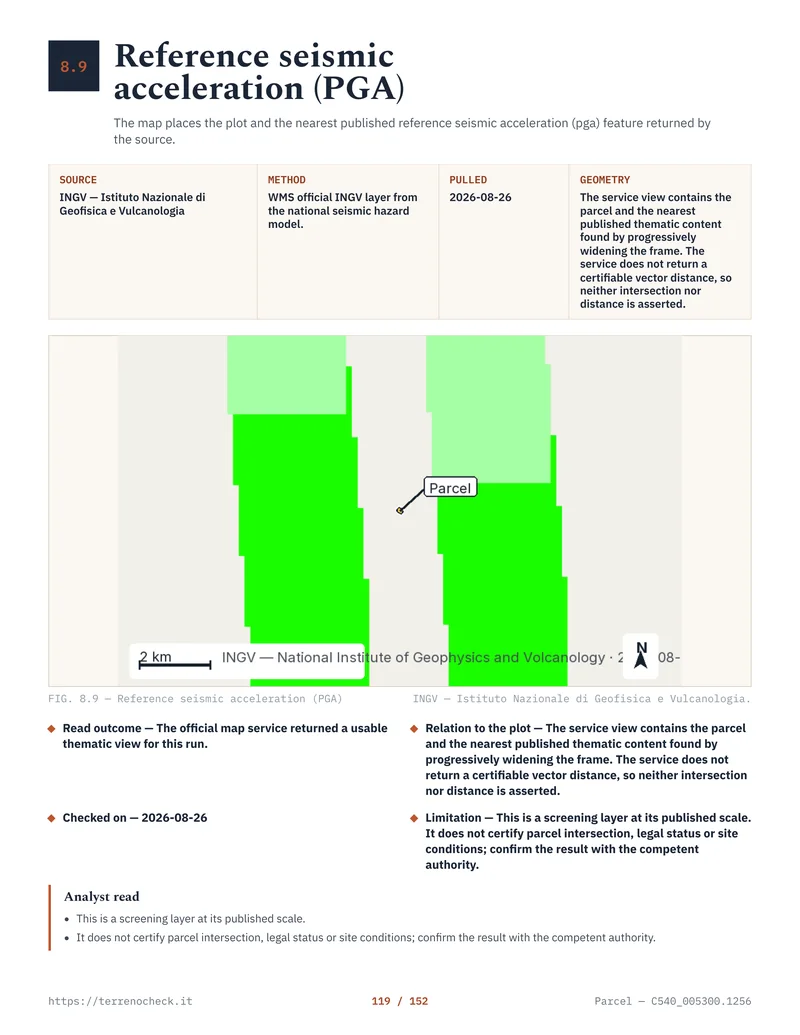 Open the full page
Bonus mobili: it survives into 2026, but only as a linked deduction
The furniture deduction survives for purchases made in 2026. Law 199/2025 Article 1(22) extended Article 16(2)’s 2025 wording into 2026. The deduction is 50% of eligible purchases, calculated on a maximum spending amount of €5,000. It is divided into ten annual amounts.
This is not a general furnishing allowance for a house you have just bought. The furniture or large appliance must furnish the property that is the subject of qualifying recovery work, and the recovery work must have started from 1 January of the year before the purchase. Eligible appliance classes and payment methods apply. The buyer needs the invoices, payment evidence and the renovation link. The Agenzia delle Entrate’s bonus mobili guide says unused furniture deductions do not transfer on the sale of the renovated property. That is different from the ordinary renovation deduction.
Superbonus: closed as a general 2026 route
The Superbonus story needs dates. Article 119 of D.L. 19 May 2020, no. 34 created the 110% regime for specified energy and seismic work. The ordinary rate later fell to 90% for 2023, 70% for 2024 and 65% for 2025. Law 207/2024 Article 1(56) limited the 2025 65% route to interventions with the required CILA, condominium resolution and CILA, or demolition-and-reconstruction title position already in place by 15 October 2024.
As of 6 August 2026, there is no general Superbonus rate for new expenses paid in 2026. The Agenzia’s 730/2026 information refers to Superbonus expenses through 2025 and to residual annual instalments. A buyer may still encounter a building with an old Superbonus file, remaining deductions, a credit already assigned, or works in a seismic reconstruction area. Those are inherited facts, not a fresh 2026 entitlement.
The residual cases need specialist handling. The 110% treatment for certain earthquake-damaged properties in municipalities where a state of emergency was declared applied to expenses through 31 December 2025 under Article 119(8-ter) as amended by Law 207/2024. A 2026 reconstruction contribution can address some costs left after incomplete works in the central Italy earthquake areas, but that is a reconstruction measure, not a blanket return of the national Superbonus. Ask the Ufficio speciale per la ricostruzione and the commercialista to identify the exact route.
Sconto in fattura and cessione del credito: do not budget them as cash
The old model let a claimant choose, in specified cases, a discount from the supplier or transfer the tax credit. D.L. 16 February 2023, no. 11, had already closed most new options. D.L. 29 March 2024, no. 39, Article 1, removed the remaining general route from 30 March 2024, subject to transitional rules and narrow exceptions.
The surviving exceptions are not a buyer-friendly shortcut. They include defined interventions on earthquake-damaged properties in the Abruzzo, Lazio, Marche and Umbria events identified by Article 2(3-ter.1) of D.L. 11/2023, within the legal conditions and spending limit. Transitional protection also survives for files with the required CILA, condominium resolution and CILA, demolition-and-reconstruction application, building-title request, or already-started works and binding supply agreement before the decree’s entry into force, depending on the type of work. The file must prove the date and the condition.
For a property sale, ask whether the seller used a direct deduction, a discount, or a credit transfer. A credit transfer is not the same as a buyer inheriting annual deductions. Do not assume that a contractor’s statement “the credit is with the bank” means the buyer has no exposure. The tax professional should reconcile the option, the communications to the Agenzia and the deductions actually used.
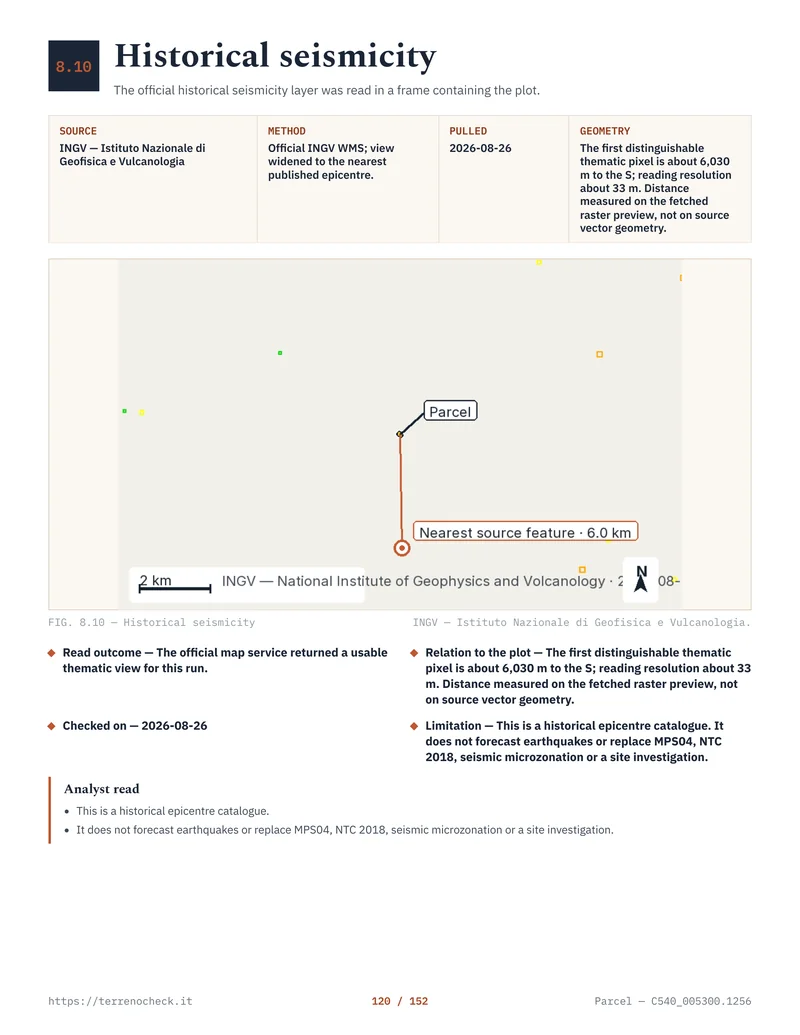 Open the full page
Who can claim?
The normal claimant is the person who owns or holds the property and pays the qualifying expense. That includes the owner and holders of a real right such as usufruct, use or habitation. The main-home uplift is narrower: the 50% 2026 rate is tied to the owner or real-right holder and the unit used as that person’s main home.
An eligible tenant or comodatario can claim expenses paid on the property when the required consent and documentary conditions are met. A cohabiting family member can also claim when they bear the expense and the invoices and payments show the position required by the Agenzia guidance. A family relationship on its own is not enough. Neither is a foreign address on an invoice.
For condominium work, the administrator’s certificate should identify the expense allocated to the unit and the person who actually paid. A tenant who pays a qualifying share may have a claim, but the administrator’s records need to match it. Check the condominium shared-cost guide before accepting a seller’s verbal account of a façade or roof project.
The documentary trail a buyer should inherit
Request a dated folder before the preliminary contract. The exact contents depend on the bonus and the work, but a serious file normally includes:
- the invoices, contracts, work descriptions and proof of payment, including the bonifici parlanti;
- the CILA, SCIA, permit, municipal protocol number or no-permit statement, plus drawings and closure documents where applicable;
- the technician’s declarations, structural documents and seismic risk-class evidence for sismabonus work;
- ENEA submissions and receipts for work that requires them, with the technical reports and APE material where applicable;
- condominium resolutions, administrator certificates, millesimal allocations and proof of the claimant’s payments for common works;
- copies of tax returns or a schedule showing the deduction rate, annual instalments used and residual amount;
- every communication or receipt for a discount or credit transfer, and evidence of who currently holds the credit;
- the seller’s written statement for the deed, saying whether residual deductions are retained or transferred.
The first four items are mainly a technician’s and tax professional’s review. The last two are tax and deed questions. The notary does not certify that every invoice is technically eligible, and a technician does not decide whether the buyer has enough Italian IRPEF. Nobody can tell you this from a desk without the file.
There is no national fixed price for this review. Ask for separate written quotes from the commercialista, geometra, architect or engineer and notary. A short document audit before the deposit is a cost you can compare. A rejected deduction, repayment, interest, penalty or unfinished building file is not.
- 2020Superbonus introduced at 110% for specified work under D.L. 34/2020 Article 119
- 2023Ordinary Superbonus rate 90%
- 2024Ordinary Superbonus rate 70%
- 2025Ordinary Superbonus rate 65%, with the 15 October 2024 procedural gate under Law 207/2024
- 2026No general new-expense Superbonus route, while ordinary renovation, ecobonus and covered sismabonus categories use the 2026 rate structure of 36% or 50% for the qualifying main-home owner/real-right case
Source: Law 30 December 2024, no. 207, Article 1(56); Law 30 December 2025, no. 199, Article 1(22); Agenzia delle Entrate, 730/2026 property-expense information.
What happens to the deduction when the property is sold?
For the unused portions of the ordinary building renovation deduction, Article 16-bis(8) TUIR provides a default transfer to the individual buyer when the whole property is sold, unless the deed says otherwise. The seller can agree to retain the residual instalments. The choice belongs in the sale deed. Silence can produce the statutory transfer, which is why a buyer should not leave the clause to an agent’s template.
The buyer needs the seller’s calculation: original qualifying expense, rate, total deduction, instalments already used and residual instalments. Check that the person selling is the person who claimed, that the unit sold is the unit connected to the work, and that no credit transfer or discount has already exhausted the direct deduction. The buyer’s Italian tax capacity still matters after the transfer.
The rule is not universal. The Agenzia’s bonus mobili guidance says unused furniture deductions do not pass to the buyer. A seller’s death, inheritance, usufruct and partial transfer can also produce different outcomes. Have the notary and tax professional classify the transaction before the contract is signed. The notary role guide explains the notary’s place in the deed; the Italian buying checklist helps keep the tax file beside the wider property checks.
- No claim or no residual deductionObtain a written statement and the work file; price future work under the 2026 rules
- Direct deduction still runningArticle 16-bis(8) default transfer on sale unless the deed says the seller retains it; reconcile the remaining annual instalments
- Sconto in fattura or cessione del credito usedConfirm the option, communication and current credit holder; do not count the same amount as a buyer deduction
- Superbonus or earthquake reconstruction fileTreat as a specialist legacy case; check dates, CILA or title, reconstruction authority records and tax advice before signing
Source: TUIR Article 16-bis(8), Agenzia delle Entrate, Ristrutturazioni edilizie: le agevolazioni fiscali; D.L. 39/2024 Article 1; Agenzia delle Entrate, Bonus mobili.
A buyer’s order of work
Start with the property, not the percentage. Confirm the building’s identity and planning history using the CDU and planning documents, then ask the technician to compare the physical building with the municipal file. Ask the seller for the complete bonus folder and the tax professional for a written rate and residual-deduction calculation.
Only after those checks should the notary draft the preliminary and final deed clauses. Put the delivery of missing documents, correction of a defective filing, or a decision about residual deductions into the contract if the transaction is proceeding. A €200,000 property does not become €190,000 because an old web page says “50% bonus”. It becomes a property with a possible tax benefit once the claimant, work, year, limit and evidence all line up.
Sources
- Gazzetta Ufficiale, Law 30 December 2025, no. 199, Budget Law 2026, Article 1(22)
- Gazzetta Ufficiale, Law 30 December 2024, no. 207, Budget Law 2025, Articles 1(55)–(56)
- Agenzia delle Entrate, Ristrutturazioni edilizie: le agevolazioni fiscali
- Agenzia delle Entrate, pre-filled return information for property expenses
- Agenzia delle Entrate, Bonus mobili ed elettrodomestici
- Normattiva, D.L. 29 March 2024, no. 39, Article 1
- Normattiva, D.L. 4 June 2013, no. 63, Articles 14 and 16
- Normattiva, D.L. 19 May 2020, no. 34, Article 119
- Normattiva, DPR 22 December 1986 no. 917 (TUIR), Article 16-bis(1), (7) and (8)
- Normattiva, D.L. 4 June 2013 no. 63, Article 16(1), (1-bis), (1-quater), (1-quinquies), (1-septies.1) and (2), text in force
- Normattiva, D.L. 4 June 2013 no. 63, Article 14(3-quinquies), text in force
- Normattiva, Law 30 December 2025 no. 199, Article 1(22), text in force
- Normattiva, Law 30 December 2024 no. 207, Article 1(55) and (56), text in force
- Normattiva, D.L. 19 May 2020 no. 34, Article 119(8-ter), direct article link