
Legga questo articolo in italiano.
Buying tenanted agricultural land in Italy
On this page
Buying Italian farmland does not establish vacant possession. Article 41 of Law 203/1982 gives agricultural contracts longer than nine years effect against third parties even if oral or unrecorded. Have a specialist examine the relationship, renewals and handover evidence before an offer.
In short
- Establish who farms each parcel. The absence of a written agreement does not establish vacant possession.
- Article 41 covers agricultural contracts longer than nine years against third parties, including oral or unrecorded contracts.
- Read ordinary direct-cultivator duration and renewal rules together with special regimes and any valid assisted derogation.
- Tenant pre-emption and the possession date are separate checks for the notary and lawyer.
- Tenant works may affect the sale: assess improvement rules and obligations before agreeing the deed.
Article 41
Oral agreements matter
Agricultural contracts over nine years can bind third parties.
Law 203/1982
Article 45
Assisted agreements
Obtain the complete agreement and assistance record.
Law 203/1982
The report brings together public information about the land, with sources and dates, to prepare questions for the relevant offices: €29 in English or Italian · €39 in both languages · total, VAT included.
Buying ownership does not establish immediate possession
Before making an offer, ask who farms the land, under what arrangement and on which parcels. Someone cutting grass for the owner does not necessarily have the same status as an agricultural tenant. Obtain the contract and subsequent agreements and compare them with actual occupation rather than relying on the label used in the listing.
Article 41 of Law 203/1982 states that agricultural contracts longer than nine years are valid and effective against third parties even if oral or unrecorded. The absence of a written agreement or property-register entry therefore does not establish that the land is vacant. Have an adviser experienced in Italian agricultural contracts classify the actual relationship.
The guide to agricultural pre-emption deals with a qualifying person’s right to buy in priority. Here the central question is what you are buying: land available for your own use or ownership subject to a farming relationship that needs to be respected and managed.
Read duration, renewal and notice together
For leases to individual or associated coltivatori diretti, direct cultivators, Article 1 provides a minimum fifteen-year duration, subject to the provisions of the same law. This is not a universal term to apply without classifying the agreement. Special regimes exist, and Article 45 permits qualifying assisted agreements that depart from the ordinary rules. A short date on the first page needs investigation.
Article 4 governs tacit renewal. For the ordinary agricultural lease, absent notice, renewal is for the minimum fifteen-year period; the article separately addresses affitto particellare, the special mountain-area plot-lease category defined by Article 3. That category concerns qualifying plots in regionally designated mountain areas which do not form a productive unit, even with the tenant’s other holdings; ask the adviser to assess the full statutory conditions before applying it. Notice must be communicated at least one year before expiry by registered letter with acknowledgement of receipt. Ask the adviser which regime applies and whether a valid derogation changes the position.
A copy of a letter or a sentence in the preliminary agreement does not establish effective notice. Obtain evidence of dispatch and receipt, the contractual date used for the calculation and later agreements. Your intended project should not depend on an undocumented expiry date given verbally by the seller.
- Immediate personal useRequest evidence of availability and assess handover
- Continue the tenancyReconstruct rent, duration, renewal and obligations
- Missing paperworkArticle 41: agricultural contracts over nine years can affect third parties even if oral or unrecorded
Sources: Law 203/1982, Article 1; Law 203/1982, Article 4; Law 203/1982, Article 5; Law 203/1982, Article 16; Law 203/1982, Article 17; Law 203/1982, Article 41; Law 203/1982, Article 45; Law 590/1965, Article 8 and amendments: pre-emption; accessed 13 November 2026.
An agreement “in deroga” needs its assistance record
Article 45 recognises agreements on agricultural contracts, including departures from ordinary rules, made with assistance from the parties’ respective nationally representative agricultural professional organisations through their provincial branches. It also addresses court settlements and the particular position of Trento and Bolzano. Writing “in derogation from Law 203” on a form signed only by the parties does not demonstrate compliance.
Request the complete agreement and signatures relating to the assistance. The lawyer needs to assess its effect on duration, renewal and improvements. A single clause should not be read as proof that every statutory protection has been removed.
If the seller and tenant are still negotiating an early termination, have that proposed agreement reviewed too. Promised handover arrangements must fit the applicable rules and the people actually conducting the farm. An agreement still awaiting signatures is not evidence that vacant possession has already been secured.
Assemble a parcel-specific tenancy file
| Record or information | Check required | Adviser or source |
|---|---|---|
| Contract and later changes | Included parcels, start, duration and rent | Agricultural-contract lawyer |
| Assisted derogation agreement | Assistance and terms actually agreed | Lawyer and participating organisations |
| Notice and receipts | Timing, recipients and legal effect | Lawyer |
| Rent statement | Payments, periods and disputes | Seller and appointed adviser |
| Tenant’s improvements | Agreements, approvals and possible indemnities | Technician and lawyer |
| Pre-emption documents | Eligibility, notices and sale conditions | Notary and lawyer |
Attach an identifiable parcel list. If the agreement describes a holding larger than the land offered for sale, determine how its terms affect the portion being purchased. One annual payment for the whole holding does not by itself explain how a partial sale or division of responsibilities will operate.
For a buyer abroad, ask for a written explanation of the outstanding points alongside the Italian documents. A translated summary is useful, but the adviser assessing signatures, notices and assistance needs the complete original file, including attachments and subsequent correspondence.
Treat pre-emption as a separate check
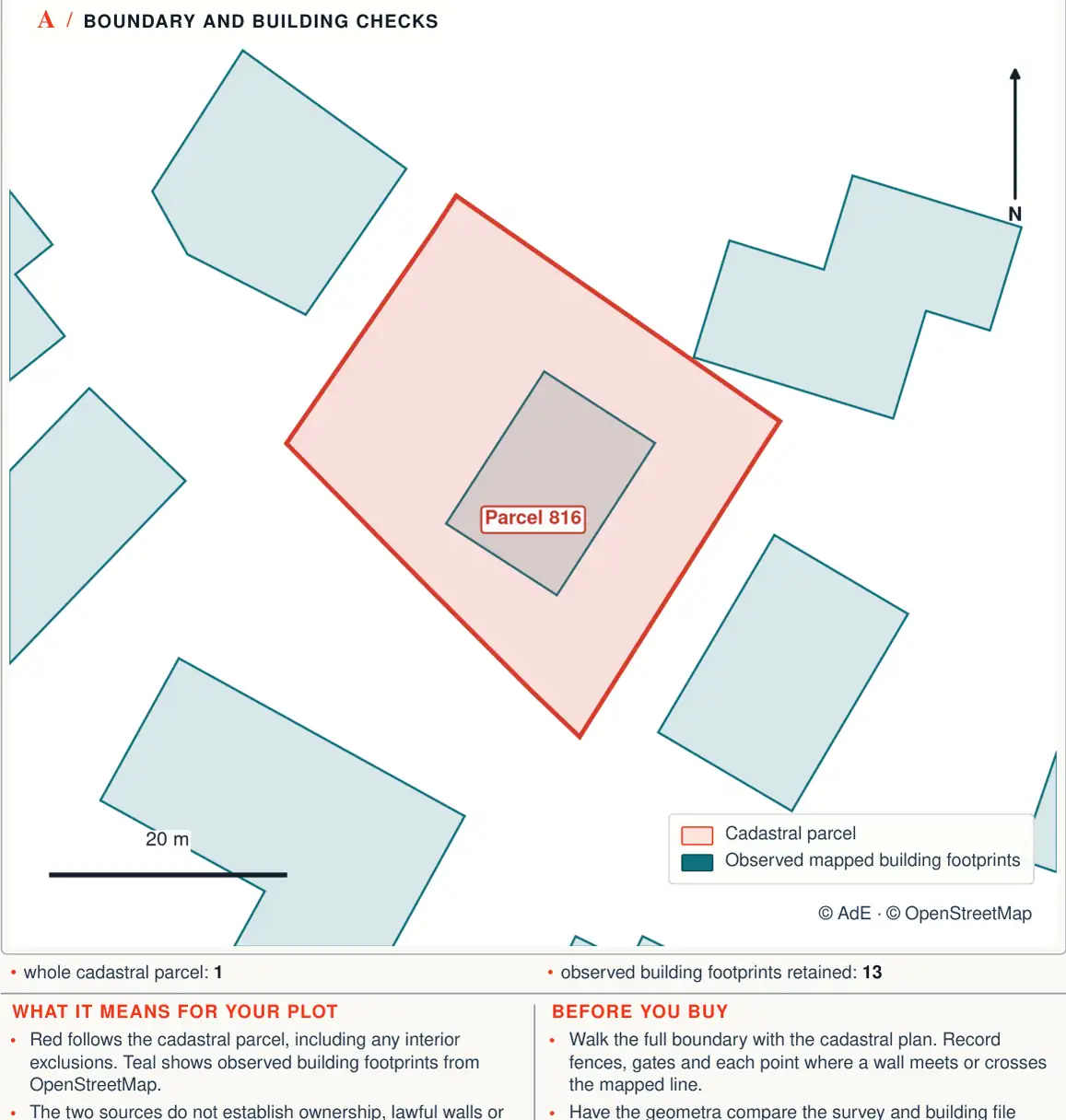
Article 8 of Law 590/1965 governs pre-emption and redemption in the cases and subject to the conditions it specifies, with amendments recorded in the current text. Not everyone cultivating a field automatically has the same right. Before preparing notices, ask the notary and lawyer to assess the person, relationship, eligibility and transaction against the complete legislation.
A generic waiver is not an answer to every sale configuration. The assessment must concern the actual terms offered to the buyer, including the property, price and other conditions. If those terms change, ask whether earlier steps need to be repeated or updated.
Request a record of the documents assessed and communications made, with evidence. Keep that work separate from establishing the tenancy’s expiry. Resolving pre-emption does not automatically establish a right to immediate possession, and checking the term does not settle pre-emption. Use the pre-emption guide for the separate subject.
Review the relationship before pricing
- LawyerContract, regime and assisted agreements
- TechnicianOccupied parcels and tenant works
- Notary and lawyerPre-emption and improvement obligations
- ContractPossession, rent and handover evidence
Sources: Law 203/1982, Article 1; Law 203/1982, Article 4; Law 203/1982, Article 5; Law 203/1982, Article 16; Law 203/1982, Article 17; Law 203/1982, Article 41; Law 203/1982, Article 45; Law 590/1965, Article 8 and amendments: pre-emption; accessed 13 November 2026.
Improvements can create obligations relevant to the sale
Articles 16 and 17 of Law 203/1982 regulate improvements, additions and transformations through their own conditions and procedures. Ask whether the tenant installed irrigation, altered farm buildings or undertook other works, and obtain the agreements and records. An invoice proves expenditure; it does not by itself establish an indemnity entitlement or its amount.
For works falling within that regime, Article 17 links the indemnity to the increase in the land’s market value at the end of the relationship, compared with the current value of the unimproved land. It also provides for retention of the land until payment of an indemnity fixed by the agricultural inspectorate or determined by a final court judgment. The adviser must examine the contract’s regime and applicability to the works, including the issues concerning older works recorded with the legislation.
If the land is sold before payment of the relevant indemnity, Article 17 requires the owner to declare the obligation to the tenant in the sale deed, releasing that owner in the stated circumstances. Take this to the notary before fixing the final price. Ask how the obligation will be described and dealt with in your purchase rather than relying on a general assurance that every expense remains with the seller.
A sale is not itself a handover arrangement
If you need the field for your own immediate use, request evidence of the basis for obtaining possession and what has actually been completed. If you intend to continue the lease, reconstruct the rent calendar and obligations you will administer. These are different purchase plans and need different contractual arrangements.
Article 5 addresses the direct-cultivator tenant’s withdrawal and termination for serious breach. An allegation of unpaid rent is not equivalent to land already available for handover: the legislation includes a formal challenge procedure and an opportunity to remedy a breach. Give the lawyer the correspondence and any proceedings rather than arranging physical shortcuts on the land.
In the preliminary agreement, identify required evidence, any termination agreement and the intended handover. Tell the notary before drafting if vacant possession is fundamental to your purchase. A phrase promising “vacant on completion” needs to be examined against how the seller can actually deliver that result.
Evaluate the rent and sequence the review
Take a hypothetical €80,000 price and €1,600 annual rent. Rent divided by price gives a gross 2% ratio. It is not a net return: taxes, expenses, unpaid rent and works are omitted. Any improvement obligation needs its own assessment and should not be deducted from rent without a documented basis.
Before the offer, agree the lawyer’s review scope, fee and delivery date. During the technical visit, compare occupied ground with the parcel list and obtain a quotation for any works investigation. Before the preliminary agreement, have the notary and lawyer address pre-emption and possession. Before the deed, update the evidence and payment statement. Obtain timing from the appointed professionals rather than promising that the farming relationship can be closed within a week or a month.
Keep the economics consistent with the actual agreement. If the seller markets the property as an income investment, ask which rent period the payment record covers and who must deal with any unpaid amounts. If it is marketed for personal use, the possession evidence may matter more to the decision than the advertised annual rent.
Buying tenanted agricultural land in Italy
https://terrenocheck.it/en/guide/buying-tenanted-agricultural-land-italy
Checklist
Before buying tenanted farmland
Common questions
Is land vacant if there is no written lease?
Do not assume that. Article 41 includes agricultural contracts over nine years that are oral or unrecorded.
Does every farm lease last fifteen years?
No. The ordinary rule must be read within its scope, alongside special regimes and valid assisted agreements.
Does selling end the lease?
Do not treat the sale as evidence of possession. Have the actual relationship and handover documents assessed.
Who pays for tenant improvements?
The notary and lawyer must examine the works, agreements and Articles 16–17 before regulating obligations in the deed.
Keep reading
Prepare the questions for your parcel
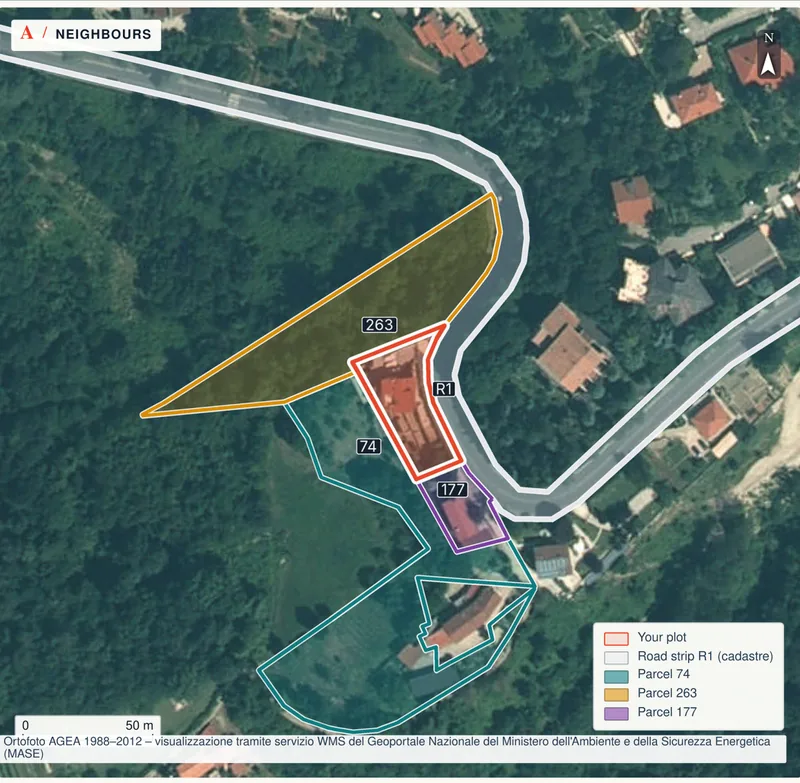
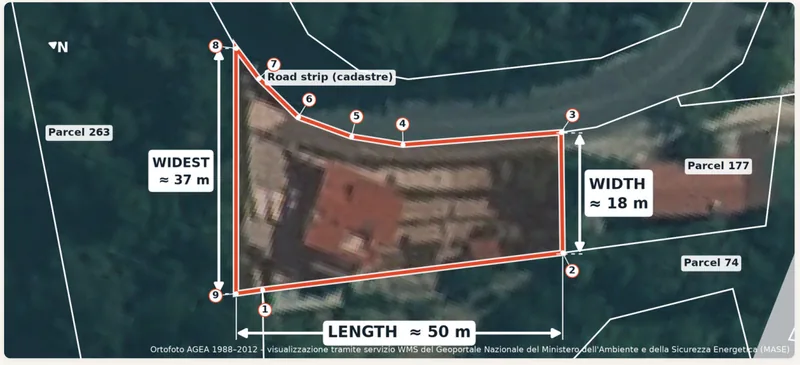
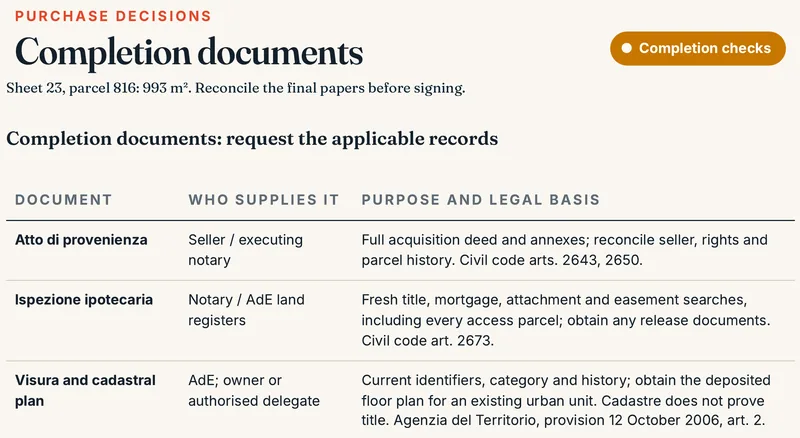
Select the land on the map to review its territorial information, sources and questions to take to the relevant offices before buying.
€29 in English or Italian · €39 in both languages · total, VAT included