
Pillar guide: Land and planning
Legga questo articolo in italiano.
Minimum agricultural plot size to build in Italy
On this page
Ask the Comune’s SUE building office for the area requirement applying to your proposed works and your status as an applicant. Dividing a house’s volume by a density figure does not establish a nationwide minimum plot size or a right to build. You also need to check agricultural eligibility and land already committed to existing buildings.
In short
- Request the applicable local provision, the area eligible for calculation and the applicant requirements for the particular building.
- Piedmont’s Article 25 Regional Law 56/1977 sets a 0.02 m³/m² ceiling for rural housing on arable land and meadow. It is a maximum density, not an Italian minimum plot size.
- The Piedmont calculation includes existing buildings, except the Article 25(2)(g) structures and equipment, including those within the dwelling.
- A compendio unico constituted under Article 5-bis D.Lgs. 228/2001 is indivisible for ten years. That is a separate restriction, not a building plot minimum.
0.02 m³/m²
Piedmont: arable and meadow ceiling
Rural housing only. Applicant conditions, overall limits, existing buildings and local PRG rules still apply.
Piedmont Regional Law 56/1977, Article 25
10 years
Compendio unico indivisibility
From its constitution; this restriction does not attach to every agricultural purchase.
D.Lgs. 228/2001, Article 5-bis
The report brings together public information about the land, with sources and dates, to prepare questions for the relevant offices: €29 in English or Italian · €39 in both languages · total, VAT included.
The advertised area is only the starting figure
An advertisement offering 20,000 square metres tells you what the seller proposes to sell. It does not tell you how much of that area the planning authority will accept for your intended building. Separate the cadastral measurement from the planning calculation before discussing a house design.
A minimum plot requirement may be a condition of the particular works under the applicable rules. The agricultural holding’s area is a different concept. Land used to generate permitted building volume is another: some parcels may already support an existing house. Ask your technician to identify each figure and its documentary source instead of placing them under a single “land available” heading.
Article 12 DPR 380/2001 requires building permits to conform to the applicable plans and planning law. The guide to building a house on agricultural land also covers the applicant’s eligibility. This article concentrates on checking the area calculation before you buy the land that is supposed to support it.
Density and minimum plot area answer different questions
A density expressed in cubic metres per square metre relates a building’s volume to a land area. Dividing your intended volume by a maximum density is an arithmetic exercise at that ceiling. It does not show that every other condition is met or that the resulting building capacity remains unused.
First record which density applies, for which use and which crop category. Then distinguish the regional ceiling from the value actually used by the municipal plan. A rural dwelling and an agricultural store need separate checks; the housing density should not simply be used to size every farm building.
| Figure | What the technician checks | Evidence to retain |
|---|---|---|
| Minimum plot | Requirement for the particular works | Local NTA rule and zoning plan |
| Holding area | Parcels belonging to the relevant farm | Parcel schedule and rights of availability |
| Area supporting volume | Crops, territorial limits and prior commitments | Reasoned calculation and recorded undertakings |
| Unused volume | Existing buildings and applicable exclusions | Building records and survey |
| Compendio unico | Whether indivisibility exists and when it ends | Constituting deed and land-registry record |
NTA means the technical provisions implementing the local plan. The cadastre identifies the parcels; the plan and building documents answer different questions about what can be done. Keep copies of the actual provisions used in the calculation, preferably with a marked drawing showing the included land.
- Local ruleSeparate minimum plot requirement and maximum density
- Holding and applicantCheck available land and applicant eligibility
- Earlier commitmentsRead building files and undertakings; do not reuse consumed capacity
- SubdivisionCheck commitments and any compendio unico with the notary
Sources: DPR 380/2001, Article 12: planning conformity; DPR 380/2001, Article 30: zoning certificate and subdivision; D.Lgs. 228/2001, Article 5-bis: indivisible agricultural holding; Piedmont, current Regional Law 56/1977, Article 25; Greve in Chianti municipal PAPMAA service, updated 7 May 2026; accessed 13 November 2026.
A worked calculation from Piedmont
In Piedmont, Article 25 Regional Law 56/1977 sets a ceiling of 0.02 m³/m² for rural housing on seminativo and prato, arable land and meadow. The article has other crop-dependent ceilings and overall limits: housing serving the holding must not exceed 1,500 cubic metres in total. We use only the arable-and-meadow example, subject to checking the local PRG plan.
Suppose the intended volume is 300 cubic metres. At the regional ceiling, 300 divided by 0.02 gives 15,000 square metres, or 1.5 hectares. If 200 cubic metres already have to be counted and you still want another 300, the theoretical total becomes 500 divided by 0.02: 25,000 square metres, or 2.5 hectares. These are scenarios, not two official purchase thresholds.
The same article excludes uncultivated and abandoned land from the volume calculation and includes existing buildings. Structures and equipment under Article 25(2)(g) are excluded from the building count, even where included within the dwelling. Your technician must therefore establish which existing volume actually counts. Neither ignoring an existing house nor adding every farm shed indiscriminately produces a reliable answer.
Separate parcels and capacity already committed
Piedmont Article 25 permits the holding’s parcels to be considered even where they do not adjoin or lie in different municipalities, within the distance from the farm centre considered appropriate by the PRG’s technical rules. Building volume cannot be transferred between different agricultural businesses. Buying a distant field therefore does not automatically add its area to your project.
Land whose capacity has already been used becomes subject to a non-building commitment and is shown on cadastral maps kept open to public inspection. Productive capacity already committed to rural structures cannot be used again for new structures either. Request the seller’s undertakings, then have the municipal files and land-registry records compared by your advisers.
Elsewhere, start again with the applicable regional and local rules. For an example of the relevant office in Tuscany, Greve in Chianti publishes a municipal PAPMAA service, the multiannual agricultural and environmental improvement programme. It calls for an application, regional technical documents and evidence of public-fee payment. That describes its local process; it does not import Piedmont’s density figures into Tuscany.
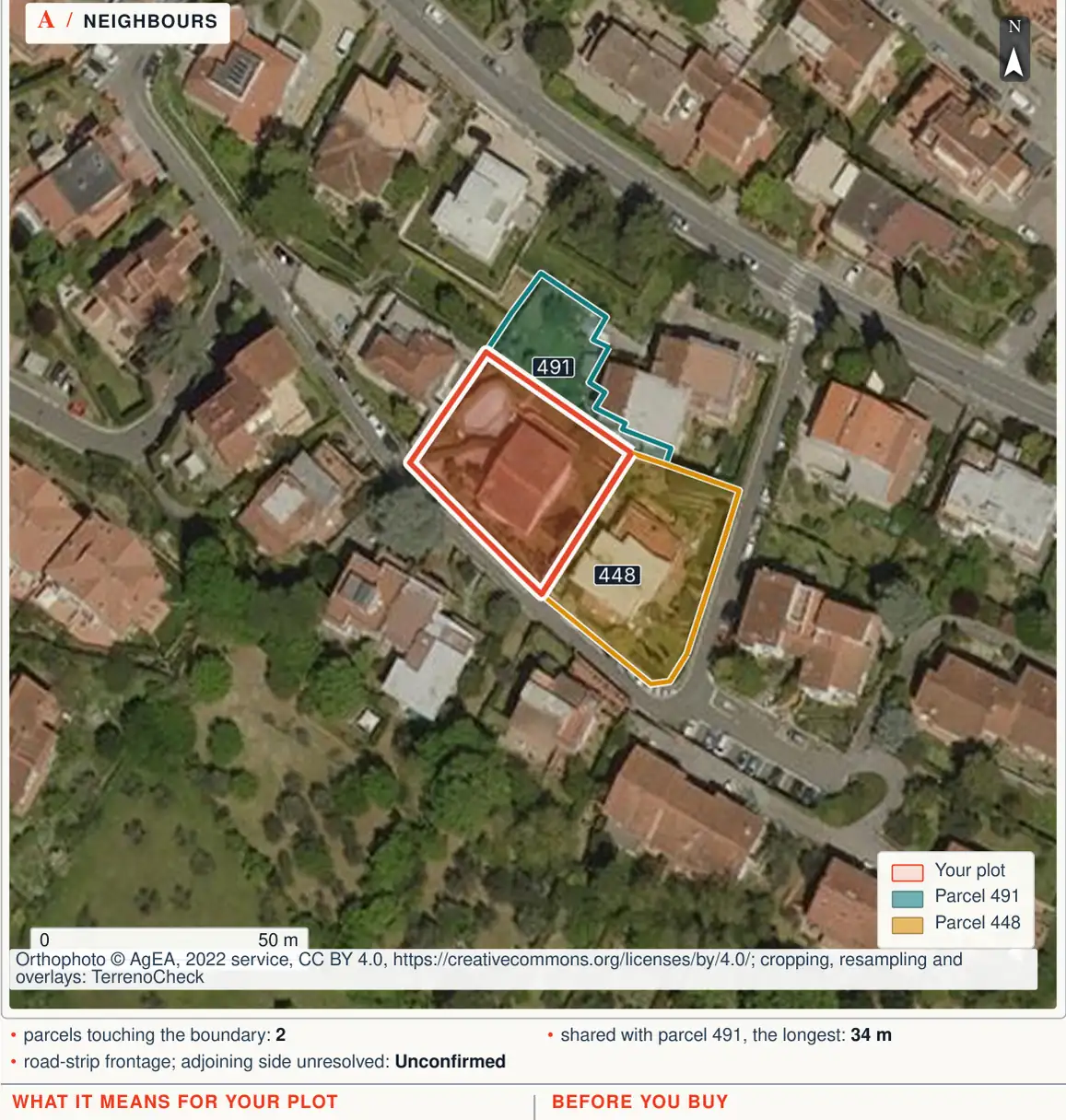
Subdivision does not release earlier commitments
If you are buying part of a field, ask whether the split preserves the restrictions attached to the original land and holding. A cadastral subdivision identifies the new portions. It is not a municipal decision that either the sold part or the retained part can support another building.
Article 30 DPR 380/2001 also covers subdivision and sales whose listed characteristics unequivocally reveal an unlawful building-development purpose. Your advisers should therefore read the proposed division alongside the plan designation and sale arrangements. The notary must separately check the zoning-certificate requirement and its statutory exceptions.
A compendio unico is another matter. Under Article 5-bis D.Lgs. 228/2001, where constituted under that regime, the land and its appurtenances are indivisible for ten years from constitution; transactions splitting it are void. It is not a general waiting period after every farmland purchase. Find the constituting deed and establish that the proposed sale actually concerns the affected assets.
Sources: DPR 380/2001, Article 12: planning conformity; DPR 380/2001, Article 30: zoning certificate and subdivision; D.Lgs. 228/2001, Article 5-bis: indivisible agricultural holding; Piedmont, current Regional Law 56/1977, Article 25; Greve in Chianti municipal PAPMAA service, updated 7 May 2026; accessed 13 November 2026.
Ask for a calculation you can trace back to documents
Commission a preliminary schedule with a row for each parcel. It should show area, relevant cultivation, availability and capacity already committed, together with the records consulted. A single figure for “remaining cubic metres” is harder to assess if nobody can show how it was reached.
In the schedule, identify each parcel’s legal availability separately from its surface area. For example: “parcel X, 8,000 m², included in the proposed purchase; earlier building commitment still to be checked”. A row like this keeps an unresolved documentary check visible in the calculation.
Agree the technician’s scope, fee and delivery date before the work. Request current document charges from the municipality and notary. The timetable must leave room to investigate old undertakings before paying a deposit that assumes a new house is possible. The zoning certificate’s issue deadline is not a deadline for approving your building scheme.
- Before making an offer, at the SUE: request the local rule and zoning plan. Article 30 provides 30 days for issue of the CDU zoning certificate.
- Before the preliminary contract, with the technician: check eligible area and unused capacity; agree a fee and delivery date based on the available records.
- Before subdividing or buying, with the notary: investigate recorded undertakings and any compendio unico; ask when the searches will be complete.
- Before signing: compare the results with the preliminary contract and identify any outstanding municipal decision.
A seller offering an additional field
Request a revised calculation identifying the extra parcel and the legal basis on which it could support the project. More advertised square metres do not resolve an earlier commitment to another building or a local rule excluding the parcel from the calculation.
If a proposed calculation includes land that will remain with a neighbour, ask the notary which existing agreement supports its inclusion. Record expected future consent as unresolved, rather than as secured capacity.
A hypothetical quotation, not a tariff: €600 for document review and calculation plus an assumed €80 of document expenses gives €680. The breakdown should state whether taxes and further charges are included. These inputs are not an average fee or an approval price; replace them with the technician’s offer and the office’s actual charges.
Minimum agricultural plot size to build in Italy
https://terrenocheck.it/en/guide/minimum-plot-size-agricultural-land-italy
Checklist
A traceable land-area calculation
Common questions
Is one hectare enough to build a home?
The area alone does not answer that. A technician must check the applicable rule, your eligibility, unused building capacity and the proposed building’s location.
Can separate fields be added together?
In Piedmont, Article 25 allows parcels in the same holding, including non-adjoining parcels and different municipalities, within the distance from the farm centre accepted by local PRG rules. Do not assume this applies elsewhere.
Does cadastral subdivision create a building plot?
It identifies the new parcels. It does not itself change planning permissions or release land from existing commitments.
What should I request from the seller?
A parcel schedule, the building titles and agricultural undertakings, existing-building records and earlier commitments of building capacity. Have the usable area checked independently.
Keep reading
Building a house on agricultural land in Italy: who may, on how many hectares, and how much
Buying part of a plot in Italy: how the frazionamento works and what to check before the deed
The certificato di destinazione urbanistica (CDU): Italy’s zoning certificate, explained for foreign buyers
Prepare the questions for your parcel
Select the land on the map to review its territorial information, sources and questions to take to the relevant offices before buying.
€29 in English or Italian · €39 in both languages · total, VAT included