
Pillar guide: Documents and contract
Legga questo articolo in italiano.
Building records in Italy: seeing the permits before you buy
On this page
You see an Italian house’s planning history by sending the comune (the municipality) a reasoned request, the accesso agli atti, at its building archive or building desk (SUE). It must answer within 30 days; viewing is free, copies and search fees are at local rates. For a buyer, it is simpler if the seller or a technician with the seller’s authority files it.
In short
- The request goes to the comune that holds the files, usually its private-building archive or SUE desk, and it must give reasons (Law 241/1990, Article 25).
- After 30 days without a reply, access counts as refused. File a TAR appeal within 30 days of knowledge of the decision or silent refusal; an alternative ombudsman review follows Article 25’s competence and substitution rules in the same filing period.
- Viewing is free; search fees, copies and stamp duty follow the applicable rules. Florence’s 2026 examples are €20 for direct viewing and €40 for a search, with the stated surcharges.
- The law asks for a direct, concrete and current interest: the owner has one, while for a would-be buyer the comune decides. That is why the seller, or a technician with the seller’s authority, is the better person to file.
- In the file you want every permit from the first to the last, with its drawings, plus any amnesty with its outcome and the certificate of fitness for use.
30 days
Time for the comune to reply
After that the request counts as refused.
€0
Viewing the documents
Copies are paid for, with the search and viewing fees.
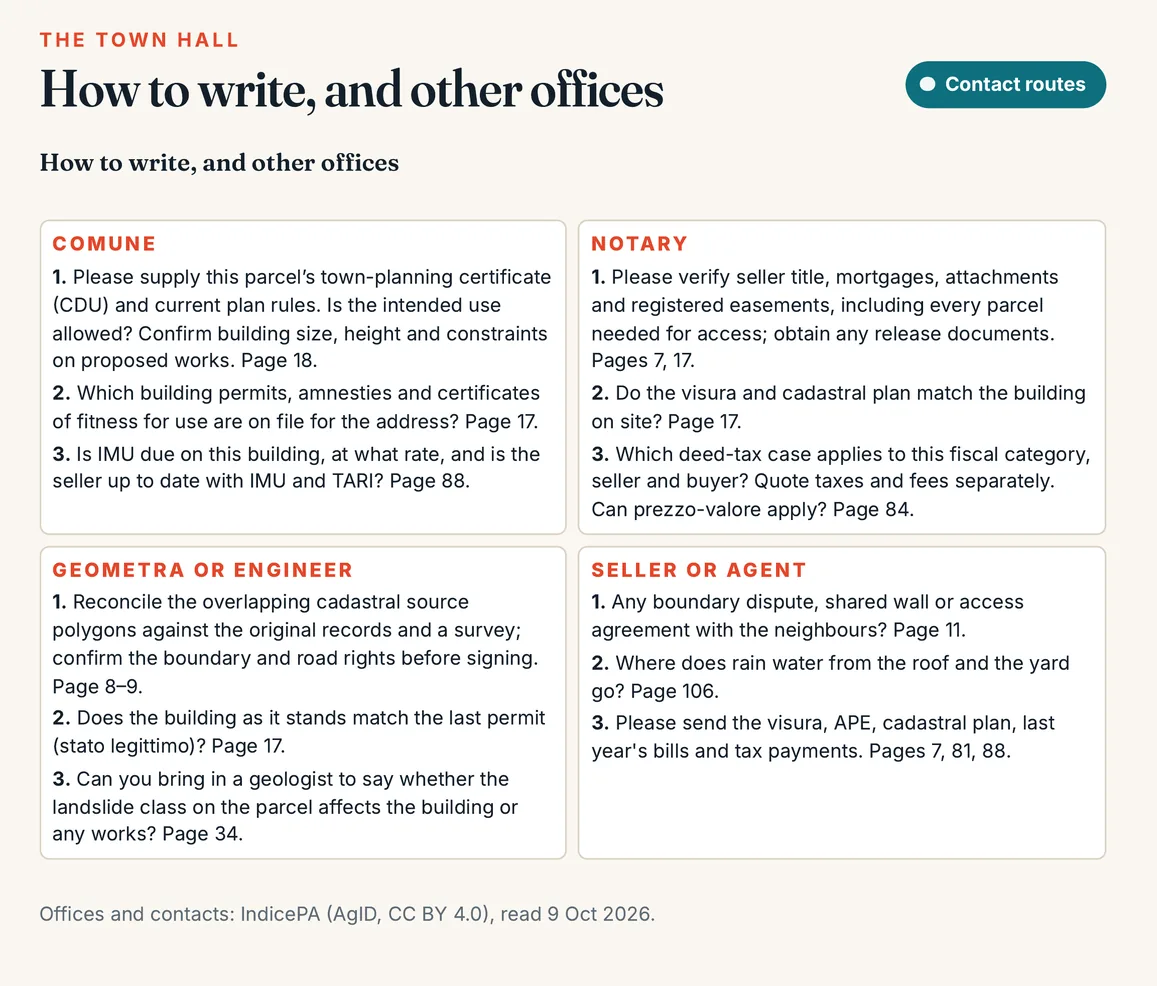
The report brings together public information about the land, with sources and dates, to prepare questions for the relevant offices: €29 in English or Italian · €39 in both languages · total, VAT included.
Who can ask for the files, and on what grounds
Law 241/1990 gives the right of access to «interested parties»: people with a direct, concrete and current interest corresponding to a legally protected position and linked to the document they ask for (Article 22). For a building file the owner is the clearest case. The comune must in any event allow access to documents a person needs to look after or defend their own legal interests (Article 24, paragraph 7).
Someone who is only thinking of buying is on less certain ground. The request must give reasons (Article 25). If the office doubts the applicant’s standing or the interest claimed, it asks for a formal request (DPR 184/2006, Article 6) and then decides. Attaching your signed offer helps the office weigh the interest; the decision stays with the comune.
In practice there are three ways in:
- The seller requests the files as owner and passes them to you.
- Your technician requests them with the owner’s written authority (delega). The national regulation asks the applicant to prove, where needed, their power to act for the person concerned (DPR 184/2006, Article 5).
- You request them in your own name, explaining your interest and attaching the offer or the preliminary contract.
There is also civic access (accesso civico generalizzato) under Legislative Decree 33/2013: anyone can use it, without giving reasons, and the comune must reply within 30 days (Article 5). It can be refused or limited to protect personal data and other people’s economic and commercial interests (Article 5-bis), and a private building file is full of names, plans and property details. For the house you want to buy, the reasoned request under Law 241 remains the main route.
- The seller, as ownerHas a direct interest: requests the file and hands over the copies
- The buyer’s technicianShows the owner’s written authority to act on their behalf
- The buyer, in their own nameExplains the interest and attaches the offer; the comune decides
- Anyone, by civic accessNo reason needed, but limited to protect personal data and third parties’ interests
Sources: Law 241/1990, Article 22; Law 241/1990, Article 25; DPR 184/2006, Article 5; DPR 184/2006, Article 6; Legislative Decree 33/2013, Article 5; Legislative Decree 33/2013, Article 5-bis; accessed 13 November 2026.
What to ask for: every permit, first to last
Asking for «the permit» is not enough. A building’s lawful status (stato legittimo) rests on the permit that allowed or legitimised its construction, or on the last permit covering the whole property, together with later permits for partial works (DPR 380/2001, Article 9-bis). The second route only works if the comune, when it issued that last permit, checked that the earlier ones were lawful. Retrospective permits under Articles 34-ter, 36, 36-bis and 38 of the same code count too, once the penalties or payments have been made.
So the request should cover the whole file: the original permit with its drawings, any variations, later permits, amnesties and retrospective permits with an express outcome or evidence establishing a legally formed tacit title, and the certificate of fitness for use (agibilità or abitabilità). The names of the permits changed over the decades, as the table shows.
For a building put up when no permit was required, lawful status is drawn from other evidence: the first cadastral records, photographs, old maps, archive documents. Whether a house falls into that period is for the technician to judge, on the law and the comune’s building rules of the time. How lawful status is pieced together, and what to do about discrepancies, is covered in the guide to stato legittimo.
| Period | Permit to look for in the file |
|---|---|
| Up to Law 765 of 1967 | Licenza edilizia, required in built-up areas and, where a town plan existed, in its expansion zones |
| From Law 765 of 1967 | Licenza edilizia for new buildings, extensions, alterations and demolitions across the whole municipal territory |
| From Law 10 of 1977 | Concessione edilizia for any planning or building transformation of the municipal territory |
| Amnesties (condoni) | Retrospective permit (concessione or autorizzazione in sanatoria) for works completed by 1 October 1983 (Law 47/1985), by 31 December 1993 (Law 724/1994) or by 31 March 2003 (Decree-Law 269/2003); the last two with limits on extensions and their own conditions |
| From 30 June 2003 | Permesso di costruire and DIA; later in the period also SCIA and CILA. Identify the instrument applicable on the works date |
| Fitness for use (agibilità) | Today a certified notice (DPR 380/2001, Article 24); in older files a certificato di abitabilità or di agibilità |
For a building put up when no permit was required, its lawful status is drawn from the first cadastral records and other evidence (DPR 380/2001, Article 9-bis). Sources: Law 1150/1942, Article 31, original text; Law 765/1967, Article 10; Law 10/1977, Article 1; Law 47/1985, Article 31; Law 724/1994, Article 39; Decree-Law 269/2003, Article 32; DPR 380/2001, Article 24; DPR 380/2001, Article 9-bis; accessed 13 November 2026.
How to file the request
The request goes to the authority that produced the document or keeps it (Law 241/1990, Article 25): for building files, the comune. The building code gives the SUE, the comune’s single building desk, the decisions on access to documents (DPR 380/2001, Article 5), and in some comuni a records office or the archive handles it, as in Florence’s dedicated procedure.
- Find the file references. The year, number and holder of each permit can be found in the seller’s purchase deed, in the seller’s papers and on the comune’s website.
- Get the form. It is on the comune’s website, under private building (edilizia privata) or access to records. You give the references or enough detail to find the documents, your interest, your identity and, if you act for someone else, your authority to do so (DPR 184/2006, Article 5).
- Send it. Usually by PEC, Italy’s certified e-mail, at the registry desk (protocollo) or through the SUE portal. Florence takes access requests at the PEC address of its planning department’s records office; follow the dedicated building-record service’s submission route, rather than the generic access portal. The 30 days run from the day the request reaches the competent office.
- Wait for the answer. Within 30 days the comune grants, defers, limits or refuses access, giving reasons.
- View the documents or receive copies. The approval names the office and gives you at least 15 days (DPR 184/2006, Article 7).
Florence offers two kinds of request. With the exact references you ask for a «direct viewing» of a file. Without them you ask for a «search and possible viewing»: the office tells you the result by PEC, with the deadline to see the plans in person or receive them digitally.
Time limits: 30 days, and what happens if the comune says nothing
Where the nature of the document shows no third parties whose privacy would be harmed (controinteressati), you can ask informally, even in person at the counter (DPR 184/2006, Article 5). If there are such parties, or the office cannot grant the request on the spot or has doubts, it asks you for a formal request and gives you a receipt (Article 6).
After 30 days without a response, the request counts as refused under Article 25 of Law 241/1990. An appeal to the TAR, the regional administrative court, must be brought within 30 days of learning of the challenged decision or the formation of silent refusal, under Article 116 of the administrative procedure code. The appeal requires notification to the administration and at least one affected third party as the provision specifies. Give the decision and receipts to a lawyer promptly.
For municipal, provincial and regional records, a review can instead be requested within the same filing period from the territorially competent difensore civico, the public ombudsman, where established. If none exists, competence passes to the ombudsman for the immediately higher territorial level. For State administration records, the request goes to the Commissione per l’accesso and the respondent administration. The ombudsman or Commission has 30 days from the review request to decide; silence means rejection. If it considers refusal or deferral unlawful, it informs the applicant and authority; access is allowed if the authority does not confirm its decision with reasons within 30 days of receiving that communication. Following an ombudsman or Commission review, the court-filing period runs from the applicant’s receipt of its outcome. Article 25 also addresses consultation of the data-protection authority where applicable.
Refusal, deferral and limitation must be reasoned, and access cannot be refused where deferring it would be enough (Law 241/1990, Articles 24 and 25). Whether the file arrives in time for your deal therefore depends on when you ask: file the request before you set a date for the preliminary contract.
A formal request, step by step
- Request to the comuneSUE or building archive, by PEC, at the registry desk or through the URP: the 30 days run from here
- Within 10 daysIf the formal request is irregular or incomplete, the comune says so; the time starts again from the corrected request
- Third partiesIf there are any, they get a copy and have 10 days to object, with reasons
- Within 30 daysAccess granted, or deferred, limited or refused with reasons; silence counts as a refusal
- Viewing and copiesAt the office named, for at least 15 days; copies are paid for
- If access is refusedTAR: file within 30 days of knowledge of the decision or silent refusal. Alternative review within that period by the competent ombudsman where established, or the next territorial level; review decision within 30 days of request
Sources: DPR 184/2006, Article 3; DPR 184/2006, Article 6; DPR 184/2006, Article 7; Law 241/1990, Article 25; accessed 13 November 2026.
What it costs: a current example from Florence
Under Article 25 Law 241/1990, examining documents is free; copies, stamp duty and search or viewing rights follow the applicable rules and the authority’s fees. Florence’s dedicated building-record service, consulted on 13 November 2026, distinguishes the following charges. These are municipal examples, not Italian national rates.
| Florence service | Charge | Condition |
|---|---|---|
| Direct viewing request | €20 | Known file references, same property unit |
| Archive search with possible viewing | €40 | File references unknown |
| Urgent procedure | +€30 | Surcharge for the requested route |
| More than ten files | +€10 for each beyond ten | Decision 237 of 26 June 2026 |
Hypothetical calculation using those published rates: an archive search covering twelve files costs €40 + 2 × €10 = €60; with the urgent procedure, €90. These are only the listed items, not a total including certified copies and stamp duty. The service lists those separately; ask the office to calculate the charge for your requested format. Agree the fee for a technician’s document and site comparison separately.
Florence asks applicants to attach the payment receipt. Use the dedicated building-record search and viewing procedure and its current channels, rather than the generic access-to-records service. Check the current form and submission route before sending your request, especially if your adviser will submit it for you.
How to read the file
The permit itself says little: measurements, heights and the layout of the rooms are in the drawings attached to it (elaborati grafici). When the file arrives, the technician looks above all at four things.
- The first permit, with its drawings. If you only have the permit number, ask the comune for the attached plans. The national regulation extends access to the documents referred to in the one requested and belonging to the same procedure (DPR 184/2006, Article 7, paragraph 2).
- The outcome of any amnesty. An amnesty application is not an amnesty granted: the technician must establish an express decision or a legally formed tacit title, proving all conditions of the applicable amnesty legislation, including Article 39(4) Law 724/1994 where relevant; the passage of time alone does not establish approval. For an express decision, obtain the decision and proof of payment. Distinguish the application from evidence establishing its legally effective outcome.
- The run of later permits. Extensions, changes of use, and units split or merged that you can see on site are checked against the permits in the file; which permit each change needed is for the technician to judge.
- Fitness for use. Today safety, hygiene and conformity with the approved plans are certified by a notice (DPR 380/2001, Article 24); older files may hold a certificato di abitabilità or di agibilità instead. See the guide to agibilità.
If the permit cannot be found but there is evidence that it existed, the same Article 9-bis allows the other records to be used where neither a copy nor the references of the permit are available. That is a case for the technician. Work done without a permit, and the ways to regularise it, is the subject of the guide to unauthorised building work.
Hypothetical example
An amnesty applied for but never closed
A hypothetical example. The file of a farmhouse holds a 1979 concessione with its drawings and a 1986 amnesty application for an enclosed porch, with no final decision or assessment of a possible tacit title. The buyer’s technician asks the amnesty office where the application stands and for the receipts of the payments made. The preliminary contract ties the date of the deed to the closing of the file, and says who follows it up and who pays.
Sources: DPR 380/2001, Article 9-bis; Law 47/1985, Article 31; accessed 13 November 2026.
A sample request
A plain letter will do if the comune does not insist on its own form. This is a sample to adapt, written in Italian because that is what the office will read, not an official form.
Al Comune di [Comune], Sportello unico per l’edilizia / Archivio pratiche edilizie
Oggetto: richiesta di accesso agli atti ai sensi degli artt. 22 e seguenti della legge 241/1990
Il sottoscritto [nome e cognome], nato a [luogo] il [data], codice fiscale [codice], in qualità di [proprietario / tecnico delegato dal proprietario, con delega e documento allegati / promissario acquirente in forza di proposta del [data], allegata], chiede di prendere visione ed estrarre copia di tutte le pratiche edilizie relative all’immobile in [indirizzo], censito al foglio [n], particella [n], subalterno [n]: titoli edilizi originari e successivi con i relativi elaborati grafici, varianti, condoni e sanatorie con esiti espressi o documentazione dell’eventuale titolo tacito, agibilità o abitabilità. Estremi noti: [anno e numero, se noti].
Motivazione: verifica dello stato legittimo dell’immobile in vista [della vendita / dell’acquisto].
Chiede l’invio delle copie in formato digitale all’indirizzo PEC [indirizzo]. Allega copia del documento d’identità.
In plain English: you identify yourself and say in what capacity you ask (owner, the owner’s technician, or buyer under a signed offer), name the property by address and cadastral references (sheet, parcel, unit), ask for every permit with its drawings, any amnesty with its express outcome or evidence of a legally formed tacit title and the fitness certificate, give your reason, and ask for digital copies by PEC. The codice fiscale is the Italian tax code.
Building records in Italy: seeing the permits before you buy
https://terrenocheck.it/en/guide/building-records-access-request-italy
Checklist
Before the preliminary contract
Common questions
Can I see the building file of a house I do not own yet?
You can try, explaining in the request why you need the documents. The law gives the right to anyone with a direct, concrete and current interest corresponding to a legally protected position and linked to the document, and the comune decides whether a would-be buyer has one. A request from the seller as owner, or from a technician holding the seller’s written authority, avoids that question.
How long does it take?
The comune has 30 days from the request. If a formal request is incomplete, the comune says so within 10 days and the 30 days start again from the corrected request. Once access is granted you have at least 15 days to view the documents or collect the copies.
How much does it cost?
Viewing is free; copies, stamp duty and public fees follow the applicable rules. Florence 2026: direct viewing €20, search €40, urgency +€30 and +€10 for each file beyond ten. These are local examples; ask the municipality for your total.
What if the comune cannot find the permit?
First check the references: year, number and holder of the permit, which you can look for in the seller’s purchase deed and papers. If the permit cannot be found but there is evidence that it existed, Article 9-bis of DPR 380/2001 lets the lawful status be pieced together from other records, such as the first cadastral entries or old photographs. A technician makes that call.
Do I need an Italian lawyer for this?
No. The request is filed by the person with the interest, and the documents can be viewed by someone they appoint. Where nobody else’s privacy is affected it can even be made in person, without a form. You do need a technician to read the drawings and compare them with the house.
Can I use civic access instead?
Civic access needs no reasons and anyone can file it (Legislative Decree 33/2013, Article 5). The comune can limit it to protect personal data and other people’s economic interests, and a private house’s file contains both. For someone with a direct interest, the reasoned request under Law 241/1990 is the route the law provides.
Keep reading
When the house doesn’t match the drawings: stato legittimo, tolerances and the 36-bis amnesty for foreign buyers
Unauthorised building work in Italy: spot an abuso
Agibilità in Italy: what it proves
Planimetria catastale: the Italian cadastral floor plan explained
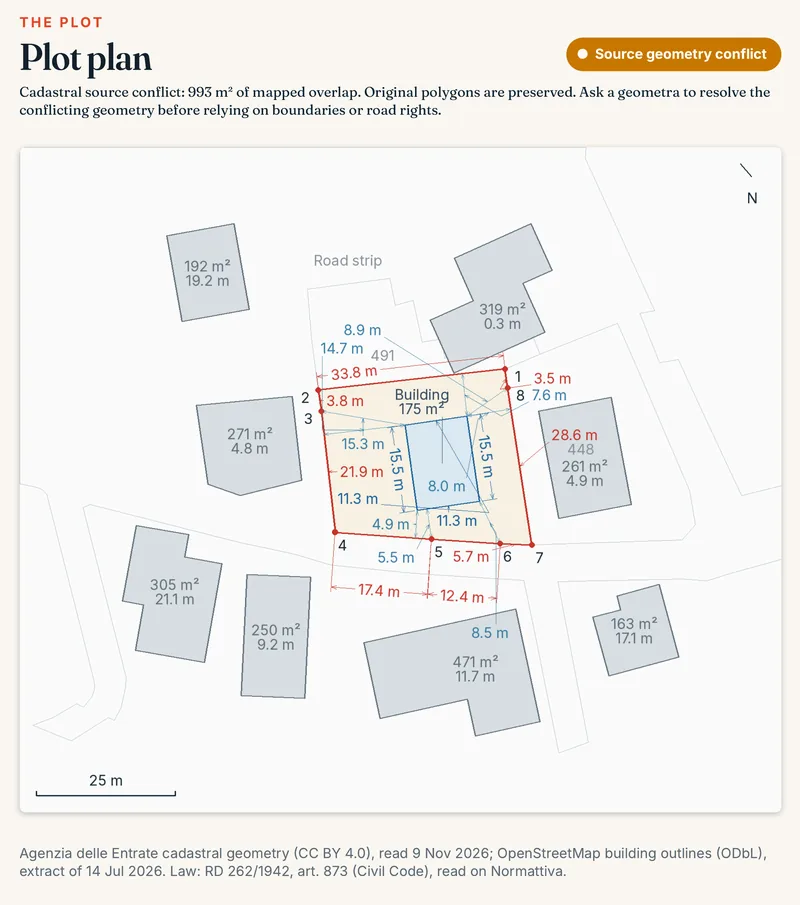
The parcel’s picture, before the building file
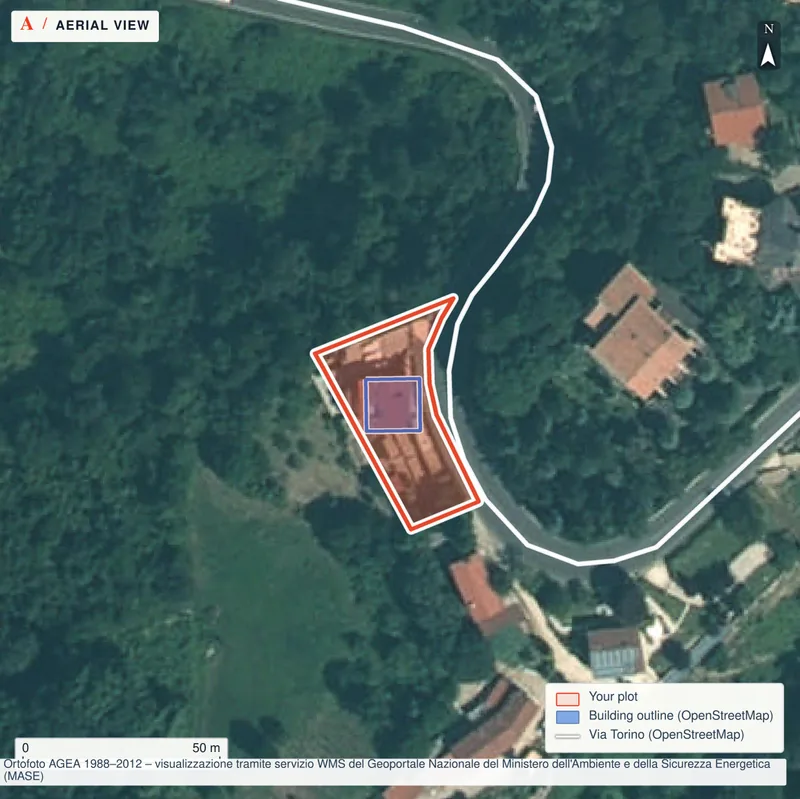
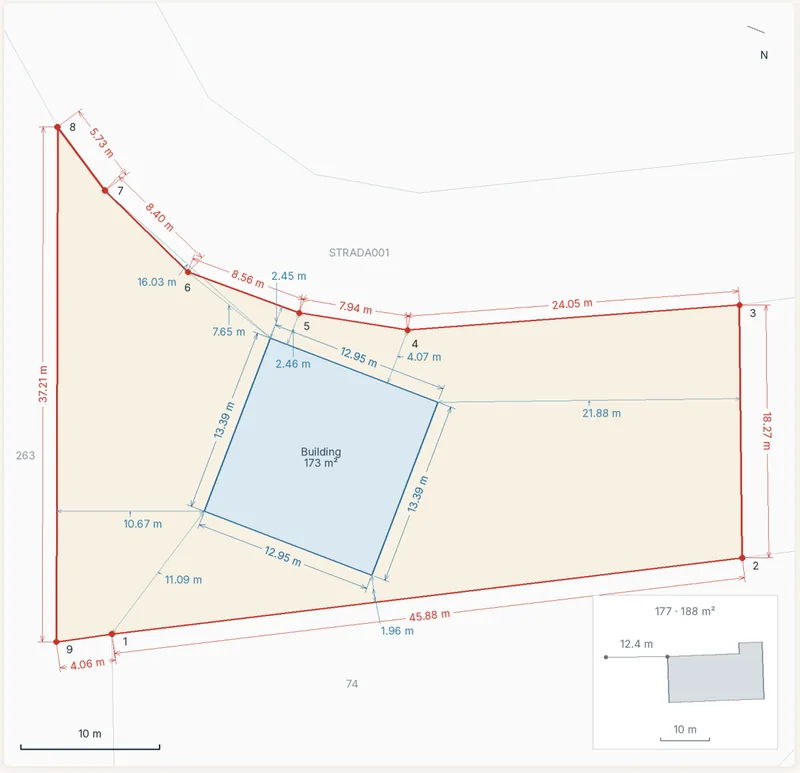
Pick the parcel on the map: public context, hazards and office contacts are assembled for that plot, each with a source and date, along with the questions to put to the comune and your technician.
€29 in English or Italian · €39 in both languages · total, VAT included