
Legga questo articolo in italiano.
Buying a Tuscan farmhouse: changing agricultural use
On this page
In Tuscany, agricultural outbuildings whose works began after 15 April 2007 cannot change agricultural use under Article 81 of Regional Law 65/2014. Other rural buildings need a documented history, binding undertakings and assessment of the municipal route.
In short
- Agricultural outbuildings started after 15 April 2007 cannot change agricultural use under Article 81.
- Earlier rural buildings require lawful condition, compliance with undertakings and Articles 82–83 conditions.
- Later rural dwellings have a minimum twenty-year restriction from completion, with further applicable conditions.
- The municipal plan must provide for the change; associated land and environmental obligations need a project-specific assessment.
15 April 2007
Check the works start
Article 81 distinguishes outbuildings from rural dwellings.
1 hectare
Associated conversion area
Article 83: environmental obligations and charges; not a building-right threshold.
The report brings together public information about the land, with sources and dates, to prepare questions for the relevant offices: €29 in English or Italian · €39 in both languages · total, VAT included.
A Tuscan casale needs an authorised-use history
In Tuscany, casale is a property description rather than proof of authorised residential use. Before buying, establish whether the building still has an agricultural use and whether obligations link it to surrounding farmland. Ask for the decision or instrument supporting any claim that it has been deruralizzato, released from agricultural use.
Regional Law 65/2014 gives rural buildings a specific framework, including Articles 74 and 81–83. Begin with the building history and binding undertakings, then establish which municipal planning route permits the intended project. The seller’s retirement from farming does not itself turn a farm store into a dwelling.
Distinguish an already lawful home from a barn you hope to convert. A ruin purchase adds questions about evidence of the former building’s dimensions and characteristics. Ask your technical adviser to identify the authorised starting point before drawing the new accommodation.
The construction dates that matter for agricultural buildings
In Tuscany, Article 81 says agricultural outbuildings whose works began after 15 April 2007 cannot change their agricultural use. Rural buildings, including dwellings, whose works began before that date can change use under Articles 82 and 83, subject to binding undertakings and a lawful existing condition. Being old is therefore one part of the assessment, rather than permission to convert.
For rural residential buildings whose works began after 15 April 2007, Article 81 prevents the use changing for at least twenty years after completion. The start-of-works date and completion date perform different roles. Ask the adviser to classify the documented circumstances rather than relying on a casual before-or-after label, including any case requiring closer interpretation of the statutory dates.
Obtain evidence of those dates from the building file. A roof’s apparent age does not establish when the authorised works began, particularly where an outbuilding was extended in stages. The guide to stato legittimo, the building’s legally authorised condition, explains why the permissions history comes before the conversion proposal.
- Outbuilding started after 15/04/2007Cannot change agricultural use
- Building started before that dateLawful condition, undertakings and Articles 82–83 conditions
- Later rural dwellingAt least 20 years from completion; further route conditions apply
Sources: Tuscany Regional Law 65/2014 Article 74: consolidated text; Tuscany Regional Law 65/2014 Article 81: consolidated text; Tuscany Regional Law 65/2014 Article 82: consolidated text; Tuscany Regional Law 65/2014 Article 83: consolidated text; Tuscany Region: GEOscopio; Tuscany Region: landscape plan, rules and updates; Bagno a Ripoli municipality: current planning documents; Legislative Decree 42/2004 Article 146: landscape authorisation; accessed 13 November 2026.
Understand whether an agricultural business programme applies
In Tuscany, the programma aziendale pluriennale di miglioramento agricolo ambientale, often shortened to PAPMAA, is an agricultural and environmental improvement programme under Article 74. The agricultural entrepreneur prepares it for the statutory purposes. Approval is a preliminary condition for the relevant building permissions, and the programme goes to the competent municipality or municipalities.
Article 82 concerns change of use through that programme. Subject to Article 81, it requires approval, absence of alternatives allowing agricultural reuse and that the farm keeps in production land areas larger than the minimum areas set in the provincial or metropolitan coordination plan (PTC or PTCM) or, where those plans set none, in the implementing regulation under Article 84. Keeping exactly the minimum is not enough. A suggestion that you can create a farming plan after purchase does not establish that this route applies to you.
If the house is being separated from the farm, obtain the convention and binding undertakings. Article 74 includes commitments concerning productive land and buildings needed for the agricultural activity. Your notary and technical adviser need to compare those obligations with the actual parcels being sold.
Find the municipal provision for the proposed conversion
In Tuscany, Article 83 permits agricultural change of use only where municipal territorial and planning instruments expressly provide for and regulate it, subject to the referenced articles, including Article 81. The regional framework does not confer a general conversion right on every rural building. Ask the adviser to identify the local provision supporting your intended use.
Bagno a Ripoli provides a useful example of where to begin. Its official planning-documents page separates the current Piano Strutturale and Piano Operativo, structural and operational plans, from superseded planning and a variation to the operational plan’s technical rules. Use the current-plan section and ask the adviser to assess any effect of instruments in progress, rather than relying on an old sheet supplied by the seller.
Request the building’s individual planning sheet where one exists and its historical classification. Article 83 requires respect for the typological, formal and construction characteristics of buildings with historical-testimonial value. The design needs checking for its actual alterations, rather than only its total floor area.
| Tuscan document | Purchase question | Who should assess it |
|---|---|---|
| Permissions and works dates | Which Article 81 situation applies? | Your technical adviser |
| Convention or binding undertaking | Which obligations affect the house and fields? | Technical adviser and notary |
| Agricultural programme where relevant | Does the agricultural route apply to this project? | Technical and agricultural advisers |
| Municipal plan and building sheet | Is the intended use permitted, and on what conditions? | Adviser and municipal office |
| PIT-PPR and protection records | Which landscape provisions affect the works? | Adviser and competent authority |
One hectare changes the environmental-obligation assessment
In Tuscany, Article 83 distinguishes the associated land defined for the conversion. Where it is at least one hectare, the convention or unilateral undertaking commits the owners to environmental improvement works with suitable guarantees. If the first decade’s expenditure, assessed as the provision requires, falls below the paragraph 5 charges, the difference is payable to the municipality.
For associated land below one hectare, paragraph 5 provides specific municipal charges within its stated limits in place of the paragraph 1 convention. Paragraph 6 addresses replacement of urbanisation charges by the specified charges and commitments. This is neither a national price per hectare nor a rule making larger plots free of cost.
The project and instruments must define the associated area under paragraph 3. It is not necessarily identical to every field in the advertisement. Dividing the land to reach a preferred area does not establish what boundary the municipality will accept for the change-of-use application.
The associated area changes the obligations
- BoundaryDefine in project and instruments, Article 83(3)
- At least 1 haEnvironmental works and guarantees; possible municipal difference, paragraph 4
- Below 1 haSpecific paragraph 5 municipal charges in place of the stated convention
- Actual assessmentMunicipality: costs and commitments; no automatic free conversion
Sources: Tuscany Regional Law 65/2014 Article 74: consolidated text; Tuscany Regional Law 65/2014 Article 81: consolidated text; Tuscany Regional Law 65/2014 Article 82: consolidated text; Tuscany Regional Law 65/2014 Article 83: consolidated text; Tuscany Region: GEOscopio; Tuscany Region: landscape plan, rules and updates; Bagno a Ripoli municipality: current planning documents; Legislative Decree 42/2004 Article 146: landscape authorisation; accessed 13 November 2026.
Read the landscape map with its written rules
In Tuscany, GEOscopio is the regional portal for viewing, querying and downloading territorial data. The region publishes the PIT-PPR, its territorial plan with landscape-plan status, with plan rules, landscape-area sheets and protection documents. Your adviser should connect the property location to the relevant written provision and applicable updates.
A map does not authorise works. Article 146 of the Cultural Heritage and Landscape Code regulates landscape authorisation and its conditions; the adviser must establish which procedure applies to the proposed intervention, considering any applicable exemptions or simplified routes. Avoid treating a sales description as evidence that particular alterations need no approval.
Include proposed external works in the assessment: a vehicle access, parking area and changes to the ground can raise separate questions. A house that can be restored does not establish that every desired outdoor alteration is permitted. Ask for a drawing that distinguishes the necessary works from optional additions.
Obtain a usable opinion before committing
- Before visiting, ask the seller: obtain permissions, works dates, agricultural programme and existing undertakings. Agree when they will be supplied; ask your adviser for the first-stage fee and any municipal records still required.
- At the municipality and through GEOscopio: locate the building and identify the plan, building sheet and protections. Request the office’s time estimate and charges for records; online viewing alone does not close the investigation.
- Before a deposit, with the technical adviser: commission a written opinion on the intended use. Agree its price and delivery date, identifying any conclusions dependent on a future municipal decision.
- Before the preliminary contract, with the notary: compare the binding obligations with the sale parcels. Request the fee and review timetable, and address unresolved conditions in the contract.
Use the actual deadlines for the records and procedures your project needs. Do not add guessed processing times into an assurance that conversion will be approved before completion. If the purchase depends on a change of use, raise the contractual condition before signing.
Decide on the authorised use the documents support
An advertisement might show a furnished room in a former store. Your purchase decision needs the authorised use evidenced in the file and the adviser’s assessment of the proposed change. Ask for any discrepancy to be shown on a plan so that the seller’s explanation can be checked against the records.
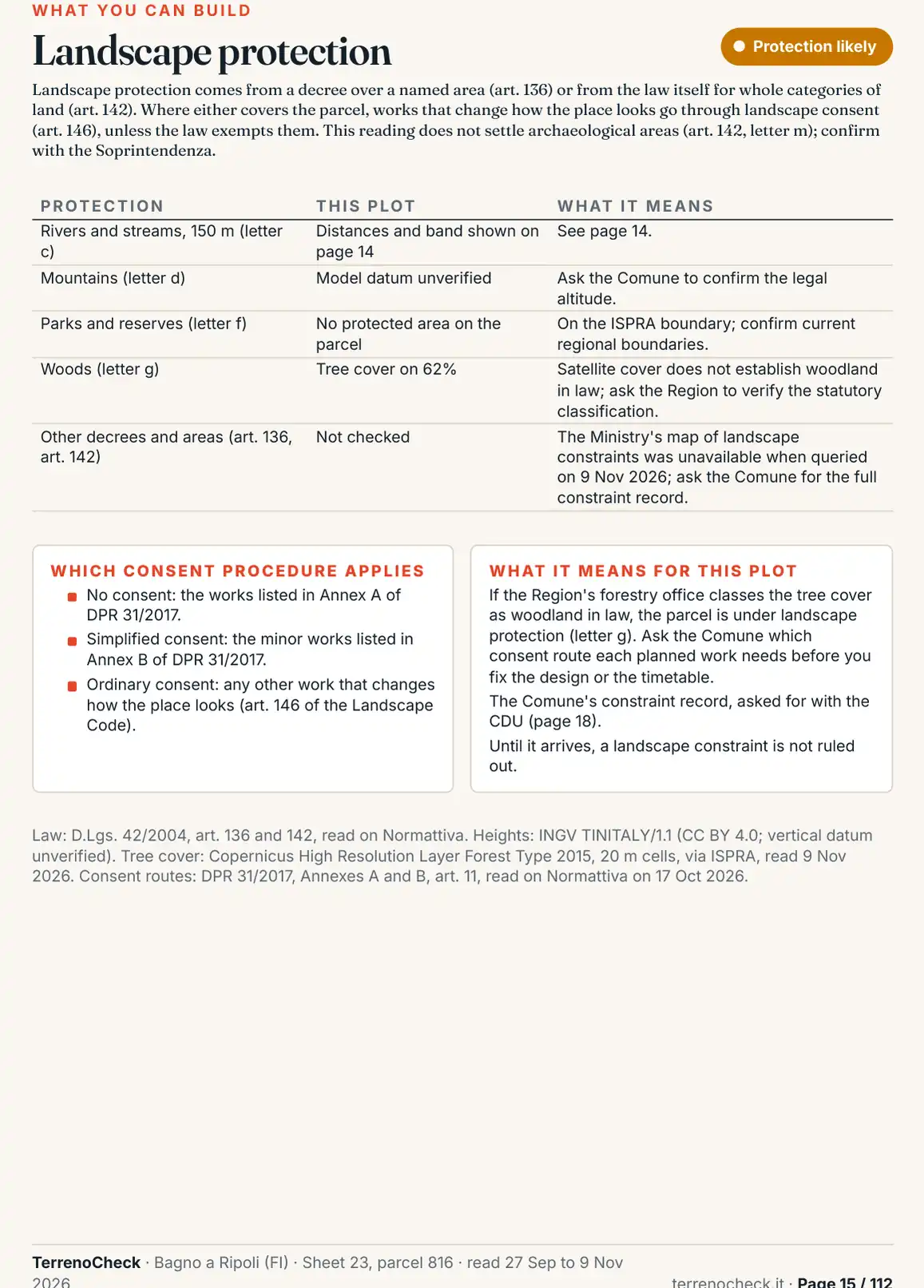
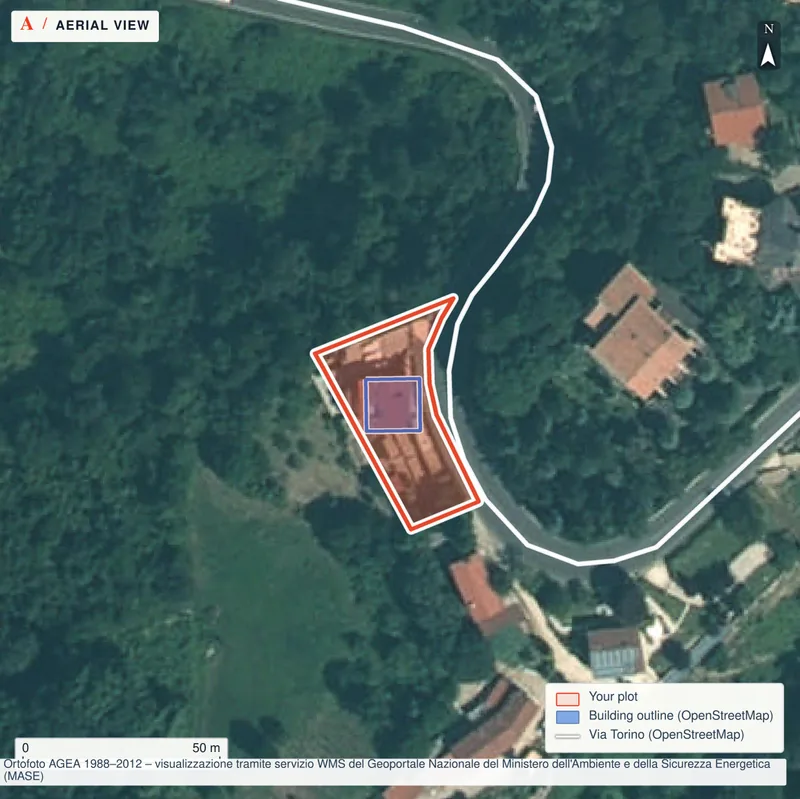
The Bagno a Ripoli sample helps locate a Tuscan parcel in its territorial context. It does not establish a particular agricultural building’s conversion rights or retrieve the private undertakings. Use the location information to prepare a property-specific enquiry to the municipality and your advisers.
Buying a Tuscan farmhouse: changing agricultural use
https://terrenocheck.it/en/guide/tuscany-rural-buildings-change-of-use
Checklist
File for a Tuscan rural purchase
Common questions
Can an old barn automatically become a home?
No. Buildings before the Article 81 date still require a lawful existing condition, compliance with binding undertakings and the Articles 82–83 conditions, including relevant municipal provisions.
What is PAPMAA?
The multiannual agricultural and environmental improvement programme under Article 74. It is not a general route for any buyer to obtain a dwelling.
Is conversion free above one hectare?
No. Article 83 provides environmental works and guarantees for associated areas of at least a hectare, with a difference payable under paragraph 4 conditions. Smaller areas fall under paragraph 5 charges.
Where should a Bagno a Ripoli enquiry start?
Use the municipality’s current planning-documents section with your adviser, including building sheets and relevant instruments in progress. GEOscopio and PIT-PPR add territorial information without authorising works.
Keep reading
Prepare the file for your parcel
Bring the parcel’s public territorial context, sources and dates to your advisers when discussing the purchase.
€29 in English or Italian · €39 in both languages · total, VAT included