
Legga questo articolo in italiano.
Italian property taxes when you live abroad
On this page
Living abroad does not by itself exempt an Italian holiday home from IMU. Check property tax, municipal waste charges and income separately; Trento, Bolzano and Friuli Venezia Giulia apply autonomous property-tax regimes.
In short
- Your only Italian home is not automatically your main residence for IMU: the exemption needs the home where you usually live and are registered as resident, or a specific case the law treats in the same way. Homes in cadastral categories A/1, A/8 and A/9 remain subject to IMU even as a main residence.
- Trento, Bolzano and Friuli Venezia Giulia use autonomous regimes; this guide illustrates national IMU.
- Overseas-pension relief requires every paragraph 48 condition, set out in the relevant section.
- Ordinary IMU dates are 16 June and 16 December; waste-charge dates come from the municipality.
- IMU does not always add to personal income tax: substitution has conditions and exceptions.
16 June
Ordinary IMU payment
Advance or annual payment; balance due 16 December.
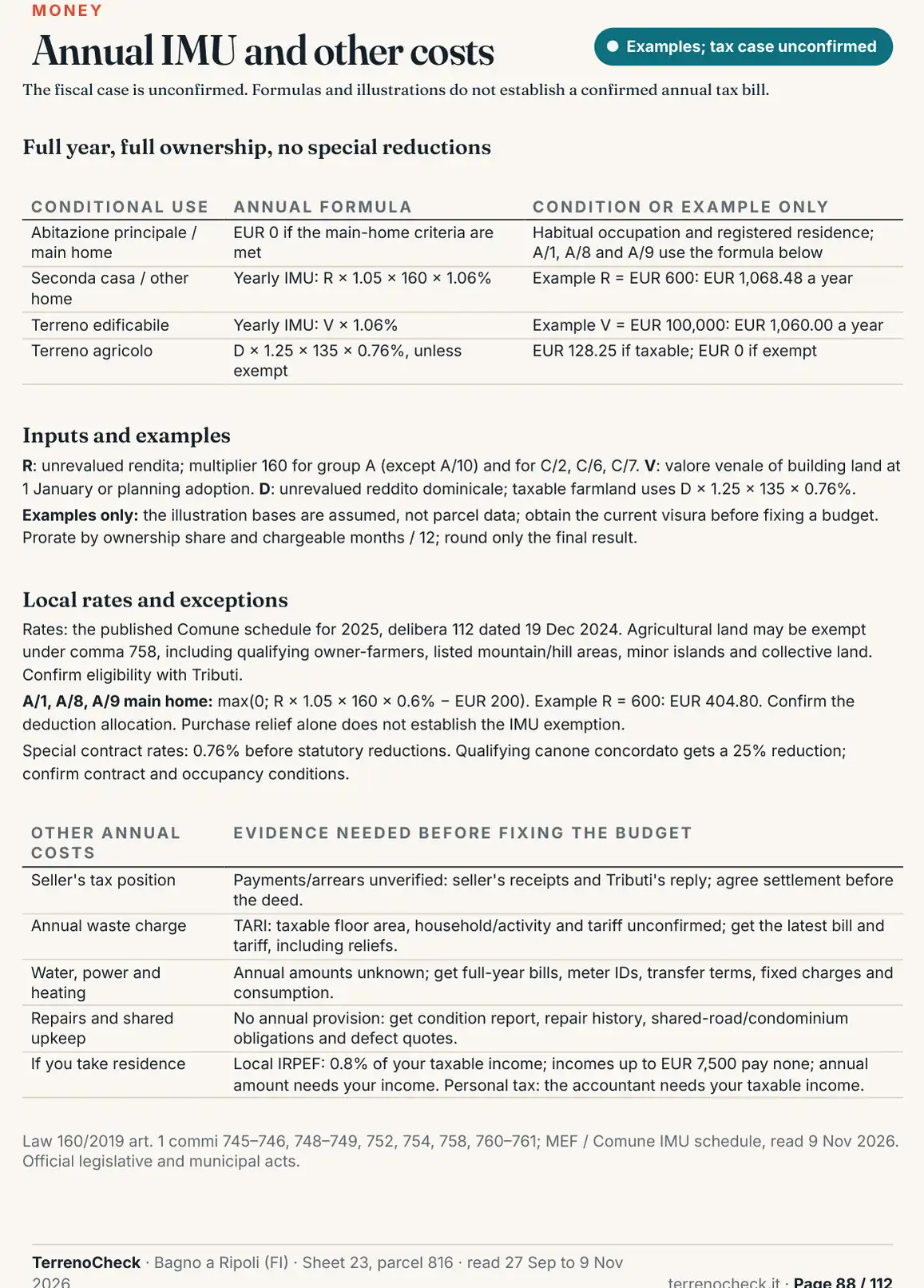
€100,800
Example A/2 taxable value
Hypothetical cadastral income €600 × 1.05 × 160; not purchase price.
The report brings together public information about the land, with sources and dates, to prepare questions for the relevant offices: €29 in English or Italian · €39 in both languages · total, VAT included.
An overseas address does not exempt your Italian home
In municipalities applying national IMU, the municipal property tax, a holiday home does not become exempt simply because it is your only Italian property. The tax is due because you own or hold the property. The main-residence exclusion covers the home where the owner usually lives and is registered as resident, plus a closed list of situations the law allows to be treated as a main residence; a holiday home owned from abroad is not one of them by default. The exclusion does not apply to homes in cadastral categories A/1, A/8 and A/9, which remain subject to IMU even when they qualify as a main residence. Purchase-tax relief known as prima casa is a separate question from annual property taxation.
This guide concerns an individual owning a house or land from abroad. Trento, Bolzano and Friuli Venezia Giulia have autonomous property taxes: do not apply the IMU calculation below automatically to IMIS, IMI or ILIA. Article 1 paragraph 739 of Law 160/2019 expressly preserves their taxing autonomy.
Before budgeting, separate the property tax, waste charges and possible income-tax obligations. Give the municipal tax office and your tax adviser the property identifiers and an accurate description of its use. A statement that you will visit only occasionally does not provide enough information to calculate all three.
Establish who pays IMU and identify the taxable asset
Paragraph 743 identifies the owner and holders of relevant rights, alongside the specific situations listed in the provision. Where a property is subject to usufruct, do not allocate IMU to the bare owner just because their name appears in the deed. For multiple taxpayers, the law considers ownership shares and individual qualifying circumstances separately.
For a dwelling registered in cadastral group A, excluding A/10, paragraph 745 starts with the rendita catastale, the assessed cadastral income. It increases that figure by 5% and applies a multiplier of 160. This taxable value is different from the purchase price; confirm category, assessed income and relevant changes before calculating.
Building land uses market value under paragraph 746, with the statutory valuation criteria. Agricultural land instead uses the reddito dominicale, the cadastral income attributed to land ownership, increased by 25% and multiplied by 135. Agricultural exemptions are governed by paragraph 758: cultivation alone, or describing a field as a future garden, does not establish exemption.
- Property taxMunicipality: regime, asset, share, months and relief; check autonomous taxes
- Waste chargeTARI office: taxable circumstances, local rules and payment dates
- IncomeAdviser: filing, IMU substitution and exceptions
Sources: Law 160/2019 Article 1, paragraphs 738–783: IMU (current text); Law 178/2020 Article 1 paragraph 48: non-resident pensioners; Law 147/2013 Article 1: TARI, paragraphs 641, 659 and 688; Income Tax Code Article 23: non-resident income; Legislative Decree 23/2011 Article 8: IMU substitution; Legislative Decree 23/2011 Article 9 paragraph 9: conditions and exceptions; Revenue Agency: filing for non-residents; accessed 13 November 2026.
A worked example with declared assumptions
Take a hypothetical A/2 dwelling with cadastral income of €600, owned outright for the whole year and qualifying for no reduction. Its taxable value is €600 × 1.05 × 160 = €100,800. At an assumed rate of 1%, annual IMU would be €1,008. Both the income and rate are hypothetical; this is not a calculation for the sample property or your municipality.
Paragraph 761 apportions tax by ownership share and qualifying months. A month counts where possession exceeds half its days; the transfer day belongs to the buyer and, if the periods are equal, that month is charged to the buyer. Ask your adviser to apply this rule for a mid-year purchase rather than dividing the tax by the days you spend on holiday.
| Asset or ownership position | Information required | Where to check |
|---|---|---|
| Example A/2 house | Cadastral income, share, months and applicable rate | Cadastral extract and municipal IMU rate schedule |
| Building land | Market value under paragraph 746 | Technical adviser and municipal tax office |
| Agricultural land | Cadastral ownership income and possible exemption | Cadastral extract, paragraph 758 and tax office |
| Usufruct or multiple owners | Correct taxpayer and individual circumstances | Deed and tax adviser |
| Property under an autonomous regional regime | IMIS, IMI or ILIA rules | Relevant tax administration |
The guide to IMU on building land explains land valuation in more detail. For your annual budget, obtain a calculation covering everything included in the purchase, including any separately registered ancillary units.
The overseas-pension reduction has cumulative conditions
Article 1 paragraph 48 of Law 178/2020 provides half IMU and a two-thirds reduction in the waste tax or charge for one residential unit, neither let nor lent under a comodato. A comodato is a loan of the property for use: the borrower uses it and must return it, and under Article 1803 of the Civil Code the loan is free of charge by nature. The unit must be owned in Italy, or held in usufruct, by a non-resident receiving a pension accrued under an international convention with Italy and residing in a state of insurance other than Italy.
The Finance Department explained both pension terms in Resolution 5/DF of 11 June 2021. A pension under an international convention is one obtained by adding together insurance periods in Italy and in another country covered by EU rules or a bilateral agreement; a pension earned only abroad does not qualify, and the resolution excludes the agreements with Mexico and South Korea because they do not provide for this totalisation. "State of insurance other than Italy" means that the country where you live must be the country that pays the pension. A UK resident with a pension built from UK and Italian contributions can fall within the rule; the same person living in Spain cannot.
All these conditions need checking together. Being retired, holding Italian citizenship or being registered with AIRE, the register of Italians living abroad, is insufficient by itself. Give your adviser the pension documentation and ask the municipal office what evidence and declarations your circumstances require.
Do not extend the example to additional properties or other periods without a separate assessment. If you let the dwelling or allow someone to use it under a comodato, tell your adviser. The actual use must remain consistent with the conditions on which the reduction is claimed.
TARI follows waste-charge rules, rather than your holiday diary
TARI is the municipal waste tax. Paragraph 641 of Law 147/2013 concerns possession or occupation of premises and uncovered areas capable of producing municipal waste, subject to its exclusions. Do not calculate liability simply by counting the bags produced during a visit.
Paragraph 659 allows municipalities to provide reductions or exemptions for specified circumstances. These include seasonal or limited use and homes occupied by people resident or habitually staying abroad for more than six months a year. The provision allows municipal measures; it does not establish an identical automatic discount everywhere.
Ask the waste operator or municipal TARI office for the applicable tariff, assessed area, required declaration and effective date of any reduction. Paragraph 688 leaves the payment dates to the municipality. Obtain that calendar separately from the IMU dates rather than assuming the bills fall due together.
Sources: Law 160/2019 Article 1, paragraphs 738–783: IMU (current text); Law 178/2020 Article 1 paragraph 48: non-resident pensioners; Law 147/2013 Article 1: TARI, paragraphs 641, 659 and 688; Income Tax Code Article 23: non-resident income; Legislative Decree 23/2011 Article 8: IMU substitution; Legislative Decree 23/2011 Article 9 paragraph 9: conditions and exceptions; Revenue Agency: filing for non-residents; accessed 13 November 2026.
IRPEF is not automatically an additional tax on every property
IRPEF is personal income tax. Article 23 of the Income Tax Code, the TUIR, includes property income among Italian-source income for non-residents. That requires an assessment of your position, but does not mean that every property attracts both full IMU and income tax.
Article 8 of Legislative Decree 23/2011 provides for IMU to replace personal income tax and related surtaxes on the property-income component of unlet assets. It must be read with Article 9 paragraph 9, which preserves ordinary taxation for specified income, addresses IMU-exempt properties and includes the particular 50% rule for unlet homes in the same municipality as the main residence. Ask an adviser to classify your situation before concluding that no return is needed.
For let property, provide the tenancy agreement, letting periods and receipts. Agricultural land also requires a distinction between ownership income and agricultural income. The holiday-home example does not calculate the tax position of a farm or an accommodation business.
Tax returns and your country of residence
Where an Italian return is required, the Revenue Agency identifies Redditi PF as the form for taxpayers non-resident for tax purposes in the tax year or submission year. Your adviser first needs to determine whether you must file and what belongs in the return. Holding an Italian tax code does not itself determine tax residence.
Tell the adviser your country of tax residence and request consideration of the applicable double-taxation convention. Paying an Italian tax does not by itself establish that no overseas reporting is required or that an equivalent credit is always available. Keep calculations and evidence identifying the tax paid for the adviser in your residence country.
If your property’s use or ownership changes, report that before reusing last year’s calculation. A letting, a changed ownership share or a completed building project can change the information needed. Ask the adviser to confirm the applicable filing deadline for the relevant submission year.
IMU dates and arranging payment from abroad
For the ordinary individual taxpayer covered here, paragraph 762 sets instalments on 16 June and 16 December, with the option of paying the annual amount by 16 June. The first instalment covers the first half-year using the preceding year’s rate and deduction; the balance reconciles the whole year under the published rate schedule and statutory conditions. The two payments are not necessarily equal.
Find the real rate on the Finance Department’s IMU rate search: type the municipality’s name (or choose the region), select the tax year and open the published resolution or rate schedule for IMU. Under paragraph 767, rates and regulations take effect for a year only if published there by 28 October of that year; otherwise the fallback rules of the same paragraph apply, and the municipal tax office can confirm which rate that gives. A notice from another municipality cannot supply your rate. If you cannot use the F24 payment form from abroad, ask the relevant municipal office for current payment instructions, account details and reference requirements.
- Before offering, with the municipal tax office and adviser: obtain an annual estimate based on the actual property. Agree the adviser’s fee and delivery time before paying a deposit.
- After purchase, with the TARI office and adviser: establish declarations, effective dates and supporting documents. Request the applicable deadlines and a quotation for assistance in that municipality.
- Before each payment date, through the relevant portal and tax office: confirm the calculation and payment route. Ask the payment provider about processing time and charges, and retain the receipt.
Italian property taxes when you live abroad
https://terrenocheck.it/en/guide/annual-property-taxes-non-residents-italy
Checklist
Annual ownership file
Common questions
Does AIRE registration exempt a property?
No. Paragraph 48 relief requires one residential unit that is neither let nor lent free of charge (comodato), held in ownership or usufruct by a non-resident whose pension combines Italian and foreign contribution periods under an agreement with Italy, and who lives in the country, other than Italy, that pays that pension.
Do occasional visits remove waste charges?
Check paragraph 641’s taxable circumstances and exclusions. Seasonal-use and overseas-residence reductions depend on local rules, apart from national relief where every paragraph 48 condition is met.
Is personal income tax also due?
It depends on the income and use. Read IMU substitution with Article 9 paragraph 9 of Legislative Decree 23/2011; have an adviser assess liability and filing obligations.
Does the example apply in Bolzano?
Not automatically. Bolzano, Trento and Friuli Venezia Giulia use autonomous property taxes; obtain the relevant administration’s calculation.
Keep reading
Prepare the file for your parcel
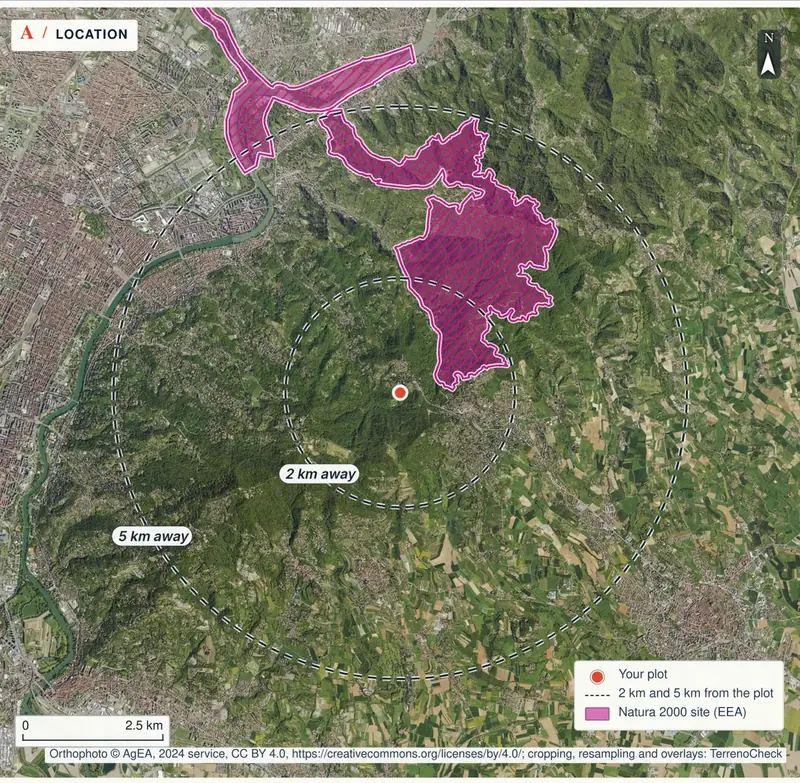
Bring the parcel’s public territorial context, sources and dates to your advisers when discussing the purchase.
€29 in English or Italian · €39 in both languages · total, VAT included