
Pillar guide: Planning and the building
Legga questo articolo in italiano.
Farm outbuilding in Italy: can an annesso become a house?
On this page
A farm outbuilding (annesso agricolo) can become a home only if the regional law and the comune’s plan allow it for that building, and only if the building itself was lawfully built or legalised. Under national law, moving from rural to residential use is a significant change of use that needs a building permit and usually a fee to the comune. The rules cited are those in force on 12 November 2026.
In short
- Under national law, rural use is a category of its own: switching to residential use is a significant change of use, even with no building work (DPR 380/2001, Article 23-ter).
- The simpler change-of-use rules brought in by the 2024 Salva Casa decree (Article 23-ter, paragraph 1-ter) do not include the rural category: an outbuilding cannot use them to become a home.
- The region and the comune decide: in Piedmont the plan can single out disused rural buildings for reuse, while buildings put up under a farming undertaking can change use only after death, disability or force majeure is confirmed.
- First check the outbuilding’s lawful status: the first cadastral survey and historical documents are enough only for buildings put up when no permit was required, or where there is initial evidence of a permit that has been lost (DPR 380/2001, Article 9-bis). Then check which permit the regional law requires and what fee the comune will charge.
d) rural
The use category of a farm outbuilding
Separate from residential (a): moving from one to the other is a significant change of use.
5–20%
Share of the construction cost in the permit fee
Set by the region; urbanisation charges worked out by the comune come on top.
4 ha
Specialised olive grove to keep in production in Tuscany
Minimum area under regulation 63/R for new outbuildings or changes of use of farm buildings, unless the provincial plan says otherwise.
The report brings together public information about the land, with sources and dates, to prepare questions for the relevant offices: €29 in English or Italian · €39 in both languages · total, VAT included.
What an annesso agricolo is in law
An annesso agricolo is a building that serves farming: a store for tools, a shelter for machinery or animals, a room for keeping produce. DPR 380/2001, Italy’s consolidated building code, sorts building uses into five use categories: residential, tourist accommodation, industrial and office, commercial, and rural (Article 23-ter). An outbuilding falls in the rural category, a house in the residential one.
A building’s use is the one shown by the documents of its lawful status (stato legittimo), meaning its building permits (Article 23-ter, paragraph 2, and Article 9-bis). It is not set by how the building is actually used, nor by its cadastral category. A barn with a bathroom stays rural until a permit says otherwise, as the guide on cadastral registration and planning permission explains.
The tax system has its own idea of a rural building: for example, buildings used to protect plants, store produce, or house machinery and animals (Decree-Law 557/1993, Article 9, paragraph 3-bis). That matters for taxes, not for what you may do with the building.
The national rule: a significant change of use
Under Article 23-ter, unless a regional law says otherwise, any use that puts a building into another use category is a significant change of use (mutamento rilevante della destinazione d’uso), even with no building work. Turning an outbuilding into a home means moving from the rural category to the residential one.
The 2024 Salva Casa decree (Decree-Law 69/2024) simplified some changes of use: for a single unit in buildings in zones A, B and C, a move between residential, tourist accommodation, industrial and office, and commercial use is allowed subject to the conditions in paragraph 1-quater, sector rules and any conditions set by the comune’s plan (Article 23-ter, paragraph 1-ter). Rural use is not among them: a move from rural to residential use falls outside the simplification.
| Question | National law’s answer | Article |
|---|---|---|
| Is rural to residential a significant change? | Yes, even with no work, unless a regional law says otherwise | 23-ter, para. 1 |
| Does the Salva Casa simplification apply? | No, it does not include the rural category | 23-ter, para. 1-ter |
| Which permit is needed? | The regional law decides: building permit or SCIA | 10, para. 2 |
| Renovation that creates a different building? | Building permit if volumes change, or the use changes in zone A | 10, para. 1 |
| What does the region decide? | It brings its law into line with Article 23-ter, which applies in any case | 23-ter, para. 3 |
In practice, the question “can the outbuilding become a house?” has two answers to look for outside DPR 380: in the regional planning law and in the comune’s plan rules for the agricultural zone.
- No permit: built when none was required, or a permit proven but lostLawful status from the first cadastral survey and reliable evidence (Article 9-bis, paragraph 1-bis)
- Built without the permit required, or departing from itCadastre and documents are not enough: legalise it first, if the law allows
- The plan provides for reuse of disused rural buildingsApply to the one-stop building office with the permit the region requires and the fee
- The building is tied to a farming undertakingIn Piedmont, change of use only after death, disability or force majeure is confirmed
Sources: DPR 380/2001, Article 23-ter; DPR 380/2001, Article 10; DPR 380/2001, Article 9-bis; Piedmont Regional Law 56/1977, Article 25; accessed 12 November 2026.
What the region and the comune decide: Tuscany and Piedmont
Tuscany. Regional regulation 63/R of 2016, which implements Regional Law 65/2014, sets the minimum farmland that must stay in production to build new outbuildings or new rural homes, and also when farm buildings change from agricultural use (Article 5): from 0.8 hectares for specialised vegetable or flower growing up to 30 hectares for woods and pasture, unless the provincial plan says otherwise. For farms on the regional register of organic operators, the areas are 30% lower. Farms below the minimum areas can build outbuildings only if the comune’s plan allows it, with a building permit and sized to the farm’s real needs; the application states why the farm needs the building (Article 6). The change of use itself is governed by Regional Law 65/2014: ask the comune which article it applies and with what obligations.
Article 12 of the same regulation covers small structures for hobby farming, where the comune’s plan allows them. Depending on how they are built they need either a SCIA or a building permit: the permit and the conditions are set out in the text in force of Article 12 and in the comune’s rules for rural land, and the comune’s one-stop building office (sportello unico per l’edilizia) will tell you which applies. To obtain the permit the owner undertakes not to sell the structure separately from the land and to remove it when farming stops (Article 12). A structure that must be removed is not an outbuilding waiting to be converted.
Piedmont. Regional Law 56/1977, Article 25, asks the town plan to identify rural buildings that are abandoned or no longer needed by farms and to set rules for reusing them, including for other compatible uses, or for demolishing them and returning the land to farming. Building in an agricultural zone requires an atto di impegno, an undertaking registered in the property registers to keep the building in farm use. For these buildings a change of use is allowed, on application and on payment of the charges, only after death, disability or the end of farming through force majeure, confirmed by the comune’s agriculture committee. If the person concerned, their heirs or family carry on living in the home, there is no change of use.
The undertaking also lists the crops grown and planned, and ties the transfer of building volume. In Piedmont building volume cannot be transferred between different farms, and land whose volume has already been used becomes “non aedificandi” (no longer buildable) and is marked on cadastral maps open to the public. For a buyer that means two checks: whether the outbuilding is tied to an undertaking, and whether the land for sale has already given its volume to another farm building. New rural homes can be requested only by professional farmers, including as members of cooperatives; by landowners and others with title, solely for the use of those farmers and of permanent workers who run the land; and by non-professional farmers covered by paragraph 2, letter m, who have both their residence and their domicile on that farm (Article 25, paragraph 3).
Sources: Tuscany Regulation 63/R/2016; accessed 12 November 2026.
First of all: is the outbuilding lawful?
A change of use starts from a lawful building. Its lawful status is the one set by the permit that allowed or legalised it, together with later permits; for buildings put up when no permit was required, it comes from the first cadastral survey and other reliable evidence, such as photos, maps and archive documents, together with the permits for later work. The same route applies where there is initial evidence of a permit that was issued but whose copy and details cannot be found (Article 9-bis, paragraph 1-bis). For an outbuilding put up when a permit was required and never authorised, the cadastre and historical documents are not enough. The steps are in the guide to lawful status of a building.
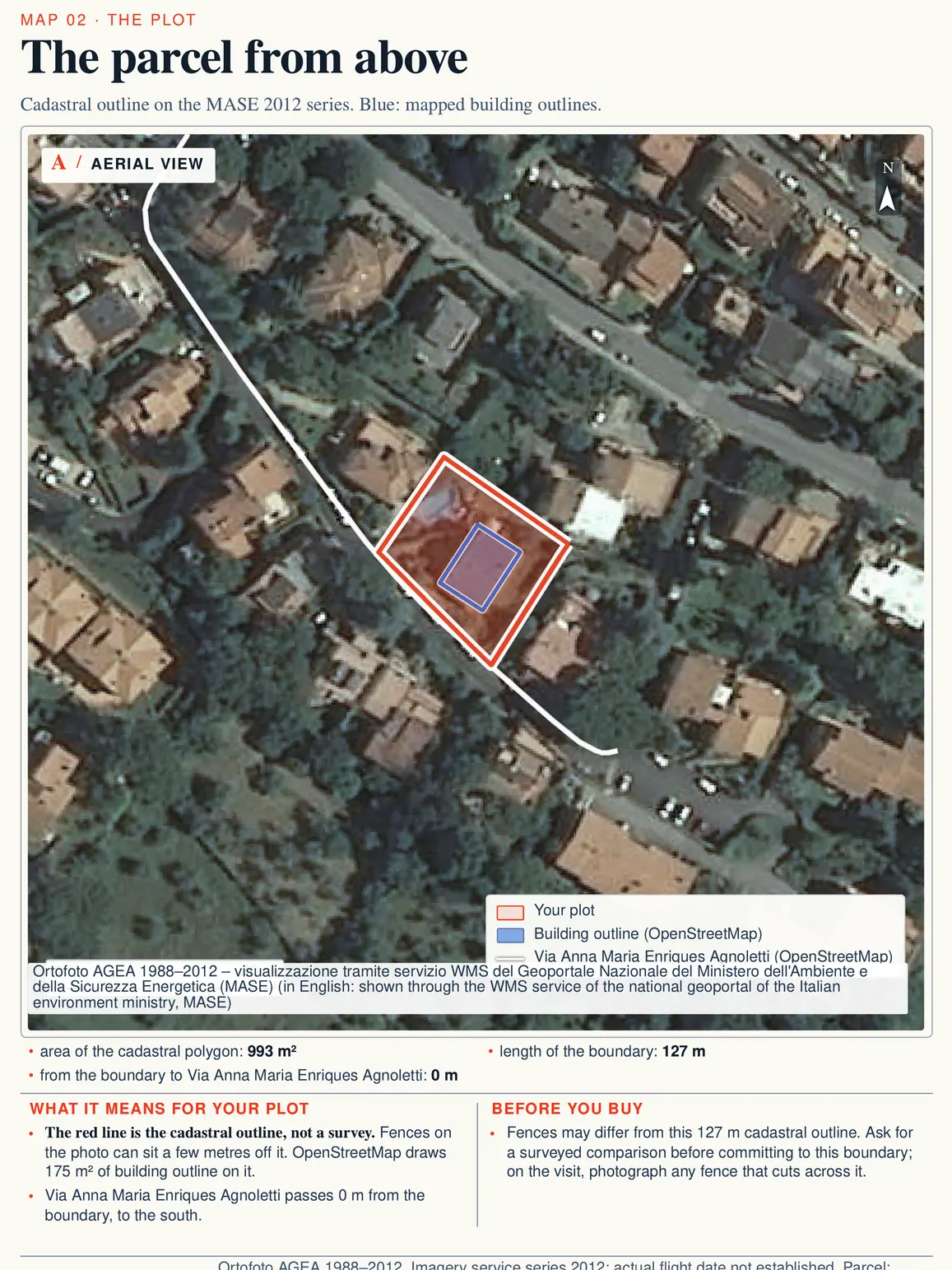
Hypothetical example
A hay barn in Piedmont
A hypothetical example. A 2-hectare plot zoned agricultural in Piedmont has a hay barn built in 1995 under a registered farming undertaking. The seller is not a farmer and markets it as “ready to convert”. The buyer asks the comune whether the town plan lists the barn among rural buildings for reuse: it does not. Outside the cases of death, disability or force majeure no change of use is allowed, so the buyer prices it as farmland with a rural building.
Sources: Piedmont Regional Law 56/1977, Article 25; accessed 12 November 2026.
Before you buy: the checks in order
- CDU and zone rules. Ask the comune’s planning office for a CDU (certificato di destinazione urbanistica, the zoning certificate): it is issued within 30 days and is valid for a year if the plan does not change (DPR 380/2001, Article 30). Ask at the same time for the plan’s technical rules for the agricultural zone: they say whether and how rural buildings can change use.
- The outbuilding’s permits. Before the preliminary contract, have a surveyor request access to the comune’s building archive (the office gives the waiting time) and compare the measurements in the permits with what stands on site. If no permit turns up, the surveyor separates three cases: an outbuilding put up when no permit was required, whose lawful status comes from the first cadastral survey and reliable evidence; a permit that was issued but cannot be found, with the same route if there is initial evidence of it; and an outbuilding built without the permit required, to be legalised if the law allows.
- Undertakings. Ask the notary to check the property registers for any registered undertaking or agricultural use restriction on the building.
- Permit and fee. Ask the comune’s one-stop building office which permit your change of use needs and for an estimate of the fee.
- Condition in the preliminary contract. If the purchase only makes sense as a home, make the preliminary contract conditional on getting the permit for the change of use.
The rules for building a new house on farmland are in a separate guide: building a house on agricultural land.
Farm outbuilding in Italy: can an annesso become a house?
https://terrenocheck.it/en/guide/farm-outbuilding-annesso-agricolo-italy
Checklist
Before buying land with a farm outbuilding
Common questions
Can I live in an annesso agricolo?
Not without a change of use. Under DPR 380/2001 rural and residential uses are different categories, and moving from one to the other is a significant change of use even if no work is done (Article 23-ter). The regional law and the comune’s plan must allow it for that building, and the comune must issue or accept the permit required.
Does the Salva Casa decree let me turn a rural building into a home?
No. Paragraph 1-ter of Article 23-ter allows a single unit in buildings in zones A, B and C to move between residential, tourist accommodation, industrial and office, and commercial use, subject to the conditions in paragraph 1-quater, sector rules and any conditions set by the comune’s plan. Rural use is not among them, so a move from rural to residential use falls outside this simplification.
Which permit does a change of use need?
National law leaves it to the regions to decide which changes of use need a building permit (permesso di costruire) and which a SCIA, a certified notice of start of works (Article 10, paragraph 2). If building work is needed, the permit for that work applies. The comune’s one-stop building office (sportello unico per l’edilizia) will tell you which applies in your case.
How much does it cost to turn an outbuilding into a house?
On top of the building work, the comune usually charges a permit fee: urbanisation charges plus a share of the construction cost between 5% and 20%, set by the region (Article 16). No fee is due for work in an agricultural zone, homes included, that serves the running of the farm and the needs of an imprenditore agricolo a titolo principale, a farmer status defined in Article 12 of Law 153/1975 (Article 17, paragraph 3). The comune checks the status and the link with the farm; working in farming full time does not prove it on its own. The comune’s one-stop building office works out the amount from its own tables.
If the outbuilding is registered as a dwelling in the cadastre, is it already a house?
The land registry does not grant building permits. A building’s use is the one shown by the documents of its lawful status (Article 9-bis), meaning its permits. The first cadastral survey and other reliable evidence count only for buildings put up when no permit was required, or where there is initial evidence of a permit whose copy and details cannot be found. A residential cadastral category does not replace the permit for the change of use.
Can a rural building in Piedmont change use?
Regional Law 56/1977 asks the town plan to identify rural buildings that are abandoned or no longer needed and to set rules for reusing them, including for other compatible uses. For buildings put up under an undertaking to keep them in farm use, a change of use is allowed, on application and on payment of the charges, only after death, disability or the end of farming through force majeure, confirmed by the comune’s agriculture committee (Article 25).
Keep reading
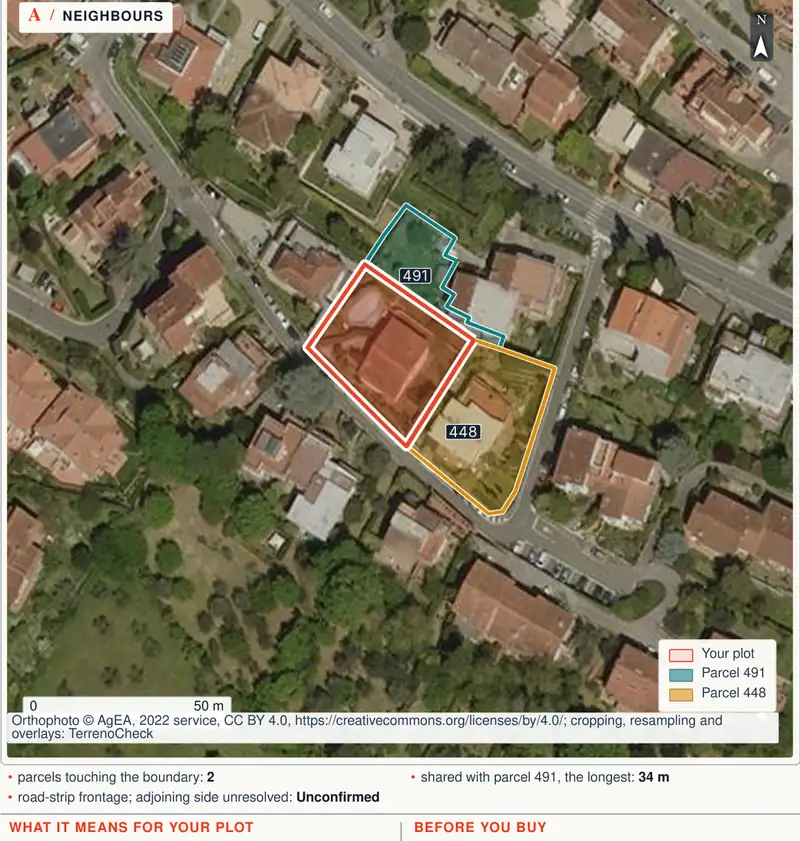
Minimum agricultural plot size to build in Italy
Building a house on agricultural land in Italy: who may, on how many hectares, and how much
When the house doesn’t match the drawings: stato legittimo, tolerances and the 36-bis amnesty for foreign buyers
Registered in the cadastre, never legalised: why Italian cadastral registration is not planning permission
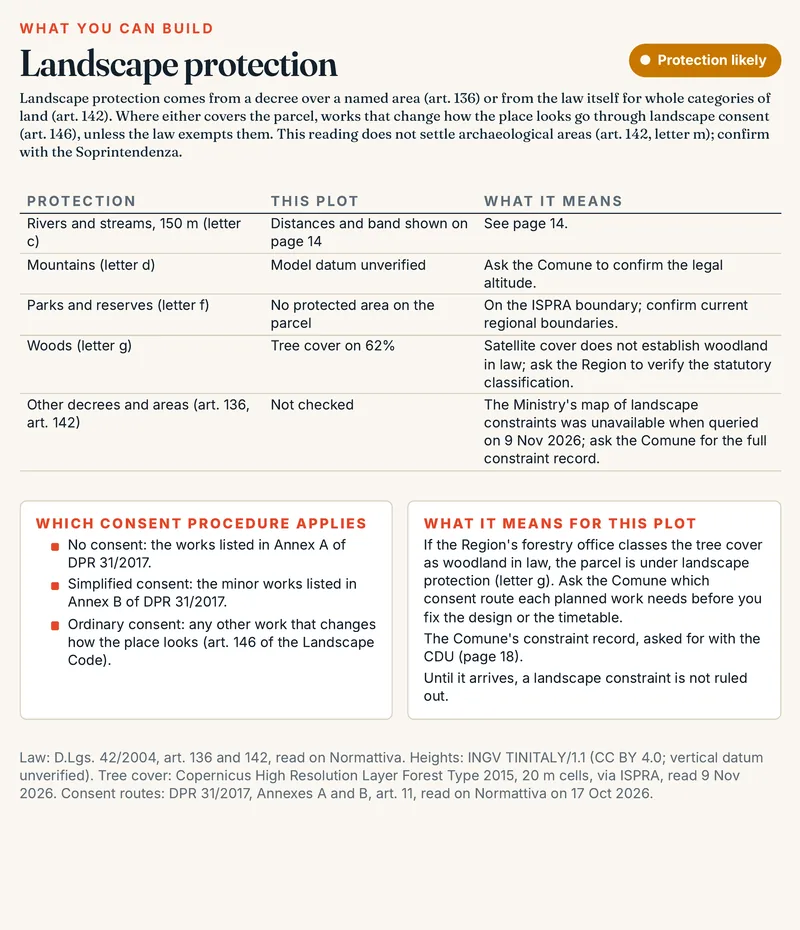
Non-building land in Italy: what you can really do on it
What stands on the land and what the plan says
Pick the parcel on the map: aerial photo, mapped building outlines, the comune’s plan and constraints are read for that plot, each with a source and date, along with the questions to put to the comune’s one-stop building office before you make an offer.
€29 in English or Italian · €39 in both languages · total, VAT included