
Pillar guide: Planning and the building
Legga questo articolo in italiano.
Non-building land in Italy: what you can really do on it
On this page
On Italian land zoned as non-building you can farm, plant, move earth for farming and put up a seasonal mobile greenhouse with no building permit, subject to the town plan and any protection order. A shed, container or caravan used for storage counts as a new building unless it serves a purely temporary need: it needs a permesso di costruire (building permit), which the comune grants in line with the town plan.
In short
- Farming, grazing, planting an orchard and earthworks that serve farming need no building permit, as long as the town plan and any protection order allow them.
- Seasonal mobile greenhouses without masonry and rainwater tanks for farm use of up to 50 m³ per cultivated hectare are also permit-free.
- A shed, container or caravan used as a home, a workplace or a store is a new building and needs a building permit, except where it serves a purely temporary need or is a mobile unit on an authorised open-air tourist site (DPR 380/2001, Article 3, letter e.5).
- Regions and comuni can change the rules: the answer for your plot is in the CDU, the town plan’s rules and the comune’s building desk.
- On land under landscape protection many works also need a landscape authorisation, obtained before work starts.
180 days
Ceiling for seasonal or temporary works
Only for seasonal works or an objective, short-term and temporary need: removed as soon as the need ends, setting up and taking down included, after notice to the comune that work is starting.
€1,000
CILA not filed
Cut by two thirds if filed voluntarily while work is under way.
Already have a parcel in mind? The report runs these checks on your land, with a source and date for every finding: €29 in English or Italian · €39 in both languages · total, VAT included.
What “non-building” actually means
In Italian listings, terreno non edificabile covers several different situations: farmland in an agricultural zone, land set aside as green space or as a buffer strip, or a plot the town plan would allow building on but a constraint blocks. Which one you are looking at is stated in the certificato di destinazione urbanistica (CDU), the zoning certificate the comune (the municipality) issues with the plan’s rules for that parcel.
This guide sets out the national rules; regions and comuni have powers of their own. Regions share law-making power on building with the State, within the principles of the national building code; the special-statute regions and the autonomous provinces of Trento and Bolzano have exclusive powers within their statutes; and each comune regulates building through its town plan and building rules (DPR 380/2001, Article 2).
Whether anything can be built in an agricultural zone, and by whom, is decided by regional law and the town plan’s rules: see our guide on building a house on agricultural land. This guide covers what you can do on land without building a house.
A rare case: in a comune with no town plan, new building outside built-up areas is allowed up to 0.03 m³ per m², unless regional law is stricter (DPR 380/2001, Article 9). On one hectare, 10,000 m², that is 300 m³.
What needs no permit at all
Article 6 of DPR 380/2001, the national building code, lists edilizia libera: works carried out with no permit and no filing with the comune. The list applies “without prejudice to the comune’s planning instruments” and subject to the rules on earthquakes, health, hydrogeological risk and the Landscape Code. On land with no buildings, the useful items are:
- Farm work. Earthworks strictly tied to farming, farming, forestry and grazing practices, and work on farm irrigation and drainage (letter d).
- Seasonal mobile greenhouses without masonry, as long as they serve farming (letter e).
- Rainwater tanks for farm use of up to 50 m³ per cultivated hectare, also as a single reservoir (letter e-sexies). With 2 cultivated hectares the cap is 100 m³.
- Paving and finishing outdoor areas, parking included, within the permeability ratio if the plan sets one (letter e-ter).
- Seasonal works and works meeting an objective, short-term and temporary need, provided they are meant to be removed as soon as the need ends and in any case within 180 days at most, setting up and taking down included, after notifying the comune that work is starting (letter e-bis).
A 2018 decree approved a glossary of permit-free works that turns these items into concrete examples; the list is expressly not exhaustive. If a permit-free work changes what the cadastre should show, the owner files the update (Article 6, paragraph 5).
Sheds, containers and caravans: when they become buildings
Under DPR 380/2001, a new building includes light structures, prefabricated or not, and structures of any kind, such as caravans, campers, mobile homes and boats, when used as a home, a workplace, a store or a warehouse (Article 3, letter e.5).
The same letter leaves out two cases. The first is a structure serving a purely temporary need. The second is tents and mobile living units with working wheels, with their fittings and accessories, placed on open-air tourist sites that already hold planning, building and, where required, landscape approval, provided they have no permanent connection to the ground and meet the size and construction standards of regional sector rules where these exist. On private land that is not an authorised tourist site, that leaves the first case.
Open-air storage of goods or materials that permanently changes undeveloped land is also a new building (letter e.7). These definitions override town plans and local building rules (Article 3, paragraph 2), so a comune cannot classify a container used as a store as garden furniture.
A new building needs a permesso di costruire, the building permit (Article 10), which the comune grants in line with the town plan and building rules (Article 12). Where the plan allows no building, no permit will come, and a tool container on four concrete blocks is unauthorised work.
Temporary versus permanent use is covered in our guide on mobile homes, tiny houses and caravans on land.
Hypothetical example
A vegetable garden, an orchard and two horses on 1.2 hectares
A hypothetical example. A couple buys 1.2 hectares in an agricultural zone for a vegetable garden, an orchard and two grazing horses. Growing, planting and grazing need no building permit; if all 1.2 hectares are cultivated, a rainwater tank can hold up to 60 m³ without one. The tool container and the horse shelter are a different matter: before the deed the couple asks the comune’s building desk whether the plan allows them and which route applies.
Sources: DPR 380/2001, Article 3; DPR 380/2001, Article 6; accessed 12 November 2026.
CILA, SCIA or building permit: which one for which work
The table below follows national law. Ordinary-statute regions can make further works permit-free, except those that need a building permit (Article 6, paragraph 6), and can require a building permit for other works (Article 10, paragraph 3). Check it against your comune’s building rules before you plan anything.
The CILA (comunicazione di inizio lavori asseverata, a notice of works certified by a professional) is the default route: it covers anything not listed as permit-free, as needing a permit or as needing a SCIA (Article 6-bis). It needs drawings and a statement from a qualified technician. The SCIA (segnalazione certificata di inizio attività) mainly covers work on existing buildings, such as structural repairs (Article 22), so it rarely applies to bare land.
| Work | Route under national law | Watch out |
|---|---|---|
| Growing crops, grazing, an orchard | None: farming, forestry and grazing | Woodland and hydrogeological constraints have their own rules |
| Farm earthworks, irrigation, drainage | Permit-free (Article 6, letter d) | If strictly tied to farming |
| Seasonal mobile greenhouse, no masonry | Permit-free (letter e) | Must serve farming |
| Rainwater tank | Permit-free up to 50 m³ per cultivated hectare (letter e-sexies) | For farm use |
| Seasonal work, or work meeting an objective, short-term and temporary need | Permit-free after notice to the comune that work is starting (letter e-bis) | Removed as soon as the need ends and in any case within 180 days, setting up and taking down included |
| Gazebo, pergola, shed, animal shelter | Permit-free as furniture in a building’s grounds (2018 glossary) | No building: ask the comune |
| Fence | Not listed in national law | Region and comune building rules decide |
| Work not listed in Articles 6, 10 or 22 | CILA (Article 6-bis) | Drawings and a technician’s statement |
| Shed, container or caravan used as a home, a workplace or a store | Building permit (Articles 3 and 10), granted in line with the plan | Exceptions in Article 3, letter e.5: a purely temporary need; mobile units on authorised open-air tourist sites |
| New building, farm buildings included | Building permit | Conditions and limits from regional law and the plan |
For fences the answer varies by comune, and national minimum distances apply along roads: see our guide on fencing agricultural land.
- Farm work, seasonal mobile greenhouse, tank up to 50 m³/haNo permit, subject to the plan and constraints
- Seasonal work, or work for an objective, short-term and temporary needNotice to the comune that work is starting; removal as soon as the need ends and in any case within 180 days, setting up and taking down included
- Work not listed in the lawCILA through a technician, unless region or comune say otherwise
- Shed, container or caravan used as a home, workplace or store, with no purely temporary needBuilding permit, granted in line with the plan (exceptions: Article 3, letter e.5)
Protected landscape: when you also need a landscape authorisation
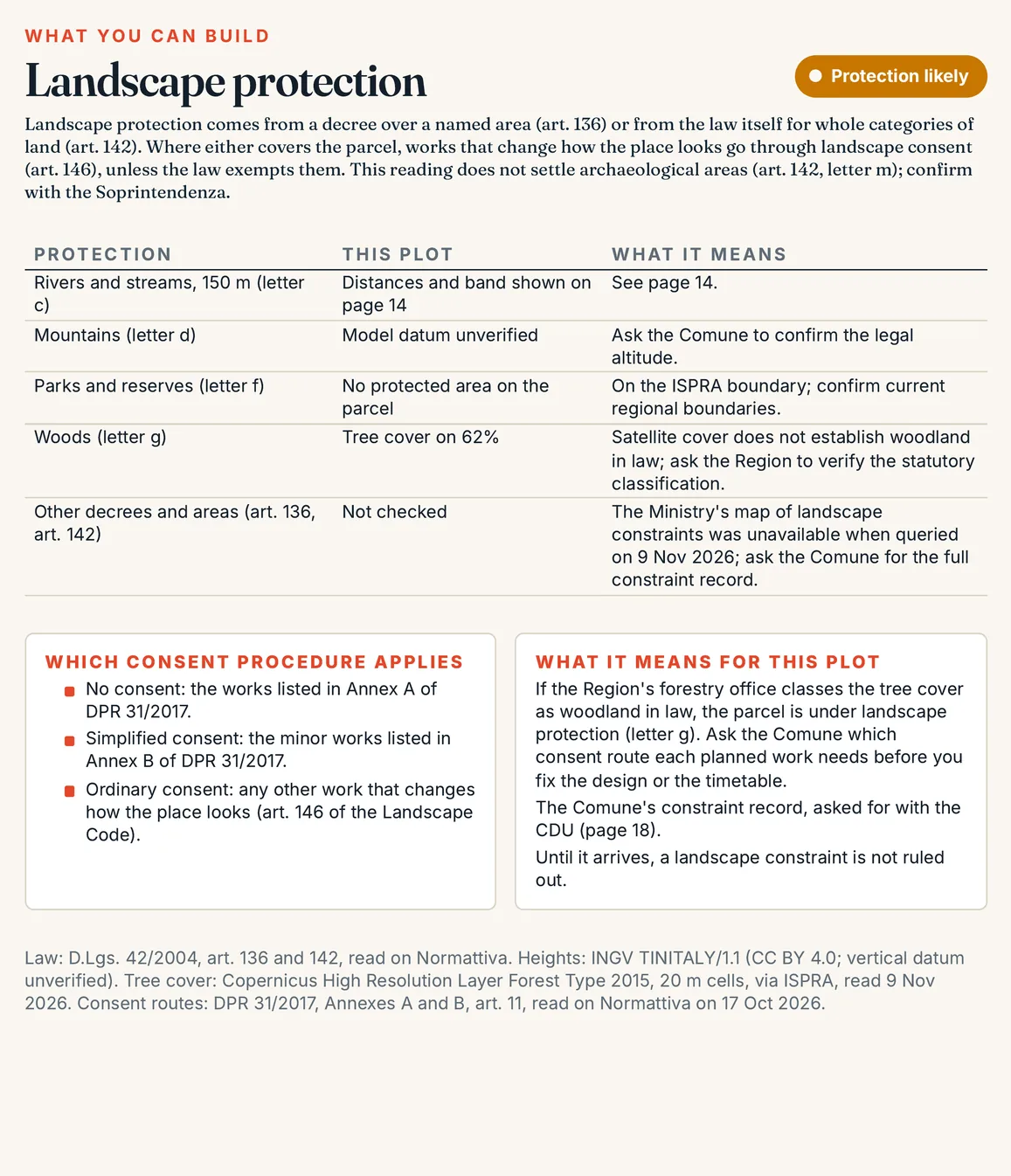
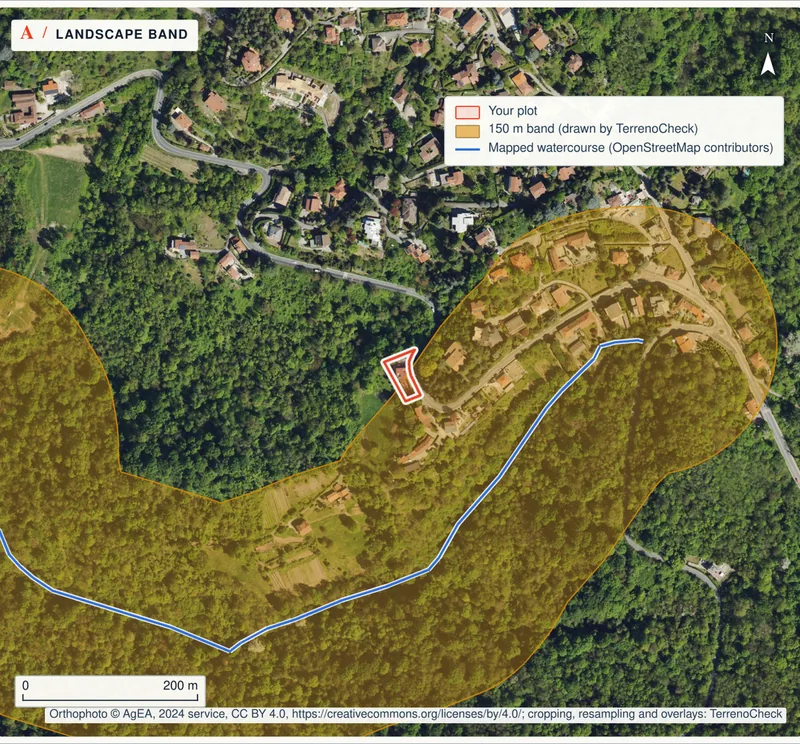
Permit-free works still have to respect the Landscape Code. Protected by law are, among others, land within 300 metres of the coast and of lakes, the 150-metre strips along rivers, streams and watercourses on the official water registers, mountains above 1,600 metres in the Alps and 1,200 metres in the Apennines and on the islands, parks, woodland, land subject to usi civici (old common rights of use) and areas of archaeological interest (Legislative Decree 42/2004, Article 142(1)).
This statutory protection has exclusions. For coasts, lakes, watercourses, mountains, glaciers, woodland, usi civici land, volcanoes and archaeological areas it does not apply to areas that on 6 September 1985 were marked in the town plan as zones A and B, to parts of other zones included in multi-year implementation plans whose provisions had actually been carried out, or, in comuni without a plan, to the mapped built-up centres (Article 142(2)). Nor does it apply to watercourses the region has placed on a public list of features of no landscape relevance, unless the Ministry confirms their relevance (Article 142(3)). Protection imposed by the individual orders listed in Article 157 stays in force (Article 142(4)). To find out whether your parcel is protected, ask the comune for the list of constraints together with the CDU.
On this land, farming, forestry and grazing need no authorisation, provided they do not permanently change the site with buildings or other civil works and do not affect drainage and slope stability (Article 149). For other works DPR 31/2017 sets three routes: works exempt from authorisation (Annex A), minor works with a simplified procedure (Annex B), and everything else through the full authorisation. See our guide to the vincolo paesaggistico.
Two other constraints have guides of their own: the hydrogeological constraint and woodland.
Sources: Legislative Decree 42/2004, Article 142; Legislative Decree 42/2004, Article 149; DPR 31/2017; accessed 12 November 2026.
What happens if something is built without a permit
If a work needed a building permit and never had one, the comune orders the owner and whoever carried out the work to remove or demolish it (DPR 380/2001, Article 31, paragraph 2). A buyer of a plot with an unauthorised shed can therefore receive the order as owner, even without having built anything.
The basic rule: if the person responsible does not demolish and restore the site within 90 days of the order, the structure, the land under it and the land needed for similar works pass to the comune free of charge, up to a limit of ten times the unauthorised floor area (paragraph 3). The comune can extend the period by reasoned decision, to a maximum of 240 days, for serious and proven health needs of people living in the building when the order was issued, or for absolute need or severe social and economic hardship that makes the deadline impossible to meet. On land that statute makes unbuildable, it passes to the authority overseeing that restriction or, where restrictions overlap, to the comune (paragraph 6).
Once non-compliance is recorded, the authority imposes a fine of €2,000 to €20,000, without prejudice to other measures and penalties; for unauthorised works on the areas and buildings listed in Article 27(2), including areas at high or very high hydrogeological risk, the fine is always the maximum (paragraph 4-bis). Ordinary-statute regions can raise these amounts and make the fine repeatable at intervals for as long as the demolition order is not obeyed (paragraph 4-quater). Building without a permit is also a criminal offence (Article 44).
How to spot unauthorised work before you sign is covered in our guide on abusi edilizi.
How to check before you buy
The answers come from the comune, in four steps. Take them before you make an offer, while you can negotiate.
- The CDU, from the planning office or the SUE (sportello unico per l’edilizia, the comune’s building desk). The comune must issue it within 30 days and it is valid for a year if the plan does not change (DPR 380/2001, Article 30, paragraph 3). For the sale of land without buildings it must be attached to the deed, or the deed is void (paragraph 2). See our guide to the certificato di destinazione urbanistica.
- The plan’s technical rules (norme tecniche di attuazione, NTA), on the comune’s website. Find the zone named in the CDU and read what uses, outbuildings, fences and distances it allows.
- The comune’s building rules (regolamento edilizio), also on its website. Where the comune regulates fences, small outbuildings and outdoor paving, the rules are there.
- A written question to the SUE, describing what you want to do and naming the parcel. If the answer is a CILA or a permit, a qualified technician files it.
If the land already has a house or a ruin on it, the checks are different: see our guide on buying a country house in Italy.
Non-building land in Italy: what you can really do on it
https://terrenocheck.it/en/guide/non-building-land-what-you-can-do-italy
Checklist
Before you make an offer
Common questions
Can I put a tool shed on agricultural land in Italy?
It depends on how it is used and where. A structure used for storage is a new building and needs a building permit, unless it serves a purely temporary need (DPR 380/2001, Article 3, letter e.5). The 2018 glossary lists a small tool shed not fixed to the ground as permit-free, but as garden furniture in the grounds of a building: on land with no building, ask the comune’s building desk first.
Can I keep a caravan on my land for weekends?
A caravan used as a home, a workplace or a store is a new building in law, unless it serves a purely temporary need or stands on an authorised open-air tourist site, on the conditions in Article 3, letter e.5, of DPR 380/2001. The permit-free route in Article 6, letter e-bis, is for seasonal works or works meeting an objective, short-term and temporary need: the comune is notified that work is starting, and the structure goes as soon as the need ends and in any case within 180 days, setting up and taking down included. For use that repeats every weekend, ask the comune’s building desk first whether it falls within these cases.
Can I keep horses or hens on non-building land?
Grazing is a farming practice and needs no permit. The shelter is another matter: the 2018 glossary treats a shelter for pets and farmyard animals as permit-free furniture in the grounds of a building, while a stable or horse box is a building governed by the town plan and regional law. Animal health rules are not covered here.
Can I fence non-building land?
The Civil Code gives an owner the right to enclose the land (Article 841), but national building law does not list fences among permit-free works. The region and the comune’s building rules decide, and minimum distances apply along roads outside built-up areas. Our guide to fencing agricultural land covers the details.
How much does the CDU cost?
The law sets the deadline, not the price: the comune must issue it within 30 days and it stays valid for a year if the plan does not change. What the application costs is shown on the building desk or planning office page of your comune.
Can I level the land or dig a pond?
National law lists earthworks strictly tied to farming among permit-free works (DPR 380/2001, Article 6, letter d). Levelling ground for parking or a garden is not covered by that item: ask the comune’s building desk which permit applies. Rainwater tanks for farm use are permit-free up to 50 m³ per cultivated hectare.
Keep reading
Building a house on agricultural land in Italy: who may, on how many hectares, and how much
A mobile home, tiny house or caravan on your Italian land: when you need a building permit
The certificato di destinazione urbanistica (CDU): Italy’s zoning certificate, explained for foreign buyers
Fencing agricultural land in Italy: permits and distances
Check the land you are looking at before you make an offer
Pick the parcel on the map: planning zone, landscape and hydrogeological constraints, mapped buildings and access are read for that plot, each with a source and date, along with the questions to take to the comune.
€29 in English or Italian · €39 in both languages · total, VAT included