
Pillar guide: Documents and contract
Legga questo articolo in italiano.
Buying a country house in Italy: 12 checks before the deed
On this page
Before you make an offer on a country house in Italy, ask the comune for the building permits of the house and its outbuildings, and use a site visit to check access, drainage, water and boundaries. Before the deed, check three things: the permit details the deed must state, the CDU if the land around the house reaches 5,000 m², and pre-emption rights if farmland is part of the sale.
In short
- The legal status of the house, stables and barns comes from the building permits, including those for later works: ask the comune for them before the offer and have them compared with the house and outbuildings as they stand today (DPR 380/2001, art. 9-bis).
- Outside the sewer network, the house’s discharge must be authorised; the region sets the rules for domestic waste water.
- For domestic use the owner may draw groundwater from their own land without the authorisation other uses need, keeping to the legal distances and precautions; for an existing well, ask the seller for its papers and the water office of the region or province what applies today.
- If the land belonging to the house measures 5,000 m² or more, the deed needs a CDU; below that, with the house in the buildings register, it does not.
- With farmland in the sale, a tenant or a neighbouring farmer may have pre-emption rights: without notice, they can buy the land back within one year of the sale deed being entered in the property registers (trascrizione).
5,000 m²
CDU threshold
Below this area of land belonging to a house in the buildings register, it is not needed.
4 years
Validity of a discharge authorisation
Unless other rules apply; renewal is requested a year before expiry.
1 year
Buy-back when pre-emption was not notified
From the trascrizione of the sale deed, its entry in the property registers.
Already have a parcel in mind? The report runs these checks on your land, with a source and date for every finding: €29 in English or Italian · €39 in both languages · total, VAT included.
The order of the checks
A country house combines two purchases: a building, often with farm outbuildings, and a plot of land, sometimes farmland. Each part comes with its own documents and risks, and the order matters: the checks that can sink the deal belong before you pay a deposit, not after.
Below, the twelve checks are grouped into four moments: at your desk before the visit, at the comune, on the site visit, and before the deed. The checks that apply to any land purchase, such as costs, the notary and taxes, are in the guide to buying land in Italy; this page keeps only those typical of a country house.
In what order to check a country house
- At your deskCadastral search and map, planning zone and protections (checks 1 and 5)
- At the comuneBuilding permits of the house and outbuildings, agibilità; CDU within 30 days, if needed (checks 2–5)
- Site visitAccess road, boundaries, natural risks, drainage and well (checks 6–10)
- Offer and preliminary contractPurchase subject to the building check, with a date
- Pre-emption noticeOnly with farmland: 30 days for whoever is entitled (check 11)
- DeedPermit details in the deed and the CDU attached, if needed (check 12)
The buildings: legal status, outbuildings and agibilità
1. What is for sale. The cadastral search and map show which parcels and buildings the price covers. Compare the list with what you see: bread ovens, stables, open sheds and stores that stand on site but are missing from the cadastre are the first thing to clear up. How to read the two documents is covered in the guides to the visura catastale and the planimetria catastale.
2. The building permits of the house. The stato legittimo (legal status) of a property is the one set by the permit that allowed or legalised its construction, or by the permit for the last works on the whole property, if the comune checked the earlier permits at that time; in both cases that permit is read together with any later permits for partial works (DPR 380/2001, art. 9-bis, paragraph 1-bis). The same paragraph lists the amnesty permits and the payments of penalties that count towards the stato legittimo. For buildings put up when no permit was required, it is what the first cadastral records or other documents with evidential value show, such as photos, maps, archive records or other deeds of proven origin, together with the permit for the last works on the whole property and any later permits for partial works. An early cadastral map or an old photograph therefore does not cover works carried out afterwards: for the house as it stands today and for a converted outbuilding you need those permits too. You request the permits from the comune’s building archive; the full route is in the guide to stato legittimo.
3. The outbuildings. Have each outbuilding compared with its permits: a stable that is now a living room, for example, may have no permit for the conversion. If a work needed a building permit and had none, the comune orders removal or demolition by the owner and by whoever carried out the work (art. 31): the order therefore also reaches someone who bought later.
4. Agibilità. The certified filing of agibilità (fitness for use) confirms the building’s safety, hygiene, healthiness and energy saving and its conformity with the approved project; for new buildings, rebuilds or added storeys and works that affect those conditions it goes to the building office within 15 days of completing the finishing works, with a fine of 77 to 464 euros if it is not filed (art. 24). What it proves and what it does not is explained in the guide to agibilità.
Hypothetical example
The hayloft that became a bedroom
A hypothetical example. A farmhouse has a hayloft that is now a bedroom with a bathroom. The cadastre still lists it as a store and the comune’s archive holds no permit for the conversion. Before paying a deposit the buyer asks a surveyor whether the room can be regularised and at what cost, and writes into the offer that the purchase depends on the answer.
Sources: DPR 380/2001, Article 9-bis; DPR 380/2001, Article 31; accessed 12 November 2026.
The land around it: zoning, CDU and protections
5. What the plan says. The land sold with the house has a planning zone and may carry protections: landscape, woodland, hydrogeological risk. For deeds that transfer land the law requires the certificato di destinazione urbanistica (CDU, zoning certificate), or the deed is void, with an exception that fits country houses: it is not needed if the land belongs to a building in the buildings register and that land measures less than 5,000 m² in total (DPR 380/2001, art. 30, paragraph 2).
A house with 3,000 m² of garden and vegetable plot is therefore sold without a CDU; the same house with 1.5 hectares of olive grove is not. The comune must issue the CDU within 30 days of the request and it is valid for a year, if the seller declares that the plan has not changed (paragraph 3). What you can do on the land without building is explained in the guide to what you can do on non-building land.
On the site visit: access, boundaries and risks
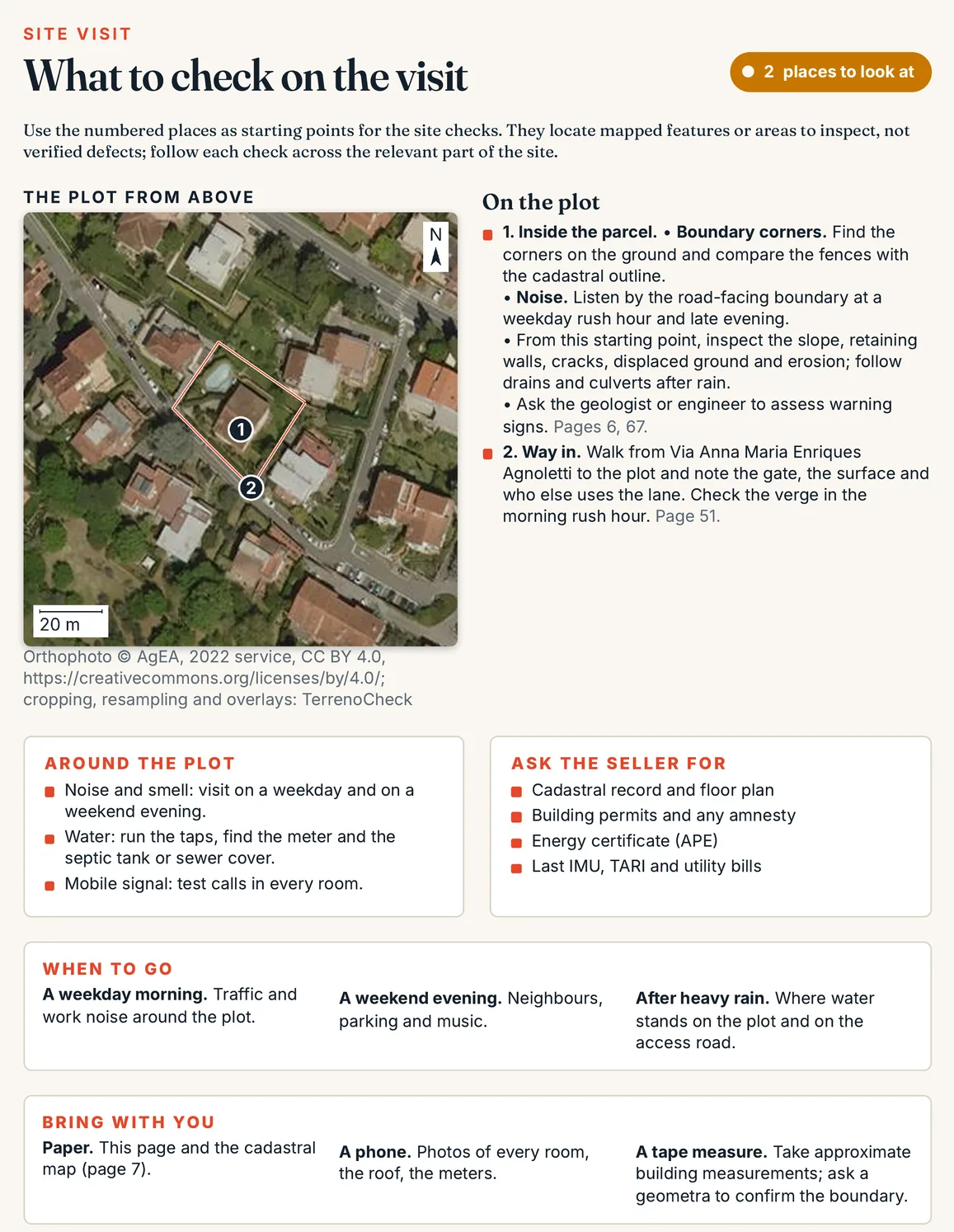
The site visit shows what the documents do not. Go on a weekday morning and come back after heavy rain, when puddles, ditches and the dirt road show how they behave.
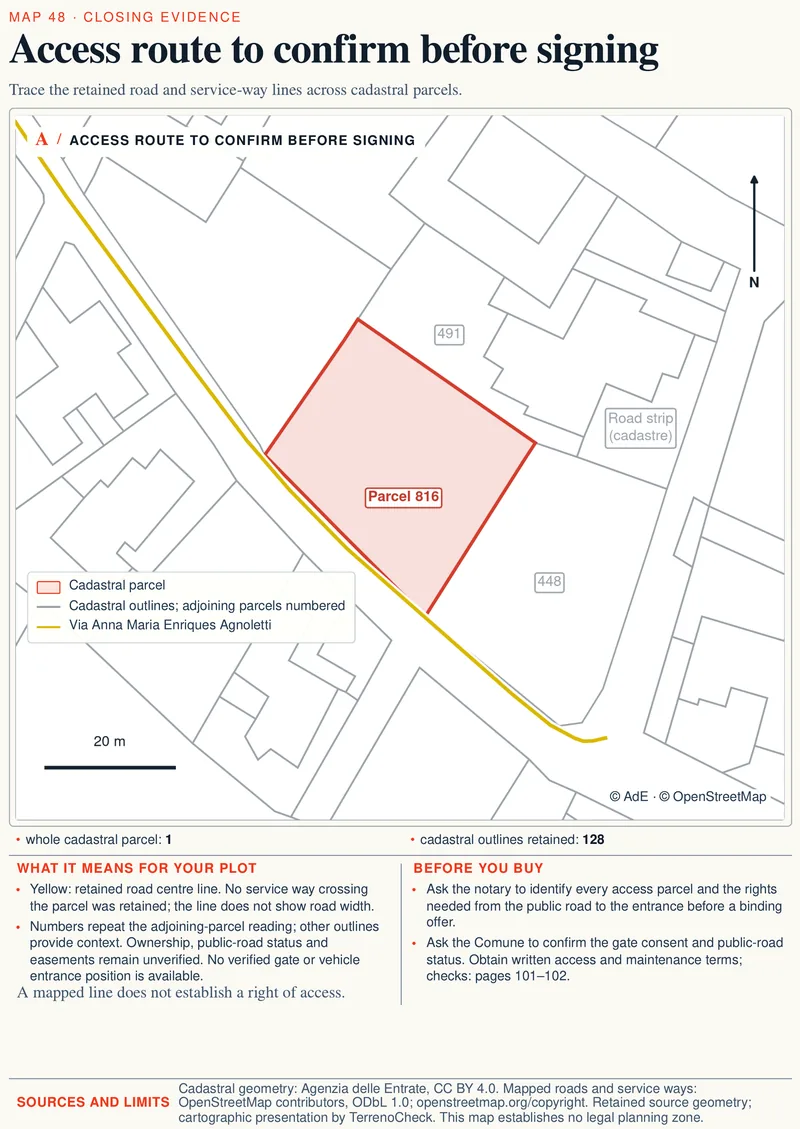
6. The road. Drive the last stretch to the house and ask whether it is a municipal, vicinale (local public-use) or private road and who maintains it. If access crosses someone else’s land, you need a written easement: how to check it is in the guide to access rights and servitù di passaggio. If you plan to extend the house towards a road outside the built-up area and outside the plan’s building zones, extensions facing the road must keep minimum distances from the road boundary, from 10 m for vicinali roads to 60 m for motorways (DPR 495/1992, art. 26, paragraph 2).
7. Boundaries and fences. Walk the perimeter with the cadastral map and note where fences and walls depart from the line. A surveyor measures the differences before the preliminary contract; the rules on fences and distances are in the guide to fencing agricultural land.
8. Natural risks. Slopes, cracked retaining walls, signs of landslides or flooding are worth looking at on site and comparing with the official maps: see the guides to flood and landslide risk and seismic zones.
Water and drainage off the public network
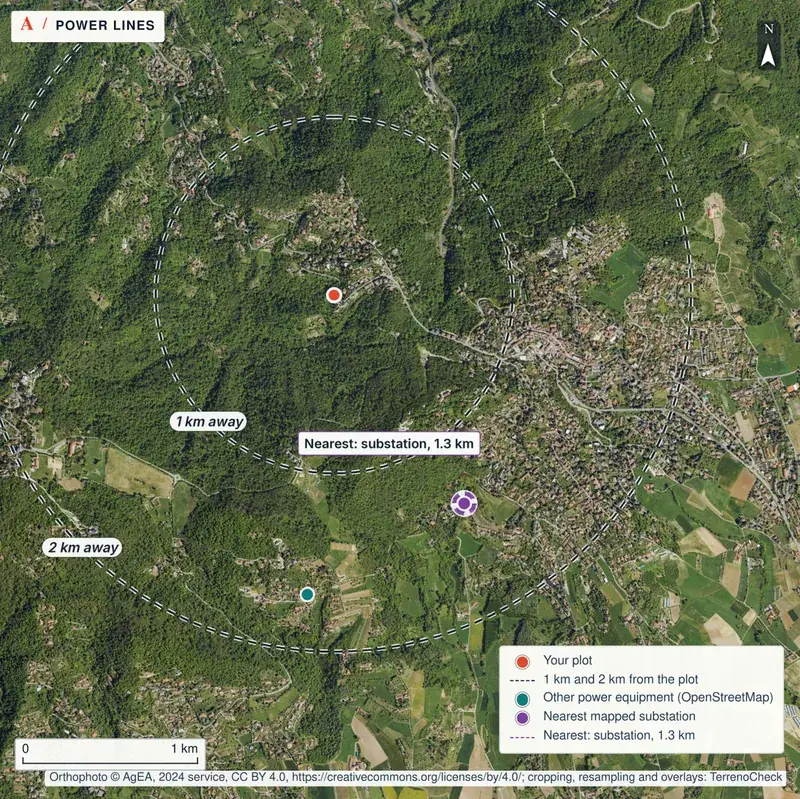
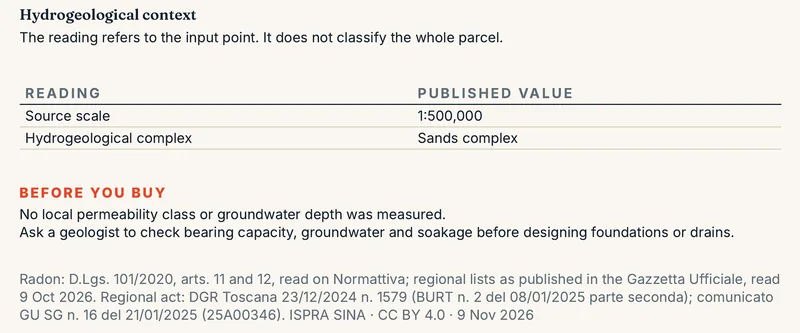
For water and drainage the rules are partly national and partly regional: national law sets the principles, the region decides procedures, competent offices and allowed systems, and the details are on the website of the region or the province. It matters, because many country houses are connected to neither the water mains nor the sewer.
9. The discharge. All discharges must be authorised in advance; the exception is domestic waste water going into the public sewer, always allowed under the operator’s rules (D.Lgs. 152/2006, art. 124). The rules for domestic waste water outside the sewer are set by the region, which also lists suitable individual systems for isolated buildings (art. 100, paragraph 3). Unless regional rules say otherwise, the application goes to the province, which decides within 90 days, and the authorisation lasts four years (art. 124, paragraphs 7 and 8).
10. The water. For domestic use, including watering the family garden and vegetable plot and watering livestock, the owner may freely draw groundwater from their own land, keeping to the legal distances and precautions (RD 1775/1933, art. 93). Other uses need an authorisation or concession from the authority (art. 17). An existing well calls for two separate checks. The first is historical: Legislative Decree 275/1993 required every well existing at the time to be reported to the region and the province within twelve months of its entry into force, and the deadline was later extended and reopened, most recently by Law 290/1999 (art. 10 and its notes); ask the seller for that report and for any later papers. The second concerns today: ask the water office of the region or province, before you pay a deposit, which documents that well needs for the use you will make of it. The rest is in the guide to well water rights; for a new connection, see the guide to utility connections.
Farmland in the sale: pre-emption
11. Who can buy before you. If farmland is part of the sale, the law may give pre-emption to a tenant who farms it as a coltivatore diretto (direct farmer) and, if no tenant or other farmer works the land, to a neighbouring coltivatore diretto or professional farmer (IAP) who owns adjoining land (Law 590/1965, art. 8; Law 817/1971, art. 7). The conditions differ for each and are explained in the guide to agricultural pre-emption.
The procedure, however, is fixed. The seller sends the preliminary contract, with the buyer’s name and the price, by registered letter, and the person entitled has 30 days to exercise the right. If the notice is missing, or states a higher price than the contract, the person entitled can buy the land back from the buyer within one year of the sale deed being entered in the property registers (trascrizione); the deed’s registration for tax is a different step and does not start this period. Among other cases, pre-emption does not apply if the plan zones the land for building, industrial or tourist use.
Sources: Law 590/1965, Article 8; accessed 12 November 2026.
What the deed must contain
12. The statements in the deed. For buildings whose construction began after 17 March 1985, the deed is void if the seller does not state the details of the building permit or the amnesty permit (DPR 380/2001, art. 46). Older buildings fall under Law 47/1985: the deed needs the details of the licence or concession, or of the amnesty application with the payments made; for works begun before 1 September 1967 a sworn declaration of the start date is enough (art. 40).
These statements say that a permit exists, not that the house matches it: that is why checks 2 and 3 come first. If a CDU is needed (check 5), it is attached to the deed. The notary’s role and its limits are in the guide to what the notary checks.
Sources: DPR 380/2001, Article 30; DPR 380/2001, Article 46; accessed 12 November 2026.
The documents: what each one establishes and where to ask
| Document | What it establishes | Where to ask | Before which step |
|---|---|---|---|
| Building permits of the house and outbuildings, including those for later works | The stato legittimo (checks 2 and 3) | The comune’s building archive | Offer |
| Certified filing of agibilità | Safety, hygiene, healthiness, energy saving and conformity with the project (check 4) | The comune’s building desk (sportello unico per l’edilizia) | Deposit |
| Discharge authorisation | That the discharge outside the sewer is authorised; it lasts four years (check 9) | The province, unless regional rules say otherwise; it decides within 90 days | Deposit |
| The well’s papers | Which documents exist for that well and for which use (check 10) | The seller; the water office of the region or province | Deposit |
| Pre-emption notice | That the person entitled has received the preliminary contract; they have 30 days to act (check 11) | Sent by the seller by registered letter | Deed |
| CDU | The planning rules for the area (check 5) | The competent office of the comune; issued within 30 days of the request | Deed, unless the land falls under the 5,000 m² exception |
Costs and times vary from one office to the next. For the CDU the comune charges administrative fees (diritti di segreteria), which the law sets between a minimum and a maximum (Decree-Law 8/1993, art. 10, paragraph 10): ask the office that issues the certificate for the amount. For the search for the building permits and for the discharge authorisation, ask the comune’s building archive and the body that authorises the discharge for times and costs before you fix the date of the preliminary contract.
Buying a country house in Italy: 12 checks before the deed
https://terrenocheck.it/en/guide/buying-country-house-checks-italy
Checklist
Before the deposit
Common questions
Which documents should I ask the seller of a country house for?
The cadastral search and floor plans of the house and outbuildings, the building permits and any amnesty applications, the certificate of fitness for use, the discharge authorisation if the house is not on the sewer, the well’s papers, the energy performance certificate (APE), the latest IMU and TARI payments and utility bills. If farmland is included, also any lease agreement.
The house has no agibilità: can I still buy it?
Yes, the law does not forbid selling a house without agibilità, but find out why it is missing. For new buildings, rebuilds or added storeys and works that affect safety and hygiene, the filing is due within 15 days of completing the finishing works, with a fine of 77 to 464 euros if it is not filed (DPR 380/2001, art. 24). A surveyor can tell you whether only the paperwork is missing or the conditions themselves.
Does a septic tank need an authorisation?
All discharges must be authorised, except domestic waste water going into the public sewer, which is always allowed under the operator’s rules. For domestic waste water outside the sewer the region sets the rules and lists the individual systems allowed for isolated buildings (D.Lgs. 152/2006, arts. 100 and 124).
Is the well fine as long as there is water?
No. For domestic use, including the family garden and watering livestock, the owner may freely draw groundwater from their own land; other uses need an authorisation or concession from the authority. For an existing well, ask the seller for its papers, starting with the report that Legislative Decree 275/1993 required for wells existing at the time, and ask the water office of the region or province what is needed today for that well and for the use you have in mind.
Do I need a CDU to buy a house with a garden?
Not if the land belongs to a building in the buildings register and measures less than 5,000 m² in total. If the land included is larger, or does not belong to the house, the CDU must be attached to the deed, or the deed is void (DPR 380/2001, art. 30).
What happens if the seller does not notify pre-emption?
The person entitled can, within one year of the sale deed being entered in the property registers (trascrizione), buy the land back from the buyer and from anyone who bought it after them. The same applies if the notice stated a higher price than the contract (Law 590/1965, art. 8).
Keep reading
How to buy land in Italy: taxes, the notary, the CDU and every check before you sign
When the house doesn’t match the drawings: stato legittimo, tolerances and the 36-bis amnesty for foreign buyers
Utility connections on Italian land: real costs
Septic tanks in rural Italy: discharge permits and costs
Private and vicinal roads in Italy: upkeep and access
Check the house you are looking at before you make an offer
Pick the parcel on the map: planning zone, protections, mapped buildings, access and risks are read for that plot, each with a source and date, along with a site-visit page and the documents to ask the seller for.
€29 in English or Italian · €39 in both languages · total, VAT included