
Legga questo articolo in italiano.
Septic tanks in rural Italy: discharge permits and costs
On this page
A house in Italy that is not on the public sewer may only discharge its waste water with a permit issued in advance, valid for four years; renewal is requested one year before expiry, unless the region provides for tacit renewal. The region decides who issues it: national law names the province, in Tuscany it is the comune. Running a discharge from an isolated home without one carries a fine of 600 to 3,000 euros.
In short
- Off the public sewer, every discharge from a house needs a permit before it starts; household waste water going into the sewer is always allowed, under the sewer operator’s rules (D.Lgs. 152/2006, Article 124).
- The application goes to the province unless regional rules say otherwise; in Tuscany the comune (municipality) permits household discharges outside the sewer.
- A permit lasts four years and renewal is applied for one year before expiry, unless the region provides tacit renewal for that type of household discharge (Article 124, paragraph 8): ask the comune whether that applies to the house. Extending or renovating the house in a way that changes the discharge needs a new permit.
- Soil decides the system and the length of a soakage trench: the ARPAT Florence guidelines give 2 to 10 metres of pipe per population equivalent, and compact clay is not suitable.
- For an isolated home without a permit the administrative fine is 600 to 3,000 euros.
4 years
Life of a discharge permit
Renewal is applied for one year before expiry; the region may provide for tacit renewal.
€600–3,000
Fine for no permit
For discharges from isolated buildings used as homes; 6,000 to 60,000 euros in other cases.
2–10 m
Trench pipe per population equivalent
From fine sand to clay with a little sand; compact clay not suitable (ARPAT Florence guidelines, 2005).
Already have a parcel in mind? The report runs these checks on your land, with a source and date for every finding: €29 in English or Italian · €39 in both languages · total, VAT included.
Off the sewer, every discharge needs a permit
Italian law puts it in one line: “Tutti gli scarichi devono essere preventivamente autorizzati”, every discharge must be permitted in advance (D.Lgs. 152/2006, Article 124, paragraph 1). The only exception is the simple case: household waste water going into the public sewer, which is always allowed under the water operator’s rules (paragraph 4). A household connection to the public sewer therefore needs no separate permit, but it must follow the operator’s rules.
For the law a scarico (discharge) is any release through a fixed pipe system running without a break into a receiving body: surface water, the ground, the subsoil or the sewer, even after treatment (Article 74). The pipe that takes the cleared water from the tank to a ditch or a soakage trench is therefore a discharge, and the permit covers that end point.
Water from bathrooms and kitchens is acque reflue domestiche, household waste water from homes and services (Article 74). For discharge purposes the law treats the waste water of businesses that only farm the land, manage woodland or raise livestock in the same way, subject to Article 112 (Article 101, paragraph 7). For an agriturismo or a winery the technician checks the specific case.
For isolated buildings producing household waste water the law hands the detail to the regions, which name individual systems or other suitable systems giving the same level of environmental protection (Article 100, paragraph 3). That is what makes it lawful, on regional terms, to discharge into the ground: discharges onto the ground or into the shallow subsoil are banned, with a list of exceptions that includes these buildings (Article 103, paragraph 1).
Who issues the permit and how long it lasts
National law names the province, or the water-area authority if the discharge goes into the sewer, and gives 90 days from receipt to decide; all of this applies “salvo diversa disciplina regionale”, unless regional rules say otherwise (Article 124, paragraph 7). The regime for household waste water is set by the regions (paragraph 3), and many have picked a different office.
In Tuscany, for example, Regional Law 20/2006 gives household discharge permits outside the sewer to the comune (Article 4). ARPAT, the regional environment agency, confirms that the application goes to your own comune and that ARPAT only gives an opinion on discharges above 100 population equivalents. In another region the office may be different. Ask the comune’s technical office about the regional time limits for a decision and the renewal rules before the discharge is put into use.
A permit is valid for four years from issue. Renewal is applied for one year before expiry; if the application arrives in time, the discharge may keep running under the previous conditions until the new decision. Regional rules may provide tacit renewal for specific household discharges (Article 124, paragraph 8). The permit can carry technical conditions tied to where the discharge is and the environment it ends up in (paragraph 10).
From application to renewal
- The technician’s designSystem sized in population equivalents; a geological report if the comune asks for one
- Application to the body the region namesUnder national law the province; in Tuscany the comune. A deposit for the review is paid first
- Decision90 days under national law, unless regional rules differ: the office gives the regional time limit
- Permit valid for four yearsWith the technical conditions written into it
- Renewal one year before expiryIf applied for in time the discharge keeps running; tacit renewal only where the region provides for it
Sources: D.Lgs. 152/2006, Article 124; Tuscany Regional Law 20/2006; ARPAT, household discharges; accessed 12 November 2026.
Imhoff tanks, soakage trenches and reed beds
National law does not list systems: regional rules and the comune’s regulations do. To understand what lies under the garden of a house for sale, the categories in the 2005 guidelines of ARPAT’s Florence department are a useful map. They split treatment into two stages.
Primary treatment clears the sewage: traditional two- or three-chamber septic tanks, Imhoff septic tanks and grease traps. Solids settle at the bottom and are pumped out from time to time by a suction truck (autospurgo). Secondary treatment finishes the cleaning and decides where the water goes: soakaway pits, sub-irrigation, drained sub-irrigation, reed beds (fitodepurazione).
The same guidelines prefer systems that discharge into surface water and limit release into the ground to cases that cannot be handled otherwise. To assess a design they consider a geological report necessary, covering stability, soil permeability, the effect on groundwater, nearby wells and the receiving body. Some comuni write this into their rules: in Lucca an application for a ground discharge system, meaning a soakaway pit, a drainage trench or sub-irrigation, must come with a geological and hydrogeological report, and cesspits (pozzi neri) are banned. The regulation allows them by exception only for rooms with no running water inside and a supply of no more than 30–40 litres per person a day; for existing buildings that cannot meet the requirements it provides for a specific exception granted by the comune’s office (Article 17). If the house you are looking at has a cesspit, ask the office which of these cases applies.
The table below compares the systems you are most likely to find and what to ask about each.
| System | What it does | What to ask for |
|---|---|---|
| Septic tank or Imhoff tank | Primary treatment: solids settle and the sewage clears | Emptying receipts, and tank size against population equivalents |
| Sub-irrigation | Spreads the water leaving the tank into the soil through a pipe laid in a trench | Percolation test, pipe length, distance from wells and groundwater |
| Drained sub-irrigation | As above, with a drain taking the water on to a receiving body | Where the drain comes out and whether the permit names that receiving body |
| Reed-bed system (fitodepurazione) | Planted gravel beds after the tank, usually gravity-fed | Maintenance plan for the plants and the size of the bed |
| Soakaway well (pozzo perdente) | Discharges below ground from a pit | Whether the comune allows it and with what geological report |
Categories from the ARPAT Florence guidelines (2005); the systems allowed and their sizing are set by the regional regulation and the comune’s rules. Sources: ARPAT Florence, 2005 guidelines; Lucca discharge regulation; accessed 12 November 2026.
The ground decides: permeability, groundwater and distances
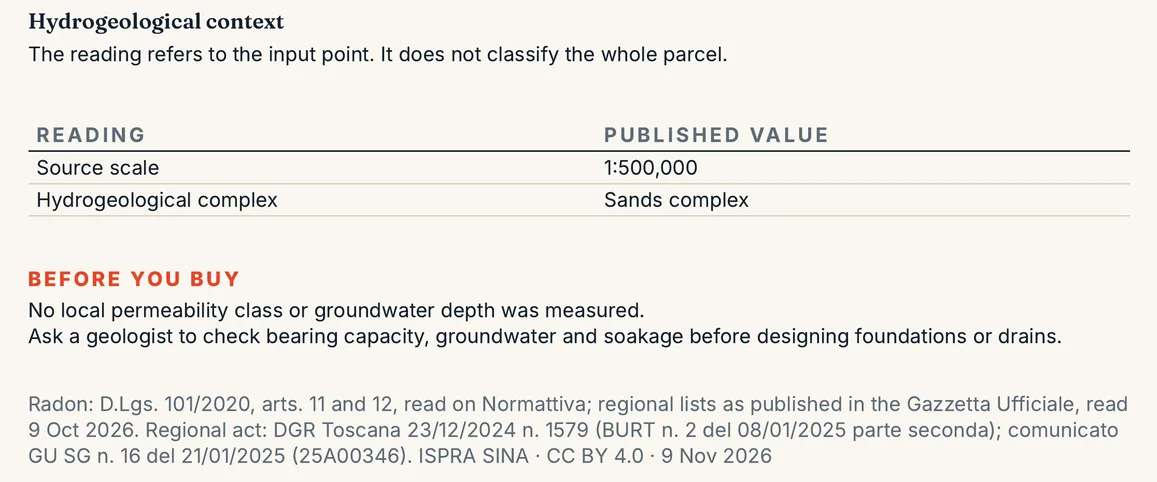
Sub-irrigation spreads the water leaving the Imhoff or septic tank into the soil through a perforated pipe laid in a trench. According to the ARPAT guidelines it works on natural, permeable ground with groundwater deep enough below, and it needs free space near the building. The pipe length depends on the percolation time, measured with a test pit: from 2 metres per population equivalent in fine sand to 10 metres in clay with a little sand. Compact clay is not suitable.
A population equivalent (abitante equivalente, AE) is a unit of polluting load, equal to 60 grams of oxygen a day of biochemical demand (D.Lgs. 152/2006, Article 74). For homes it is worked out by convention; the guidelines quote the Florence building regulation, one AE for every 35 m² of gross floor area or part of it.
A hypothetical example using those figures: a house of 140 m² gross floor area counts as 4 AE. On fine sand with clay at 5 metres per AE that is 20 metres of pipe; on clay with a little sand it is 40 metres, a much larger share of the garden. The guidelines add two distances for the trench: at least 30 m from drinking-water pipes, tanks or other supply, and at least 1 m between the bottom of the trench and the water table. The sizing in force is in the regional regulation and in your comune’s rules.
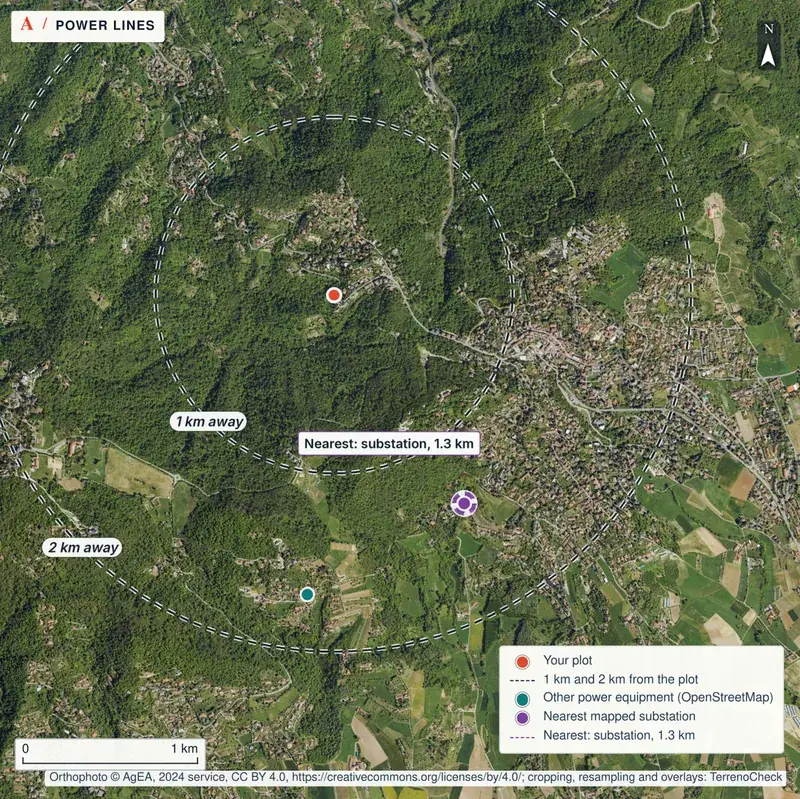
If the property has a well, check its distance from the trench before anything else: the rules on wells are in the guide to well water rights.
Sources: ARPAT Florence, 2005 guidelines; D.Lgs. 152/2006, Article 74; accessed 12 November 2026.
What it costs: application, system and fines
The cost of surveys, checks and site visits needed to review a discharge application falls on the applicant. The authority first sets a deposit, which must be paid before the application is examined, and at the end settles the costs from its own scale of charges (Article 124, paragraph 11). There is no national figure: in Lucca the comune’s regulation asks for 50 euros, plus ARPAT’s review charges where its opinion is needed, which means above 100 AE.
There is no official price statistic for the system itself. The cost depends on population equivalents, soil type, trench length, digging and the distance to the ditch or other receiving body. The technician who prepares the application sizes the system; with that design, get two or three quotes and add a geological report if the comune requires one.
A house with an existing tank: what to check before you buy
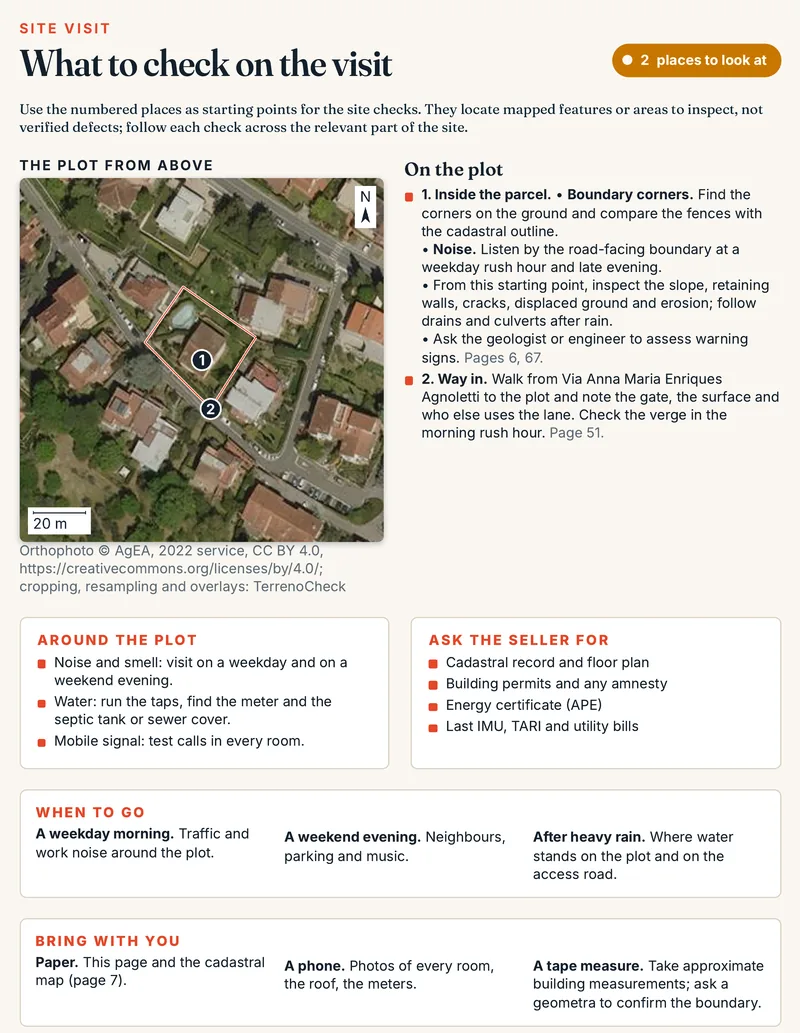
The permit is issued to the holder of the activity the discharge comes from (Article 124, paragraph 2). As a buyer you need to know whether it exists, what it covers and whether it is still valid. Do these checks before the deposit, because a system that has to be rebuilt changes the price.
- The permit. Ask the seller for a copy of the discharge permit, with its date and conditions. If it cannot be found, a request to see the file goes to the comune or the competent body; how long it takes depends on the office.
- The expiry date. Count four years from issue and check whether renewal was applied for, or whether the regional rules give tacit renewal for that type of discharge.
- The system on the ground. With your technician, compare what was permitted with what is there: type of tank, secondary treatment, discharge point. Ask for the tank-emptying receipts, since the sludge has to be removed from time to time.
- Your plans after the deed. If you mean to extend or divide the house, the technician assesses whether the discharge will change and a new permit will be needed.
- The preliminary contract. If the permit is missing or the system does not match, the contract (compromesso) should say who applies, who pays for upgrading and by what date.
A comune’s rules can set deadlines for upgrading existing systems: in Lucca, household discharges that already existed when the regulation came into force and do not meet its requirements must be upgraded within the deadlines the comune sets, and in any case no later than 360 days after the non-compliance is found, or the discharge is shut off. Connections to power, water and sewer for a plot without a house are covered in the guide to utility connections; the other checks on a rural house in the guide to buying a country house.
Hypothetical example
A farmhouse with a 2009 tank
A hypothetical example. The seller hands over a discharge permit issued by the comune in 2009 for an Imhoff tank with sub-irrigation; there is no record of a renewal application. The buyer’s technician asks the office whether the regional rules provide tacit renewal for that discharge and whether the house has been extended since 2009. On site the technician also finds two more bathrooms than the file shows. The preliminary contract says the seller files the new application and hands over the tank-emptying receipts before the deed, and pays for any work on the trench.
Sources: D.Lgs. 152/2006, Article 124; D.Lgs. 152/2006, Article 133; accessed 12 November 2026.
Septic tanks in rural Italy: discharge permits and costs
https://terrenocheck.it/en/guide/septic-tank-drainage-rural-house-italy
Checklist
Before the deposit
Common questions
Does a septic tank in Italy need a permit?
Yes, if the waste water does not go into the public sewer. Every discharge needs a permit in advance; the only exception is household waste water going into the sewer, which is always allowed under the operator’s rules (D.Lgs. 152/2006, Article 124, paragraphs 1 and 4). The tank on its own is not a permitted discharge; it becomes one through the decision of the body the region names.
Who do I apply to?
National law names the province, unless regional rules say otherwise (Article 124, paragraph 7). A region can assign another office: in Tuscany household discharges outside the sewer are permitted by the comune. Start with the comune’s environment or technical office where the house stands.
How long does the permit last and what happens when it expires?
Four years from issue. Renewal is applied for one year before expiry; if the application is made in time, the discharge can keep running under the old conditions until the new decision. Regional rules may provide tacit renewal for some household discharges (Article 124, paragraph 8): ask the office whether that applies to the house.
The seller cannot find the permit. What is the risk for me as buyer?
Running a household discharge without a permit carries an administrative fine of 600 to 3,000 euros for an isolated building used as a home, and 6,000 to 60,000 euros in other cases (Article 133, paragraph 2). Before the preliminary contract, ask the comune or the competent body for a copy. If none exists, the contract should say who applies, who pays for any upgrade and by what date.
If I renovate, do I need a new permit?
Yes, if after a change of use, an extension or a renovation the discharge changes in quality or quantity, for example because there are more bathrooms and more occupants. If the discharge stays the same, notifying the competent body is enough (Article 124, paragraph 12).
What does an Imhoff tank with a soakage trench cost?
There is no official national price: it depends on population equivalents, soil, digging and the distance to the receiving body. On top of the system come the technician who prepares the application, a geological report where required and the authority’s review costs; in Lucca, for example, the comune’s regulation asks for 50 euros. Get two or three quotes on a design the technician has already sized.
Keep reading
Utility connections on Italian land: real costs
Buying a country house in Italy: 12 checks before the deed
Buying a ruin in Italy: can you rebuild it?
The hydrogeological constraint (vincolo idrogeologico): what it stops, who approves works, and what to check on an existing house
Ground, water and constraints, checked before you pay a deposit
Pick the parcel on the map: hydrogeological context, watercourses, recorded wells and constraints are read for that plot, each with a source and date, along with the questions to put to the seller and the technician.
€29 in English or Italian · €39 in both languages · total, VAT included