
Pillar guide: Planning and the building
Legga questo articolo in italiano.
Fencing agricultural land in Italy: permits and distances
On this page
Italy’s national building law does not list fences among permit-free works, so whether you need a filing depends on regional law and the comune’s building rules. Two sets of rules apply everywhere: minimum distances from the road boundary outside built-up areas, from 1 to 5 metres depending on height, type of fence and type of road, with two exceptions, and a landscape authorisation on protected land.
In short
- An owner may enclose the land at any time, but must not obstruct a right of way that runs across it (Civil Code, Articles 841 and 1067).
- The national list of permit-free works does not mention fences: which building filing you need depends on regional law and the comune’s building rules, so ask the comune’s building desk.
- Outside built-up areas a fence up to 1 m on posts stands at least 1 m from the road boundary, a taller one at least 3 m, and a boundary wall 3 or 5 m depending on the road; the exceptions in paragraphs 5 and 9 of Article 26 have precise conditions, set out below.
- On land under landscape protection a new fence goes through the simplified procedure; replacing one with the same materials is usually exempt.
1 m
Fence up to 1 m from the road
On posts or a kerb up to 30 cm, outside built-up areas.
3–5 m
Boundary wall from the road
3 m from type C and F roads, 5 m from type A and B; for type F roads paragraph 5 makes an exception on the conditions of paragraph 3.
3 m
Boundary wall on the line
Up to this height it does not count for distances between buildings.
Already have a parcel in mind? The report runs these checks on your land, with a source and date for every finding: €29 in English or Italian · €39 in both languages · total, VAT included.
The right to fence, and its limits
The Italian Civil Code puts it plainly: “The owner may enclose the land at any time” (Article 841). You need neither your neighbour’s consent nor a reason. The right applies on your own land, inside the boundary, and it sits alongside three limits that matter before you buy.
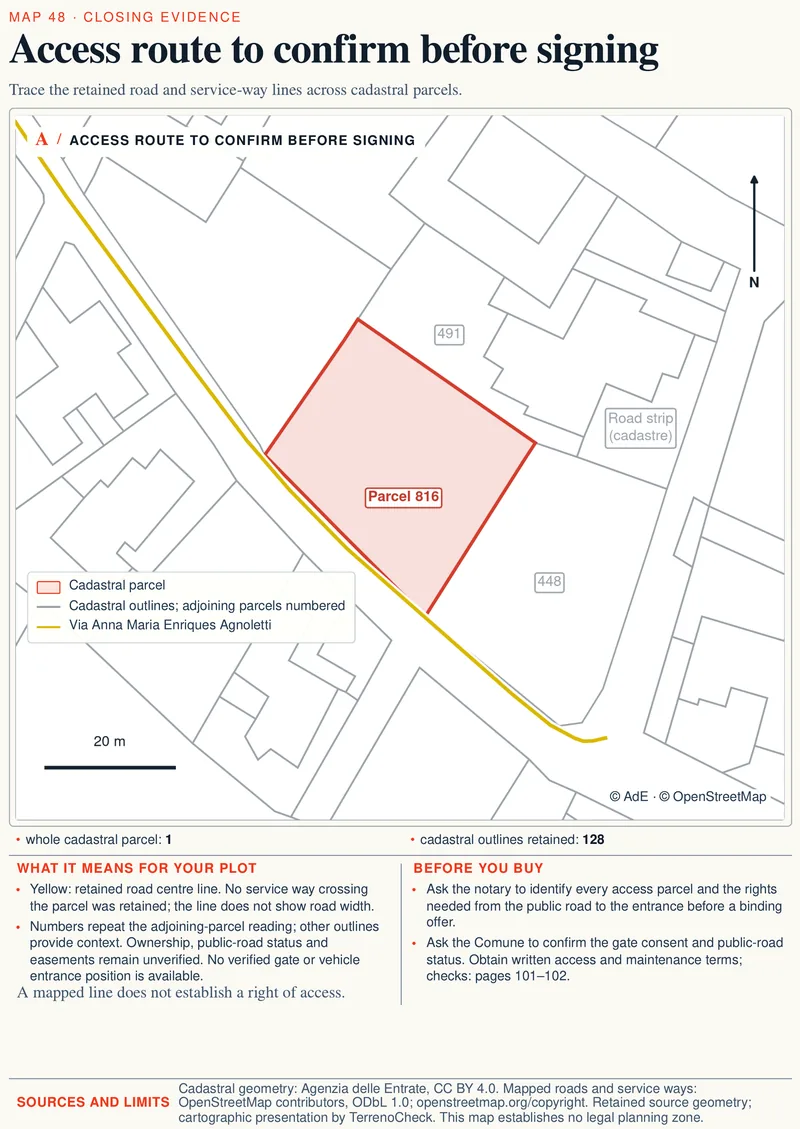
The first is a right of way (servitù di passaggio). If a neighbour has a right to cross the land, the owner may do nothing that reduces that right or makes it harder to use (Article 1067). A gate across the track is only possible if it does not get in the way. How rights of way work is explained in our guide on access and servitù di passaggio.
The second is hunting. An owner cannot stop hunters coming onto the land unless it is enclosed in the way the hunting law requires, or unless growing crops could be damaged (Article 842). An ordinary fence does not change that.
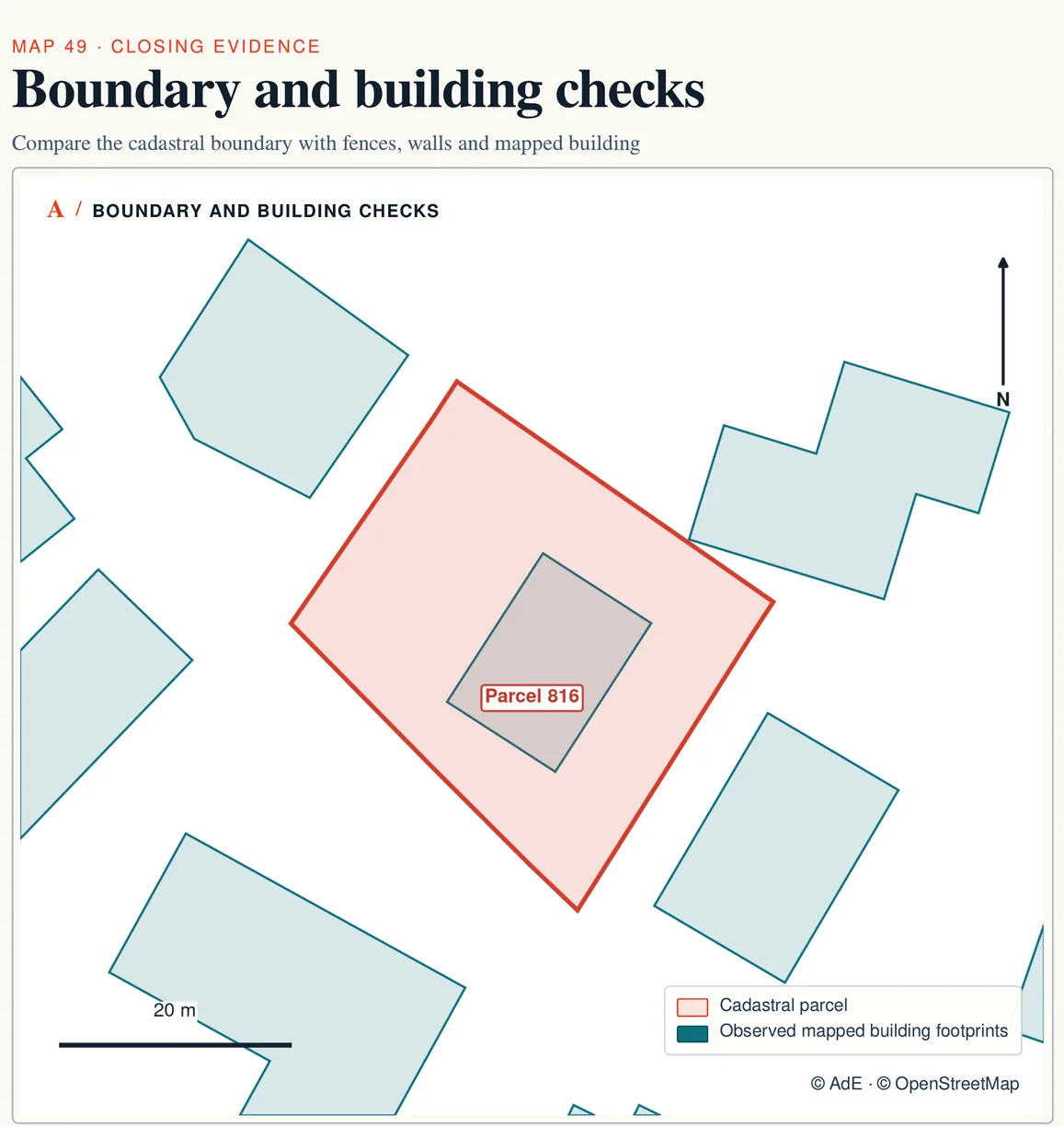
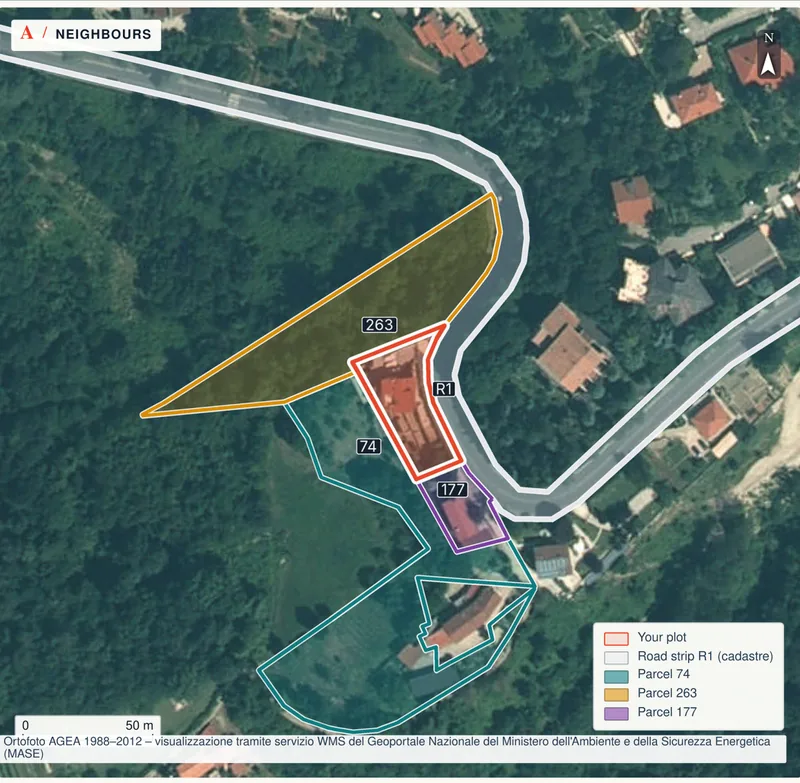
The third is the boundary. Neither an existing fence nor the line on the cadastral map tells you by itself where it runs: where a boundary is uncertain either owner can ask the court to establish it, any means of proof is admitted, and the judge follows the cadastral map where there is no other evidence (Article 950). If a listing says terreno recintato (fenced land), the first question is whether the fence matches the map, the title deeds and what is on the ground: see our guide on cadastral and real boundaries.
Do you need a building filing? The region and the comune decide
The answer changes from region to region and from comune to comune. Article 6 of DPR 380/2001, the national building code’s list of permit-free works, does not mention fences. The 2018 glossary of permit-free works mentions them only as part of a children’s play area or a shelter for farmyard animals, under the heading of furniture in the grounds of a building.
Under national law, a work not listed as permit-free, as needing a building permit or as needing a SCIA goes through a CILA, a notice of works certified by a qualified technician (Article 6-bis). Ordinary-statute regions can, however, make further works permit-free (Article 6, paragraph 6), and each comune regulates building through its own regolamento edilizio (Article 2, paragraph 4). That building code is the first document to read: it is where the comune sets out, if it does, the heights, materials and positions allowed.
In practice, before you buy or order the materials, read the comune’s building rules and ask the SUE (sportello unico per l’edilizia, the comune’s building desk) which filing applies to the fence you have in mind. If the answer is a CILA, a qualified technician, for example a geometra (surveyor), files it with a drawing. If a CILA was needed and was never filed, the fine is €1,000, cut by two thirds if the notice is filed voluntarily while work is under way (Article 6-bis, paragraph 5).
| Type of fence | Building filing | Along a road outside a built-up area | On land under landscape protection |
|---|---|---|---|
| Mesh or wooden fence up to 1 m, on posts | Set by regional law and the comune’s rules | At least 1 m from the road boundary | New: simplified procedure (Annex B) |
| Mesh or wooden fence over 1 m, or on a kerb over 30 cm | As above | At least 3 m; does not apply to works already there (paragraph 9) | New: simplified procedure |
| Hedge | It is planting: distances apply | 1 m if up to 1 m high, 3 m if taller | Exempt on the terms of item A.14 of Annex A |
| Boundary wall | As above | 3 m from type C and F roads, 5 m from type A and B; type F roads: the paragraph 5 exception, explained below | New: simplified procedure |
| Replacement with the same materials and design | As above | A rebuilt boundary wall keeps to the distances (paragraph 4) | Usually exempt (Annex A, item A.13) |
Distances from the road outside built-up areas
This rule is national and applies everywhere. Along roads outside built-up areas, the Highway Code forbids landowners to plant hedges and trees or put up fences within the distances set by its implementing regulation (Article 16). The regulation sets them by type of work, height and type of road (DPR 495/1992, Article 26).
Distances are measured from the road boundary (confine stradale): the limit of the road owner’s land as shown in the expropriation or acquisition records; failing that, the outer edge of the roadside ditch or gutter, the foot of the embankment if the road is raised, or the top of the bank if it runs in a cutting (Highway Code, Article 3). Not from the edge of the tarmac, which usually lies further in.
Road types are those of the Highway Code: A motorways, B main extra-urban roads, C secondary extra-urban roads, F local roads, including strade vicinali, private roads outside built-up areas that are open to public use (Articles 2 and 3). The centro abitato, the built-up area, is drawn by the comune in a council resolution published with a map (Article 4): ask the technical office, because inside it the rules differ.
The diagram at the end of this section sums up the minimum values. There are two exceptions, each with its own conditions.
The first concerns boundary walls along type F roads, and only in the case described in paragraph 3: the stretch is outside the built-up area but inside a zone that the comune’s general plan marks for building or transformation, and in addition either that plan can be implemented directly or the detailed implementing plans for the zone are already in force. Where all of these conditions are met, the regulation sets no minimum distance from the road boundary, for road-safety purposes, for building or rebuilding the wall (Article 26, paragraphs 3 and 5). The colour of the zone on the plan map is not enough: before designing a wall closer than 3 m, ask the comune’s technical office to confirm in writing that the plan is implemented directly or that the implementing plan is in force.
The second: the requirements of paragraphs 1 and 8, meaning the distances for ditches and excavations and the 3 m distance for hedges, planting and fences, do not apply to works and crops that were already there (paragraph 9). For a fence that already exists, ask the body that manages the road whether it falls under this exclusion, stating the year it was put up.
Inside built-up areas, a boundary wall must stand at least 3 m from type A roads and 2 m from type D, while for other roads the regulation sets no minimum (Article 28).
Sources: Highway Code, Article 16; Highway Code, Article 3; DPR 495/1992, Article 26; accessed 12 November 2026.
Distances from the neighbour: walls, hedges and trees
Towards the neighbour, the Civil Code applies. A boundary wall (muro di cinta) up to 3 m high does not count for the 3 m distance between buildings in Article 873, so it may stand on the line; if it does, the neighbour may make it a shared wall and build against it, unless a building already stands less than 3 m away on the other side (Article 878).
The rule that neighbours split the cost of a boundary wall applies only between houses, courtyards and gardens “in built-up areas”, not between two fields (Article 886). In open country, whoever wants the wall pays for it.
For hedges and trees, the Code first defers to local regulations and customs; only where there are none do its own distances from the boundary apply: 3 m for tall trees, 1.5 m for smaller trees, 0.5 m for vines, shrubs, hedges and fruit trees no taller than 2.5 m. For hedges the half metre has two exceptions: 1 m if the hedge is of alder, chestnut or similar plants that are cut back periodically close to the stump, and 2 m if it is of robinia (Article 892). These distances do not apply if there is a dividing wall on the boundary, your own or shared, and the plants are kept no higher than the top of the wall.
Landscape protection: new fence or replacement
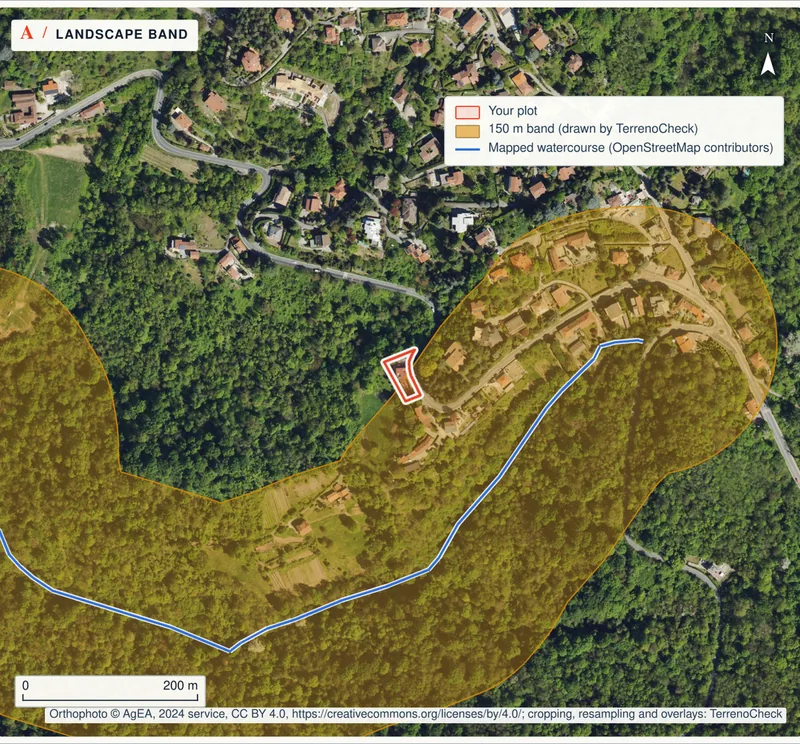
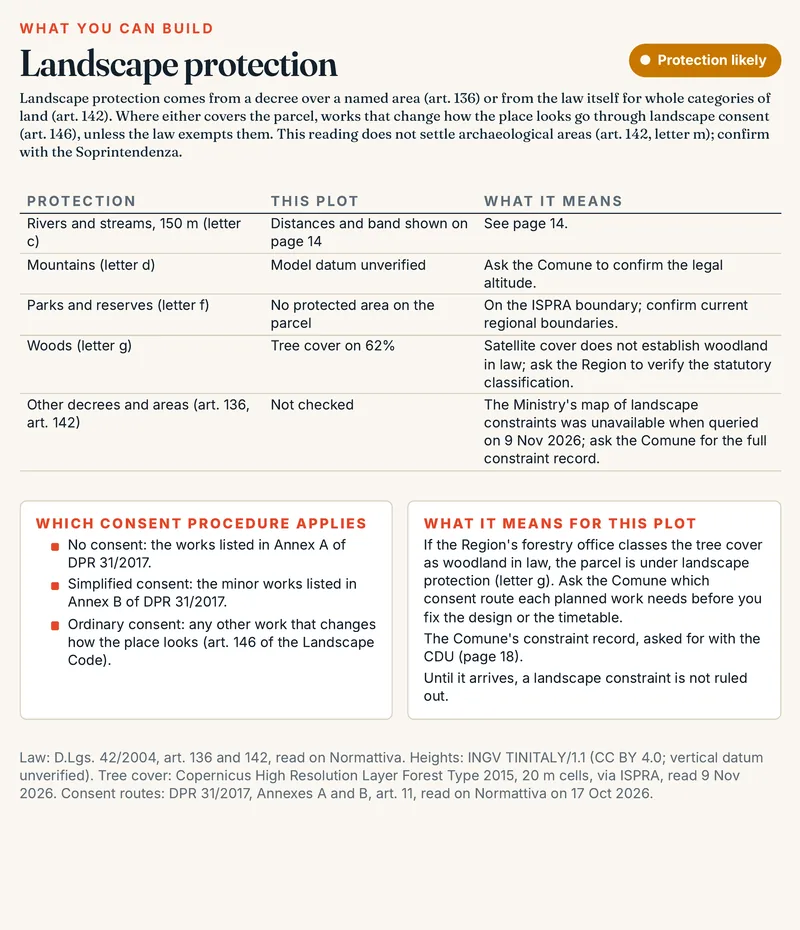
If the parcel lies in a protected area, for example within 150 m of a listed river or in woodland, the fence also falls under DPR 31/2017. Replacing or adapting gates, fences and boundary walls with the same design, materials and finish needs no authorisation (Annex A, item A.13), unless it concerns certain sites formally declared of significant public interest (Article 136 of the Landscape Code, paragraph 1, letters a and b, and part of c).
Building new gates, fences and boundary walls, or replacing them with different materials or finishes, counts as minor work (Annex B, item B.21) under the simplified authorisation. The application goes to the authority responsible for landscape, which the comune will name. Article 11, paragraph 5, describes the route where no consent is needed beyond the landscape authorisation and the building filing, and both assessments are positive: the authority sends a proposal to approve to the Soprintendenza (the State heritage office) within 20 days of receiving the application, or of receiving the further documents if it asked for any; if the Soprintendenza’s assessment is also positive, its opinion follows within 20 days of the proposal and the decision within the next 10 days. These are the steps of that route, not a guaranteed duration: where other consents are needed the authorities meet in a conferenza di servizi (paragraph 2), and when either body’s assessment is negative, its notice of the reasons suspends the time limit (paragraphs 6 and 7).
How to find out whether land is protected is covered in our guide to the vincolo paesaggistico.
An existing fence: what to check before you buy
Land that is already fenced looks like a bonus, and often is. Before the preliminary contract, though, walk the fence with the cadastral map in hand, because a buyer inherits its problems too.
- Where it runs. Walk the perimeter with a geometra and compare fences, gates and walls with the cadastral outline and the title deeds. A few metres’ difference along a long side needs clearing up with the seller and the neighbour before the preliminary contract, because the cadastral map alone does not settle the boundary.
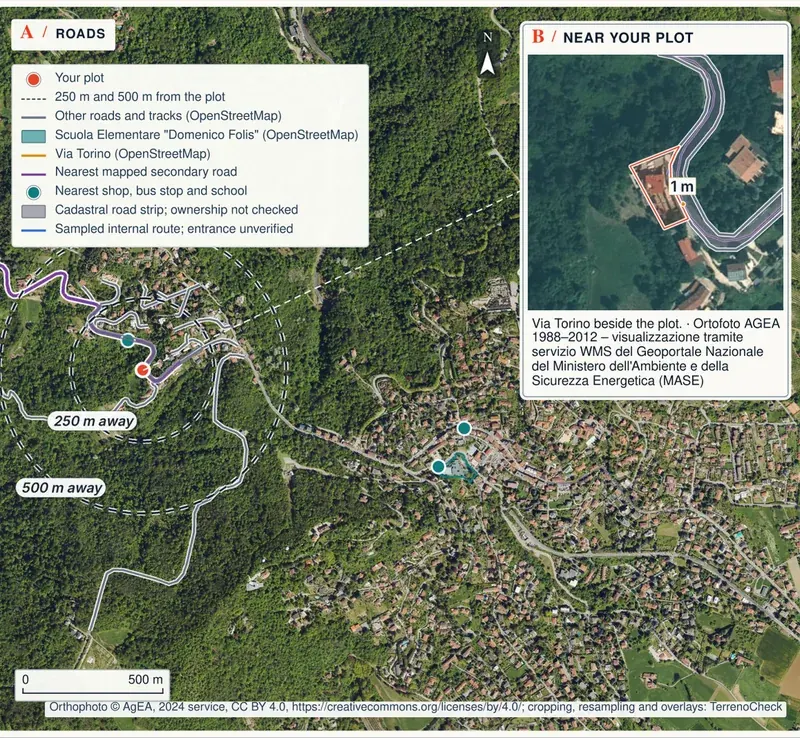
- What it shuts off. Check that the fence does not cut across a neighbour’s right of way, or across your own only access to the road.
- Distance from the road. Measure from the road boundary, not the tarmac, and ask the comune for the road type and the edge of the built-up area. If the distance is shorter than in the diagram, ask the body that manages the road whether paragraph 9 on existing works applies.
- Filing and constraints. Ask the seller for the filing under which it was built, if the comune required one, and for any landscape authorisation.
If something turns up, write into the preliminary contract who fixes it and by when. The other checks on land without buildings are in our guide on what you can do on non-building land; for a farmhouse or a house with land, see our guide on buying a country house in Italy.
Hypothetical example
Mesh fencing 2 metres from a provincial road
A hypothetical example. An olive grove for sale is enclosed by mesh fencing 1.5 m high, 2 m from the outer edge of the ditch of a provincial road in open country; on one side the fence stands 4 m beyond the line on the cadastral map. Before the preliminary contract the buyer asks the body that manages the road where the road boundary runs and whether the fence, given the year it was put up, counts as an existing work under paragraph 9. The buyer asks a geometra for a survey to compare with the map and the title deeds. If the fence turns out to be subject to the 3 m, the preliminary contract says who moves it, by what date and at whose cost; for the side facing the neighbour it says how the line is cleared up before the deed.
Sources: Highway Code, Article 3; DPR 495/1992, Article 26; Civil Code, Article 950; accessed 12 November 2026.
Fencing agricultural land in Italy: permits and distances
https://terrenocheck.it/en/guide/fencing-agricultural-land-permits-italy
Checklist
Before you fence, or buy fenced land
Common questions
Do I need a CILA for wire mesh on posts?
It depends on the comune. Fences are not among the permit-free works in Article 6 of DPR 380/2001, so the answer lies in regional law and the comune’s building rules. Ask the comune’s building desk before you put one up, giving the height, material and position.
How far from the road must a fence be?
Outside built-up areas: at least 1 m from the road boundary for mesh or wooden fences up to 1 m high on posts or on a kerb up to 30 cm; at least 3 m if taller or if the kerb is higher than 30 cm. A boundary wall needs 3 m from type C and F roads and 5 m from type A and B (DPR 495/1992, Article 26). Along type F roads no minimum is set for the wall only in the case of paragraph 5: inside zones the general plan marks for building or transformation, where the plan can be implemented directly or the detailed plans are already in force. The 3 m distances for hedges and fences do not apply to works that were already there (paragraph 9).
Where is the distance from the road measured from?
From the road boundary, meaning the limit of the road owner’s land as shown in the acquisition records. Failing that, it is the outer edge of the roadside ditch, or the foot or top of the embankment (Highway Code, Article 3). Not from the edge of the tarmac.
Can I build a wall right on the boundary with my neighbour?
Yes: a boundary wall up to 3 m high does not count for the 3 m distance between buildings and may stand on the line (Civil Code, Article 878). You still need whatever filing the comune requires and, where it applies, landscape clearance.
Does fencing my land keep hunters out?
Only if the land is enclosed in the way the hunting law sets out, or if there are growing crops that could be damaged (Civil Code, Article 842). An ordinary fence is not enough.
Is an existing fence a problem for a buyer?
It can be if it does not match the cadastral map and the title deeds, blocks a right of way, lacks landscape clearance on protected land, or sits too close to the road. Have a geometra (surveyor) make the comparison before the preliminary contract; the cadastral map alone does not settle the boundary (Civil Code, Article 950).
Keep reading
Cadastral vs real boundaries in Italy
Access rights in Italy: servitù di passaggio
Vincolo paesaggistico: what it permits
Non-building land in Italy: what you can really do on it
Private and vicinal roads in Italy: upkeep and access
Boundary, roads and constraints, checked before you fence
Pick the parcel on the map: cadastral outline, nearby roads, access and landscape constraints are read for that plot, each with a source and date, along with the points to check with a geometra.
€29 in English or Italian · €39 in both languages · total, VAT included