
Pillar guide: Land, rights and services
Legga questo articolo in italiano.
Private and vicinal roads in Italy: upkeep and access
On this page
A strada vicinale is a privately owned road outside built-up areas that the public may use. Its upkeep falls on the users grouped in a consortium, which the law makes compulsory for vicinal roads in public use, and the comune (the municipality) pays between one fifth and one half of the cost when the road is open to public traffic. A purely private road gives access only to those with a legal title: ownership, an easement or a court ruling. Before signing anything, ask the comune in writing how the road to the plot is classified.
In short
- Municipal, vicinal or private: the road’s status decides who maintains it and who may drive on it, and the comune confirms it, not the listing.
- For vicinal roads in public use the users’ consortium is compulsory, and if nobody sets it up the prefect does (Law 126/1958, Article 14).
- On vicinal roads open to public traffic the comune pays one fifth to one half of the upkeep; on the others its share is optional, only for improvement or rebuilding, and capped at one fifth.
- A purely private road gives access to owners, holders of an easement or those with a court ruling: a neighbour letting you through is not a right.
- Before the preliminary contract get the comune’s written answer on the road’s classification, the consortium’s rules and shares if one exists, and the easements shown in the title deeds.
1/5–1/2
The comune’s share
On vicinal roads open to public traffic, depending on how important the road is.
1/3
To request a consortium
Users who represent, or take on, at least one third of the cost.
6/10
To approve works
Votes of users representing at least six tenths of the cost, the comune’s share included.
Already have a parcel in mind? The report runs these checks on your land, with a source and date for every finding: €29 in English or Italian · €39 in both languages · total, VAT included.
Municipal, vicinal or private: three different roads
To a buyer the track leading to a plot is simply the way in. Italian law distinguishes three kinds of road outside built-up areas, and they differ in who may use them and who pays for work on them.
A municipal road (strada comunale) belongs to the comune, the local municipality, and is public domain land (Civil Code, Articles 822 and 824). The comune maintains it as the road owner (Highway Code, Article 14), and its formal classification is made by the competent regional bodies (DPR 495/1992, Article 2).
A strada vicinale, also called poderale or di bonifica, is defined by the Highway Code as a «private road outside built-up areas in public use» (Article 3, no. 52). The land under it stays private, but anyone may use it, and for the purposes of the Highway Code vicinal roads are treated like municipal ones (Article 2, paragraph 6).
A private road in the strict sense is not open to the public. It serves its owners and anyone holding a right of way; everyone else passes only because the owner tolerates it.
The table at the end of this section sets the three side by side. Seen from the field, the same gravel track could be any of them, which is why the answer has to come from the comune and not from the surface or from local habit.
| Road | Who owns the land under it | Who maintains it | Who may use it |
|---|---|---|---|
| Municipal (comunale) | The comune, as public domain | The comune, as road owner | Anyone |
| Vicinal, open to public traffic | Private owners | The users’ consortium, compulsory; the comune pays 1/5 to 1/2 | Anyone |
| Vicinal, not in public use | Private owners | The users, in an optional consortium; the comune may give up to 1/5, only for improvement or rebuilding | Users and easement holders |
| Private | Private owners | The owners; works to keep an easement usable are paid by the land that benefits, unless the title or the law says otherwise, and shared in proportion to the benefit if they also serve the land crossed | Owners and easement holders; others only if allowed |
The comune confirms how a given stretch is classified: what the road looks like does not tell you which row it belongs to. Sources: Highway Code, Article 3; Highway Code, Article 14; Civil Code, Articles 822 and 824; D.L.Lgt. 1446/1918, Article 3; Law 126/1958, Article 14; Civil Code, Article 1069; accessed 12 November 2026.
What the comune does on a vicinal road
The comune does not own a vicinal road, but the Highway Code gives it the powers of the road owner (Article 14, paragraph 4). That matters as soon as you want to connect the plot to the road.
No new access from the road to the land or buildings alongside it may be opened, and no existing access altered, without the road owner’s prior consent (Highway Code, Article 22, paragraphs 1 and 4). For a new gate onto a vicinal road, then, the application goes to the comune. If a listing promises vehicle access, ask the seller for the consent under which the entrance was opened.
The comune also shares the cost, and how much depends on one fact: whether the road is open to public traffic (soggetta al pubblico transito).
Who pays for upkeep: the users’ consortium
Vicinal roads are still governed by Decree 1446 of 1918 (a decreto luogotenenziale, issued during the First World War). Users of a vicinal road, even one not open to public traffic, may form a consortium (consorzio) to maintain, improve or rebuild it (Article 1). For vicinal roads in public use the consortium is compulsory: if neither the users nor the comune take the initiative, the prefect sets it up (Law 126/1958, Article 14).
The comune’s contribution follows two different rules:
- vicinal road open to public traffic: the comune must pay towards maintenance, improvement and rebuilding, between one fifth and one half of the cost depending on how important the road is;
- vicinal road not in public use: the comune’s contribution is optional, only for improvement or rebuilding, and no more than one fifth of the cost.
Either way the comune votes in the consortium in proportion to what it pays (D.L.Lgt. 1446/1918, Article 3). The users pay the rest according to the cost-sharing plan (piano di ripartizione).
Anyone whose use of the road, even temporary, wears it out noticeably, for instance with heavy lorries, must contribute to upkeep in line with the extra cost; the rule covers vicinal roads open to public traffic (Article 9). Bear it in mind if you plan building work on the plot or want to fell timber.
- Municipal roadThe comune, as road owner
- Vicinal road open to public trafficCompulsory consortium; comune pays 1/5 to 1/2 of maintenance, improvement and rebuilding
- Vicinal road not in public useThe users; the comune may give up to 1/5 only for improvement or rebuilding, not for maintenance
- Private roadThe owners and easement holders, under their titles and Civil Code Article 1069
Sources: Highway Code, Article 14; D.L.Lgt. 1446/1918, Article 1; D.L.Lgt. 1446/1918, Article 3; Law 126/1958, Article 14; Civil Code, Article 1069; accessed 12 November 2026.
How a consortium is formed and how contributions are collected
The request to form a consortium goes to the mayor (sindaco) from users who represent, or take on, at least one third of the cost, with an outline estimate, draft rules and a draft list of users with the cost-sharing plan. The municipal executive draws up proposals, which are on deposit at the town hall for 15 days; after at least another 15 days the municipal council rules on objections and approves the consortium, the list of users and the cost split (D.L.Lgt. 1446/1918, Article 2).
Detailed projects for improvement and rebuilding pass with the votes of users representing at least six tenths of the total cost, the comune’s share included (Article 6). A buyer who joins a consortium can therefore find works approved without their vote.
Contributions are collected in the same way as direct taxes, from rolls based on the cost-sharing plan. The decree calls them an onere reale del fondo, a charge on the land itself, and sets an annual ceiling: no user can be made to pay more each year than twice the «main tax» on their land (Article 7). The ceiling is written in the tax terms of 1918, so ask the consortium and the comune how it applies today, and ask for the consortium’s rules at the same time.
Private roads: who has the right to pass
On a private road a right of way rests on a legal title: owning the road, alone or with others, or an easement (servitù). Two Civil Code rules explain why years of passing through are not enough.
Easements that are not apparent, meaning there are no visible and permanent works built for their use, cannot be acquired by long use (Article 1061). Driving across a neighbour’s field with their tacit consent, with no works built for the passage, does not turn into a right over time; where such works exist, have a lawyer look at the case.
If the plot is enclosed by other land with no way out to a public road, and cannot get one without excessive cost or inconvenience, its owner is entitled to a compulsory right of way (passaggio coattivo) over the neighbouring land, along the shortest and least damaging route; houses, courtyards, gardens and threshing floors are exempt (Article 1051). Compensation in proportion to the harm is due (Article 1053). The owner of the land that benefits from an easement carries out, at their own cost, the works needed to keep it usable, unless the title or the law provides otherwise; if the works also benefit the land crossed, the cost is shared in proportion to the benefit each side gets (Article 1069).
How to read and check an easement is covered in our guide to access rights and the servitù di passaggio.
How to check before the preliminary contract
How long these checks take depends mostly on the comune and the notary, so start them once your offer is serious and finish before you sign the preliminary contract (compromesso), the binding agreement that usually comes with a deposit.
- Site visit (on the spot). Drive the road from the tarmac to the plot. Note signs, barriers, chains and gates, and photograph where the road enters the parcel.
- The comune’s technical office (written request by PEC, Italy’s certified email, or at the front desk). Ask how the stretch is classified: municipal, vicinal in public use, vicinal without public use or private, which records the answer relies on, and whether a consortium exists. If you ask for copies of resolutions or lists through a formal access request, it must state your reasons; after 30 days without a reply it counts as refused (Law 241/1990, Article 25).
- Cadastral map (online). With a map extract see which parcels the road crosses on its way to the plot. A line on the map is not a right of way.
- Notary or surveyor (deeds and registers). In the title deeds and the property registers, look for rights of way registered in favour of the plot; our guide to the ispezione ipotecaria shows how the registers are searched.
- The consortium, if there is one (written request to its chair). Its rules, the cost-sharing plan with the plot’s share, contributions over recent years, works already approved and anything unpaid.
The findings belong in the preliminary contract: which road gives access, under what title, which consortium share passes to you and who pays what fell due before the final deed (rogito). For a house with land, the other checks are in our guide to buying a country house; for how far fences and walls must stand from a vicinal road, see the guide to fencing agricultural land.
Hypothetical example
An olive grove at the end of a gravel track
A hypothetical example. The olive grove for sale is reached by 400 m of gravel track that leaves a provincial road and crosses three parcels belonging to other owners. The listing calls it a «strada vicinale». The comune replies in writing that the stretch is not classified and that no consortium is on record; the seller’s title deeds show a registered right of way over the first of the three parcels only. Before the preliminary contract the buyer asks the seller to obtain a deed of easement from the other two owners, and the preliminary contract makes the purchase conditional on it.
Sources: Civil Code, Article 1051; Civil Code, Article 1061; Civil Code, Article 825; accessed 12 November 2026.
Private and vicinal roads in Italy: upkeep and access
https://terrenocheck.it/en/guide/private-and-vicinal-roads-italy
Checklist
Before the preliminary contract
Common questions
What is the difference between a strada vicinale and a private road?
Both run over privately owned land. A vicinal road lies outside built-up areas and is open to public use (Highway Code, Article 3): anyone may drive on it, and for the Highway Code it counts as a municipal road. A purely private road serves its owners and anyone holding an easement; others use it only if the owner allows it.
Who pays to maintain a vicinal road?
The users, grouped in a consortium, according to the cost-sharing plan approved by the municipal council. If the road is open to public traffic the comune must pay between one fifth and one half; if it is not, the comune may contribute only to improvement or rebuilding, and never more than one fifth (D.L.Lgt. 1446/1918, Article 3).
Is a road consortium compulsory?
For vicinal roads in public use, yes: Law 126/1958 makes it compulsory, and if neither the users nor the comune set it up, the prefect (the central government’s local representative) does. For vicinal roads without public use the users may form one but do not have to.
Will I have to pay the consortium after I buy?
The 1918 decree calls the contribution an «onere reale del fondo», a charge that attaches to the land. Before the final deed, get a written statement from the consortium of contributions paid, works already approved and amounts still owed, and have the preliminary contract say who pays what fell due before the sale.
Everyone drives down this dirt track. Does that make it public?
Use alone does not tell you. Whether the road carries a public right of use is shown by the comune’s records or by a court ruling; ask the technical office in writing how it classifies the road and on what records it relies.
The plot has no access to a public road. What then?
An owner whose land is enclosed by other plots, with no way out to a public road, can obtain a compulsory right of way over a neighbour’s land, paying compensation in proportion to the harm (Civil Code, Articles 1051 and 1053). That means an agreement with the neighbour or a court case, and it should be settled before you buy.
Keep reading
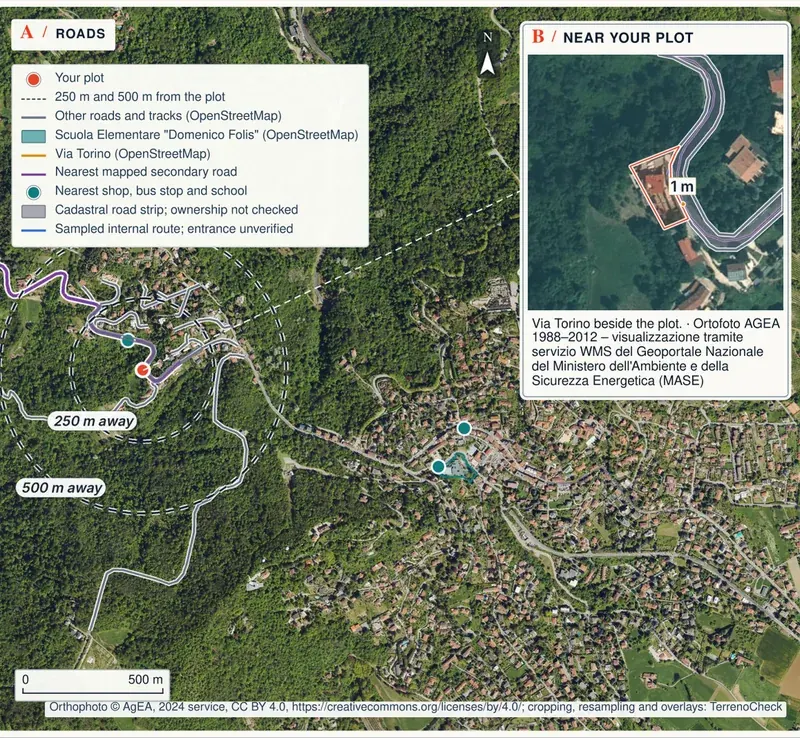
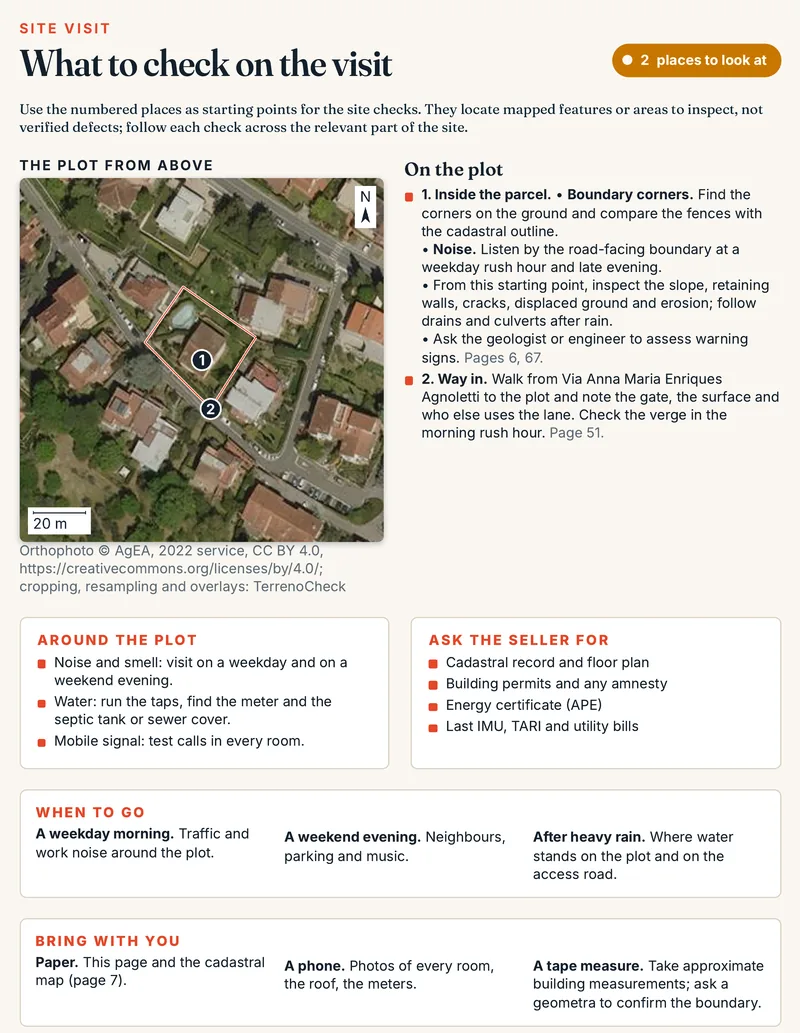
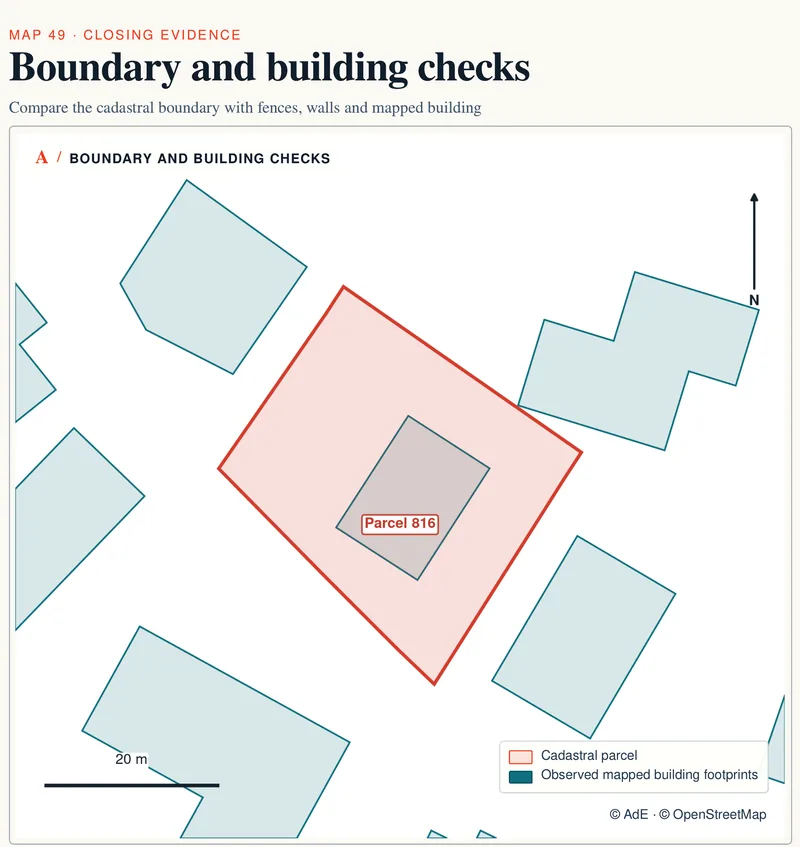
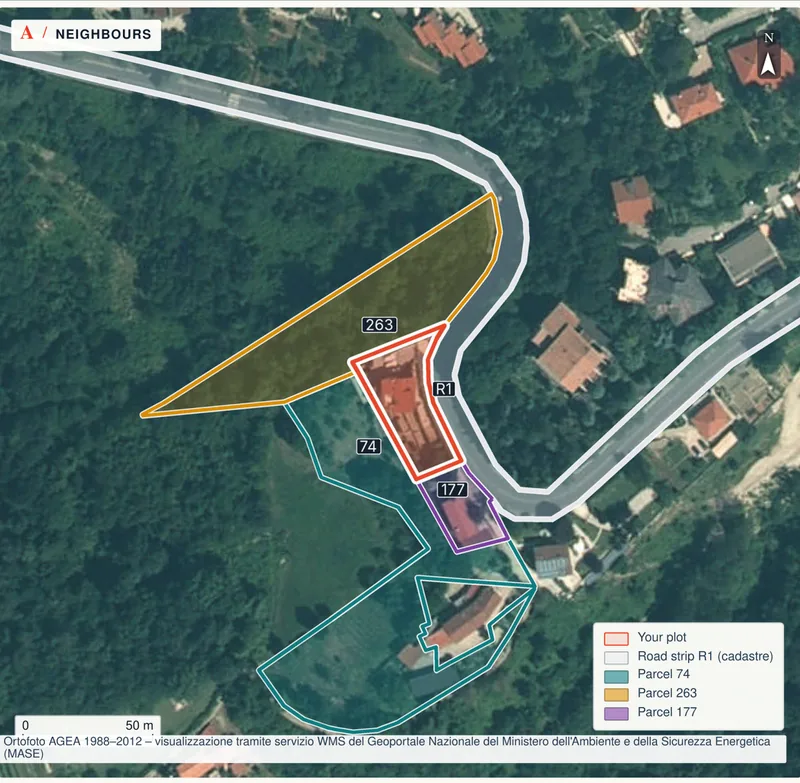
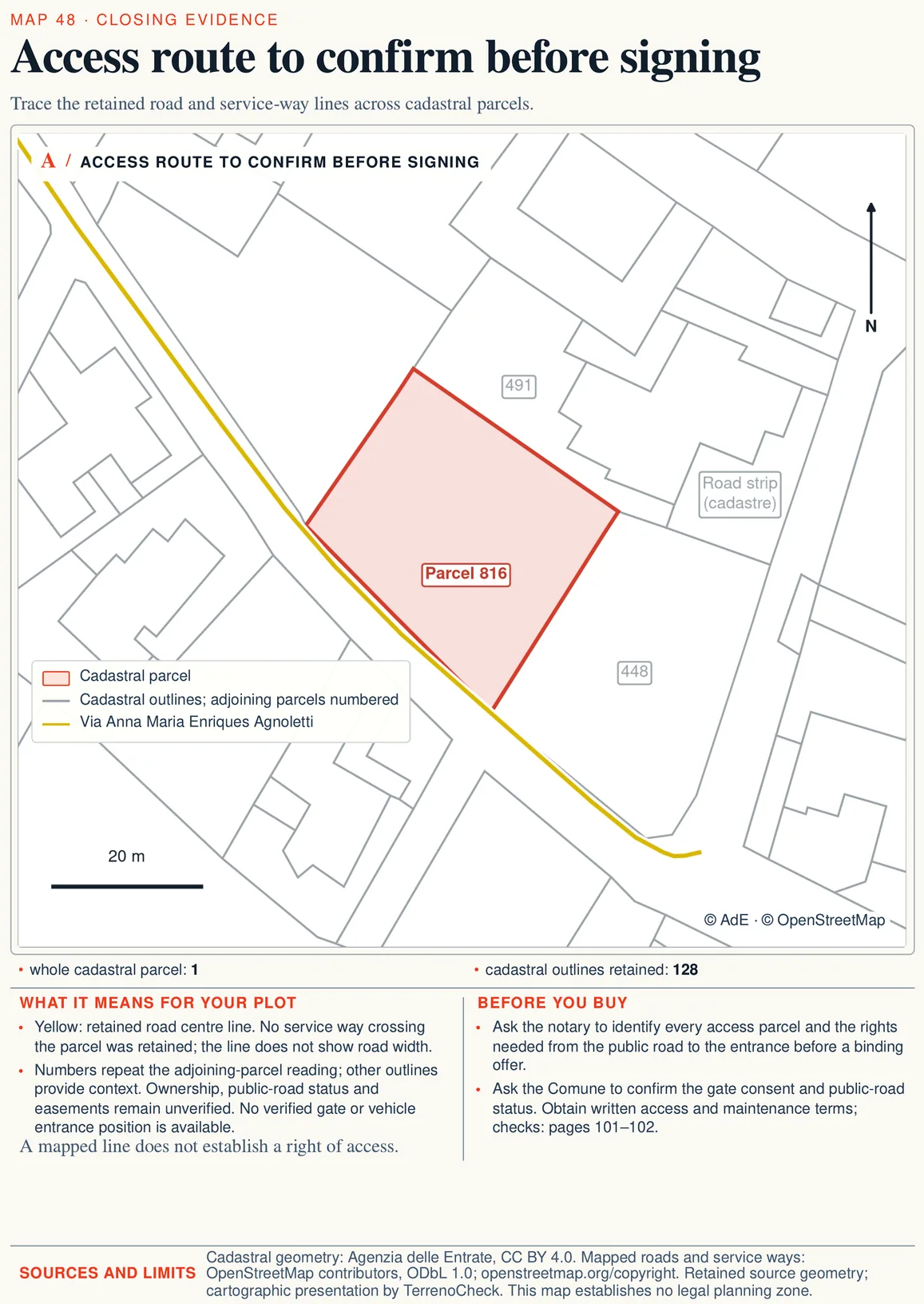
The road and access to the plot, checked before you sign
Pick the parcel on the map: nearby roads, the parcels crossed on the way to the entrance and the neighbours are read for that plot, each with a source and date, along with the questions to put to the comune and the notary.
€29 in English or Italian · €39 in both languages · total, VAT included