
Pillar guide: Planning and the building
Legga questo articolo in italiano.
Land in a Natura 2000 site or a park in Italy: what changes
On this page
Land inside a Natura 2000 site can be bought, farmed and sometimes built on: the sites are not strict reserves and many are privately owned. Read the conservation measures and the plan for that site. A project not connected with managing the site that may significantly affect it goes through an appropriate assessment; in national parks you also need the park authority’s clearance and must follow the park plan, and in certain national park zones the authority has a right of first refusal on the sale.
In short
- Natura 2000 (SIC, ZSC and ZPS sites) covers about 19% of Italy’s land; the sites are not strict reserves and the land can be private.
- Works that may significantly affect a site go through an appropriate assessment; the region sets who decides and the time limits, otherwise the check closes within 60 days (Presidential Decree 357/1997, art. 5).
- In a national park, permits for works and installations first need the park authority’s clearance (nulla osta): 60 days, extendable once by 30; with no answer in time the clearance counts as granted (Law 394/1991, art. 13).
- Regional parks follow their own regional law. In a national park’s integral and general reserves the park authority has a right of first refusal on sales for value, to be used within three months of notice, after the farmers the law puts first (Law 394/1991, art. 15).
19%
Of Italy’s land in Natura 2000
SIC, ZSC and ZPS together, according to the Environment Ministry.
60 days
National park clearance (nulla osta)
Can be extended once by 30 days; silence counts as approval.
3 months
National park right of first refusal
National parks only: integral and general reserves, on sales for value.
The report brings together public information about the land, with sources and dates, to prepare questions for the relevant offices: €29 in English or Italian · €39 in both languages · total, VAT included.
What SIC, ZSC and ZPS sites are
Natura 2000 is the European network of sites that protect habitats and species. In Italy it is made up of SIC (sites of community importance), ZSC (special areas of conservation, that is SIC sites where conservation measures apply) and ZPS (special protection areas for birds). The protection duties and the appropriate assessment apply to ZPS sites as well (Presidential Decree 357/1997, art. 2).
The Environment Ministry states that the network’s areas are not strictly protected reserves where human activity is excluded, and that private parties can own the sites. According to the Ministry, SIC, ZSC and ZPS sites together cover about 19% of Italy’s land and 6.5% of its sea. ISPRA, the national environmental agency, counts 5,844,888 hectares on land net of overlaps, 19.4% of the national territory. The chart shows how many sites the regions have identified.
Ask the regional authority for the site’s conservation measures and current management plan. The conservation measures for each ZSC are adopted by the region or autonomous province, through management plans or regulatory, administrative or contractual measures; if the ZSC lies inside a protected area, that area’s measures apply (Presidential Decree 357/1997, art. 4).
Source: MASE, SIC, ZSC and ZPS in Italy, January 2026 data, read on 12 November 2026
Sources: MASE, SIC, ZSC and ZPS in Italy; ISPRA, Natura 2000 network; accessed 13 November 2026.
How to check where the land falls
The national maps are on the Environment Ministry’s national geoportal (gn.mase.gov.it, formerly the Portale cartografico nazionale), in the Natura section. The "Rete Natura 2000 (SIC/ZSC e ZPS)" layer was updated on 12 January 2026. Regions also publish the sites on their territory: Regione Toscana, for example, lists them on its pages about the appropriate assessment.
For parks, the official list of protected areas is the EUAP. The geoportal gives the 6th update, approved by ministerial decree of 27 April 2010, as the list in force: for an area set up later, check with the region or the park authority. If the land is inside a park, ask the park authority which zone of the plan the parcel falls in and which regulations apply.
The sample report map below shows how the result reads for a real parcel: Natura 2000 sites and other protected areas within 25 km, with the distance to the nearest boundary.
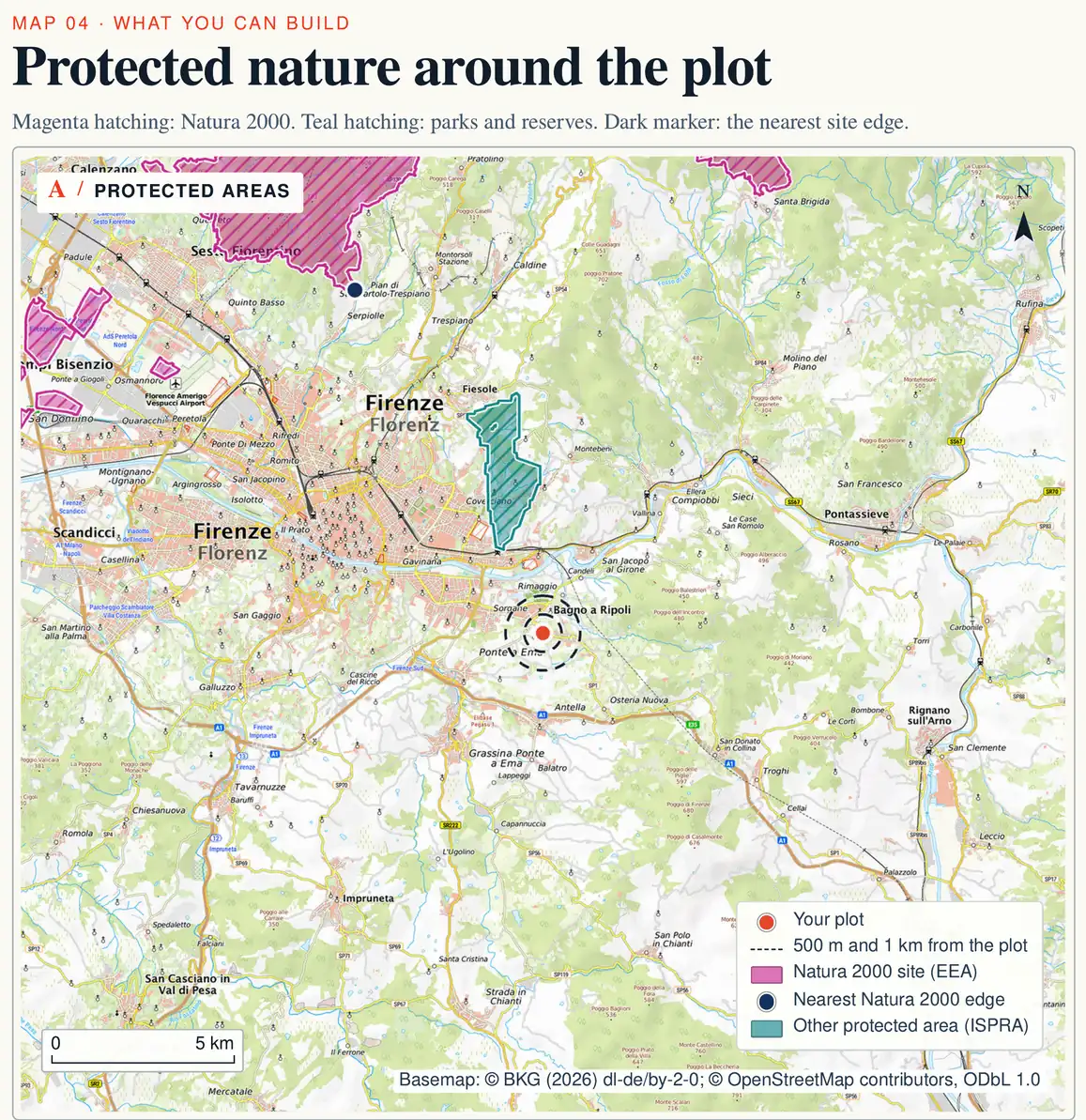
Sources: MASE national geoportal, Natura; National geoportal, updates; accessed 13 November 2026.
The appropriate assessment: when, who decides, how long
Anyone proposing works that are not connected with managing the site but may have a significant effect on it, alone or together with other projects, submits a study for the appropriate assessment (valutazione di incidenza, VIncA) (Presidential Decree 357/1997, art. 5, paragraph 3).
The 2019 national guidelines split it into three levels:
- Screening (level I). The applicant gives a full description of the project, with no impact study; the competent authority decides whether significant effects can be ruled out. Self-declarations are not accepted.
- Appropriate assessment (level II). An impact study is needed, following annex G of Presidential Decree 357/1997.
- Derogation (level III). After a negative outcome the project can go ahead only for imperative reasons of overriding public interest, with no alternative and with compensation measures; where priority habitats or species are involved, only for human health, public safety, primary environmental benefits or, after consulting the European Commission, other imperative reasons.
Who decides and how long it takes is set by the region or autonomous province (art. 5, paragraph 5). Until the region sets time limits, the check closes within 60 days of receiving the study; the authority can ask for additional information once, and the time limit then runs again from when it arrives (art. 5, paragraph 6). According to the guidelines the 60 days also apply to screening, regions can set shorter limits, and if the site lies in a national protected area the time limit is suspended until the managing authority gives its opinion.
The guidelines rule out thresholds and lists of works exempt in advance. Regions can, however, pre-assess some types of work. In Tuscany, regional resolution (DGR) 1267/2025, annex A, treats as pre-assessed, only for Natura 2000 sites in Tuscany, ordinary farming and forestry activities that can be carried out freely under the Tuscan forestry regulation 48/R/2003 and need no approval procedure. They count as ordinary if they continue what was done before, without permanently altering the site or its hydrogeological and landscape set-up. Felling woodland, bringing land back into cultivation by cutting or uprooting returning scrub, and felling dead trees stay outside. Other regions apply their own acts.
If the land is in a park
In national parks, permits and authorisations for works, installations and building first need the park authority’s clearance (nulla osta), which checks the project against the park plan and regulations (Law 394/1991, art. 13):
- the park authority answers within 60 days of the request;
- the president can extend the time limit once by a further 30 days, by written notice within the first 60;
- if the time limit passes with no answer, the clearance counts as granted;
- a refusal can be challenged at once and is posted for 7 days on the notice boards of the comune (municipality) and the park authority.
The park plan divides the land into zones. In integral reserves the natural environment is kept intact. In general reserves new building, extensions of existing buildings and works that transform the land are banned, though traditional productive uses may be allowed. In protection areas farming, forestry and grazing carry on along traditional lines or as organic farming; in economic and social development areas, more shaped by people, activities compatible with the park’s aims are allowed. Under art. 12 the national park plan replaces territorial and town plans and binds public bodies and private owners once published. For landscape protection, however, the landscape plan prevails even over the plans of protected-area authorities, which must bring their plans into line with it (Legislative Decree 42/2004, art. 145, paragraphs 3–4). The park’s bans still apply: complying with one plan does not clear the other.
The park regulations cover, among other things, the type and design of buildings and farming and forestry activities, ban activities that could harm the protected landscape and habitats, and set any exceptions (art. 11). Property rights and the civic use rights (usi civici) of local communities are preserved.
Regional parks follow their own region’s law, within the principles of art. 22 of Law 394/1991. For a regional park the clearance, time limits and bans are set in the regional law and in the park’s regulations.
Works in a national park
- Clearance request to the park authorityBefore permits and authorisations for works and installations
- Answer within 60 daysThe president can extend once by 30 days, in writing
- No answer in timeClearance counts as granted; a refusal can be challenged at once
- Appropriate assessment, if the site is Natura 2000Body and time limits set by the region; otherwise 60 days, one request for more information
- Site inside a national protected areaThe assessment time limit is suspended until the managing authority’s opinion
Sources: Law 394/1991, Article 13; Presidential Decree 357/1997, Article 5; 2019 appropriate assessment guidelines (Official Journal no. 303); accessed 13 November 2026.
The park’s right of first refusal on a sale
In national parks this rule reaches the buyer before any project. The park authority has a right of first refusal (prelazione) on sales for value of ownership and property rights in land in the park plan’s integral and general reserves, zones a) and b) of art. 12, paragraph 2. The private parties named in art. 8 of Law 590/1965, the farmers' pre-emption law, come first (Law 394/1991, art. 15).
The seller notifies the park authority of the proposed sale with the cadastral description, the date possession passes, the price and how it is paid. The park authority has three months from notice to use its right. If no notice is given, or the notice states a higher price than the sale price, the authority can buy the land back (riscatto) within a year of the deed being registered, from the buyer and anyone who bought later. In the national park’s other zones the art. 15 right does not apply. For a regional park, any pre-emption right and its time limits are found in the regional law.
Works without clearance: the penalties
Anyone who carries out works without the clearance or breaches the interim safeguards faces arrest of up to twelve months and a fine, with amounts still expressed in lire in the text of the law; breaching the bans in the park regulations carries arrest of up to six months or a fine (Law 394/1991, art. 30). Breaches of the managing authorities' rules also carry an administrative penalty. For environmental offences under the Criminal Code, the person responsible must restore the area where possible and pay for the damage.
The interim safeguards apply before a protected area is set up: outside built-up centres they ban new building, changes to existing buildings and changes of land use other than to farming, while ordinary and extraordinary maintenance is allowed after notice (art. 6).
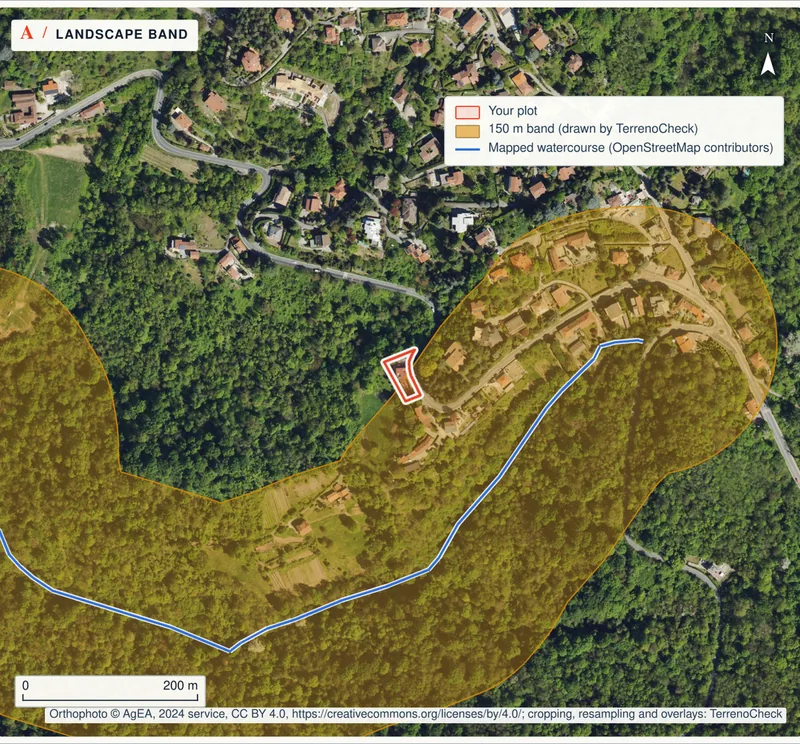
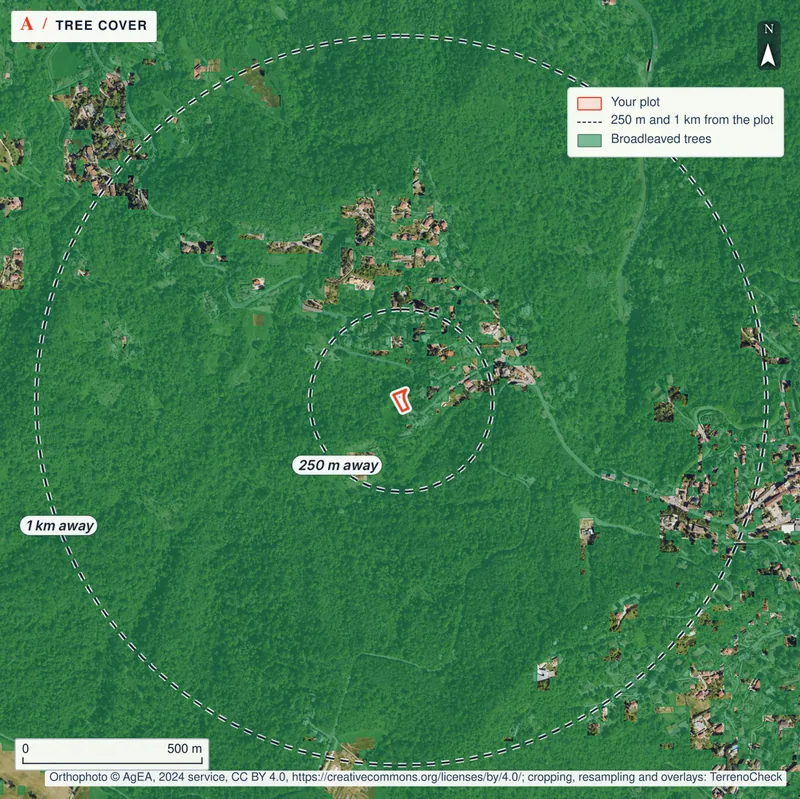
Natura 2000 and parks are not the only constraints on attractive land. They often come together with landscape protection, the rules on woodland and the hydrogeological constraint, each handled by its own office.
| Protection | Document to obtain | Authority and route | What the map cannot decide |
|---|---|---|---|
| Natura 2000 | Conservation measures and management plan | Regional designated authority; VIncA assessment for the project | Whether a significant effect can be excluded |
| National park | Park plan and regulations | Park authority; Article 13 clearance | The conditions attached to the zone |
| Regional park | Regional law, park plan and regulations | Authority and deadlines under regional law | National park deadlines cannot be assumed |
| Overlapping protection | Landscape plan as well | Each relevant authority | One layer cannot clear every restriction |
Before your preliminary contract, identify the site code and park zone on the regional portal. Send the regional VIncA authority and any park authority the parcel identifiers and a description of the intended work. Ask which screening or assessment documents are required, who can prepare them, which form to use and where the official fee schedule is published. Obtain separate timing and cost estimates from the office and your specialist before commissioning the application. The Article 5 and regional time limits described above apply with their rules for further information. Regional parks follow their own legislation for clearance and for any pre-emption right.
Land in a Natura 2000 site or a park in Italy: what changes
https://terrenocheck.it/en/guide/land-in-natura-2000-or-park-italy
Checklist
Before you sign a preliminary contract
Common questions
Can I build on land in a Natura 2000 site?
The law does not ban it as such: Natura 2000 sites are not strict reserves. A project that may significantly affect the site goes through the appropriate assessment before the building permit; if the outcome is negative it can go ahead only for imperative reasons of overriding public interest, with no alternative and with compensation measures (Presidential Decree 357/1997, art. 5). The comune’s zoning plan still applies.
Can I keep farming land in a Natura 2000 site?
According to the Environment Ministry the sites do not exclude human activity. The conservation measures for each ZSC are adopted by the region (Presidential Decree 357/1997, art. 4) and can cover farming. Some regions have pre-assessed ordinary activities: Tuscany, for example, does so in regional resolution 1267/2025 for ordinary farming and forestry, with exceptions such as felling woodland.
Who decides on the appropriate assessment?
The body named by the region or autonomous province, which also sets the procedure and time limits (Presidential Decree 357/1997, art. 5, paragraph 5). If the site lies in a national protected area, the authority that manages it is consulted. The 2019 guidelines rule out self-declarations: even the screening is decided by the authority.
Can the park buy the land instead of me?
In a national park the park authority has a right of first refusal if the land is in an integral or general reserve of the park plan and the sale is for value. It has three months from notice to use its right of first refusal, after the farmers the law puts first; if no notice is given, or the notice states a higher price than the one paid, it can buy the land back within a year of the deed being registered (Law 394/1991, art. 15). For a regional park, check the regional law for any pre-emption right and its time limits.
How do I find out whether the land is in a Natura 2000 site or a park?
Look at the Natura 2000 map on the Environment Ministry’s national geoportal, updated on 12 January 2026, and at the region’s maps. For a park, ask the park authority which zone of the plan the parcel falls in and which regulations apply.
Keep reading
Vincolo paesaggistico: what it permits
Buying woodland in Italy: what the forest rules let you do, and what to check before you sign
The hydrogeological constraint (vincolo idrogeologico): what it stops, who approves works, and what to check on an existing house
How to buy land in Italy: taxes, the notary, the CDU and every check before you sign
Natura 2000 and parks around your parcel
Pick the parcel on the map: Natura 2000 sites, protected areas, constraints and hazards are read for that plot, with distances, a source and a date, before you sign a preliminary contract.
€29 in English or Italian · €39 in both languages · total, VAT included