
Pillar guide: Planning and the building
Legga questo articolo in italiano.
Building land rezoned as farmland in Italy: what owners can do
On this page
In Italy land loses its building status when the comune approves a change to its town plan, sometimes at the owner’s own request. From then on the CDU planning certificate shows the new zoning, and the comune can state whether the plot still counts as building land for IMU, the annual property tax. Tax already paid is refunded only if that comune’s IMU rules provide for it (Law 160/2019, paragraph 777).
In short
- Zoning is changed by the comune through a variation of its town plan; owners can ask for it themselves where regional law allows (in Veneto, «varianti verdi»).
- The CDU planning certificate shows the current zoning: the comune issues it within 30 days of the request and it stays valid for a year if the plan has not changed.
- For IMU, land is building land if the adopted general plan makes it buildable, except land owned and farmed by coltivatori diretti or IAP (professional farmers) enrolled in farmers’ social security, while farming continues; on request the comune states whether the parcel still is.
- IMU paid while the land was building land comes back only if the comune’s rules say so, on their terms: in Oristano within 5 years and for at most 5 tax years (Law 160/2019, paragraph 777).
- An appeal to the regional administrative court against an approved variation has a 60-day time limit, running from notice, communication or full knowledge of the decision or from the end of its publication; if you live abroad the time to serve the appeal can be longer. Written comments come earlier, while the adopted plan is on deposit.
30 days
Time limit to issue a CDU
From the request; valid for a year if the planning instruments have not changed.
60 days
Appeal to the TAR against a variation
The time bar for an action to annul the decision; the day it starts and any extension for people living abroad are for your lawyer to confirm (Article 41).
5 years
Life of a reservation for public works
A different case from rezoning: when it lapses, Article 9 of DPR 380/2001 applies.
The report brings together public information about the land, with sources and dates, to prepare questions for the relevant offices: €29 in English or Italian · €39 in both languages · total, VAT included.
Why building land goes back to agricultural use
What you can build on a plot in Italy is decided by the comune’s town plan, not by the cadastre or by the deed. Land marked for building can lose that status in three ways, and each leaves the owner with different options.
The first is a variation (variante) of the plan or a new plan: the comune redraws its zones and some plots become agricultural or green space. The second is a request from the owner, where regional law allows one: people who will never build ask to give up the building capacity so they stop paying tax on it. The third concerns land reserved for a public work, a reservation that lasts five years and can then lapse.
| Cause | Who decides | What the owner can still do |
|---|---|---|
| Variation or new plan | The town council | Comments during the deposit; appeal to the TAR within 60 days of the start date set by Article 41 of the administrative procedure code; an IMU refund only if the comune’s rules provide one |
| Owner’s request (in Veneto, «variante verde») | The comune assesses it and, if it agrees, approves a variation | The request can be refused; the land no longer takes part in any development scheme |
| Lapsed reservation for public works | The law: it lasts 5 years | If no declaration of public interest is made, Article 9 of DPR 380/2001 applies; the reservation can be renewed with reasons |
Varianti verdi: how Padova handles them
Veneto introduced «green variations for the reclassification of building land» with Regional Law 4/2015, Article 7. Padova’s report on its variation no. 72 of 2024 shows how this works in practice. The comune published its notice on 19 January 2024, inviting owners who wanted their land stripped of the building capacity given by the Piano degli Interventi (the comune’s operational plan) to apply.
Requests are not granted automatically. Padova weighed each one against the aim of reducing land take, current planning, any harm to third parties’ building rights and any obstacle to planned works or public-interest agreements. Of the two requests it received, it found one acceptable and turned the other down.
The step is hard to undo. According to the same report, reclassified land cannot take part in development, directly or indirectly, including through transferable or compensatory building rights. If you buy land in Veneto that went through a variante verde, its building capacity is gone, including any right to sell volume to another plot.
Outside Veneto, whether owners can ask for this and how depends on regional law. The comune’s planning office (ufficio urbanistica) knows whether there is a regular call for requests and when it closes.
Land reserved for public works is a separate case
If the plan earmarks the plot for a road, a school or another public work, it has not been zoned as farmland: it carries a vincolo preordinato all’esproprio, a reservation for compulsory purchase. It lasts five years, during which the work can be declared of public interest; if that does not happen the reservation lapses and Article 9 of DPR 380/2001 applies, but the comune can renew it with stated reasons (DPR 327/2001, Article 9). Compensation follows the compulsory purchase code (DPR 327/2001).
IMU: when it changes and when you can get money back
IMU is the annual municipal property tax, and it treats two kinds of land very differently. Area fabbricabile (building land) is land that can be built on under general or implementing plans (Law 160/2019, paragraph 741, letter d), and Decree-Law 223/2006 adds that the general plan adopted by the comune is enough, even before regional approval or any implementing plan (Article 36, paragraph 2). Terreno agricolo (farmland) is any land recorded in the cadastre, whatever its use and even if left uncultivated (letter e).
The tax base differs. For building land it is the market value on 1 January, or from the date the plan was adopted; for farmland it is the reddito dominicale (the land’s cadastral income), raised by 25% and multiplied by 135 (paragraph 746). Land owned and farmed by coltivatori diretti or IAP (registered professional farmers enrolled in the farmers’ pension scheme) is not treated as building land, even in a building zone, as long as it stays in farm use (paragraph 741).
To find out when your parcel started to be taxed as farmland, the law gives you a specific tool: on the taxpayer’s request, the comune states whether a plot is building land under these criteria (paragraph 741, letter d). Write to the ufficio tributi (the comune’s tax office) with the sheet and parcel numbers and the variation that changed the zoning; the office tells you how long it takes to answer.
A refund of tax already paid is not automatic. The law lets each comune provide one in its own rules for land that later became unbuildable, setting deadlines, time limits and conditions (paragraph 777, letter c). If the comune’s rules say nothing, there is no refund on these grounds.
Oristano’s IMU regulation, adopted in 2020 and amended in 2023, shows what such a rule looks like (Article 3). It refunds tax paid from 1 January 2020 on land that became unbuildable after a variation was finally approved, or because of a constraint imposed by national or regional law. The refund is the difference between the tax paid on the land’s value and the tax worked out on its cadastral income, for at most five tax years. The application must be made within five years of the date the land became unbuildable, or the right is lost, and only if nothing has ever been built on the land or any part of it, even illegally.
With the figures above and rules like Oristano’s, five years of difference come to (1,032 − 11.54) × 5 = €5,102.30. What counts for your plot is the regulation in force in your comune and the rates it set for each year: both are on the comune’s website, or the tax office can send them.
What the CDU tells you
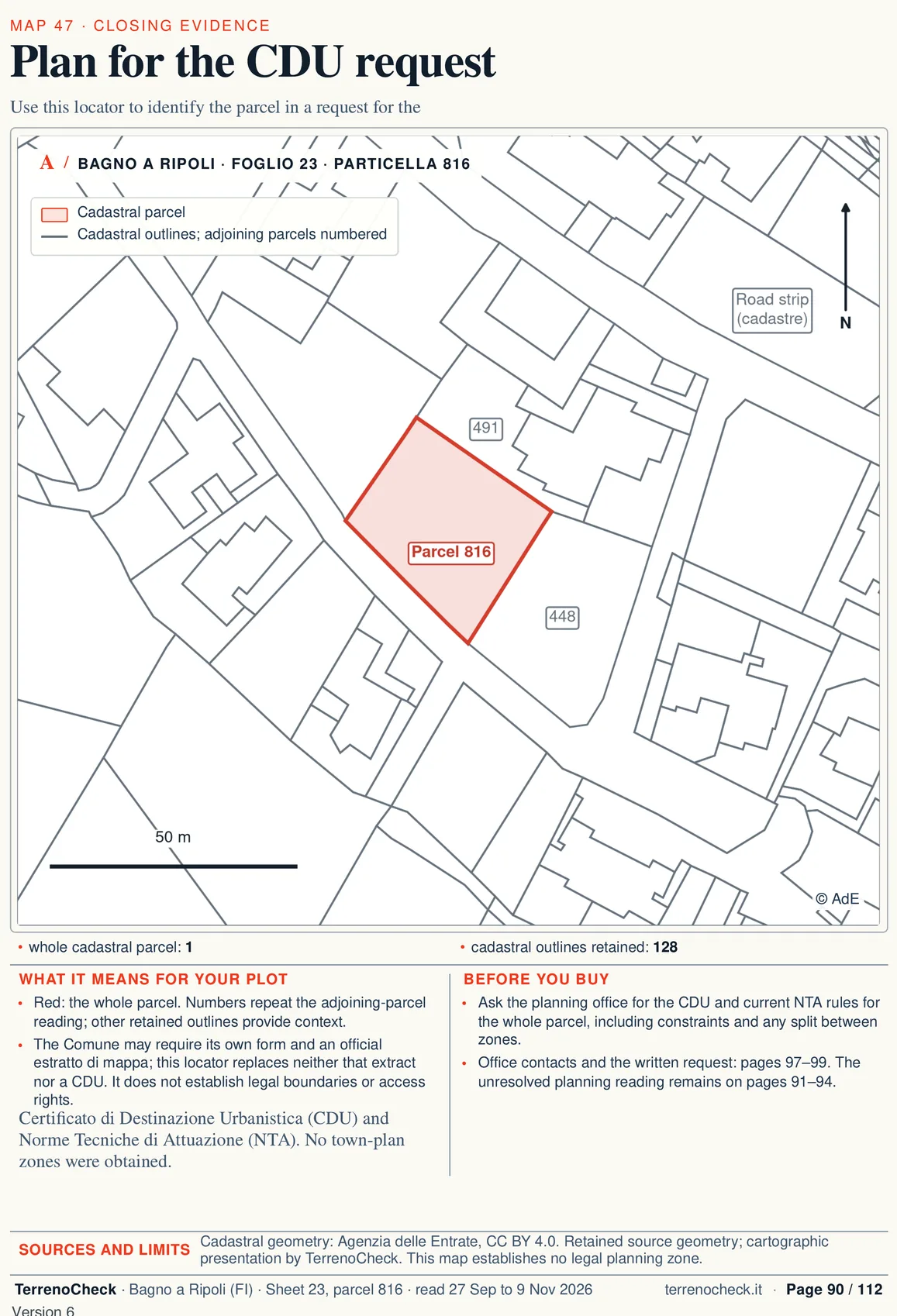
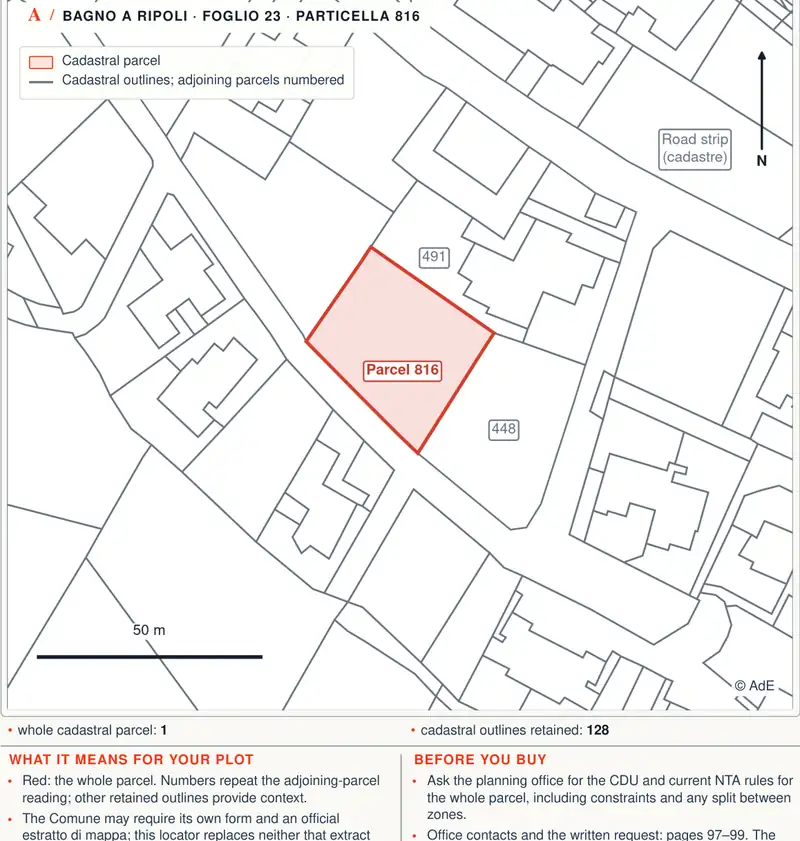
The certificato di destinazione urbanistica (CDU) is the document that states a parcel’s current zoning. The head of the relevant comune office must issue it within a strict 30 days of the request, and it stays valid for a year if, according to a statement by the seller or a co-owner, the planning instruments have not changed (DPR 380/2001, Article 30). If the comune misses the deadline, the seller can replace it with a declaration that the request was made, stating the zoning under the plans in force or adopted.
After a variation the CDU is the first document to request: it shows the new zone and the rules that apply. For a buyer the date matters. A certificate issued eleven months ago may describe a plan that has since been changed by an adopted variation, which is exactly when the one-year validity does not hold. How to request and read the certificate is covered in the guide to the CDU planning certificate; what the plan lets you build, in what you can build under the PRG.
Sources: DPR 380/2001, Article 30; accessed 12 November 2026.
What an owner can do, and when
There are only a few useful steps, and the deadlines are short. The timeline below puts them in order, from the adopted plan to the refund application.
- While the adopted plan is on deposit. Read the map and the rules for your parcel and send written comments (osservazioni) to the planning office within the deadline in the comune’s notice. At this stage the council has not yet decided.
- After approval: 60 days to appeal. An action to annul the decision must be brought before the TAR within a 60-day time bar (administrative procedure code, Article 29). The time does not simply run from the day of approval: it runs from notice, communication or full knowledge of the decision or, for acts not notified individually, from the end of any publication required by law. The time to serve the appeal is extended by 30 days if the parties, or some of them, live in another European country, and by 90 days if they live outside Europe (Article 41, paragraphs 2 and 5). Your exact deadline is for a lawyer who practises administrative law to work out, and you should contact one at once.
- After approval. Ask the planning office for an updated CDU (30 days) and the tax office for the statement on building-land status.
- For an IMU refund. Read the comune’s IMU regulation: if it provides a refund, apply within the deadline it sets. In Oristano that is five years from the date the land became unbuildable.
After the rezoning: steps and deadlines
- Plan or variation adoptedPublic deposit: written comments to the planning office within the comune’s deadline
- Variation approvedAppeal to the TAR within 60 days of notice, communication, full knowledge or the end of publication; longer time to serve it for people living abroad (Article 41)
- Updated CDUPlanning office: issued within 30 days of the request
- IMU statementTax office: the comune states whether the land is still building land
- Refund applicationOnly if the comune’s IMU rules provide for it; in Oristano within 5 years, for at most 5 tax years
Sources: Administrative procedure code, Article 29; Administrative procedure code, Article 41; DPR 380/2001, Article 30; Law 160/2019, Article 1, paragraphs 741, 746 and 777; Oristano IMU regulation, Article 3; accessed 12 November 2026.
If you are buying land sold as «edificabile»
A listing that says «edificabile» (buildable) describes the plan at the time it was written. Before you sign a preliminary contract, three checks are worth making, all at the comune.
The first is a recent CDU, with its date. The second is a question to the planning office about variations adopted but not yet approved that affect the parcel: a CDU issued before adoption will not show them, and for IMU the law already looks at the adopted plan. The third is about the past: ask the seller whether a reclassification request (in Veneto, a variante verde) was ever filed and what came of it, then check with the comune and on the CDU whether the variation was approved and is in force. A request on its own changes nothing, because the comune can turn it down; the building capacity is lost only once the variation is approved and in force.
If buildability is the reason you are buying, make the zoning shown in the CDU a condition of the preliminary contract and state what happens if a variation changes it before the deed. How conditions and the deposit work is explained in the guide to the preliminary contract. For the annual tax on land that keeps its building status, see IMU on building land.
Building land rezoned as farmland in Italy: what owners can do
https://terrenocheck.it/en/guide/building-land-rezoned-agricultural-italy
Checklist
After a rezoning, or before you buy
Common questions
Can the comune turn my building plot into farmland without asking me?
Yes, through a variation of the town plan adopted and approved by the council. Owners can file written comments while the adopted plan is on public deposit and, once it is approved, appeal to the regional administrative court (TAR) within 60 days of notice, communication or full knowledge of the decision, or of the end of any publication required by law (administrative procedure code, Articles 29 and 41). The comune’s notice of deposit gives the deadline for comments.
When do I stop paying IMU on the plot as building land?
The law defines building land as land that can be built on under the plan, and says the general plan adopted by the comune is enough (Decree-Law 223/2006, Article 36). Ask the comune’s tax office from which date it taxes the parcel as farmland, using the statement provided for in paragraph 741 of Law 160/2019.
Will I get back the IMU I paid while the land was buildable?
Only if your comune’s IMU rules provide a refund for land that has become unbuildable (Law 160/2019, paragraph 777). In Oristano, for example, the refund is the difference between the tax paid on the land’s market value and the tax on its cadastral income, for at most 5 tax years, with an application within 5 years, and only if nothing has been built on the land, even without a permit.
What is a variante verde?
It is the term used in Veneto for rezoning requested by the owner, who gives up the land’s building capacity (Regional Law 4/2015, Article 7). In Padova the comune assesses each request and grants it only through a variation of its Piano degli Interventi; in 2024 it accepted one request out of two.
Is there compensation when land loses its building status?
The IMU refund under paragraph 777 is not compensation: it returns part of the tax, and only where the comune’s rules allow it. If the loss comes from land being reserved for a public work, the compulsory purchase rules apply (DPR 327/2001). To weigh an appeal or a damages claim you need a lawyer who practises administrative law.
I’m buying a plot advertised as building land: what should I check?
A recent CDU with its date, and whether the comune has adopted variations that are not yet approved. A CDU stays valid for a year only if the plan has not changed, and for IMU the law already looks at the adopted plan. Make the zoning a condition of the purchase in the preliminary contract.
Keep reading
IMU on building land in Italy: what a foreign buyer pays each year, and what to check before buying
The certificato di destinazione urbanistica (CDU): Italy’s zoning certificate, explained for foreign buyers
Can you build on land in Italy? PRG, PUC and zoning
Land reserved for compulsory acquisition in Italy
What the plan says about the parcel today
Pick the parcel on the map: cadastre, constraints, hazards and costs are read for that plot, each with a source and date, along with the locator plan and a CDU request ready for the planning office.
€29 in English or Italian · €39 in both languages · total, VAT included