
Pillar guide: What you can build
Legga questo articolo in italiano.
Buying cubatura in Italy: how building rights are transferred
On this page
In a cessione di cubatura (transfer of building volume) the owner of one plot gives up part of the volume the town plan allows there and sells it to someone who will use it on another plot. It needs a town plan and regional law that do not rule it out and, according to the administrative courts, two plots with the same permitted use that lie close together; the contract is signed before a notary and recorded in the property registers.
In short
- A transfer of cubatura moves part of one plot’s building volume to another plot: the plot that gives it up loses that capacity to build.
- The comune’s plan and the regional law say where a transfer is allowed; according to the administrative courts the plots must have the same permitted use and lie close together, though they need not share a boundary.
- The contract is recorded in the property registers (trascrizione), so it needs a notarial deed or a private agreement with signatures authenticated by a notary (Civil Code, Article 2643, no. 2-bis).
- Taxes depend on the seller: for a company the Agenzia delle Entrate has said VAT at the standard rate plus a flat €200 registration tax (ruling 69/2023). The two Agenzia positions cited here do not deal with a sale by a private individual; in that case the notary works out the tax before the deed.
No. 2-bis
Recording of building rights
Civil Code, Article 2643, added in 2011 to make transfers of building rights certain.
VAT 22% + €200
Transfer by a company
A supply of services with standard VAT and flat registration tax (Agenzia delle Entrate, ruling 69/2023).
1 January 2027
New consolidated registration tax code
Legislative Decree 123/2025, Article 205, date set by Decree-Law 200/2025.
Already have a parcel in mind? The report runs these checks on your land, with a source and date for every finding: €29 in English or Italian · €39 in both languages · total, VAT included.
What a transfer of cubatura is
Cubatura, or volumetria, is the building volume the town plan allows on a plot, usually a ratio multiplied by the plot area. In a transfer the owner of one plot (the fondo cedente) gives up part of it and passes it to the owner of another plot (the fondo ricevente), who can then build more. The plot that gives up the volume loses that capacity to build.
The Agenzia delle Entrate, Italy’s tax agency, describes it in general terms as an agreement between owners of adjacent areas; in the same ruling it quotes the definition of the Supreme Court sitting in joint session, which speaks of a transfer to the owner of another plot that is “urbanistically homogeneous”. The law recognised the practice in 2011, when Decree-Law 70/2011 allowed contracts on building rights to be recorded in the property registers “to ensure certainty in the circulation” of those rights (Article 5, paragraphs 1 and 3).
A hypothetical example shows the numbers. Plot A covers 1,000 m² with a ratio of 0.8 m³/m², so 800 m³; a house already uses 300 and the owner sells 200 to the neighbour. A keeps 300 m³ still to build. Plot B, 800 m² with the same ratio, goes from 640 to 840 m³, but only if the plan allows a transfer between those two plots and does not set a lower cap for B.
When the town plan allows it
The first references are the comune’s plan and the regional law. They can forbid transfers in some areas, set a maximum ratio for the receiving plot, or allow transfers only within one development area or towards areas the plan names.
Then there are the requirements the administrative courts have set out, collected in the official case-law review of the Giustizia amministrativa (§10.1). According to these judgments the two areas must have the same permitted use and must lie close together: not necessarily sharing a boundary, but “in reasonably adjacent zones”, so that moving the building load from one to the other does not upset the balance of the plan. The receiving plot must be identified when the volume is transferred. The plan’s volume limits for the zone, distances and any minimum plot size still apply. These are principles from case law, not a statutory article: the comune tells you how they apply to your two plots.
Before you negotiate, ask the comune’s technical office in writing whether a transfer between those two plots is allowed and on what terms, and ask by when you will have the answer.
Piemonte’s planning law shows two mechanisms that differ from a transfer between two neighbouring owners (Regional Law 56/1977). Under urban equalisation (perequazione urbanistica) plans can transfer, create and modify building rights within areas made up “of parts that are not adjacent too” (Article 12 bis, paragraph 2). In farm zones a farm can use all its plots for farmhouses, including plots that are not adjacent and lie in other comuni, within the distance set by the plan’s rules; volume cannot be transferred between different farms, and land whose volume has been used becomes non-building land, marked on cadastral maps open to the public (Article 25). These are special rules: they do not mean that any two owners can exchange volume at any distance.
Extra volume does not lift the other rules. Heights, distances from boundaries and between walls, plot coverage and constraints apply on the receiving plot as for any project. Distances between buildings are covered in the guide to the 10-metre rule, and reading the plan in the guide to what you can build.
Sources: Piemonte Regional Law 56/1977, Articles 12 bis and 25; accessed 12 November 2026.
The contract and its recording
The Civil Code provides for recording (trascrizione) in the public property registers the contracts that transfer, create or modify building rights, whatever they are called, provided for by national or regional law or by planning instruments (Article 2643, no. 2-bis). Recording needs a public deed or a private agreement with signatures authenticated or confirmed by a court (Article 2657). In practice that means a notary, who must see that the deed is recorded as soon as possible (Article 2671).
Recording protects the buyer. An unrecorded contract cannot be relied on against someone who acquired rights in the same property under a deed recorded earlier; once your deed is recorded, later recordings of rights acquired from the same seller have no effect against you (Article 2644).
In the ruling quoted by the Agenzia, the Supreme Court classed the transferred right as a building right that is not a property right in the strict sense (diritto non reale), which can be recorded, and held that the contract does not need written form to be valid. For a buyer, recording is still what counts: only a public deed or a private agreement with signatures authenticated or confirmed by a court can be recorded, and an unrecorded purchase cannot be relied on against someone who records first.
In some regions the comune records a deed as well. In Piemonte, for building in farm zones, the building permit only takes effect once the owner files an undertaking that includes the tie created by the volume transfer; the comune has it recorded at the owner’s expense.
The steps in a transfer of cubatura
- Comune technical officeWritten answer: the transfer between the two plots is allowed, and on what terms. Ask at once by when it will reply
- Your surveyor or architectVolume left on the selling plot; project on the receiving plot. Fee in a written quote (Decree-Law 1/2012, Art. 9); delivery date in the engagement letter
- NotarySearches in the property registers; contract with conditions on permit and price. Written quote with fee, taxes and the date of the deed
- Deed and recordingPublic deed or authenticated agreement; the notary has it recorded as soon as possible (Civil Code, Art. 2671)
- Building permitApplication to the comune for the receiving plot, with the transferred volume; the technical office gives the timing. The volume moves when the permit is issued
Sources: Civil Code, Articles 2643, 2644 and 2657; accessed 12 November 2026.
Taxes: it depends on the seller
The taxes on a transfer of cubatura depend on who sells and on how the Agenzia delle Entrate classes the right. The two Agenzia positions cited here cover specific cases and must be read with their conditions; the 2018 case is historical and is not guidance for today.
| Seller | What the Agenzia said | Taxes stated |
|---|---|---|
| A company, in 2023 (ruling 69/2023: a company transfers part of its building rights to the neighbour) | The right is not a property right: the transfer is a supply of services subject to VAT | VAT at the standard rate, now 22%; registration tax at a flat €200 |
| A comune, in 2018, by public auction (resolution 80/E) | Historical case: the comune acted as a public body, outside VAT, and the transfer was treated like the transfer of a property right; in 2023 the Agenzia called that treatment superseded | Then: registration tax 9%, mortgage and cadastral taxes €50 each; not the treatment to apply today, have the current taxes worked out before the deed |
| A private individual | The two positions cited do not deal with this case | Have the notary work out the tax before the deed |
In 2023 the Agenzia wrote that, in the light of the Supreme Court judgment, the view treating a transfer of cubatura like the transfer of a property right “must be considered superseded”. So the 2018 treatment cannot simply be applied today. The judgment speaks of proportional registration tax as on an “other” deed with financial content; which rate applies to a sale between private individuals is for the notary to state.
From 1 January 2027 registration tax is governed by a new consolidated code (Legislative Decree 123/2025, Article 205, date set by Decree-Law 200/2025). For a deed signed from 2027 ask the notary which rules apply. As for IMU, the annual property tax, some comuni also tax transferred building rights: Fidenza’s resolution on 2026 values says so expressly. Check with your comune’s tax office.
- A companyRuling 69/2023: standard VAT, now 22%, and flat €200 registration tax
- A comune, by public auctionHistorical case only, not current guidance: in 2018 (res. 80/E) outside VAT, registration tax 9%, mortgage and cadastral taxes €50 each; superseded in 2023, have today’s taxes worked out before the deed
- A private individualNot dealt with in the two documents cited: have the notary work out the tax before the deed
Sources: Agenzia delle Entrate, ruling 69/2023; Agenzia delle Entrate, resolution 80/E of 2018; Legislative Decree 123/2025, Article 205; accessed 12 November 2026.
What the price depends on
There is no official price list for a cubic metre. The buyer pays for what the volume lets them build: the value of the extra floor area once finished, minus the cost of building it, the permit fee and the time needed to get the permit. It is the same residual reasoning used to value a building plot.
The seller looks at the other side: after the transfer their land is worth less, because it loses part of what could be built on it. IMU values for building land, where the comune has approved them, are reference values for a tax, not sale prices, and they apply to land, not to volume detached from a plot. So the price is negotiated case by case, with a written estimate from a surveyor or architect, who must tell you the fee in advance, in writing, with an outline quote (Decree-Law 1/2012, Article 9, paragraph 4); put the delivery date in the engagement letter.
Before you sign: what to check
The most common risk is buying volume you cannot use. The plan can change, the transfer may not be allowed between those plots, and the receiving plot may have constraints that rule out the extra volume. The second risk lies with the seller: the volume must really exist and still be free, not already used or sold to someone else.
Buying cubatura in Italy: how building rights are transferred
https://terrenocheck.it/en/guide/buying-building-rights-cubatura-italy
Checklist
Transfer of cubatura: before the deed
Common questions
Can I buy volume from a plot that does not border mine?
It can be. According to the administrative courts the plots need not share a boundary, but they must have the same permitted use and lie significantly close, “in reasonably adjacent zones”; the plan can forbid or limit transfers. Equalisation schemes and the use of a single farm’s plots, as provided in Piemonte, are different mechanisms. The comune’s technical office gives the answer for your plots.
Is a private agreement between neighbours enough?
To record the contract in the property registers you need a notarial deed or a private agreement with signatures authenticated by a notary or confirmed by a court (Civil Code, Article 2657). An unrecorded purchase cannot be relied on against someone who records first, such as another buyer of the same volume.
What does a cubic metre of cubatura cost?
There is no official price. It depends on what building is worth in that area, how much extra volume the receiving plot can still take, and the time and conditions for the permit. The reasoning is the same as for valuing a building plot.
Who pays IMU on transferred volume?
It depends on the comune’s rules and on the case. Some comuni say so in their resolutions on land values: Fidenza, for example, confirms that transferred building rights are taxed too. Ask the comune’s tax office before the deed.
What if the comune refuses the building permit?
The transfer contract does not guarantee the permit on its own. That is why the contract sets conditions on the permit and its timing, and why the project is checked with the technical office first.
Keep reading
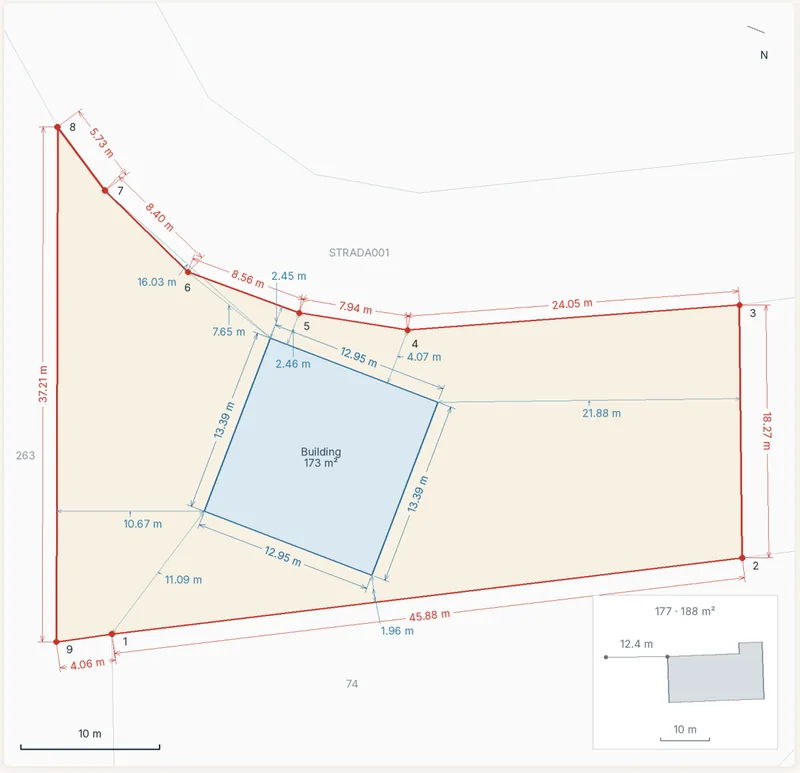
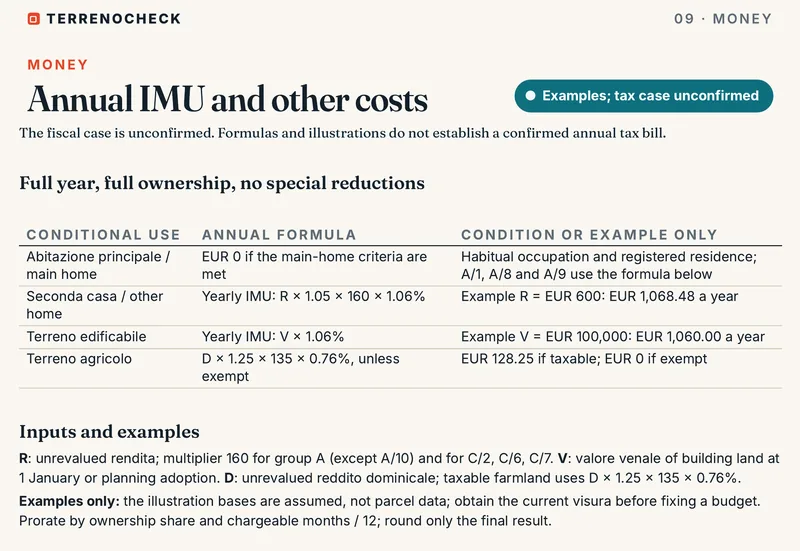
What the plan allows on the plot, before you buy volume
Pick the parcel on the map: area, building outlines, zoning, constraints and distances are read for that plot, each with a source and date, along with the questions to put to the comune and the notary.
€29 in English or Italian · €39 in both languages · total, VAT included