
Pillar guide: Costs, tax and use
Legga questo articolo in italiano.
Taxes on buying building land in Italy: private sale or VAT
On this page
If a private owner sells you building land in Italy, you pay 9% registration tax, never less than €1,000, plus €100 in two fixed taxes. If a business or a trading company sells it in the course of its trade, you pay 22% VAT and three fixed taxes of €200 each.
In short
- From a private seller you pay 9% registration tax, with a €1,000 minimum, plus €50 mortgage tax and €50 cadastral tax: €6,400 on a plot bought for €70,000.
- From a business or a trading company (snc, sas, spa, srl, cooperative) selling in the course of its trade you pay 22% VAT plus fixed registration, mortgage and cadastral taxes of €200 each: €16,000 on the same price, before stamp duty and fees.
- For tax purposes land counts as building land once the comune’s general plan, as adopted, allows building on it, even before the region approves the plan (Decree-Law 223/2006, Article 36).
- The first-home relief and the prezzo-valore method are for homes. On the plot you will build your house on you pay 9% of the value declared in the deed, or of the price if that is higher, if a private owner sells, or 22% VAT on the price if a business sells.
- From 1 January 2027 the same rules move into new consolidated acts on registration tax, VAT and tax assessment, under new article numbers.
9%
Registration tax, private seller
Never less than €1,000, plus €50 + €50.
22%
VAT, business seller
With fixed registration, mortgage and cadastral tax.
€200 × 3
Fixed taxes with VAT
Registration, mortgage and cadastral tax: €168 each until 2013, €200 from 2014.
Agenzia delle Entrate, circular 18/E/2013, section 4.2; Decree-Law 104/2013, Article 26
Already have a parcel in mind? The report runs these checks on your land, with a source and date for every finding: €29 in English or Italian · €39 in both languages · total, VAT included.
The seller decides the taxes
With building land (terreno edificabile) the first question is not who buys but who sells. A sale by a private owner is outside the scope of VAT: you pay registration tax (imposta di registro), mortgage tax (imposta ipotecaria) and cadastral tax (imposta catastale), partly as a percentage and partly as fixed sums. A sale by a business or a trading company acting in the course of its trade carries VAT (IVA), and the other three taxes become fixed amounts.
| Seller | VAT | Registration tax | Mortgage tax | Cadastral tax |
|---|---|---|---|---|
| Private owner | no | 9%, minimum €1,000 | €50 | €50 |
| Business or trading company, in the course of its trade | 22% | €200 | €200 | €200 |
The table applies to deeds signed up to 31 December 2026; from 2027 the same figures move into the consolidated acts (last section).
Partnerships, joint-stock companies and limited companies, Italy’s snc, sas, spa and srl, are always treated as businesses for VAT, as are cooperatives and de facto companies (DPR 633/1972, Article 4). A società semplice (simple partnership) or another body counts as a business if its sole or main object is a commercial or farming activity. For an individual with a VAT number, such as a sole-trader builder, what matters is whether the sale is part of a trade carried on habitually, which is how the same article defines a business. For a farmer (imprenditore agricolo), the Agenzia delle Entrate requires two conditions for the sale to carry VAT: the land is building land and the seller used it in the farm business; if either is missing, the sale bears the proportional taxes that apply to land sold by private owners (circular 18/E/2013, section 4.5). In any of these cases ask the notary, before you make an offer, in which capacity the seller is selling: the bill changes by thousands of euros.
- A private owner not selling as a businessRegistration tax 9% (minimum €1,000) + €50 + €50
- A company (snc, sas, spa, srl, cooperative)22% VAT on the price + €200 + €200 + €200, plus stamp duty and fees
- An individual with a VAT number, a società semplice or another bodyVAT if selling as a business (DPR 633/1972, Article 4): ask the notary
- A farmerVAT if the land was used in the farm business, otherwise as for a private owner (circular 18/E/2013, section 4.5)
Sources: DPR 633/1972, Article 4; Agenzia delle Entrate, circular 18/E/2013, sections 4.2 and 4.5; Legislative Decree 23/2011, Article 10; DPR 131/1986, Article 40; Legislative Decree 347/1990, Article 10; Legislative Decree 347/1990, tariff, Article 1; Decree-Law 104/2013, Article 26; accessed 12 November 2026.
When land counts as building land for tax
For VAT, registration tax and income tax, an area is building land if it «can be used for building under the general planning instrument adopted by the comune, regardless of approval by the region and of the adoption of implementing instruments» (Decree-Law 223/2006, Article 36(2)). The adopted plan is enough: land that a new plan makes buildable is building land for tax before the plan is finally approved.
The document to ask for is the CDU, the certificato di destinazione urbanistica (zoning certificate) issued by the comune.
The difference matters between private sales too. The 15% registration rate in the tariff is for farmland and its appurtenances bought by someone who is not a working or professional farmer enrolled in the farmers’ pension scheme; building land sold by a private owner pays the 9% rate for property in general. The farmland rules are in the guide to taxes on buying agricultural land.
Sources: Decree-Law 223/2006, Article 36; Legislative Decree 23/2011, Article 10; accessed 12 November 2026.
Worked examples: private seller and business seller
A hypothetical example: a building plot for €70,000 (price before VAT), bought by an individual without a VAT number. Only the deed taxes are counted, without the notary’s fee or technical costs.
A second hypothetical example, a small plot for €8,000 sold by a private owner: 9% would be €720, but registration tax cannot fall below €1,000. Total €1,100 with the mortgage and cadastral tax, 13.75% of the price. The minimum applies to any price up to €11,111.11 (1,000 divided by 0.09).
The chart compares the three bills: in the business sale almost everything is VAT.
Private seller: 9% registration tax
9% is the rate for deeds transferring ownership of property in general (Legislative Decree 23/2011, Article 10(1)). The same article sets the €1,000 minimum, the mortgage and cadastral taxes at €50 each, and the exemption from stamp duty, cadastral fees and land-registry fees.
The 2% rate in the same provision is for dwellings that meet the first-home conditions. A plot is not a dwelling, even if you will build your own home on it, so from a private seller it pays 9%.
Sources: Legislative Decree 23/2011, Article 10; accessed 12 November 2026.
Business seller: 22% VAT and fixed taxes
Italian VAT law does not treat as a supply of goods the sale of land «that cannot be used for building» (DPR 633/1972, Article 2(3)(c)). Building land stays inside: sold by a business, it carries VAT at the standard 22% rate (Article 16).
When the sale is subject to VAT, registration tax is a fixed amount (DPR 131/1986, Article 40(1); the exceptions in that paragraph concern VAT-exempt transactions, not a taxable sale). Mortgage tax is fixed too for «transfers subject to value added tax» (tariff annexed to Legislative Decree 347/1990, Article 1, note), and so is cadastral tax where the change of cadastral owner follows from «deeds subject to value added tax» (Legislative Decree 347/1990, Article 10(2)).
For sales of building land by VAT-registered sellers, the Agenzia delle Entrate (Italy’s revenue agency) listed registration, mortgage and cadastral tax at €168 each in 2013, plus stamp duty (circular 18/E/2013, section 4.2). From 1 January 2014 every fixed registration, mortgage and cadastral tax of €168 rose to €200 (Decree-Law 104/2013, Article 26).
The exemption from stamp duty, land-registry fees and special cadastral fees is granted to deeds charged with proportional registration tax (Legislative Decree 23/2011, Article 10(3)). For transfers subject to VAT the Agenzia lists those items among the sums due (circular 2/E/2014): the notary works them out and the examples leave them out.
If the buyer is a company or professional with a VAT number buying for the business, the VAT paid can be deducted under the general rules (DPR 633/1972, Article 19). An individual buying privately deducts nothing: for them VAT is a cost.
Sources: DPR 633/1972, Article 2; DPR 633/1972, Article 16; DPR 131/1986, Article 40; Legislative Decree 347/1990, tariff, Article 1; Legislative Decree 347/1990, Article 10; Agenzia delle Entrate, circular 18/E/2013, sections 4.2 and 4.5; Decree-Law 104/2013, Article 26; Legislative Decree 23/2011, Article 10; Agenzia delle Entrate, circular 2/E/2014; DPR 633/1972, Article 19; accessed 12 November 2026.
What value the taxes are based on
Registration tax is worked out on the value stated in the deed or, if higher, the price; for property, value means market value (DPR 131/1986, Article 51). If the tax office thinks the value is higher, it adjusts it and claims the difference with interest and penalties (Article 52(1)). VAT, by contrast, is charged on the consideration due to the seller under the contract (DPR 633/1972, Article 13).
The value declared for building land is not shielded from adjustment. Article 52(4) bars an adjustment for property entered in the cadastre with an assigned income and declared at no less than seventy-five times the reddito dominicale (the notional income the cadastre assigns to the owner) for land, or one hundred times the cadastral income for buildings; later laws have revalued those multipliers. The same paragraph, however, «does not apply to land for which the planning instruments provide for building use».
Article 52(5-bis) also limits paragraphs 4 and 5 to the sales covered by Article 1(497) of Law 266/2005: residential property and its appurtenances sold to individuals not acting in a business capacity, at the buyer’s request to the notary. That is the prezzo-valore method, which taxes the cadastral value instead of the price (resolution 149/E/2008). For other sales the multiplier rule does not apply, and a plot sold on its own is not residential property. The declared value therefore needs market evidence behind it, such as a valuation or sales of similar plots.
Sources: DPR 131/1986, Article 51; DPR 131/1986, Article 52; DPR 633/1972, Article 13; Agenzia delle Entrate, resolution 149/E/2008; accessed 12 November 2026.
IMU after the purchase
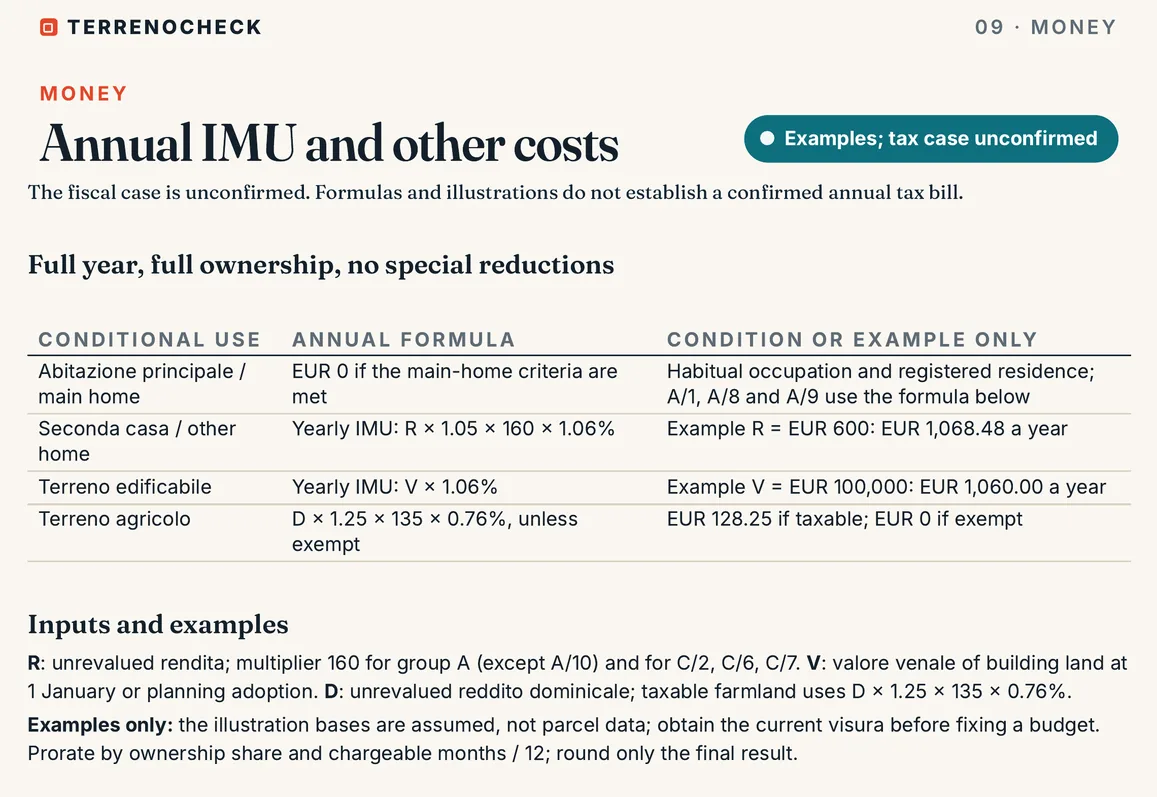
Once you own it, building land is liable to IMU, the annual municipal property tax, on its market value at the rate set by the comune. Reference values, council resolutions and the exemption for registered farmers are covered in the guide to IMU on building land.
The sample report page on the Bagno a Ripoli parcel shows the annual formula for building land, value times the comune’s rate, with an example on a hypothetical value, alongside a main home, a second home and farmland.
Who pays, and when
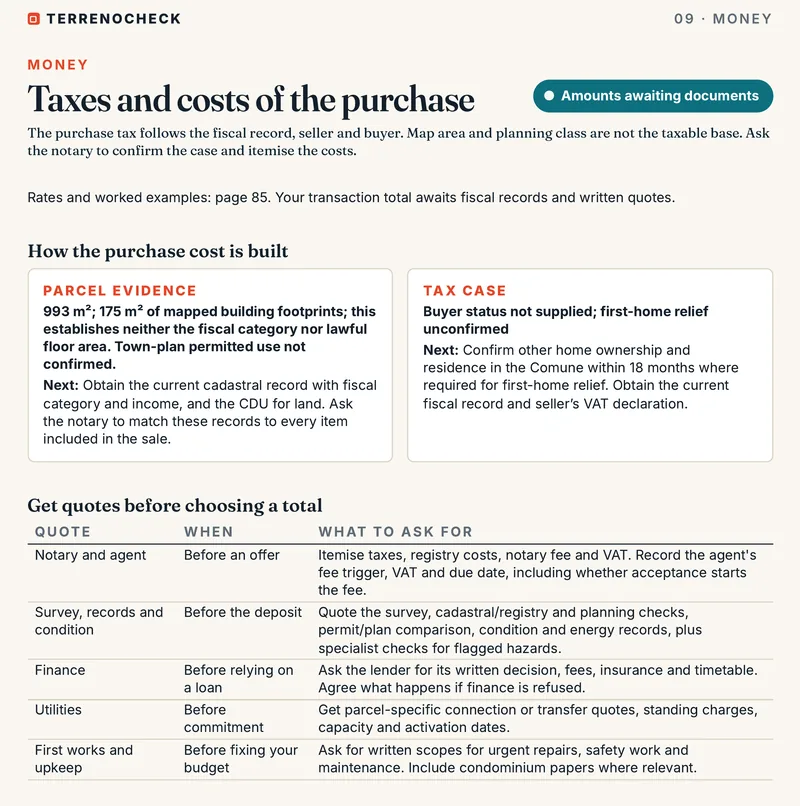
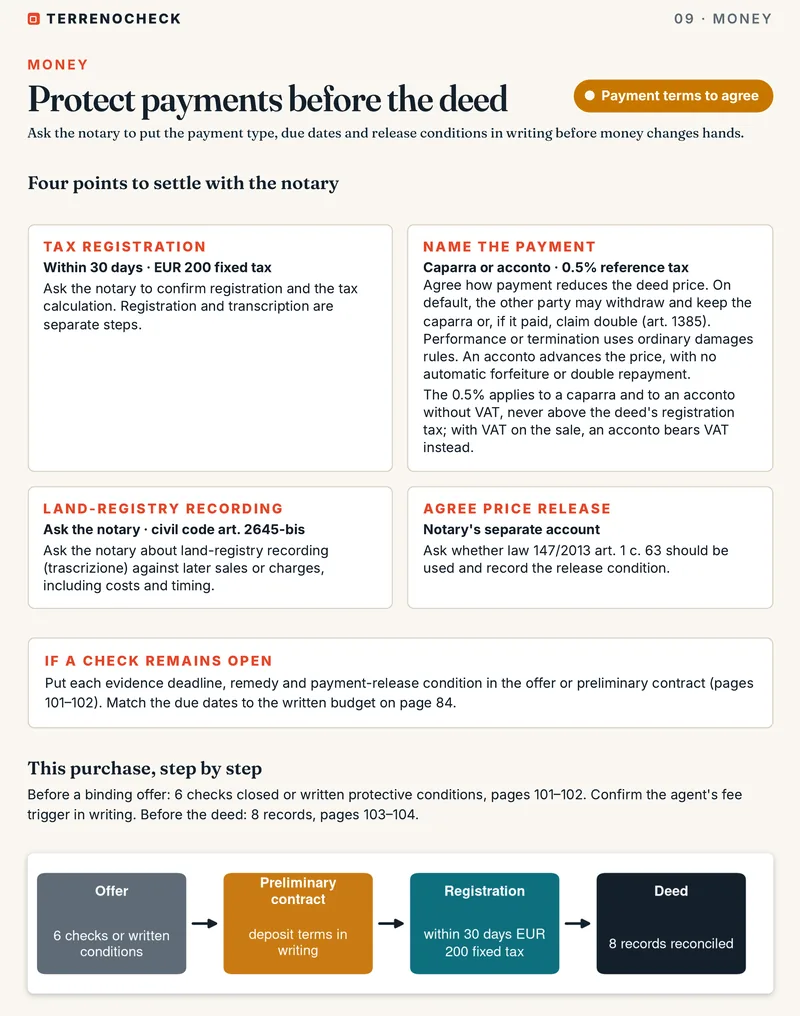
The notary pays the taxes, being the person required to register the deed (DPR 131/1986, Article 10) within thirty days of signing (Article 13). VAT is different: the seller charges it on the invoice, together with the price. By law the parties to the contract are jointly liable with the notary for registration tax (Article 57): if more turns out to be due, the tax office can claim it from you too.
Sources: DPR 131/1986, Article 10; DPR 131/1986, Article 13; DPR 131/1986, Article 57; accessed 12 November 2026.
What changes from 1 January 2027
Three new consolidated acts gather rules now spread across separate laws, all applying from 1 January 2027: registration tax (Legislative Decree 123/2025, Article 205, date moved by Decree-Law 200/2025, Article 4(5)), VAT (Legislative Decree 10/2026, Article 171) and tax filing and assessment (Legislative Decree 141/2026, Article 368). Deeds signed up to 31 December 2026 stay under DPR 131/1986, DPR 633/1972 and Decree-Law 223/2006.
| Rule | Until 31.12.2026 | From 1.1.2027 |
|---|---|---|
| Registration 9%, €1,000 minimum, €50 mortgage and cadastral tax | DPR 131/1986, tariff, Article 1; Legislative Decree 23/2011, Article 10 | Registration tax act, Annex 1, tariff part I, Article 1 |
| Fixed registration tax on deeds subject to VAT | DPR 131/1986, Article 40 | Registration tax act, Article 44 |
| Fixed €200 mortgage and cadastral taxes on transfers subject to VAT | Legislative Decree 347/1990, Article 10 and tariff, Article 1; Decree-Law 104/2013, Article 26 | Registration tax act, Article 79 and Annex 2, tariff, Article 1 |
| Non-building land outside VAT | DPR 633/1972, Article 2 | Consolidated VAT act, Article 5 |
| 22% VAT | DPR 633/1972, Article 16 | Consolidated VAT act, Article 34 |
| Building land for tax purposes | Decree-Law 223/2006, Article 36(2) | Legislative Decree 141/2026, Article 336 |
What stays: the 9%, the €1,000 minimum, the €50 fixed taxes, the fixed registration tax on VAT deeds and the fixed €200 mortgage and cadastral taxes on transfers subject to VAT; the 22% VAT rate; the definition of building land, restated in the same words and now naming IMU in its heading as well.
What changes for anyone reading a deed or a quote: the legal references. Normattiva already shows Article 36(2) of Decree-Law 223/2006 as repealed by Legislative Decree 141/2026, with effect from 2027. If your deed falls close to the turn of the year, ask the notary to calculate under the text in force on the day you sign.
Sources: Legislative Decree 123/2025, Article 205; Legislative Decree 123/2025, Article 44; Legislative Decree 123/2025, Article 79; Legislative Decree 10/2026, Article 5; Legislative Decree 10/2026, Article 34; Legislative Decree 141/2026, Article 336; accessed 12 November 2026.
Taxes on buying building land in Italy: private sale or VAT
https://terrenocheck.it/en/guide/taxes-buying-building-land-italy
Checklist
Before you sign
Common questions
How much tax do I pay to buy building land from a private owner in Italy?
9% registration tax on the value stated in the deed, or on the price if that is higher, never less than €1,000, plus €50 mortgage tax and €50 cadastral tax. On €70,000 that comes to €6,400. The notary’s fee and the cost of documents come on top.
Is there VAT if an srl or another trading company sells me the plot?
Yes. Sales by partnerships (snc, sas), joint-stock and limited companies (spa, srl) and cooperatives always count as business activity, and building land is not among the goods excluded from VAT. You pay 22% VAT plus fixed registration, mortgage and cadastral taxes of €200 each, and the stamp duty and fees the notary works out.
Can I get the first-home relief on the land I will build my house on?
No. The 2% rate applies to dwellings, and a plot is not a dwelling even if you plan to build your own home on it. You pay 9% if a private owner sells, VAT if a business sells.
Is the land building land if the region has not approved the plan yet?
For tax purposes, yes. What counts is the general plan adopted by the comune, even without regional approval or detailed implementing plans. The CDU (zoning certificate) shows the land use: get it before the preliminary contract.
Can the tax office challenge the price of building land?
Yes, when a private owner sells: registration tax is due on market value and the tax office can adjust the declared value if it finds it too low. The rule that bars an adjustment above a multiple of the cadastral income does not apply to land zoned for building, and it is limited to sales of homes and their appurtenances to individuals under the prezzo-valore method (DPR 131/1986, Article 52(4) and (5-bis)).
What changes for buyers of building land in 2027?
Deeds from 1 January 2027 fall under the consolidated registration tax act (Legislative Decree 123/2025), the consolidated VAT act (Legislative Decree 10/2026) and the consolidated act on tax assessment (Legislative Decree 141/2026). The rates, the fixed taxes and the definition of building land in the new texts are the same; the references change.
Keep reading
Check these points on your parcel
Find the land on the map and pick the parcel: cadastre, municipal plan, constraints, landslides, floods, access and costs are read for that parcel, with source and date.
€29 in English or Italian · €39 in both languages · total, VAT included