
Pillar guide: Costs, tax and use
Legga questo articolo in italiano.
Italy’s small farm ownership relief: who qualifies, 5-year rule
On this page
Under the small farm ownership relief, a working or professional farmer enrolled with INPS buys Italian farmland for €200 registration tax, €200 mortgage tax and 1% cadastral tax. The relief is lost if, within five years of the deed, the buyer voluntarily sells the land or stops farming or running it directly, subject to the exceptions the law allows.
In short
- It is open to working farmers and professional farmers (coltivatori diretti and IAP) enrolled in the INPS farmers’ scheme and, on conditions of their own, to buyers under forty, a spouse or direct-line relatives living with the farmer who already own farmland, farming companies and owners of masi chiusi. The land must be classified as agricultural by the planning instruments.
- You pay €200 registration tax, €200 mortgage tax and 1% cadastral tax, and the notary’s fee is halved: €1,250 on €85,000 against €7,750 at 9%.
- You lose it if, within five years of the deed, you voluntarily sell the land or stop farming or running it yourself; leasing it to someone else as a rule means losing it. You keep it if you transfer the land to, or let it be used by, a spouse, relatives up to the third degree or in-laws up to the second degree who are farmers, and the land stays agricultural.
- Buyers under forty can claim it by stating in the deed that they intend to obtain INPS enrolment within twenty-four months (Decree-Law 194/2009, Article 2(4-ter)).
- From 1 January 2027 the relief moves to Article 173 of the consolidated registration tax act, on the same conditions.
€200 + €200 + 1%
Registration, mortgage, cadastral
Notary’s fee cut by half.
5 years
Lock-in from the deed
Lost by a voluntary sale or by ceasing to farm the land yourself, subject to the exceptions in the law.
Already have a parcel in mind? The report runs these checks on your land, with a source and date for every finding: €29 in English or Italian · €39 in both languages · total, VAT included.
What the relief is and what it saves
The small farm ownership relief, piccola proprietà contadina (PPC for short), cuts the purchase taxes on farmland. For deeds signed up to 31 December 2026 it sits in Article 2(4-bis) of Decree-Law 194/2009: deeds in favour of working and professional farmers enrolled in the farmers’ social security scheme pay registration and mortgage tax «at the fixed rate» and cadastral tax at 1%. The Agenzia delle Entrate (Italy’s revenue agency) puts the fixed taxes at €200 each (resolution 15/E/2017). The same paragraph halves the notary’s fees.
A hypothetical example: arable land bought for €85,000, a private sale outside VAT. Only the three deed taxes are counted.
| Regime | Registration | Mortgage tax | Cadastral tax | Total |
|---|---|---|---|---|
| Small farm ownership relief | €200 | €200 | €850 (1%) | €1,250 |
| Enrolled farmer without the relief | €7,650 (9%) | €50 | €50 | €7,750 |
| General rule for a buyer who is not an enrolled working or professional farmer | €12,750 (15%) | €50 | €50 | €12,850 |
Against the 9% rate the relief saves €6,500. The 15% line is the general rule for a buyer who is not an enrolled working or professional farmer and does not fall within one of the cases admitted to the relief, described below; an enrolled farmer who does not claim the relief pays 9% (rulings 7/2020 and 551/2020). None of the three bills applies other reductions, such as the 60% for young farmers. The full picture of taxes on farmland is in the guide to taxes on buying agricultural land.
Sources: Decree-Law 194/2009, Article 2; Agenzia delle Entrate, resolution 15/E/2017; Legislative Decree 23/2011, Article 10; Agenzia delle Entrate, ruling 7/2020; Agenzia delle Entrate, ruling 551/2020; accessed 12 November 2026.
Who qualifies: enrolled working and professional farmers
There are two conditions: being a coltivatore diretto (working farmer) or an IAP (imprenditore agricolo professionale, professional farmer), and being enrolled in the farmers’ social security scheme run by INPS, Italy’s national social security institute.
For INPS a working farmer is a small farm operator who farms «exclusively and mainly» and works the land by hand or raises livestock. In circular 112/2023 INPS lists among the checks on enrolment a farm workload of at least 104 working days and a family contribution of no less than a third of the total.
An IAP has professional farming skills, spends at least 50% of working time on farming and earns at least 50% of work income from it; in less-favoured areas both thresholds drop to 25% (Legislative Decree 99/2004, Article 1). The regions check the requirements. An individual IAP must enrol in the farmers’ scheme, and losing the requirements within five years of the relief means losing the relief.
There is also the IAP in progress (IAP in itinere): someone who does not yet meet the requirements but has applied to the region for recognition and has enrolled with INPS is treated as an IAP. They have twenty-four months from the application, unless the region sets another deadline, to meet them; otherwise they lose the benefits (Article 1(5-ter)).
Sources: INPS, enrolment in the farmers’ scheme; INPS, circular 112/2023; Legislative Decree 99/2004, Article 1; accessed 12 November 2026.
Under-40s, family members, companies and masi chiusi
Four other groups of buyers are entitled to the relief.
- Under forty. Individuals under forty get the relief if they state in the deed that they intend to obtain, within twenty-four months, enrolment in the scheme for working or professional farmers (paragraph 4-ter).
- Spouse and direct-line relatives. The relief also covers the spouse and direct-line relatives of someone who meets the conditions, if they already own farmland and live together (Law 208/2015, Article 1(907), restated in Article 173 of the consolidated act).
- Farming companies. Farming companies that qualify as IAP have the tax benefits of a working farmer; so do partnerships with at least one working-farmer partner, companies with at least one working-farmer director and cooperatives with at least one working-farmer director who is a member, enrolled in the farmers’ scheme. If the requirements lapse within five years, the benefits are lost (Legislative Decree 99/2004, Article 2(4) and (4-bis)).
- Masi chiusi and ISMEA. Paragraph 4-bis covers owners of masi chiusi, farms in the province of Bolzano under provincial law no. 17 of 2001, who farm them habitually: in the Agenzia’s view the relief applies whatever their farming status or enrolment (resolution 15/E/2017). It also covers land transactions carried out through ISMEA, the Institute of services for the agricultural and food market.
Sources: Decree-Law 194/2009, Article 2; Legislative Decree 99/2004, Article 2; Legislative Decree 123/2025, Article 173; Agenzia delle Entrate, resolution 15/E/2017; accessed 12 November 2026.
Which land qualifies
The relief covers land and its appurtenances «classified as agricultural by the planning instruments in force». The document that shows this is the CDU, the certificato di destinazione urbanistica (zoning certificate) issued by the comune: get it before the preliminary contract. How to read it is covered in the guide to the zoning certificate.
Land that the adopted plan makes buildable falls outside this relief and follows the rules for building land.
In mountain areas there is a separate relief, in Article 9 of DPR 601/1973, quoted by the Agenzia in ruling 183/2026: fixed registration and mortgage tax and exemption from cadastral tax and stamp duty for rural land bought by enrolled working and professional farmers. It also applies to buyers who are not enrolled but undertake in the deed to farm or run the land themselves for five years. If the land is in a mountain comune, ask the notary which of the two works better for you.
Sources: Decree-Law 194/2009, Article 2; Agenzia delle Entrate, ruling 183/2026; accessed 12 November 2026.
The steps, from preliminary contract to deed
The relief is not automatic: it has to be claimed in the deed of purchase. According to the Agenzia, an enrolled farmer who does not claim it, or waives it, pays 9% registration tax (ruling 7/2020).
If your enrolment is still pending on the date of the deed and you do not fall within one of the other cases admitted (under forty with the statement in the deed, spouse or direct-line relative living with the farmer and already owning farmland, maso chiuso), talk to the notary before fixing the date: paragraph 4-bis speaks of working and professional farmers who are «enrolled».
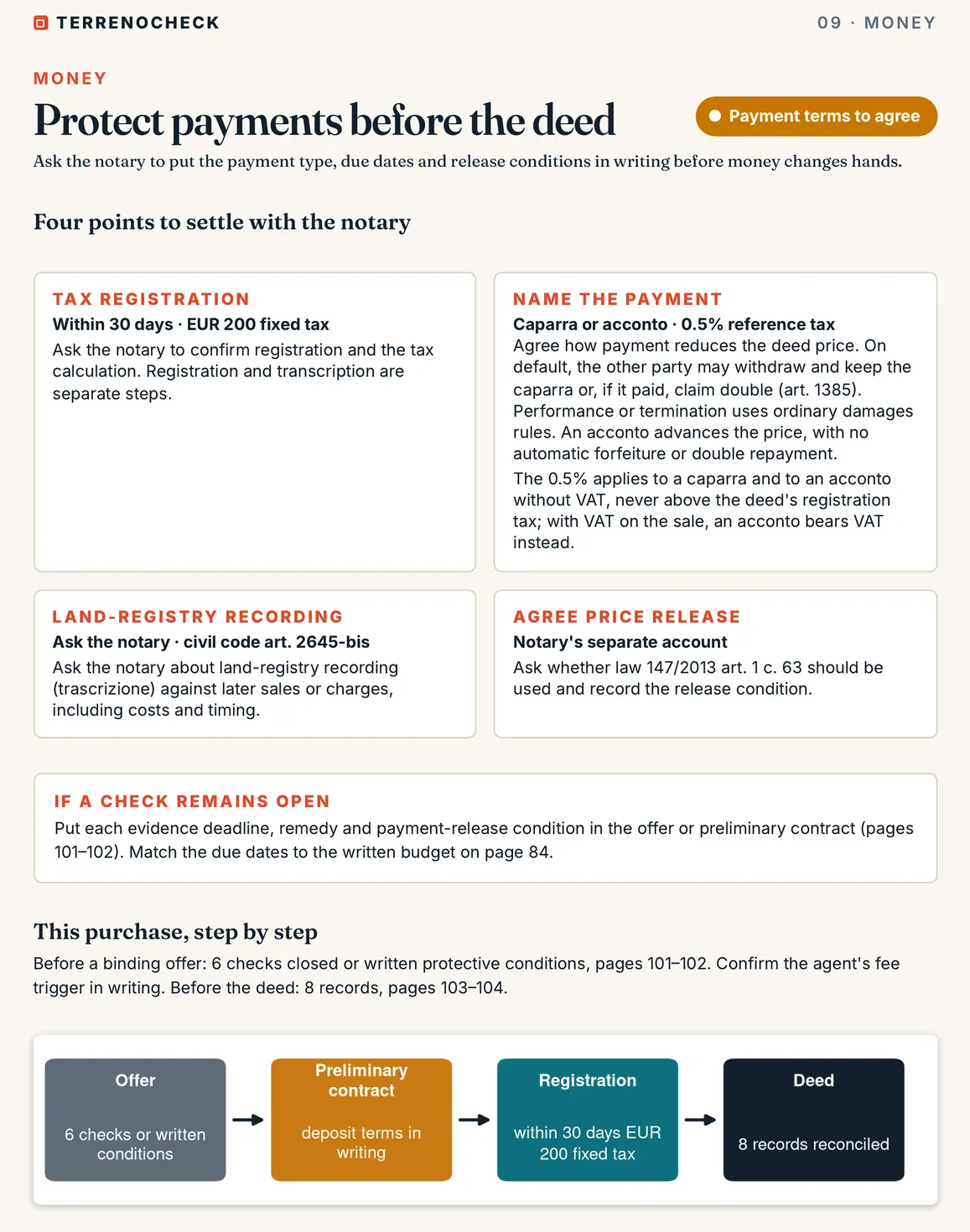
The sample report page on the Bagno a Ripoli parcel sets out the payments due before the deed: registration and tax on the preliminary contract, deposit or advance payment, registration of the preliminary contract in the property registers, and the price held by the notary.
Sources: Agenzia delle Entrate, ruling 7/2020; INPS, enrolment in the farmers’ scheme; INPS, circular 112/2023; DPR 131/1986, Article 13; accessed 12 November 2026.
The five-year rule
A buyer who used the relief loses it if, before five years have passed from the deed, they voluntarily sell the land or stop farming or running it directly. These are the two grounds the Agenzia listed in resolution 36/E/2010. The period was cut from ten to five years by Legislative Decree 228/2001 (Article 11(1)), which also bars selling the land before five years are up (paragraph 2).
The same article sets two exceptions, referred to in paragraph 4-bis. You do not lose the relief if, keeping the land in agricultural use, you sell it or let it be used by your spouse, relatives up to the third degree or in-laws up to the second degree who work as farmers. Nor do you lose it by selling under EU, national or regional schemes to help young people start farming or to support early retirement from farming (paragraph 3).
If you lose it, you pay the ordinary taxes. In ruling 551/2020 an enrolled professional farmer who was selling before the five years asked whether 9% was correct, and the Agenzia confirmed that rate. In the €85,000 example the gap between the ordinary and the relieved bill is €6,500.
The five years of the small farm ownership relief
- Before the deedCDU showing agricultural land and the notary’s written calculation. INPS enrolment already obtained if you claim the relief as a working or professional farmer; a buyer under 40 can state it in the deed and obtain it afterwards
- DeedRelief claimed in the deed: €200 + €200 + 1% cadastral tax, notary’s fee halved
- Within 30 daysThe notary registers the deed and pays the taxes
- Within 24 monthsFor buyers under 40 who stated it in the deed: INPS enrolment
- Years 1–5Farm or run the land yourself; a voluntary sale, a lease to third parties or a transfer to an srl as a rule loses the relief, subject to the exceptions in the law
- After 5 yearsThe lock-in ends: selling or leasing no longer loses the relief
Sources: Decree-Law 194/2009, Article 2; Legislative Decree 228/2001, Article 11; Agenzia delle Entrate, resolution 36/E/2010; Agenzia delle Entrate, ruling 551/2020; accessed 12 November 2026.
When the relief is lost and when it is kept
The Agenzia delle Entrate’s rulings give some concrete cases.
| Situation within the five years | Outcome according to the Agenzia |
|---|---|
| Lease or other use granted to a third party | Relief lost, as a general rule (ruling 183/2026) |
| Merger between IAP farming companies | Relief kept if the absorbing company keeps the requirements and goes on farming until the five years are up (ruling 183/2026) |
| Land contributed to a farming limited company (srl) | Relief lost (ruling 68/2020) |
| Building right on the roofs of farm buildings for solar panels | Relief kept if direct farming continues and the buildings stay rural (ruling 337/2022) |
| Sale to, or use granted to, a spouse, relatives up to the third degree or in-laws up to the second degree who are farmers, agricultural use kept | Relief kept: the law says so (Legislative Decree 228/2001, Article 11(3)) |
In ruling 183/2026 the Agenzia writes that the beneficiary must keep taking part «actively and concretely» in farming, and that formally meeting the requirements is not enough. Each ruling applies to the case of whoever asked for it: if your situation is different, you can file your own request for a ruling (interpello).
Sources: Agenzia delle Entrate, ruling 183/2026; Agenzia delle Entrate, ruling 68/2020; Agenzia delle Entrate, ruling 337/2022; Legislative Decree 228/2001, Article 11; accessed 12 November 2026.
Young farmers: taxes at 60%
Since 1 January 2024, young farmers as defined in Article 2 of Law 36/2024 who are working or professional farmers enrolled in the relevant social security scheme pay registration, mortgage and cadastral tax at 60% of the ordinary or reduced amounts set by law when they buy or exchange farmland and its appurtenances (Article 7).
The definition is not about age alone. Under Article 2 a «young farmer» (giovane imprenditore agricolo) is a business, in whatever legal form, that carries on exclusively farming activity within the meaning of Article 2135 of the civil code and is in one of these situations:
- the owner of the business is a farmer aged over eighteen and under forty-one;
- in a partnership or cooperative, at least half of the partners or members are farmers of that age;
- in a company with share capital, at least half of the capital is subscribed by farmers of that age and at least half of the directors are those same farmers.
The 60% is worked out on the «ordinary or reduced» taxes. If your business meets the definition, ask the notary for a written calculation with and without this reduction, including on the fixed taxes of the small farm ownership relief. The table and chart at the top of this guide do not apply it.
Sources: Law 36/2024, Article 7; Law 36/2024, Article 2; accessed 12 November 2026.
What changes from 1 January 2027
Legislative Decree 123/2025, the new consolidated registration tax act, applies from 1 January 2027 (Article 205, date moved by Decree-Law 200/2025, Article 4(5)). From the same date its Article 204 repeals paragraphs 4-bis and 4-ter of Article 2 of Decree-Law 194/2009 and paragraph 907 of Law 208/2015.
| Rule | Until 31.12.2026 | From 1.1.2027 |
|---|---|---|
| Small farm ownership relief | Decree-Law 194/2009, Article 2(4-bis) | Consolidated act, Article 173(1) |
| Under-40s enrolling within 24 months | Decree-Law 194/2009, Article 2(4-ter) | Consolidated act, Article 173(2) |
| Spouse and direct-line relatives living together | Law 208/2015, Article 1(907) | Consolidated act, Article 173(3) |
| Young farmers, taxes at 60% | Law 36/2024, Article 7 | Consolidated act, Article 172 |
What stays: Article 173 restates today’s text almost word for word. Fixed registration and mortgage tax, 1% cadastral tax, halved notary’s fees, loss of the relief if within five years you sell or stop farming, and the exceptions in Legislative Decree 228/2001 and Legislative Decree 99/2004. The tariff of the new act sets fixed registration tax at €200.
What changes: the references to cite in the deed. A 2027 deed will refer to Article 173 of the consolidated act.
Sources: Legislative Decree 123/2025, Article 205; Official Gazette, registration tax consolidated act; Legislative Decree 123/2025, Article 173; Legislative Decree 123/2025, Article 172; accessed 12 November 2026.
Italy’s small farm ownership relief: who qualifies, 5-year rule
https://terrenocheck.it/en/guide/small-farm-ownership-tax-relief-italy
Checklist
Before you sign
Common questions
Who can claim the small farm ownership relief?
Working farmers (coltivatori diretti) and professional farmers (IAP) enrolled in the INPS farmers’ social security scheme. The law extends it to buyers under forty who undertake in the deed to enrol within twenty-four months, to a spouse or direct-line relatives living with the farmer who already own farmland, to owners of masi chiusi in the province of Bolzano who habitually farm them and, on conditions, to farming companies.
How much does the relief save?
You pay €200 registration tax, €200 mortgage tax and 1% cadastral tax instead of 9% (or 15%) plus €100 in fixed taxes. On land bought for €85,000 that is €1,250 instead of €7,750, and the notary’s fee is halved.
Can I lease out land bought with the relief?
Within five years of the deed, as a rule, no. The Agenzia delle Entrate says that letting a third party use the land, a lease included, generally ends the relief. You keep it if you transfer the land or let it be used by a spouse, relatives up to the third degree or in-laws up to the second degree who are farmers, and the land stays agricultural.
What happens if I sell the land before five years?
If the sale is voluntary and is not covered by the exceptions in Article 11 of Legislative Decree 228/2001, such as a transfer to a spouse or to relatives up to the third degree who are farmers, you lose the relief and pay the ordinary taxes. For an enrolled professional farmer who sold early, the Agenzia delle Entrate confirmed 9% registration tax (ruling 551/2020). On €85,000 the gap between the two bills is €6,500.
Can I put solar panels on the land or the farm buildings?
For a building right (diritto di superficie) on the roofs of farm buildings, the Agenzia ruled out losing the relief as long as you keep farming the land yourself and the buildings stay rural (ruling 337/2022). That ruling is about the roofs of buildings: for a ground-mounted system, get advice before signing.
Does the relief still exist in 2027?
Yes. From 1 January 2027 it moves to Article 173 of the consolidated registration tax act (Legislative Decree 123/2025), on the same conditions: fixed taxes, 1% cadastral tax, halved notary’s fees, the five-year rule, under-40s and family members living with the farmer.
Keep reading
Taxes on buying agricultural land in Italy: 15%, 9% or relief
Taxes on buying building land in Italy: private sale or VAT
Buying agricultural land in Italy: pre-emption rights
The certificato di destinazione urbanistica (CDU): Italy’s zoning certificate, explained for foreign buyers
Check these points on your parcel
Find the land on the map and pick the parcel: cadastre, municipal plan, constraints, landslides, floods, access and costs are read for that parcel, with source and date.
€29 in English or Italian · €39 in both languages · total, VAT included