
Pillar guide: Costs, tax and use
Legga questo articolo in italiano.
Taxes on buying agricultural land in Italy: 15%, 9% or relief
On this page
If you buy Italian farmland and are not a working or professional farmer registered with the farmers’ social security scheme, the general rule is 15% registration tax, never less than €1,000, plus €100 in two fixed taxes. A registered farmer pays 9%, or €400 plus 1% under the small farm ownership relief, which the law extends to other groups of buyers.
In short
- The general rule: a buyer who is not a working or professional farmer registered with the farmers’ social security scheme pays 15% registration tax, with a €1,000 minimum, plus €50 mortgage tax and €50 cadastral tax. On land bought for €48,000 that is €7,300.
- A working or professional farmer registered with the farmers’ social security scheme who does not claim the relief pays 9%, with the same minimum and the same €100: €4,420 on the same land.
- With the small farm ownership relief the bill is €200 registration, €200 mortgage tax and 1% cadastral tax, so €880. The relief is lost if, within five years of the deed, the buyer voluntarily sells the land or stops farming or running it directly, subject to the exceptions in Article 11 of Legislative Decree 228/2001.
- The law extends the relief to other buyers: those under forty who state in the deed that they intend to obtain registration within twenty-four months; the spouse and direct-line relatives of a qualifying farmer, if they live with that person and already own farmland; owners of masi chiusi, farms in the province of Bolzano governed by a provincial law of 2001, who habitually farm them.
- Non-building land is sold outside VAT even when the seller is a company (DPR 633/1972, Article 2). From 1 January 2027 these rules move into a new consolidated registration tax act: the article numbers change, the rates in the new text are the same.
15%
Registration tax, general rule
Buyer who is not a registered working or professional farmer. Never less than €1,000.
€50 + €50
Mortgage and cadastral tax
When registration is at 9% or 15%.
€200 + €200 + 1%
Small farm ownership relief
Registration, mortgage and cadastral tax.
Already have a parcel in mind? The report runs these checks on your land, with a source and date for every finding: €29 in English or Italian · €39 in both languages · total, VAT included.
The three deed taxes, case by case
When you buy agricultural land from a private seller, the notary (the public official who draws up and registers every Italian property sale) charges three taxes: registration tax (imposta di registro), mortgage tax (imposta ipotecaria) and cadastral tax (imposta catastale). How much depends mainly on you: whether you are a coltivatore diretto (working farmer) or an IAP (imprenditore agricolo professionale, professional farmer) enrolled in the farmers’ social security scheme run by INPS, or not.
Every figure in this guide assumes a sale outside the scope of VAT, which is the normal case for farmland.
| Buyer | Registration tax | Mortgage tax | Cadastral tax |
|---|---|---|---|
| General rule: not an enrolled working or professional farmer | 15%, minimum €1,000 | €50 | €50 |
| Enrolled farmer who does not claim the small farm ownership relief | 9%, minimum €1,000 | €50 | €50 |
| Buyer entitled to the small farm ownership relief who claims it in the deed | €200 | €200 | 1% |
The table leaves out other reductions: for example, young farmers as defined in Article 2 of Law 36/2024 who are enrolled working or professional farmers pay 60% of the taxes, ordinary or reduced (Article 7).
The €1,000 minimum and the €50 fixed taxes come from Article 10 of Legislative Decree 23/2011, in the text in force until 31 December 2026. The same article exempts these deeds from stamp duty, cadastral fees and land-registry fees.
- Not an enrolled working or professional farmer, and no relief appliesGeneral rule: registration tax 15% (minimum €1,000) + €50 + €50
- Enrolled farmer who does not claim the reliefRegistration tax 9% (minimum €1,000) + €50 + €50
- Enrolled farmer who claims the small farm ownership relief€200 + €200 + 1% cadastral tax, five-year lock-in
- Other buyers admitted to the small farm ownership relief (see below)€200 + €200 + 1% cadastral tax, five-year lock-in
Sources: Legislative Decree 23/2011, Article 10; Agenzia delle Entrate, ruling 7/2020; Agenzia delle Entrate, ruling 551/2020; Decree-Law 194/2009, Article 2; Legislative Decree 123/2025, Article 173; Agenzia delle Entrate, resolution 15/E/2017; Law 36/2024, Article 7; Law 36/2024, Article 2; accessed 12 November 2026.
Who pays 15% and who pays 9%
The 15% rate applies when farmland goes to buyers «other than working farmers and professional farmers enrolled in the relevant social security scheme». That is the wording of the registration tax tariff, quoted by the Agenzia delle Entrate (Italy’s revenue agency) in its ruling 551/2020. The 15% rate is the general rule and leaves the special reliefs in place: a buyer who is not enrolled can still have the small farm ownership relief in the cases the law provides for, listed further down.
An enrolled farmer who does not claim the small farm ownership relief pays 9%, the rate for property transfers in general. The Agenzia confirmed this in two situations: an express waiver of the relief in the deed, when the buyer already knows the five-year conditions cannot be met (ruling 7/2020), and loss of the relief through an early sale (ruling 551/2020).
In practice, a buyer of a few hectares for a vegetable garden or an olive grove who is not enrolled as a farmer and does not meet the conditions of a special relief is in the 15% band.
Sources: Agenzia delle Entrate, ruling 551/2020; Agenzia delle Entrate, ruling 7/2020; Agenzia delle Entrate, ruling 456/2023; accessed 12 November 2026.
Worked example on land bought for €48,000
A hypothetical example: arable land bought for €48,000, a private sale outside VAT. Only the three deed taxes are counted, with no other reductions; the notary’s fee, the CDU and other costs are left out.
The chart sets the three totals side by side.
The €1,000 minimum on small plots
Proportional registration tax cannot fall below €1,000. At 15% the minimum applies to prices up to €6,666.67 (1,000 divided by 0.15); at 9% up to €11,111.11 (1,000 divided by 0.09).
A hypothetical example: a small plot for €6,000 bought at the 15% rate. 15% would be €900, but €1,000 is due, plus €50 mortgage tax and €50 cadastral tax: €1,100, more than 18% of the price.
If the same seller sells you several parcels in the same deed, it counts as one sale. Circular 2/E/2014 of the Agenzia explains that in a deed with a single transaction the minimum applies once, even when the tax worked out on each parcel stays below €1,000.
Sources: Legislative Decree 23/2011, Article 10; Agenzia delle Entrate, circular 2/E/2014; accessed 12 November 2026.
The small farm ownership relief in brief
The relief, piccola proprietà contadina, sits in Article 2(4-bis) of Decree-Law 194/2009. It covers land and its appurtenances zoned agricultural by the planning instruments in force, bought by working or professional farmers enrolled in the social security scheme. Registration and mortgage tax are fixed, €200 each according to resolution 15/E/2017, cadastral tax is 1%, and the law halves the notary’s fee.
The law extends the same relief to other buyers:
- Under forty. Individuals who state in the deed that they intend to obtain, within twenty-four months, enrolment in the social security scheme for working and professional farmers (paragraph 4-ter).
- Spouse and direct-line relatives of a person who meets the conditions of paragraph 4-bis, provided they already own farmland and live with that person (Law 208/2015, Article 1(907)).
- Owners of masi chiusi, the farms governed by Bolzano provincial law no. 17 of 2001, who habitually farm them: in the Agenzia’s view the relief applies whatever their farming status or enrolment (resolution 15/E/2017).
The buyer loses the relief if, before five years from the deed, they voluntarily sell the land or stop farming or running it directly. Paragraph 4-bis keeps in force Article 2 of Legislative Decree 99/2004, on farming companies, and Article 11(2) and (3) of Legislative Decree 228/2001. Under the latter the relief is not lost by a buyer who, with the land staying in agricultural use, sells it or lets it be used by a spouse, relatives up to the third degree or in-laws up to the second degree who are farmers, nor by one who sells under schemes to help young people start farming or to support early retirement from farming.
Farming companies, the definition of a young farmer, the cases the Agenzia has ruled on and the steps at the notary are in the guide to the small farm ownership relief.
Sources: Decree-Law 194/2009, Article 2; Agenzia delle Entrate, resolution 15/E/2017; Legislative Decree 123/2025, Article 173; Legislative Decree 228/2001, Article 11; accessed 12 November 2026.
Why there is no VAT on farmland
Italian VAT law (DPR 633/1972, Article 2(3)(c)) does not treat the sale of «land that cannot be used for building under the rules in force» as a supply of goods. The sale stays outside VAT even when the seller is a company or a farm business, and the notary charges registration, mortgage and cadastral tax as between private parties. The same provision adds that putting up the works listed in Article 9(a) of Law 10/1977, works in agricultural zones, farmhouses included, serving the running of the farm, is not building use.
Building land sold by a business is different: VAT is charged and registration tax becomes a fixed amount. The comparison is in the guide to taxes on building land.
Sources: DPR 633/1972, Article 2; accessed 12 November 2026.
What value the taxes are based on
The base is the value stated in the deed, or the price if that is higher; for property, value means market value (DPR 131/1986, Article 51). If the tax office thinks the value is higher than declared, it adjusts it and claims the extra tax with interest and penalties (Article 52(1)).
The prezzo-valore method, which taxes the cadastral value instead of the price, was not designed for land. The law reserves it for sales of homes and their appurtenances to private individuals. In the Agenzia’s view (resolution 149/E/2008) farmland only qualifies if, under the civil code, it really is an appurtenance of the house being sold.
Article 52(4) rules out an adjustment for land declared at no less than seventy-five times its updated reddito dominicale (the notional income the cadastre assigns to the owner). Paragraph 5-bis, however, limits that rule to prezzo-valore sales. For farmland sold on its own, ask the notary whether it can be relied on before the value in the deed is fixed.
Sources: DPR 131/1986, Article 51; DPR 131/1986, Article 52; Agenzia delle Entrate, resolution 149/E/2008; accessed 12 November 2026.
Land with a house or farm building
If you buy a house together with the land, the notary taxes each item under its own rule. The farmland follows the table in this guide; the house follows the rules for buildings, at 9% or, if you meet the first-home conditions, 2% (Legislative Decree 23/2011, Article 10(1)). First-home conditions and the other costs are in the guide to the cost of buying property in Italy.
That is why it pays to have the deed state a separate price for each item. When one sale covers items taxed at different rates and the prices are not split, the highest rate applies to everything (DPR 131/1986, Article 23(1)). Appurtenances always follow the rules of the property they serve (paragraph 3).
Sources: Legislative Decree 23/2011, Article 10; DPR 131/1986, Article 23; accessed 12 November 2026.
Who pays, and when
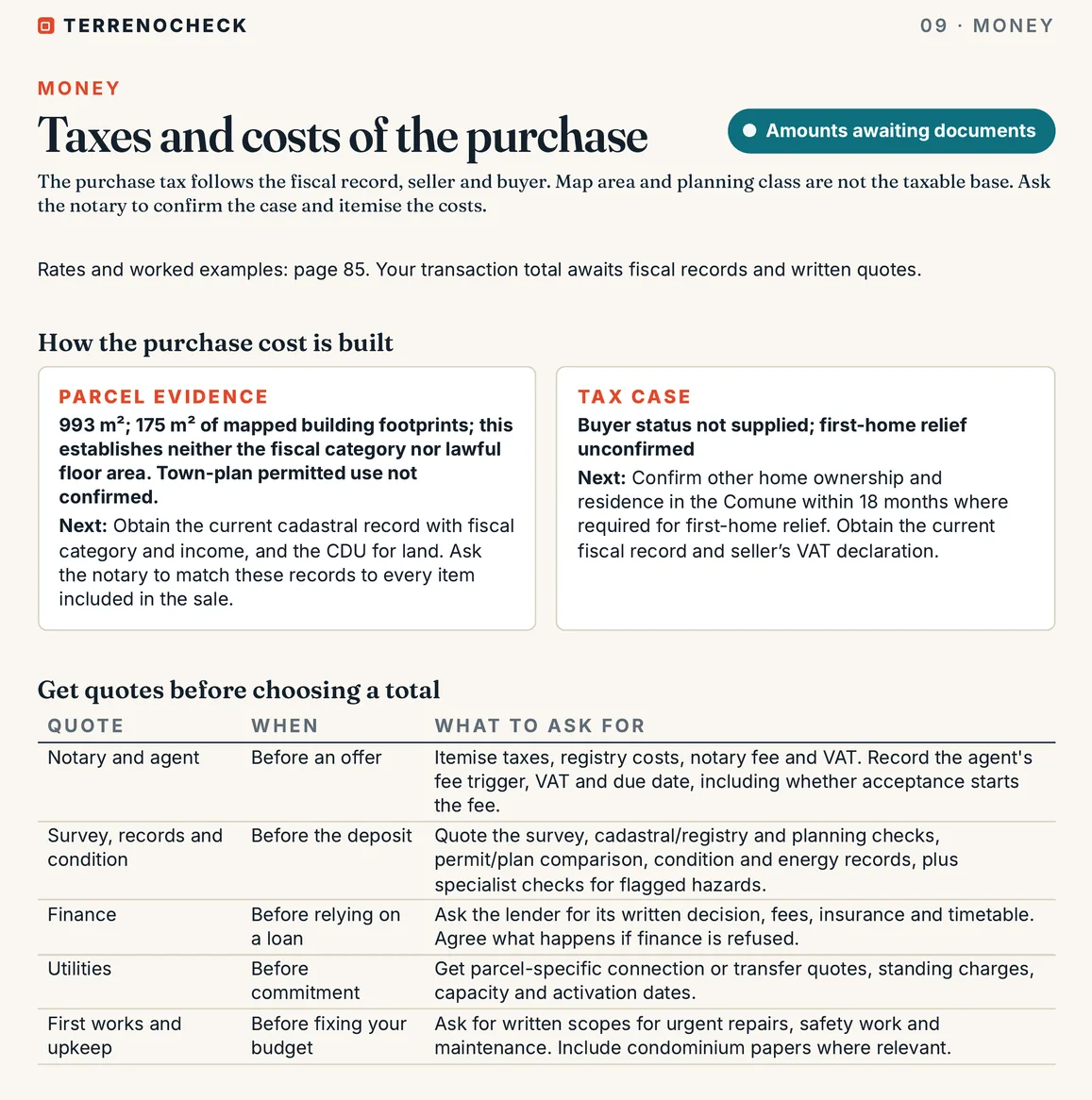
The notary pays the three taxes, being the person required to register the deed (DPR 131/1986, Article 10) within thirty days of signing (Article 13). By law the parties to the contract are also jointly liable for the tax (Article 57): if more turns out to be due, the tax office can claim it from you too.
The notary’s fee has no single public scale: agree it in a written quote. For deeds under the small farm ownership relief the law cuts it by half.
Sources: DPR 131/1986, Article 13; DPR 131/1986, Article 57; Decree-Law 194/2009, Article 2; accessed 12 November 2026.
What changes from 1 January 2027
Legislative Decree 123/2025 rewrote the rules on registration tax and the other indirect taxes as a new consolidated act (testo unico). It was due to apply from 1 January 2026; Decree-Law 200/2025 (Article 4(5)) moved the date to 1 January 2027 (Article 205 of the consolidated act). Deeds signed up to 31 December 2026 stay under DPR 131/1986, Legislative Decree 23/2011 and Decree-Law 194/2009.
What moves, and where to:
| Rule | Until 31.12.2026 | From 1.1.2027 |
|---|---|---|
| Registration 9% and 15%, €1,000 minimum, €50 mortgage and cadastral tax | DPR 131/1986, tariff, Article 1; Legislative Decree 23/2011, Article 10 | Consolidated act, Annex 1, tariff part I, Article 1 |
| Small farm ownership relief | Decree-Law 194/2009, Article 2(4-bis) and (4-ter); Law 208/2015, Article 1(907) | Consolidated act, Article 173 |
| Young farmers, taxes at 60% | Law 36/2024, Article 7 | Consolidated act, Article 172 |
| Non-building land outside VAT | DPR 633/1972, Article 2 | Consolidated VAT act (Legislative Decree 10/2026), Article 5 |
What stays: the new tariff repeats the 9%, the 15% with the same enrolment condition, the €1,000 minimum and the €50 fixed taxes. Article 173 restates the small farm ownership relief almost word for word: the same taxes, the halved notary’s fees, loss of the relief within five years with the exceptions of Legislative Decree 228/2001, and the same extensions to buyers under forty, to a spouse or direct-line relatives and to owners of masi chiusi.
What changes for anyone reading the law: the references. A 2027 deed will cite Article 173 of the consolidated act, not Decree-Law 194/2009, and Normattiva already shows paragraphs 2 and 3 of Article 10 of Legislative Decree 23/2011 as repealed, with effect from the same date.
Sources: Legislative Decree 123/2025, Article 205; Official Gazette, registration tax consolidated act; Legislative Decree 123/2025, Article 173; accessed 12 November 2026.
Taxes on buying agricultural land in Italy: 15%, 9% or relief
https://terrenocheck.it/en/guide/taxes-buying-agricultural-land-italy
Checklist
Before you sign
Common questions
How much tax do I pay to buy agricultural land in Italy?
In a sale outside VAT, the general rule for a buyer who is not a registered working or professional farmer is 15% registration tax, with a €1,000 minimum, plus €50 mortgage tax and €50 cadastral tax: €7,300 on €48,000. Special reliefs remain, such as the small farm ownership relief for a buyer under forty who states in the deed that they intend to obtain registration within twenty-four months. The notary’s fee and the cost of documents come on top.
Can a foreign buyer get the 9% rate or the farmer relief?
The 9% rate goes to a coltivatore diretto (working farmer) or IAP (professional farmer) enrolled with the INPS farmers’ scheme. The relief goes to the same enrolled farmers and to the other groups the law lists, such as buyers under forty who state in the deed that they intend to obtain enrolment within twenty-four months. A buyer who meets none of these conditions pays 15%.
Is there VAT if a company sells me farmland?
No. Italian VAT law does not treat the sale of land that cannot be built on as a supply of goods, so it stays outside VAT whoever sells it. Registration, mortgage and cadastral tax are paid as in a private sale.
Is the tax worked out on the price or on the cadastral value?
On the value stated in the deed, or on the price if that is higher. The prezzo-valore method, which taxes the cadastral value instead, was written for homes: agricultural land only falls under it if it genuinely is an appurtenance of the house being sold.
Below what price does the €1,000 minimum kick in?
At 15% the minimum applies to prices up to €6,666.67, at 9% up to €11,111.11. A €6,000 plot bought at the 15% rate therefore costs €1,000 in registration tax plus €100 in fixed taxes.
Do the taxes on farmland change in 2027?
Deeds signed from 1 January 2027 fall under the new consolidated registration tax act (Legislative Decree 123/2025). Its tariff repeats the 9%, the 15%, the €1,000 minimum and the €50 fixed taxes, and the small farm ownership relief moves to Article 173 with the same conditions. For a deed close to the turn of the year, ask the notary to calculate under the text in force on the day you sign.
Keep reading
Check these points on your parcel
Find the land on the map and pick the parcel: cadastre, municipal plan, constraints, landslides, floods, access and costs are read for that parcel, with source and date.
€29 in English or Italian · €39 in both languages · total, VAT included