
Pillar guide: Planning and the building
Legga questo articolo in italiano.
Lottizzazione abusiva: illegal land subdivision in Italy
On this page
In Italy, splitting land into plots and selling them is lottizzazione abusiva, an illegal subdivision and a criminal offence, when the features of the plots, such as their size, number, position, the works planned or the profile of the buyers, show unequivocally that they are meant for building against the zoning plan or without permission (DPR 380/2001, Article 30). The buyer of a plot carries real risk: a recorded order from the comune makes deeds on the plots void, after 90 days without withdrawal the land passes to the comune, and a final criminal judgment leads to confiscation.
In short
- There is an illegal subdivision when works start that transform land against the plan or without permission, or when land is divided and sold in plots plainly meant for building.
- Once the comune finds a subdivision without permission it orders a stop and records it in the property registers: from then on deeds on the plots are void and, unless the order is withdrawn within 90 days, the land passes to the comune.
- A final criminal judgment that finds an illegal subdivision orders confiscation of the land and the buildings; the statute does not write in an exception for a buyer acting in good faith.
- Before signing a preliminary contract, check the cadastral history of the original field, the entries recorded against the owners, the zoning certificate and the comune’s planning office (DPR 380/2001, Articles 30 and 44).
90 days
Without withdrawal of the order
If the order is not withdrawn, the subdivided land passes by law to the comune.
2 years
Maximum prison term
Plus a fine of 30,986 to 103,290 euros: the Article 44 amounts, doubled by Decree-Law 269/2003.
17.3.1985
Cut-off date
Article 30 applies to deeds signed and subdivisions filed after this date.
Already have a parcel in mind? The report runs these checks on your land, with a source and date for every finding: €29 in English or Italian · €39 in both languages · total, VAT included.
What Article 30 says
The rule sits in Article 30, paragraph 1, of DPR 380/2001, Italy’s consolidated building code, and covers two different situations. In the first, works begin that transform land in planning or building terms against the zoning instruments in force or adopted, against national or regional law, or without the required permission. Think of a new access track or foundations being dug on farmland.
The second concerns splitting the field into new cadastral parcels (frazionamento) and selling them. Land is also illegally subdivided when the transformation is «prepared through the subdivision and sale, or equivalent deeds, of the land in plots» whose features «show unequivocally» that they are meant for building. Lawyers and judges call the first a material subdivision (lottizzazione materiale) and the second a paper subdivision (lottizzazione cartolare). The statute does not use those labels, but it describes both cases.
The paragraph also gives examples («quali», such as) of the plot features to look at: size against the nature of the land and its use under the plan, the number of plots, where they lie, any planned infrastructure such as roads and utilities, and facts about the buyers. What the law requires is that the features of the plots show «unequivocally» that they are meant for building; whether they do in a given case is for the comune and the courts to assess. The diagram below places these elements on an imaginary field.
Sources: DPR 380/2001, Article 30; accessed 12 November 2026.
Warning signs on a plot for sale
A buyer usually looks only at the plot on offer. The warning signs often sit in the field it was carved out of, and they can be read in public records. The table turns the criteria in paragraph 1 into practical questions. It is a reading aid, not a list set out in the law.
| Criterion in Article 30(1) | What to look for | Where |
|---|---|---|
| Size against the nature and planned use of the land | Plots of a few hundred or a few thousand square metres in a farming zone, too small to farm | Map extract, visura, CDU |
| Number | One original parcel recently split into many parcels with different owners | Historical visura of the original parcel |
| Position | Plots side by side in a row, each fronting the same track | Map extract and site visit |
| Planned infrastructure | An internal road, manholes, cable ducts, meters or identical fencing on every plot | Site visit, listing, title deeds |
| Facts about the buyers | Buyers with no farming activity who live elsewhere, listings that promise «land for your house» or «plot with a project» | Listing, the neighbours’ title deeds |
An advert selling «plots» of farmland «with room for a cabin» is a sign not to ignore: the seller is the one talking about building. A visura is an extract from the cadastral database; a map extract (estratto di mappa) shows the parcel with its neighbours. To tell this apart from an ordinary split of a field, see the guide on buying part of a plot.
What the buyer of a plot risks
The consequences run on two tracks, one administrative and led by the comune (the municipality), the other criminal. Both concern the land, whoever owns it when they arrive.
The comune’s track. When the head of the relevant municipal office finds a subdivision without the required permission, he or she orders it suspended. The order is served on the owners of the land and on the others answerable under Article 29: the permit holder, the client and the builder. It halts work at once, bans any transfer of the land and buildings between living persons, and must be recorded (trascritto) in the property registers (Article 30, paragraph 7).
Once recorded, deeds on those plots are void and cannot be signed, whether before a notary or privately, until the order is cancelled or lapses (paragraph 9). If the order is not withdrawn within 90 days, the subdivided land passes by law into the comune’s disposable assets, and the comune must demolish the works (paragraph 8).
The criminal track. An illegal subdivision is punished with imprisonment of up to two years and a fine of 30,986 to 103,290 euros. The sentence is arresto, the custodial penalty Italian law provides for the class of offences called contravvenzioni (Criminal Code, Article 17). The fine is the 15,493 to 51,645 euros written in Article 44, paragraph 1, letter c, doubled by Decree-Law 269/2003, which provided that the fines in Article 44 are «increased by one hundred per cent» (Article 32, paragraph 47). A final judgment that finds the subdivision orders confiscation of the subdivided land and the buildings on it: the land passes to the comune free of charge, and the judgment is entered in the property registers at once (Article 44, paragraph 2).
What happens to the plot once a subdivision is found
- The comune finds a subdivision without permissionSuspension order served on the owners and on those answerable under Article 29 (Article 30, paragraph 7)
- The order is recorded in the property registersWork stops; from now on deeds on the plots are void until the order is cancelled or lapses (paragraphs 7 and 9)
- 90 days without withdrawalThe subdivided land passes by law into the comune’s disposable assets, and the comune must demolish the works (paragraph 8)
- Criminal proceedingsImprisonment (arresto) of up to 2 years and a fine of 30,986 to 103,290 euros (Article 44(1)(c), amounts doubled by Decree-Law 269/2003)
- Final judgment finding the subdivisionConfiscation of land and buildings, which pass to the comune free of charge; the judgment is recorded at once (Article 44, paragraph 2)
The zoning certificate in the deed
Paragraph 2 of Article 30 is the rule the notary applies to sales of land. A deed is void, and can be neither signed nor recorded, unless the certificato di destinazione urbanistica (CDU), the comune’s certificate of the planning rules for the land, is attached. The exception is land that forms the grounds of a building registered in the buildings cadastre, provided those grounds cover less than 5,000 m².
The comune must issue the CDU within 30 days of the request, a binding deadline. It stays valid for a year if the seller declares that the plan has not changed (paragraph 3). If the comune misses the deadline, the CDU can be replaced by a declaration from the seller, or one of the co-owners dividing the land, stating that the request was made and giving the land’s planning use under the plans in force or adopted, or that no such plans exist, or that the approved general plan requires detailed implementing plans (paragraph 4). Agree its wording with the notary. A deed signed without a CDU can be confirmed later, even by one party alone, by a notarial or authenticated deed with a certificate attached that refers to the date of the original deed (paragraph 4-bis).
The CDU tells you what the plan allows on that land. It does not tell you whether the field has already been divided and sold in plots, or whether proceedings are open: a perfectly valid CDU can sit alongside a subdivision under way. How to read one is explained in the guide to the CDU.
When Article 30 does not apply
Paragraph 10 sets a time limit and a list of exclusions. The article’s provisions apply to deeds signed and subdivisions filed with the cadastre after 17 March 1985. In any case they do not apply to:
- divisions between heirs, and wills;
- gifts between spouses and between relatives in the direct line, such as parent and child;
- deeds that create, change or end security rights, such as a mortgage, or easements.
The list covers those deeds, not what happens next. A division between heirs or a gift to a son stays outside, but later sales to strangers are not on the list. If the history of a field shows a division between heirs followed by sales of pieces to outsiders, have the notary assess the whole sequence.
An illegal subdivision concerns the land. If a house already stands on the plot, Article 46 applies as well: deeds on buildings begun after 17 March 1985 are void unless the seller states the details of the building permit or of the permit issued in regularisation. How to spot unauthorised work on the building itself is covered in the guide to unauthorised building work.
How to check before the preliminary contract
Do these checks before you sign any commitment, including the preliminary contract (compromesso), because once an order is recorded no deed on the plot can be signed. The comune has up to 30 days to issue the CDU, so request it first.
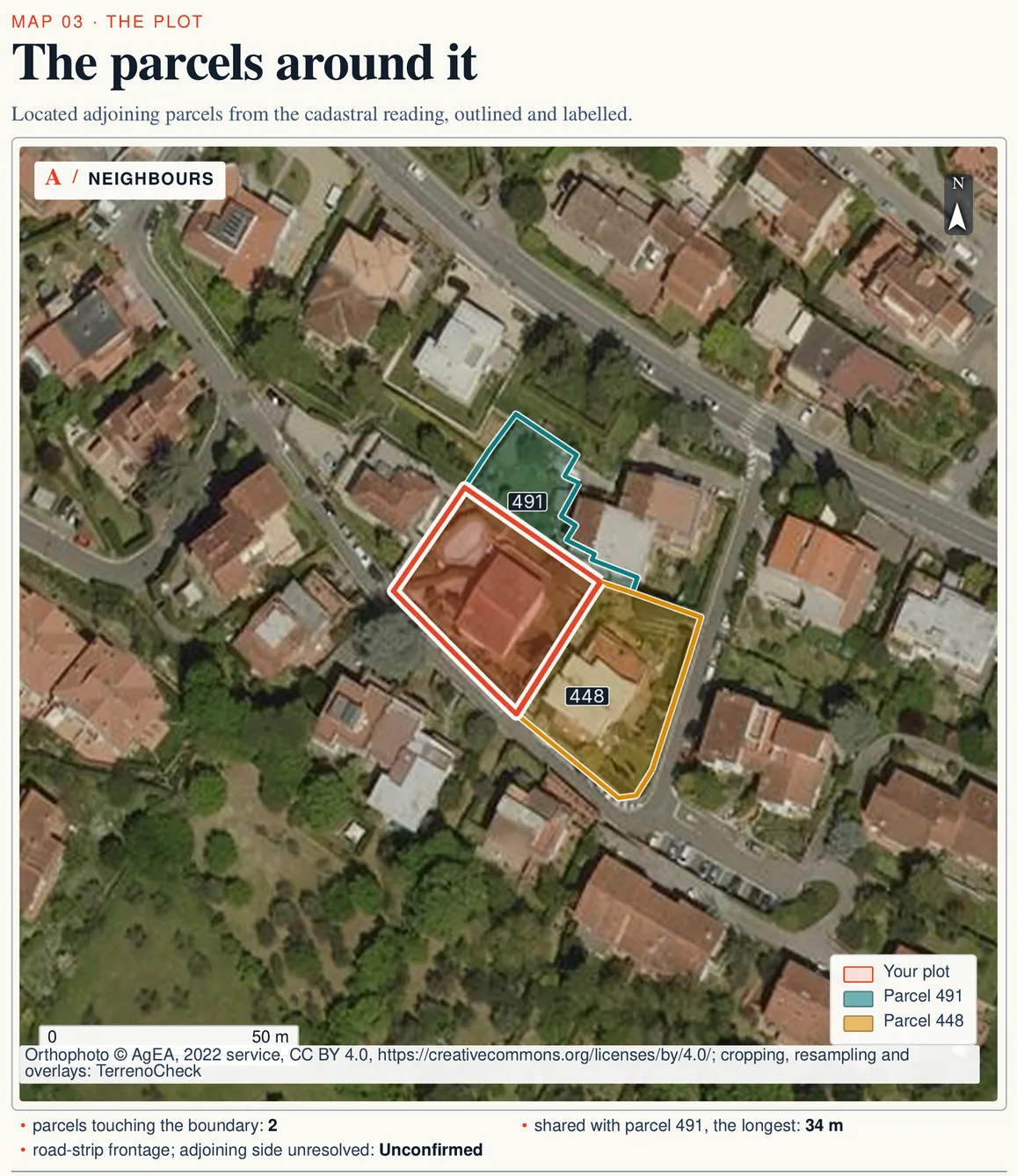
- The map around the plot (online, same day). Order the map extract centred on the parcel and look at the parcels around it: shape, size, numbering. Narrow, regular parcels in a row with consecutive numbers may point to a recent split. The Agenzia delle Entrate, which runs the cadastre, issues the extract free of charge as a PDF, including for parcels owned by others; the steps are in the guide to the cadastral map extract.
- The history of the original parcel (online, same day). A historical visura, also available online from the Agenzia delle Entrate, shows which parcel the plot came from, when it was split and how many parcels were created. If the seller has already sold other pieces, the owners’ names show it. The guide to the historical visura explains how to read it.
- The property registers (online or at the counter). A search of the property registers (ispezione ipotecaria) on the seller and earlier owners shows whether a suspension order or a confiscation judgment has been recorded. The procedure is in the guide to the ispezione ipotecaria.
- The comune’s planning office (timing depends on the comune, so ask early). Ask in writing, quoting sheet (foglio) and parcel (particella), whether any proceedings for illegal subdivision concern the field, and whether an approved subdivision plan (piano di lottizzazione) authorises the split.
- The CDU (up to 30 days). The seller or your technician requests it from the comune; the comune charges a secretarial fee on it within a minimum and maximum set by law (Decree-Law 8/1993, Article 10, paragraph 10), and the issuing office will tell you the amount.
- The notary (before the preliminary contract). Hand over everything: map, visure, register search, the comune’s reply and the listing. The notary judges whether what you have gathered points to a risk and whether the deed can be signed.
The TerrenoCheck report helps with the first step: it shows the parcel together with its neighbours found in the cadastral data, as in the example below.
Hypothetical example
Six plots from one olive grove
A hypothetical example. A listing offers a 1,200 m² plot in a farming zone «with access and an electricity connection». The map extract shows six identical parcels in a row along a new gravel track; the historical visura shows they come from one parcel split two years ago, and four are already in different owners’ names. Before the preliminary contract the buyer orders a property register search on the sellers and writes to the comune’s planning office, then takes the answers to the notary, who judges whether the deed can be signed.
Sources: DPR 380/2001, Article 30; Agenzia delle Entrate, map extract; accessed 12 November 2026.
Lottizzazione abusiva: illegal land subdivision in Italy
https://terrenocheck.it/en/guide/illegal-subdivision-lottizzazione-italy
Checklist
Before you sign for a plot
Common questions
Does buying a plot make me guilty of an offence?
The law punishes an illegal subdivision with imprisonment of up to two years (arresto) and a fine, now 30,986 to 103,290 euros (DPR 380/2001, Article 44, paragraph 1, letter c, and Decree-Law 269/2003, Article 32, paragraph 47), without listing who is liable. Whether a buyer is liable in a given case is for the criminal court. Confiscation is different: it targets the subdivided land and the buildings, not people.
Can I lose the land if I bought in good faith?
Article 44, paragraph 2, orders confiscation of the illegally subdivided land through the final judgment that finds the subdivision, and it writes in no exception for a buyer in good faith. How far confiscation can reach someone who took no part has been worked out by the courts. Before buying, ask the notary; if a case is already open, a criminal lawyer.
Does the zoning certificate attached to the deed rule out an illegal subdivision?
No. The certificato di destinazione urbanistica (CDU) sets out the planning rules for the land, and a deed on land without it is void, except for grounds of a registered building under 5,000 m² (Article 30, paragraph 2). It does not say whether the field has been divided and sold in building plots; that is traced through the cadastral history and the property registers.
Can land split between heirs be an illegal subdivision?
Paragraph 10 of Article 30 takes divisions between heirs, gifts between spouses or between relatives in the direct line (parents, children, grandchildren), and wills outside its provisions. Later sales to outsiders are not on that list. If an inherited field was then divided and sold off in pieces, ask the notary to assess the whole sequence.
What if a suspension order is already recorded against the plot?
Once it is recorded, deeds on those plots are void and cannot be signed until the order is cancelled or lapses (Article 30, paragraph 9). If it is not withdrawn within 90 days, the land passes by law to the comune, which must demolish the works (paragraph 8).
Does Article 30 reach sales made before 1985?
Its provisions apply to deeds signed and subdivisions filed with the cadastre after 17 March 1985 (paragraph 10). Earlier transactions fall under the rules of their time, which a notary can assess.
Keep reading
Buying part of a plot in Italy: how the frazionamento works and what to check before the deed
The certificato di destinazione urbanistica (CDU): Italy’s zoning certificate, explained for foreign buyers
Unauthorised building work in Italy: spot an abuso
How to check an Italian property for mortgages, seizures and court charges before you buy (ispezione ipotecaria)
The parcels around the plot, before you make an offer
Pick the parcel on the map: adjoining parcels, constraints and the zoning plan are read for that plot, each with a source and date, along with the documents to ask the comune and the notary for before you sign.
€29 in English or Italian · €39 in both languages · total, VAT included