
Legga questo articolo in italiano.
Buying trulli and masserie in Puglia: what to check
On this page
In Puglia, have the PPTR landscape plan and municipal rules checked against your project before offering for a trullo or masseria. The building name proves neither residential use nor extension rights; investigate olive trees, water and drainage separately.
In short
- Read PPTR and municipal rules against the actual parcel and project.
- Landscape assets and additional contexts have different procedures, subject to exceptions and coordination.
- Listed masseria in a zone that was rural when the PPTR came into force (NTA Art. 81): restoration and some new works only on the paragraph 3 conditions and through the Article 91 assessment.
- Investigate plant-health decisions for olives and utility arrangements for the intended use separately.
PPTR
Mapping and written rules
Identify the actual layers and provisions, rather than map colour alone.
June 2026
AQP service regulation
For areas served by the operator; obtain a site-specific connection assessment.
The report brings together public information about the land, with sources and dates, to prepare questions for the relevant offices: €29 in English or Italian · €39 in both languages · total, VAT included.
Define the property and intended use before offering
In Puglia, check a trullo, the traditional conical-roofed building, or a masseria, a rural farm complex, against the regional landscape plan and municipal planning rules before committing. Neither building name proves residential use or permission to extend. Have the actual project assessed, courtyards and land included.
Furnished guest rooms do not establish that every part of a masseria is authorised for accommodation. A registered trullo does not by itself permit new openings or demolition of additions.
The landscape protection guide explains the general relationship with building works.
Connect every PPTR map layer to its written provision
In Puglia, the PPTR, Piano paesaggistico territoriale regionale, is the regional landscape plan. The regional Paesaggio portal publishes its documents, technical rules and updates. The official rules page reviewed includes the twenty-sixth update, Regional Executive Decision 1155 of 11 August 2026; an old sheet from the seller may be out of date.
Ask your adviser to locate the cadastral parcel and record each layer with its name, applicable rule or sheet, and the authority able to answer.
The NTA, the plan’s technical implementation rules, distinguish landscape assets from additional landscape contexts. Article 89 separates authorisation under the national Cultural Heritage and Landscape Code from the PPTR compatibility assessment for the specified circumstances. Several map layers do not automatically mean two applications; exceptions and coordination rules depend on the works.
- Permissions and useMunicipal rules and building comparison: residential or another use?
- LandscapeIdentify asset or additional context, with conditions and coordination
- Trees and utilitiesPlant-health, water and drainage enquiries remain separate
Sources: Puglia Region: PPTR rules and updates; PPTR technical rules Articles 76, 81, 89 and 91; Regional Decision 1155/2026: twenty-sixth update; Santeramo in Colle: demarcated area, June 2026; Puglia Region, Xylella emergency portal: maps and WMS; SIT Puglia: PPTR map service; Plant-health service: Decision 79/2026; Acquedotto Pugliese: regulation effective 1 June 2026, Article 26; Puglia Regional Regulation 26/2011: current text; accessed 13 November 2026.
Read the historic setting as well as the main building
In Puglia, NTA Article 76 defines evidence of historic settlement (point 2): letter a) covers sites with historic-cultural assets, meaning the architectural and archaeological listings shown on plan sheets 6.3.1, where many masserie appear; letter b) the network of historic droving routes (tratturi); letter c) areas of archaeological risk. Point 3 adds a buffer zone around the sites in letters a) and b). For letter a) sites without indirect-protection requirements under Article 45 of the Cultural Heritage Code (distances and other measures the Ministry may impose around a listed building), the zone is 100 metres unless sheet 6.3.1 maps it differently; for droving routes it is 100 or 30 metres, depending on whether they are reintegrati (formally restored as public routes) or not. Where an indirect-protection decision exists, point 3 does not set the 100 metres: your adviser should read the sheet together with that decision. The question for a buyer is whether the building lies in the site itself, only in the buffer zone, or outside both.
The same article describes rural landscapes and references features including dry-stone walls, trulli, lamie (vaulted rural buildings) and cisterns. Parking, a new access or a new garden boundary may affect features absent from photographs of the rooms.
Also ask whether a specific cultural-heritage protection applies under Part II of the national code. Do not infer or exclude that status from the PPTR alone or from private ownership. The guide to listed cultural buildings covers the distinct heritage-office file.
From a PPTR layer to a usable enquiry
- ParcelLocate identifiers and external works
- ComponentRead definition, sheet and applicable technical rules
- ProcedureArticles 89–91: conditions, exceptions and coordination
- FileIdentify required decision, office, times and costs to confirm
Sources: Puglia Region: PPTR rules and updates; PPTR technical rules Articles 76, 81, 89 and 91; Regional Decision 1155/2026: twenty-sixth update; Santeramo in Colle: demarcated area, June 2026; Puglia Region, Xylella emergency portal: maps and WMS; SIT Puglia: PPTR map service; Plant-health service: Decision 79/2026; Acquedotto Pugliese: regulation effective 1 June 2026, Article 26; Puglia Regional Regulation 26/2011: current text; accessed 13 November 2026.
A real case: Masseria Chietri in Alberobello
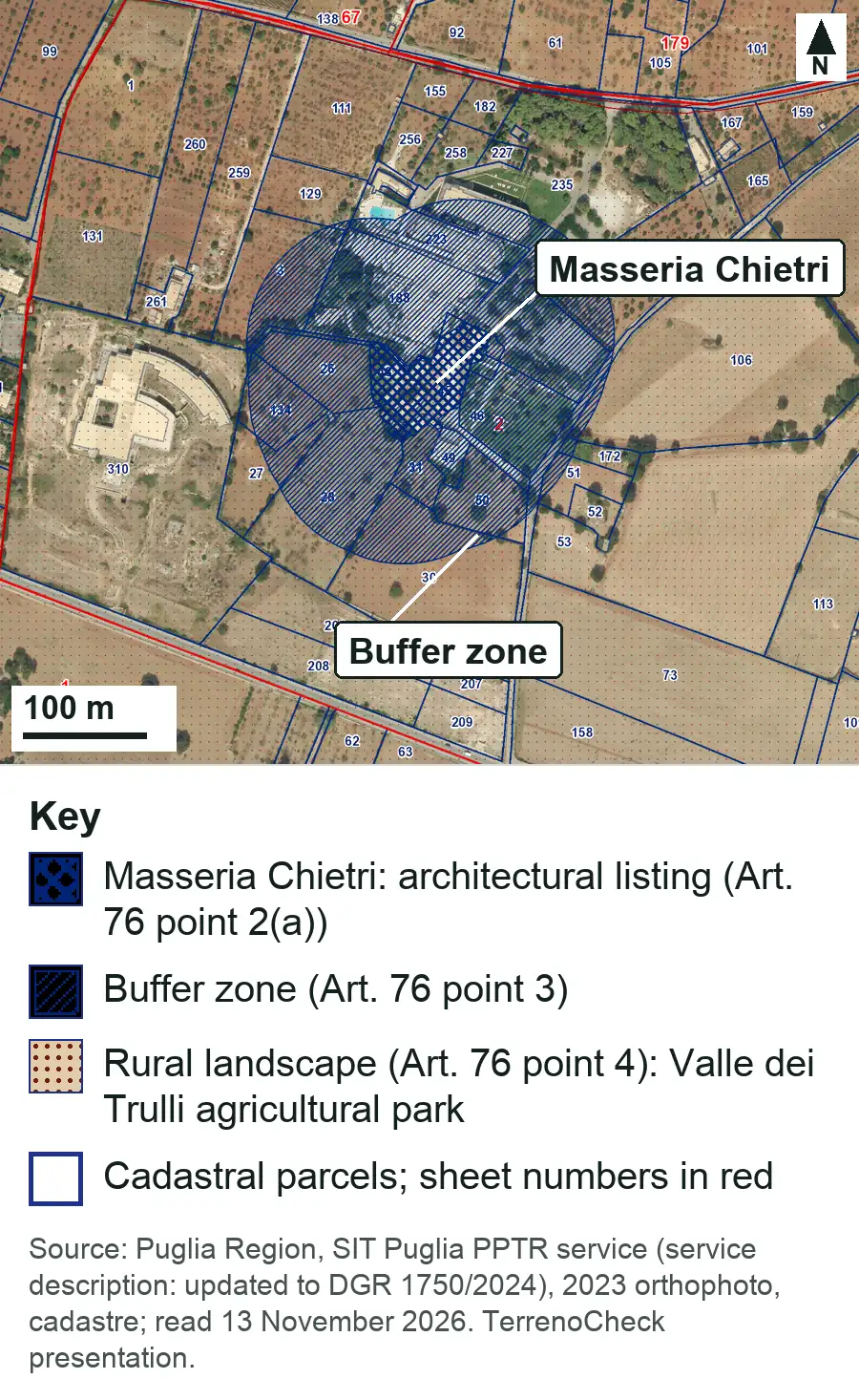
In the Region’s PPTR map service, read on 13 November 2026, Masseria Chietri in Alberobello is an architectural listing (Article 76 point 2(a)), with its own buffer zone. The same spot lies in the rural landscape of the Valle dei Trulli multifunctional agricultural park and in the “Murgia dei trulli” landscape area.
The service description states that it is updated to DGR 1750/2024, the twenty-second update (DGR is a regional executive decision). Since then the Region has approved four further updates of the plan documents (DGR 415/2025, 1112/2025, 328/2026 and 1155/2026); none names Alberobello among the municipalities to be notified. For a purchase, your adviser should still compare the parcel with the plan documents in force on the date of the check.
Article 81 applies to the sites in letters a) and b) in areas designated for rural use when the PPTR came into force, without prejudice to cultural-heritage protection under Part II of the national code. The first check is therefore the municipal zoning at that date. If it was rural, paragraph 2 treats as not permissible in the assessment, among other things and except as paragraph 3 allows, any change that could compromise the site’s conservation (a1), new buildings, plant and works of any kind, even temporary ones (a2), building or extending waste-disposal and waste-water treatment plants (a3), and gas pipelines, power lines or telephone lines with their associated above-ground works (a7), subject to the exceptions in that letter. Any part of the land that lies only in the buffer zone is governed by Article 82 instead, which needs its own reading.
Paragraph 3 lists what remains permissible, always through the Article 91 compatibility assessment and subject to Part II of the code, the quality objectives and use rules of Article 37, and any stricter planning instruments in force. Rebuilding the masseria’s collapsed roof falls under letter b1: renovation of lawfully existing structures that keeps, recovers or restores the traditional construction features, building types, materials and colours of the place, avoids discordant elements and favours environmentally compatible technology; for structures of recognised cultural or identity value, demolition and rebuilding is excluded.
A new guest annexe can fall under letter b5, which covers farm outbuildings and other structures linked to agricultural, forestry or grazing activities and to residential or tourist-accommodation use. The same letter requires the structure to be built preferably next to the existing buildings, to be compatible in size with the existing buildings and the character of the site, and to keep, recover or restore building types, materials and colours consistent with the landscape, avoiding discordant elements and favouring environmentally compatible technology. A design drawn up on these conditions still depends on the outcome of the assessment. Ask the designer before you offer whether the planned septic tank or treatment unit counts as a letter a3 “plant”.
Article 91 sets out the compatibility assessment, with coordination rules, exclusions and cases involving municipal plans adapted to the PPTR: the designer should justify the chosen route by the paragraph applied. An exemption from one assessment does not establish that the works comply with municipal planning rules.
| Your intended project | Documents to compare | Question to resolve |
|---|---|---|
| Live in a trullo | Permissions and authorised use | Is residential use established, or is conversion required? |
| Restore a masseria | Municipal plan, building sheet and relevant PPTR rules | Which building characteristics must be retained? |
| Alter external areas | PPTR boundaries and a drawing of the works | Which layers affect excavations, access and plant? |
| Open guest accommodation | Building permissions and activity requirements | Can the proposed use and project be authorised? |
| Acquire the included olive grove | Plant-health maps and applicable decisions | Which requirements affect these parcels and trees? |
Xylella needs a parcel enquiry, not a provincial assumption
In Puglia, the regional Xylella emergency portal publishes the demarcated-zone viewer, a search by cadastral parcel and WMS map services for the infected, containment and buffer zones of the pauca, fastidiosa and multiplex subspecies. Queried on 13 November 2026 at the Masseria Chietri point, the pauca service returns both the infected zone and the containment zone.
For 2026 the regional plant-health service required shallow soil working across the whole region against the juvenile stage of the insect vectors: ploughing, rotary tilling, harrowing or mulching, with grass cut to a maximum of 10 cm where mulching is used. Decision No. 79 of 28 April 2026 extended the deadlines to 15 May 2026 in municipalities with an average altitude below 200 metres and to 30 May 2026 elsewhere, including Alberobello.
The duty falls, among others, on owners and farmers of agricultural land; it does not apply to woodland, pine forest or private gardens, nor to protected areas except their olive groves, orchards and vineyards. On land with standing herbaceous crops, and olive trees, the soil is worked only under the tree canopy. Ask the seller whether the 2026 work was carried out; later years follow new decisions from the plant-health service.
Zones change through regional decisions: Santeramo in Colle, for example, published on 22 June 2026 the updated demarcated area for the multiplex subspecies, with the decision and annexes. Keep the date of your search and the decision that set the boundary.
Request any notices or directions received by the seller, then ask the regional Osservatorio fitosanitario, the plant-health service, which decisions apply to your parcels. If the price reflects the grove’s commercial value, have an agricultural adviser assess it. A landscape check does not certify tree health, yield or permission to move and replant trees.
Establish the water and drainage arrangements
In the Puglia areas served by Acquedotto Pugliese, the service regulation effective from 1 June 2026 governs connections. Article 26 provides for an application by a legally entitled party and works at the applicant’s expense. Check service coverage and technical conditions for the actual property.
A visible cistern does not prove a mains connection or adequate supply for your project. Obtain the account details, contract and installation documents, and identify the pipe route.
In Puglia, domestic drainage outside the integrated water service needs assessment under current Regional Regulation 26/2011 and the actual discharge arrangement. Request the discharge permission, system details and maintenance record; have the adviser identify the competent authority and any update required. The rural drainage guide explains why an existing installation does not prove a lawful discharge.
Separate the purchase price from the project budget
Identify purchase taxes and professional fees separately from the building works. Request estimates for the same described project so they can be compared.
If the project needs the compatibility assessment, NTA Article 91(4) provides for the decision within 60 days of receipt of the application, which must include the landscape report (paragraph 3). That deadline applies to the stand-alone procedure. If the works are also subject to VIA (Italy’s environmental impact assessment) or to VIA screening, NTA Article 89(2) has the assessment issued within that procedure and on its timetable, so plan around that procedure. The 60 days do not cover preparing the design and report, the water connection or the discharge permission; the building permit, for which the assessment is a precondition, comes afterwards. Nor is it the deadline to use if the works also need landscape authorisation, because only the authorisation is then issued (paragraph 10), or in the cases governed by paragraphs 8, 9, 11 and 12. As a hypothetical timetable for a restoration outside all these cases, four weeks for design and report plus the 60 days make about three months to the assessment outcome.
If guest accommodation is essential to the purchase, ask your adviser to separate the cost of restoring the building from the work needed for the activity; an advertised price per guest bed measures neither.
Follow a sequence before the deposit
- Before inspecting, ask the seller: request permissions, identifiers, protection documents, utility records and grove notices. Agree a delivery date and obtain the adviser’s quotation for reviewing them.
- Through the regional portal and municipality: ask the adviser to identify PPTR layers, municipal rules and the relevant procedure. Ask the offices for fees and times for missing records; agree the adviser’s reporting date.
- With the operator and plant-health service where relevant: establish connection feasibility and applicable tree decisions. Obtain their timetable and quotation before budgeting.
- With the notary before the preliminary contract: compare findings and purchase conditions. Agree the legal-review timetable and address objectives still dependent on permission in the contract.
Buying trulli and masserie in Puglia: what to check
https://terrenocheck.it/en/guide/puglia-trulli-masserie-buying
Checklist
Before an offer in Puglia
Common questions
Are all trulli protected in the same way?
Do not infer legal classification from the building name. Check PPTR components, municipal rules and any separate cultural-protection decisions.
Can a masseria become guest accommodation?
Have the authorised use, project and activity requirements assessed. Furnished rooms and advertised beds do not establish permission.
Does the PPTR establish olive-tree health?
No. The Region’s Xylella maps and the plant-health service’s decisions form a separate enquiry. An agricultural adviser should assess any assumed productive value.
Can I build a pool or guest annexe next to a listed masseria?
Within the listed site, if it was zoned rural when the PPTR came into force, NTA Article 81 treats new buildings and works as not permissible, except as paragraph 3 allows. A guest annexe can fall under letter b5 only if it meets every condition of that letter, set out in the Masseria Chietri section; for a pool, the designer must state which letter of paragraph 3 applies. The buffer zone is governed by Article 82 instead. The Article 91 compatibility assessment decides, together with the municipal plan where stricter.
Does a cistern establish workable utilities?
No. Obtain supply and discharge records and check the proposed use and technical arrangements. For AQP, use the service regulation and a property-specific quotation.
Keep reading
Prepare the file for your parcel
Bring the parcel’s public territorial context, sources and dates to your advisers when discussing the purchase.
€29 in English or Italian · €39 in both languages · total, VAT included