
Pillar guide: Planning and restrictions
Legga questo articolo in italiano.
Can you build a pool on agricultural land in Italy?
On this page
Ask the Comune’s SUE building office to check the local rules for your parcel before ordering a pool on agricultural land. A permanent pool needs a reasoned classification under Italian building law; describing it as an accessory to a house does not make it permit-free. Landscape approval is a separate check where protection applies.
In short
- Give the Comune (municipality) the parcel identifiers and a site drawing. Ask which local-plan rule allows the proposed pool.
- New construction needs a building permit under Article 10 DPR 380/2001. Your technician must classify the actual works.
- Removable does not automatically mean temporary. Article 6 requires seasonal works or objective contingent and temporary needs, notice and timely removal.
- Where landscape protection applies, check its approval route separately. Building permission does not settle landscape consent.
SUE
Your starting office
Sportello unico per l’edilizia: the municipality’s one-stop building office.
DPR 380/2001, Article 12
180 days
Only qualifying temporary works
Article 6(e-bis): seasonal works or objective contingent temporary needs; includes assembly and dismantling, with prior notice.
DPR 380/2001, Article 6
The report brings together public information about the land, with sources and dates, to prepare questions for the relevant offices: €29 in English or Italian · €39 in both languages · total, VAT included.
Start with the parcel and a site drawing
Send the municipal building office a drawing showing the pool, the house and the cadastral identifiers, the foglio (map sheet) and particella (parcel). Include dimensions and the intended position of the equipment. A supplier’s photograph cannot show how the installation changes this particular site.
Article 12 DPR 380/2001 requires a building permit to comply with the planning instruments, building regulations and applicable planning law. Ask the SUE, the Sportello unico per l’edilizia, which provision of the NTA, the local plan’s technical rules, admits your proposal on that parcel. Request the actual provision rather than a general assurance that pools are common locally.
For an overseas buyer, a field beside a farmhouse deserves a separate question. Ask whether it can be used for the proposed accessory works, rather than assuming that the sale makes every adjoining parcel part of a residential garden. If the house itself needs restoration or a change of use, have both proposals examined together. The guide to building on agricultural land explains the separate position of new rural housing.
What changes between an in-ground and a removable pool
Italy’s consolidated building act defines broad categories of works in Article 3, including new construction and certain accessory structures. Your technician must apply those categories to the actual proposal and the regional and local rules. The label “accessory pool” in a quotation is not a planning decision.
For an in-ground pool, describe excavation, any retaining structures and the finished ground levels. For an above-ground installation, show its supports, decking and connections. Include the equipment room and external paving even if different suppliers will provide them: the assessment should concern the complete project you intend to build.
| Proposal | Information the technician needs | Evidence before work starts |
|---|---|---|
| In-ground pool | Excavation, dimensions, equipment and finished site | Reasoned classification and required approval |
| Permanent above-ground pool | Supports, platforms, connections and intended use | Local-rule check and appropriate approval |
| Seasonal or temporary installation | Actual need, dates and removal arrangements | Full Article 6 check and notice where applicable |
| Pool already on the property | Date, drawings and seller’s building records | Comparison of the existing pool with authorised plans |
The table prepares your enquiry; it does not assign a permission solely by construction material. If the works are classified as new construction, Article 10 requires a building permit. Another route needs its own legal justification for the particular proposal.
- In-ground or permanentTechnician and SUE: classification, local rule and required approval
- Seasonal or objective contingent and temporary needAll Article 6 conditions, notice and removal within 180 days including assembly and dismantling
- Landscape protectionSeparate procedure; any exemption needs justification
- Well or tankCheck source use and the tank’s building requirements
Sources: DPR 380/2001, Article 3: building-work categories; DPR 380/2001, Article 6: permit-free and temporary works; DPR 380/2001, Article 10: building permits; DPR 380/2001, Article 12: conformity with planning rules; D.Lgs. 42/2004, Article 146: landscape authorisation; RD 1775/1933, consolidated water law Article 93; RD 1775/1933, consolidated water law Article 17; accessed 13 November 2026.
A removal date is only part of the temporary-works test
Article 6(1)(e-bis) concerns seasonal works and works meeting objective, contingent and temporary needs. They must be removed as soon as the need ends and in any event within 180 days, including assembly and dismantling. Prior start-of-works notice to the municipality is also required.
Ask your technician to explain why the proposal meets those conditions and what evidence of installation and removal you should retain. A permanent intended use is not automatically converted into a temporary one by an emptying valve or a manufacturer’s “removable” description.
Article 6 also preserves local-plan requirements and the sector rules it lists. Send the site drawing and technical specification before ordering. Ask the office what type of written response or application it requires and its expected processing time. A supplier’s delivery date should follow the permissions timetable, rather than dictate it.
Landscape consent is a separate enquiry
Where landscape protection applies, Article 146 D.Lgs. 42/2004 provides for an authorisation distinct from, and preliminary to, the building permit or other building approval. Your designer must identify the applicable procedure and any precisely applicable exemption. An exemption from one process does not automatically remove the other.
The submission should describe the visible setting as well as the water basin. Show changes in ground level and finishes, and whether the equipment housing will be underground or visible. The guide to landscape protection explains how to find the designation and landscape plan that apply.
Check where the water comes from and where it goes
Ask the water supplier whether it can serve the intended use and which local provisions apply, including any seasonal restrictions. For well water, have the abstraction documents and authorised uses examined. Article 93 of the consolidated water law concerns domestic uses by a landowner; it does not prove that filling this proposed pool is covered by your particular arrangements.
Article 17 treats rainwater collection in tanks serving land or a building differently from abstraction of public water: no abstraction licence or concession is required for that collection. The tank itself remains subject to building and other applicable laws. Include it in the proposal. The well-water guide covers the documents to request from a seller.
A hypothetical calculation helps frame the question. An internal water area of 4 by 8 metres and an average water depth of 1.4 metres gives about 44.8 cubic metres, or 44,800 litres. That is a geometric volume, not annual demand. Ask the installer for an operating water budget, and ask your technician about filter backwashing and emptying. Do not assume those discharges can enter the septic tank or a nearby ditch.
Greve in Chianti: building-permit route
- Before applicationComplete Article 78 NTA check, design and required approvals
- Examination60 days where approvals accompany application; Article 142 supplementation and suspension rules
- Decision30 days from proposal; 40 with reasons against approval
- Other routesComplexity doubles only the 60 days; conference route for missing external approvals
Sources: DPR 380/2001, Article 3: building-work categories; DPR 380/2001, Article 6: permit-free and temporary works; DPR 380/2001, Article 10: building permits; DPR 380/2001, Article 12: conformity with planning rules; D.Lgs. 42/2004, Article 146: landscape authorisation; RD 1775/1933, consolidated water law Article 93; RD 1775/1933, consolidated water law Article 17; accessed 13 November 2026.
Get a feasibility brief before a construction quotation
Commission the technician’s preliminary check separately from the pool supply quote. The check should identify the parcels, the applicable provisions and any unresolved issue. The construction quote should say who handles excavation and where excavated material goes, as well as list the external works. A cheap basin may describe only one part of an admissible project.
Ask the professional for a written scope, fee and delivery date; obtain the current official fees from the SUE and any landscape authority. Request a timetable for the identified procedure rather than treating an informal enquiry as a permit application. If the pool is essential to your decision to buy, take the findings to your notary before agreeing a condition in the preliminary sale contract.
- Before the offer, at the SUE: identify the local provision and required documents; ask when a response can be given.
- Before final design, with your technician: agree classification, protection checks and any investigations, with a fee and delivery date.
- Before ordering, with the competent authorities: complete the required approval procedures and their applicable time limits.
- Before construction, with the installer: confirm the approved drawing, included works and water arrangements, then agree delivery and site dates.
A local example: a rural pool in Greve in Chianti
In the rural territory of Greve in Chianti, Tuscany, the designer must apply Article 78 of the published Piano Operativo rules, updated to the amendment approved by council decision 184 of 18 December 2025. Read paragraphs 1 and 2 together with their exclusions and the building’s specific rules. Siting, finishes, water supply and changes to the ground must be assessed against those provisions.
A pool permanently transforming previously unbuilt land, including a private accessory pool, falls within the building-permit provision in Article 134(1)(m) of Tuscany Law 65/2014. A residential application goes to the SUE using the regional forms, required drawings and municipal electronic submission route. Obtain landscape and hydrogeological approvals where necessary.
Where all required approvals accompany the application, Article 142 provides 60 days from the application, or the supplementary documentation under paragraph 6, for examination and a proposed decision. The final decision follows within 30 days of that proposal, increased to 40 with the same starting point where reasons against approval are communicated. The 60-day examination period can double for a reasoned finding of particular complexity; the final 30 or 40 days do not double.
Within 30 days of application, the officer may interrupt the period once for the reasoned documentary request specified in paragraph 6; time starts again on receipt. Paragraph 7’s design-change request has its own suspension, with documentation due within the following 15 days where accepted. Missing approvals from other administrations trigger the services-conference route, subject to the cited landscape provisions. These qualifications explain why the municipal service’s stated 90 days is not a guaranteed construction-start date.
The fee schedule currently attached to the municipal service, decision 124/2023, groups permit charges by volume. The rows below exclude infrastructure works under Article 134(1)(c). Ask the SUE to classify the application: the basin’s water volume is not automatically the volume used for fee assessment.
| Permit fee band | Ordinary charge | Where geological-geotechnical investigation is prescribed |
|---|---|---|
| Up to 100 m³ | €150 | €200 |
| 101–500 m³ | €300 | €350 |
| Over 500 m³ | €500 | €550 |
The same schedule lists €60 for ordinary or simplified landscape authorisation. If the office confirms that your permit falls in the €200 row and that a €60 landscape application is required, those administrative charges total €260. Stamp duty, any development contributions, other approvals, professional work and construction remain separate. Obtain the current assessment before paying. These are Greve’s published charges, not an Italian pool tariff.
If the sale already includes a pool
Request the building file in which the pool appears, including its equipment and external works. Have a technician compare the approved drawing with a measured survey. Identify the position, dimensions and accessory structures; if records are incomplete, apply for them before agreeing that the property will be delivered with every check resolved.
At the inspection, record the pump room and discharge point as well as the basin. Ask about alterations since construction and their documentation. The original permit should not simply be assumed to cover later work that has never been examined.
In the preliminary contract, distinguish the seller’s statements from the documents still to be delivered. For an unresolved condition, agree the required evidence, responsible party and date with the notary. If the supplier later changes the design, have the technician check the revision before accepting it. Give the installer a dated version of the approved drawing so the quotation and the completed works concern the same installation.
Can you build a pool on agricultural land in Italy?
https://terrenocheck.it/en/guide/swimming-pool-on-agricultural-land-italy
Checklist
Before buying with a pool in mind
Common questions
Does owning the land give me permission for a pool?
No. Your project must comply with the local plan and other applicable protection. Ask a technician to identify the category of works and the necessary approval.
Is an above-ground pool always permit-free?
No. Consider its actual use, supports, associated works and changes to the site. The temporary-works route has all the Article 6 conditions described below.
Does the house permit cover its pool?
Have the approved drawings and permit checked. A pool that is absent from those documents should not simply be treated as authorised.
Can I fill it from the well?
Check the abstraction documents and permitted use with the competent water authority. Article 93’s domestic-use provision does not establish that your particular well can supply the proposed pool.
Keep reading
Prepare the questions for your parcel
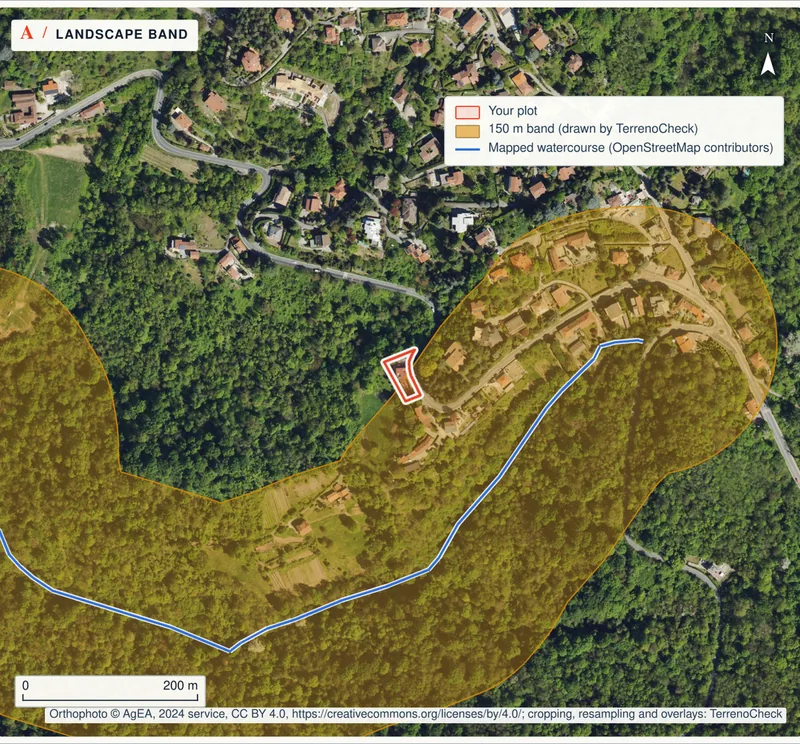
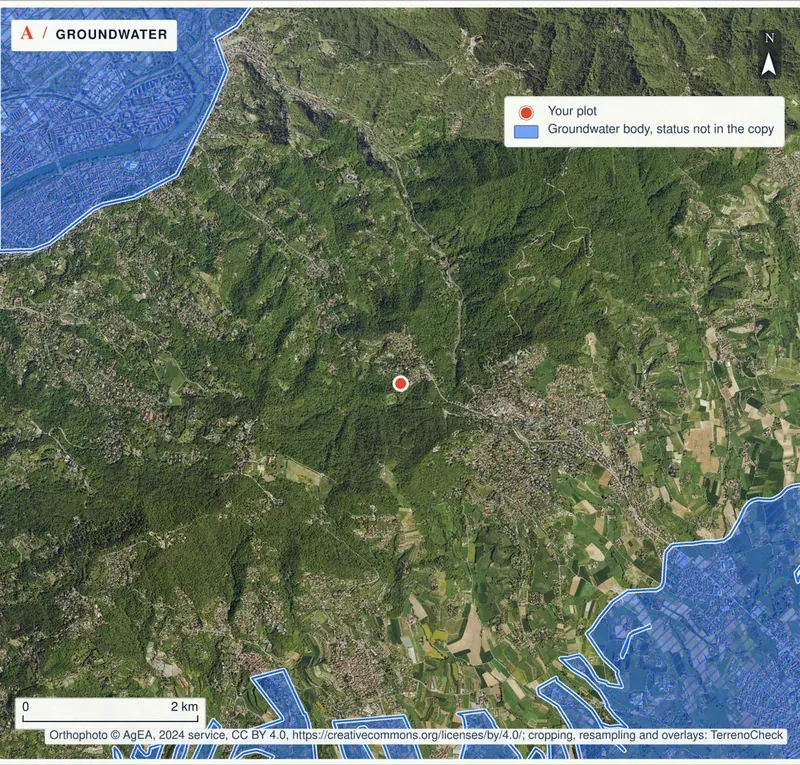
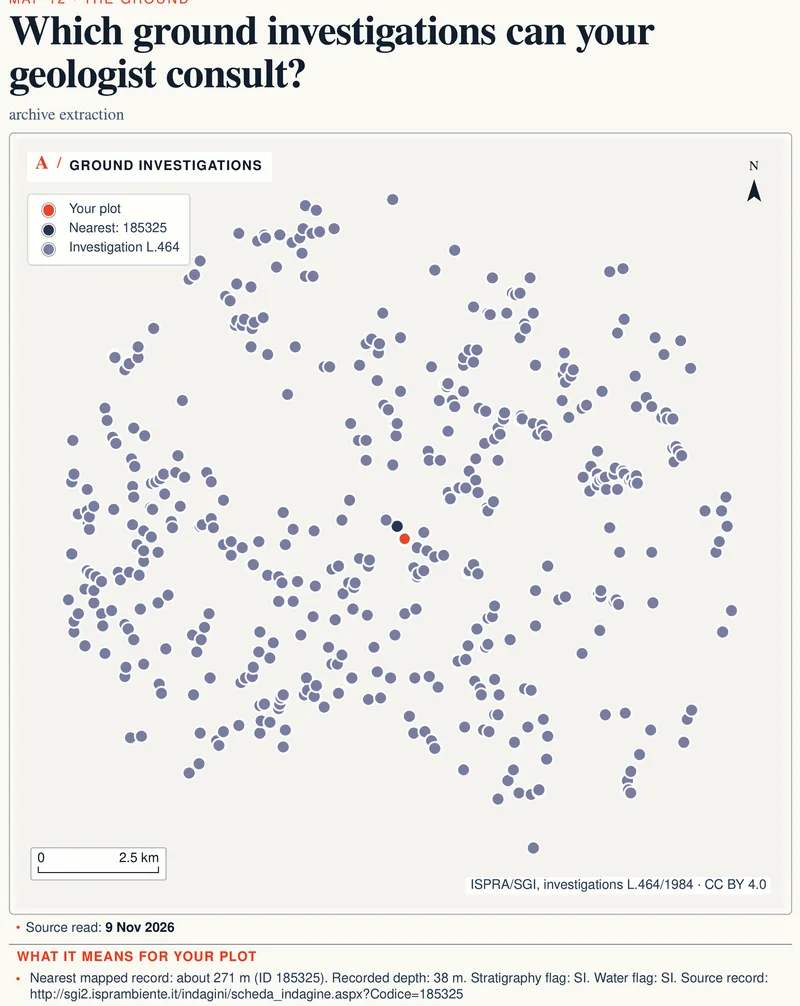
Select the land on the map to review its territorial information, sources and questions to take to the relevant offices before buying.
€29 in English or Italian · €39 in both languages · total, VAT included