
Pillar guide: Agricultural land
Legga questo articolo in italiano.
Buying a vineyard in Italy: authorisations and records
On this page
Before buying an Italian vineyard, obtain the current vineyard-register entry, planting-authorisation details and farm-file records. An unused authorisation should not be treated as an asset automatically transferred with the land. AGEA regulates holders and changes. The 2026 rules count validity by wine marketing years and distinguish new planting from replanting.
In short
- Each vineyard unit suitable for producing wine grapes must be entered in the schedario viticolo, the vineyard register (Law 238/2016, Article 8).
- Authorisations are free and generally non-transferable between producers. Exceptions and changes require case-specific checks under AGEA circular 69499/2026.
- New planting: ordinary validity ends with the third marketing year following the marketing year in which it was granted, subject to the updated rules’ derogations.
- Article 66 replanting authorisations granted from 18 March 2026, or valid on that date, run to the end of the eighth marketing year following the marketing year in which it was granted.
- A cadastral map does not establish vineyard registration, DOC suitability or an available planting authorisation.
3rd marketing year
New planting: ordinary rule
End of the third marketing year following grant; check the decision and any applicable derogation.
Decree of 23 July 2026, Article 1
8th marketing year
Replanting covered by the 2026 change
Article 66 grants from 18 March 2026 or valid that day; counted after the marketing year of grant.
Decree of 23 July 2026, Article 1
60 days
Notification after planting
To the region or autonomous province, identifying authorisation, parcel, area, planting date and technical details.
AGEA circular 69499/2026
The report brings together public information about the land, with sources and dates, to prepare questions for the relevant offices: €29 in English or Italian · €39 in both languages · total, VAT included.
Define what the sale includes
Ask the seller to list exactly what is being sold before agreeing a price. A parcel carrying vines, the business managing those vines and an unused planting authorisation are different things. They should not become a single undocumented item described as “vineyard with rights” in the sale agreement.
Separate ownership from management as well. The landowner may not be the person shown as managing the vineyard in the agricultural records. Ask who will make the necessary updates and which existing arrangements must end before handover. Tell the notary about agricultural tenancies and the separate checks on agricultural pre-emption rights.
Arrange a site visit with an agricultural specialist who can compare the planted rows with the documents. An advertised vineyard area may include tracks or unplanted ground. Request a drawing distinguishing cadastral area from planted area and identifying the registered units. Have any difference explained before your offer is binding.
Put the vineyard register beside the cadastral map
Article 8 Law 238/2016 requires every vineyard unit suitable for wine-grape production to be entered in the schedario viticolo, the vineyard register. Regions manage it through SIAN, the national agricultural information system, using information in the fascicolo aziendale, the agricultural business file. A cadastral search does not replace this check.
Obtain an up-to-date record from the seller and have a CAA, a Centro di assistenza agricola, or your agricultural technician explain it unit by unit. Check area, varieties and location against the property offered. Identify outstanding correction requests and who will complete them, rather than treating an application receipt as an updated record.
If you will establish a new business in Italy, ask the regional agricultural office how the farm file and management records must be updated for your situation. Obtain its required-document list and ask your adviser to identify those tasks in the fee quotation. The cadastre and vineyard register have different functions, even where both describe the same land.
| Document | Check | What it does not establish alone |
|---|---|---|
| Title and parcel schedule | Land and rights included in the sale | Compliance of vineyard productive potential |
| Vineyard register | Current units, areas and technical data | Ownership of the land |
| Authorisation | Holder, category, area, use and expiry | Automatic transfer to the buyer |
| Farm business file | Management and business records | Approval of every requested update |
| Suitability and production specification | Designation and technical conditions | A right to sell any wine under a DOC name |
- Existing vineyardCompare registered units, planted rows and manager
- Land intended for plantingCheck authorisation, holder, unused area and expiry
- Change of holderAsk the region to identify the applicable case and process
- DesignationCheck suitability and production specification, not the listing’s name
Sources: Law 238/2016, Article 8: vineyard register and suitability; AGEA Coordinamento circular 69499 of 31 August 2026; MASAF Decree of 23 July 2026, Article 1, published 11 September 2026; accessed 13 November 2026.
New planting and replanting changed in 2026
The MASAF decree of 23 July 2026 updated Italian rules following Regulation EU 2026/471. Ordinary validity for new planting ends with the third marketing year following the marketing year of grant. Article 66 replanting authorisations granted from 18 March 2026, or valid on that date, run to the end of the eighth marketing year following grant.
A marketing year runs from 1 August to the following 31 July. Two grants in the same calendar year can therefore have different expiry dates. In a hypothetical ordinary new-planting example, a grant on 20 July 2026 falls in 2025/2026 and runs to 31 July 2029; a grant on 20 August 2026 falls in 2026/2027 and runs to 31 July 2030.
Read the authorisation category and decision before applying that calculation. The updated rules include derogations, including specified extensions for exceptional events. Converted former rights and simplified replanting procedures need their particular provisions checked. AGEA circular 69499 of 31 August 2026 supplies the current operating instructions: an older document saying only “three years from issue” needs to be reconciled with them.
A change of holder is not created by putting a value in the contract
The AGEA circular says authorisations are free and non-transferable between producers, with exceptions for inheritance and anticipated succession, mergers or divisions, marriage or civil union, divorce or termination of the union, and other circumstances assessed individually by the Ministry. Selling the land should not be presented as automatic evidence that an unused authorisation passes to its buyer.
Before signing, ask the CAA and regional office whether your proposed transaction qualifies for the relevant change and what records it requires. Identify the current holder, authorisation number and remaining unused area. An assurance that the paperwork will be transferred afterwards is an unresolved condition if that area is central to the agreed price.
For a buyer abroad, ask who is authorised to submit the application and how you will receive evidence of its outcome. Agree whether the seller or your adviser supplies each document. This helps prevent a language or representation problem being discovered only when the purchase documents are ready to sign.
DOC or DOCG in an advertisement needs documentary support
Article 8 links suitability to produce grapes for DOCG, DOC or IGT wine to the registered unit’s technical information and the relevant production specifications, subject to the law’s stated conditions. Ask which suitability is currently recorded, for which area and on which technical basis. Do not rely solely on the estate agent’s designation.
Take the designation’s name to the competent office and ask which disciplinare, the production specification, applies to your intended output. Vineyard suitability is not a promise about every wine you could sell: production and declaration requirements for your business need their own check. Have projected trading income assessed separately if it supports the seller’s price.
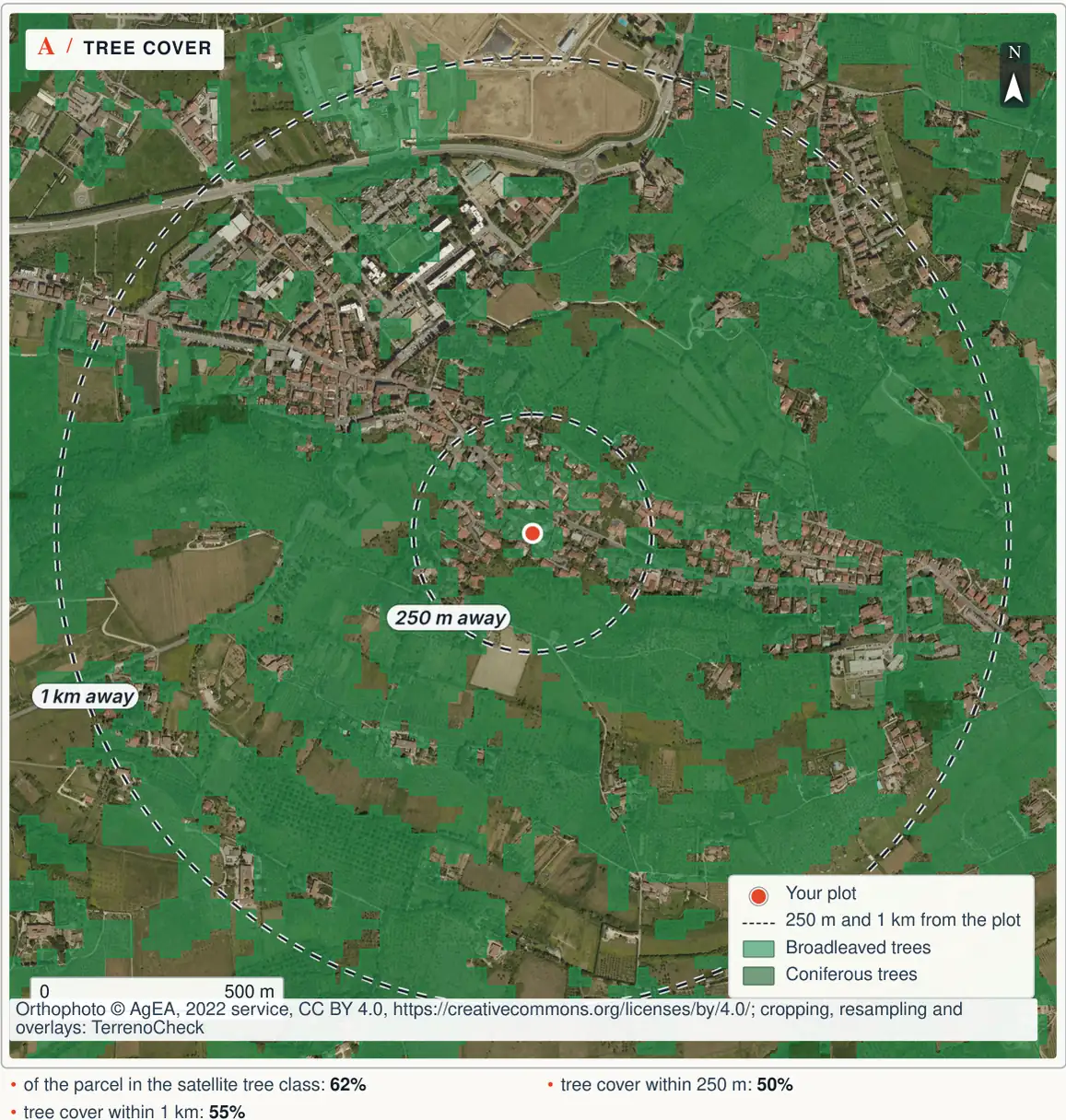
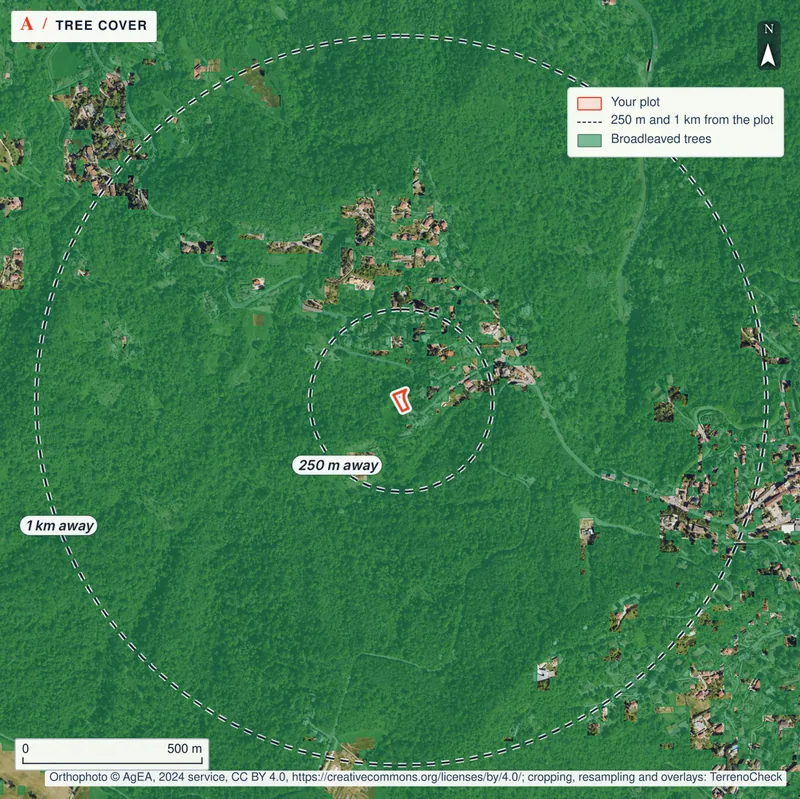
A land-cover map or aerial image can organise the inspection. It cannot certify grape variety, vineyard registration or eligibility for a designation. Compare the records with the site, particularly where the sale includes unplanted land or rows intended for replacement. Mark those areas separately in the transaction documents.
Sources: Law 238/2016, Article 8: vineyard register and suitability; AGEA Coordinamento circular 69499 of 31 August 2026; MASAF Decree of 23 July 2026, Article 1, published 11 September 2026; accessed 13 November 2026.
Budget for professional work as well as the land
Free authorisation means a zero charge for the authorisation itself. It does not make the vineyard project free. Obtain separate quotations for document checking, record updates and application assistance. New planting or replanting then needs its own project budget reflecting the proposed work and planting material.
Separate the land price from buildings and any machinery, and ask the notary to check the transaction’s tax treatment. The farmland purchase-tax guide explains why the parties’ circumstances matter. This article does not provide a supposed national vineyard price per hectare; compare documented properties and equivalent usable areas.
If irrigation is proposed, obtain the abstraction documents and permitted use. A well needs a separate investigation. Ask the technician whether access and row layout suit the equipment you expect to use, and what works or approvals any change would require. Those are feasibility questions to resolve before basing the purchase on advertised hectares alone.
Put document delivery before the deposit
- Before the offer, with the seller: obtain the vineyard register, farm-file information and authorisations, with a delivery date before the deposit.
- Before the preliminary contract, with the CAA and regional office: check holder, expiry and the update route; ask for the applicable processing times and professional fees.
- Before completion, with technician and notary: reconcile the assets sold, their management and outstanding checks; agree what must be completed first.
- If you plant: the producer must notify the region or autonomous province of full or partial use within 60 days after planting, with the identifiers and technical information required by AGEA. The planting date must fall within the authorisation’s validity.
Check an unused balance against the register
Suppose the seller shows an authorisation for one hectare and says half has been used. Request the recorded position and a drawing locating the planted area. Do not infer the remaining usable authorisation solely by subtracting what you can see from the figure printed on the original grant.
Under the current AGEA circular, notifying partial use does not extend the validity of the remaining area. Check quantity, holder and remaining time together. If your business budget depends on planting that balance, have the administrative route for using it examined before the preliminary contract.
In Tuscany, the official new-planting authorisations page links the 2026 campaign decisions and identifies SIAN as the electronic application route. Ask the regional wine office, vitivinicolo@regione.toscana.it, and your CAA to identify the relevant procedure, holder and documents. This route does not itself transfer an existing authorisation. The page also records a 2026 extension decision: use the campaign’s actual decisions for deadlines, rather than copying a previous year’s dates.
For an explicitly hypothetical professional quotation, €250 for register review plus €150 for document assistance gives €400, with the quotation specifying tax treatment. These are invented inputs, not CAA or regional tariffs. The authorisation itself remains free; planting and vineyard works need a separate budget.
Buying a vineyard in Italy: authorisations and records
https://terrenocheck.it/en/guide/buying-vineyard-planting-rights-italy
Checklist
Before buying the vineyard
Common questions
Do planting rights come with the land?
Distinguish an existing vineyard, an unused authorisation and a proposed change of holder. AGEA’s non-transferability rule has specific exceptions. A contract price does not replace the administrative check.
Does a cadastral vineyard entry prove DOC eligibility?
No. The vineyard register and suitability for a designation are separate checks. Article 8 connects suitability with technical vineyard data and production specifications.
Are authorisations still valid for three years?
For new planting the updated ordinary rule is the end of the third marketing year after grant. The specified replanting authorisations use the eighth marketing year. Check category, dates and derogations.
Is the authorisation free?
AGEA describes authorisations as free. That does not cover planting work, professional assistance or purchase costs.
Keep reading
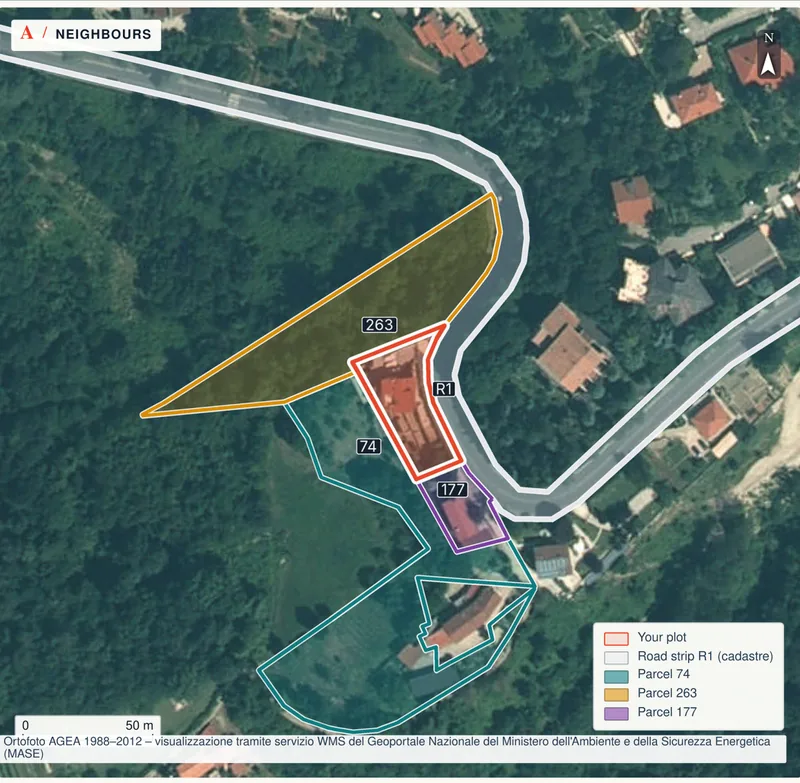
Buying agricultural land in Italy: pre-emption rights
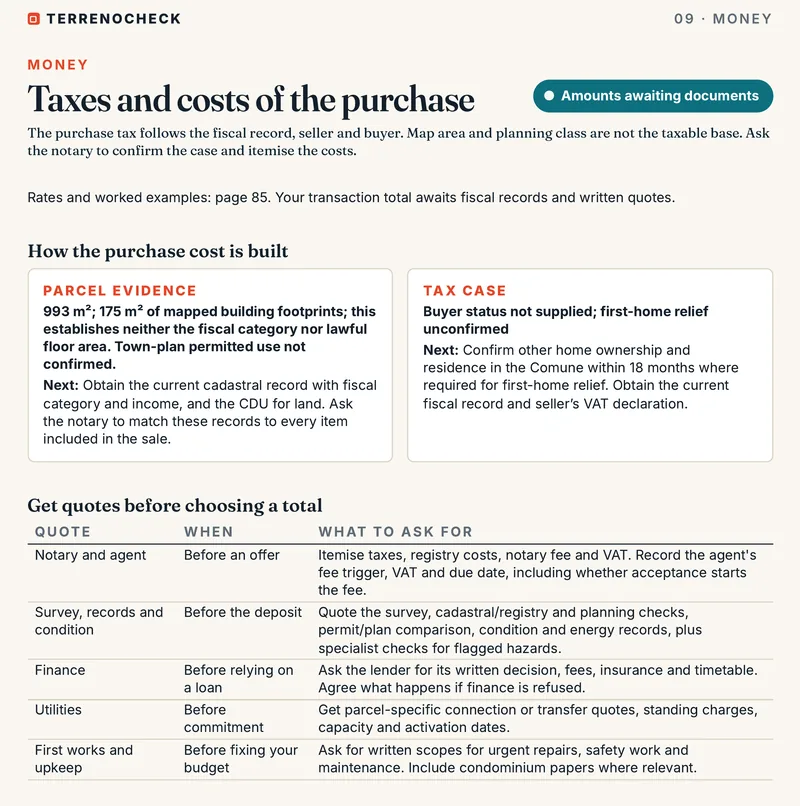
Taxes on buying agricultural land in Italy: 15%, 9% or relief
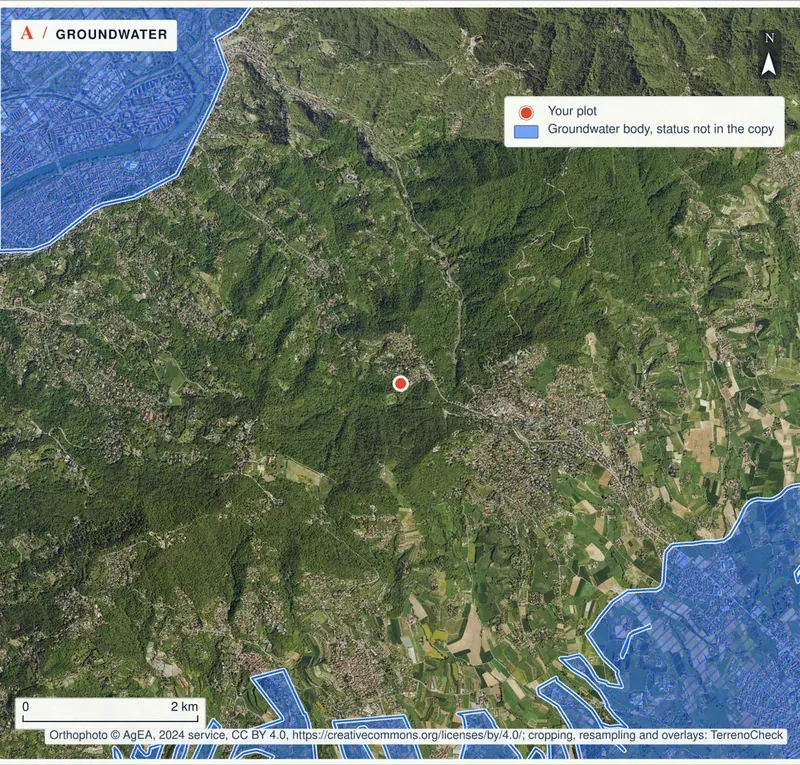
Well water rights in Italy: what buyers must check
Buying woodland in Italy: what the forest rules let you do, and what to check before you sign
Prepare the questions for your parcel
Select the land on the map to review its territorial information, sources and questions to take to the relevant offices before buying.
€29 in English or Italian · €39 in both languages · total, VAT included