
Pillar guide: Costs, tax and use
Legga questo articolo in italiano.
Mortgage for buying land in Italy: when banks lend
On this page
Land can secure a mortgage in Italy, and Italian consumer mortgage rules expressly cover borrowing to buy land. The ordinary 80% limit belongs to credito fondiario, a specific statutory mortgage regime, with conditional increases. Other products depend on the lender’s offer. Ask whether the bank accepts your land and your income before signing a preliminary contract.
In short
- Land can be mortgaged and a mortgage can pay for it; if you buy outside a business, the consumer rules on property credit apply (Banking Act, art. 120-quinquies).
- For credito fondiario, a specific statutory mortgage regime, the ordinary ceiling is 80% of mortgaged value, with a conditional increase up to 100% under the required guarantees. Other products depend on the bank’s terms.
- To build, the loan is paid out in stages as the works progress (SAL) and the lending limit has to hold at every stage; the mortgage extends to the house built on the land (Civil Code, art. 2811).
- For young farmers ISMEA funds up to 100% of the price through Generazione Terra; the 2026 call closed on 19 June 2026.
80%
Credito fondiario: ordinary limit
Specific to credito fondiario. Conditional increases require additional guarantees; other products depend on the offer.
0.25%
Substitute tax
If chosen in the deed, for a loan over 18 months that does not fund housing.
30 years
ISMEA Generazione Terra
Maximum term, including up to 2 years of interest-only pre-amortisation.
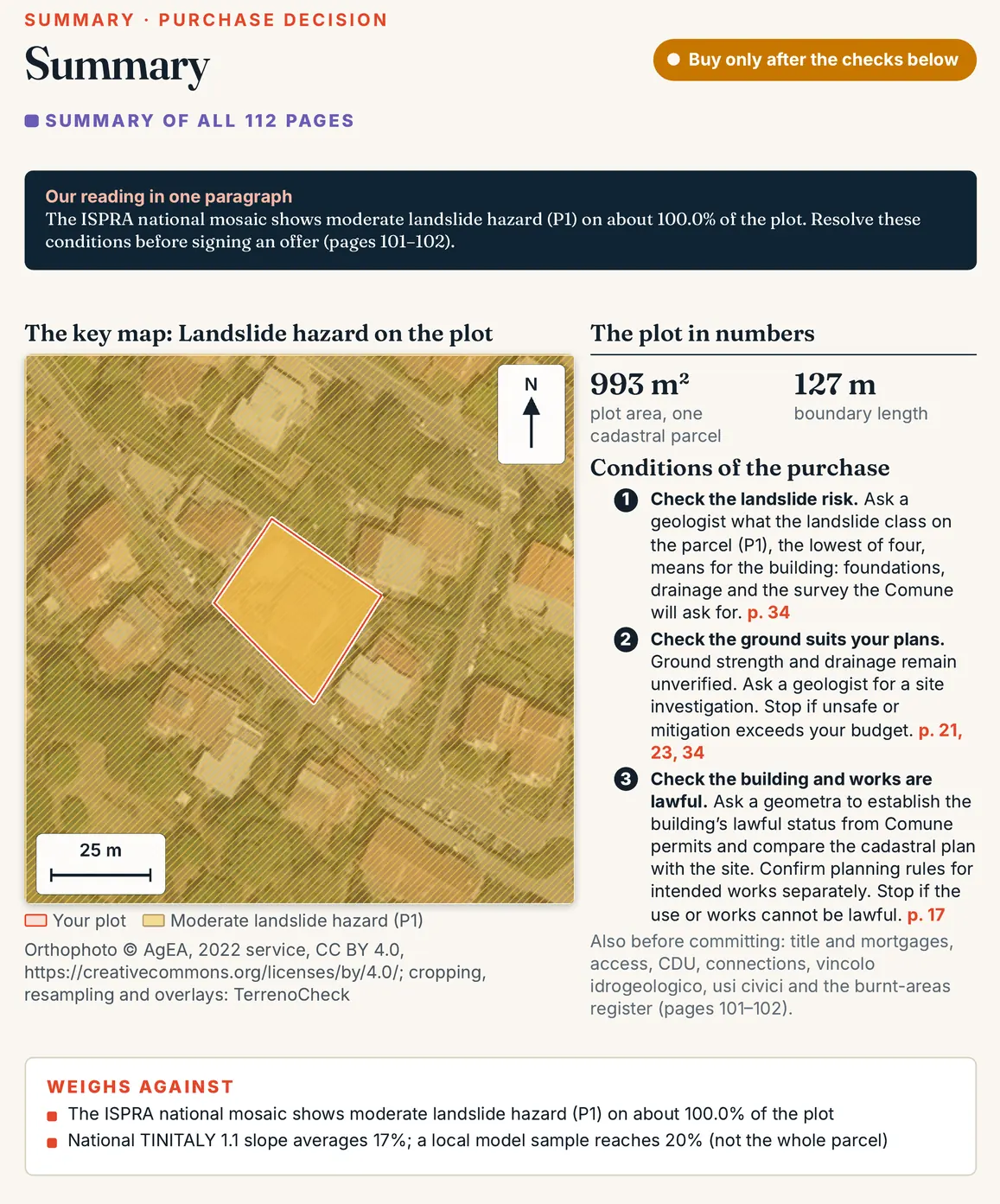
The report brings together public information about the land, with sources and dates, to prepare questions for the relevant offices: €29 in English or Italian · €39 in both languages · total, VAT included.
Land in Italy can be bought with a mortgage
Land is immovable property and so it can carry a mortgage (Civil Code, art. 2810). The Bank of Italy instructions on land credit operations, published in the Official Journal of 22 April 1996, give land as an example of property mortgaged as security. Land credit (credito fondiario) is medium and long-term bank lending secured by a first-ranking mortgage on property (Banking Act, art. 38).
If you buy as a private person, outside a business or profession, the loan also follows the consumer rules on property credit. The Banking Act definition of a credit agreement covers credit "to acquire or retain property rights in land" (art. 120-quinquies). In practice that gives you two things: before you sign, the bank has to hand you the ESIS (PIES in Italian), the European Standardised Information Sheet with your personalised terms (art. 120-novies), and it has to assess your creditworthiness on verified information (art. 120-undecies).
The law does not oblige any bank to lend on land. Each bank decides whether to lend and how much after valuing the plot and looking at your income. That is why you ask early, before you commit to the seller.
Credito fondiario and other mortgage products
For credito fondiario, the limit is set by the Bank of Italy, following resolutions of the Interministerial Committee for Credit and Savings, as a share of the value of the mortgaged property or the cost of the works (Banking Act, art. 38, paragraph 2). Under the 1996 instructions banks may lend up to 80% of the value of the mortgaged property or of the cost of the works, including the cost of the plot. The limit can rise to 100% with extra guarantees from the borrower, such as bank guarantees, surety policies or guarantees from public funds, provided the loan does not exceed 80% of property value plus guarantees. If the property already carries a mortgage, the outstanding capital of the earlier loan is added to the new amount.
For other products, ask the bank for its terms: the statutory limit does not apply to every mortgage. The Bank of Italy mortgage guide, updated in 2026, describes usual practice: a mortgage usually does not exceed 80% of the property value set by the valuation; sometimes banks go further, but they ask for more guarantees and often apply less favourable terms.
The value matters more than the price. The valuation, the Bank of Italy points out, need not match what you pay. For residential property the law requires banks to use reliable valuation standards and valuers who are competent and independent of the loan sale (Banking Act, art. 120-duodecies); for bare land ask the bank which method its valuer uses.
The chart at the end of this section splits the same example into loan, your own share and taxes.
Sources: Bank of Italy, 1996 instructions (Official Journal no. 94); Bank of Italy, mortgage guide 2026; Legislative Decree 23/2011, Article 10; Ministerial Decree 265/2012, table A; Agenzia delle Entrate, circular 19/E/2005; accessed 13 November 2026.
Agricultural land, building land or land with a building
What changes for the bank is what secures the loan and which rules apply. The table sets out the common cases and the question to ask in each.
| What you buy | Type of funding | Rules and limits | Ask the bank |
|---|---|---|---|
| Agricultural land, bought privately | Mortgage on the land | Credito fondiario: ordinary 80% limit, subject to conditional increases; other products under the bank’s terms; consumer rules if you buy outside a business | Whether it lends on farmland and what share |
| Agricultural land for a farm business | Agricultural credit with a mortgage, or ISMEA for young farmers | With a mortgage, the land credit rules apply, limits included | Whether it is agricultural credit and what guarantees it wants |
| Building land with a project | Purchase and build loan paid in stages | Limit on the cost of the works including the plot, at every stage | Which project papers it needs and how stage payments work |
| Land with a building | Mortgage on the whole | For residential property, valuation standards and an independent valuer | How the valuer treats the building and its legal status |
Agricultural credit secured by a mortgage follows the land credit rules, lending limit included, as the 1996 instructions themselves state. The purchase tax relief for professional farmers (coltivatori diretti and IAP) is a separate matter that does not depend on the loan: see the guide to small farm ownership relief.
Sources: Banking Act, Article 38; Banking Act, Article 120-duodecies; accessed 13 November 2026.
Buying and building: a loan paid in stages
If you buy a plot to build on, one loan can cover both land and house. The limit is then worked out on the cost of the works, plot included, and the money is paid out in stages as the works progress (SAL, stati di avanzamento lavori). The Bank of Italy instructions require the lending limit to hold at every stage of the works: the bank does not pay out more than the value reached by the site and the land allows.
Two practical consequences. The mortgage registered on the land extends to improvements and buildings put up on it (Civil Code, art. 2811), so the new house secures the loan without a new mortgage. When the loan agreement and the payment are separate deeds, the payment is noted in the margin of the mortgage registration (Banking Act, art. 39, paragraph 2): each instalment goes through the notary or a deed that records it, at a cost the offer should show.
Before you apply, have the preliminary contract, the cadastral extract and map, the zoning certificate (CDU) and, to build, the project and building permit with the cost estimate. The bank tells you which papers it actually needs.
Young farmers: ISMEA Generazione Terra
For people under 41 who want to enlarge or start a farm there is a public route. Generazione Terra from ISMEA, the Italian agri-food market agency, funds up to 100% of the purchase price of agricultural land. The 2026 edition had three groups: young farmers enlarging a farm run for at least two years, young start-ups with experience, under 41 when applying, and young start-ups with a relevant qualification, under 35 when applying.
The maximum is €1,500,000 for the first two groups and €500,000 for start-ups with a qualification; notary fees and taxes sit outside the cap. The term runs to 30 years, including up to 2 years of pre-amortisation, at a fixed rate linked to the EU base rate and to risk. For the land valuation you pay a flat 0.3% of the assessed value, at least €500.
The main formula is unusual: ISMEA buys the land and assigns it to the young farmer under a retention of title agreement (patto di riservato dominio), so ownership passes once it is paid for; after at least five years a rate review can be requested if it lowers the rate. Alongside it there is a mortgage loan formula. The chart shows how the 2026 applications split.
The 2026 window ran from 22 April to 19 June 2026 and is closed. For a later edition, check the measure’s page on the ISMEA site. The same site hosts the Banca delle terre agricole, the inventory of supply and demand for farmland and farms, free for registered users (Law 154/2016, art. 16).
The Consap first-home guarantee fund, often mentioned to mortgage applicants, covers loans to buy a main home of up to €250,000. For land with no house, ask Consap or the bank whether the deal qualifies.
Source: ISMEA press release of 24 June 2026, read on 12 November 2026
Sources: ISMEA, Generazione Terra; ISMEA, press release of 24 June 2026; accessed 13 November 2026.
What the mortgage costs besides interest
The Bank of Italy lists the costs on top of interest: an arrangement fee, the valuation of the property to be mortgaged, notary fees for the loan deed and the mortgage registration, and insurance. The APR (TAEG) on the ESIS includes interest and costs, the valuation too when it is needed to get the loan, but not notary fees (Banking Act, art. 120-quinquies).
For loans of more than 18 months the deed can opt for the substitute tax, which replaces registration, stamp, mortgage and cadastral taxes and government concession charges (Presidential Decree 601/1973, arts. 15 and 17). According to the Agenzia delle Entrate the rate is 0.25% for loans that are not for buying, building or renovating housing, and 2% for loans that are when the first-home conditions are not met (circular 19/E/2005). A loan only for agricultural land falls in the first case; if the loan also funds a house to be built, ask the bank which rate it applies and why.
A notary is required by law, because the mortgage is entered in the land registers. The notaries' guide notes that towards the bank the notary takes responsibility for ownership and for the property being free of mortgages; the Bank of Italy guide adds that the borrower can choose the notary. If you later want to repay early, a land credit loan (credito fondiario) falls under art. 40, paragraph 1, of the Banking Act: you may repay all or part of the debt early, against the all-inclusive fee set in the contract. Article 120-ter adds a protection: any clause obliging the borrower to pay a fee, penalty or other sum for early or partial repayment is void for mortgages taken out, or taken over following a split (frazionamento), by individuals to buy or renovate property used as a home or for their own business or professional activity. A fee written into the contract is therefore not automatically due; have the bank or the notary confirm which case your loan falls into.
The steps, from application to payout
Before signing a preliminare (binding preliminary sale contract), ask each bank whether it accepts non-resident applicants and income earned abroad. Request its list of income documents, accepted languages and any certified translations. Ask how it wants evidence of title and planning status presented, whether a foreign account can be used, and when funds become available to the seller. These are questions for the lender’s written offer, not assumptions based on an Italian resident’s application. Agree any mortgage condition with your notary before paying the deposit.
Before the preliminary contract, ask several banks whether they lend on that type of land: the notaries' guide recommends comparing the terms offered by different banks. If you sign the preliminary contract before the bank approves the loan, discuss with the notary a clause that ties the purchase to getting the mortgage, as explained in the guide to the preliminary contract.
- Application and ESIS, at the bank. You hand in the papers the bank asks for and receive the ESIS with your personalised terms, free of charge. The time from handing in the papers to payout is stated in the bank’s general information sheet (Foglio informativo).
- Valuation, on the land. The valuer appointed by the bank assesses the value; the bank or the valuer sets the date of the visit. If the figure comes in below the price, recalculate your share straight away.
- Binding offer, at the bank. From the moment you receive it you have at least 7 days to reflect and compare offers; during that time the bank is bound and you can accept at any point.
- Deed and loan agreement, at the notary. The parties agree the date with the notary; you sign the sale and the loan agreement and the notary registers the mortgage.
- Payout, to your account. The money usually arrives a few days after signing, once the mortgage is effective. With a stage-payment loan each instalment follows the progress of the works as checked by the bank, on the timing the bank sets out in the offer.
From application to payout
- Application and ESIS, at the bankTime to payout: the bank’s information sheet
- Valuation, on the landVisit date: set by the bank or the valuer
- Binding offer, at the bankAt least 7 days to reflect from receipt
- Deed and loan, at the notaryDate agreed by the parties with the notary
- Payout, to your accountUsually a few days after signing; in stages if SAL
Sources: Bank of Italy, mortgage guide 2026; Bank of Italy, Economia per tutti; Notariato, Living and doing business in Italy; accessed 13 November 2026.
Mortgage for buying land in Italy: when banks lend
https://terrenocheck.it/en/guide/mortgage-for-land-purchase-italy
Checklist
Before you apply for a land mortgage
Common questions
Will an Italian bank lend on agricultural land?
It can: land can be mortgaged (Civil Code, art. 2810) and the Bank of Italy instructions name land among the property that secures land credit. Whether and how much to lend each bank decides after the valuation and the creditworthiness check. Ask for a written offer with the ESIS, the European Standardised Information Sheet (PIES in Italian).
How much will the bank lend against land?
For credito fondiario, the ordinary Bank of Italy limit is 80% of the value of the mortgaged property, including the cost of the plot when you build; up to 100% is possible only with extra guarantees from the borrower, provided the loan stays within 80% of property value plus guarantees. The value is the valuer’s figure, which can differ from the price.
Can one mortgage cover the land and building the house?
Yes, as a loan paid out in stages as the works progress: the limit is worked out on the cost of the works including the plot and has to hold at every stage. The house you build falls under the mortgage on the land (Civil Code, art. 2811).
Does the Consap first-home fund cover land?
The Consap page describes a public guarantee on mortgages to buy a main home, for loans of up to €250,000. For land with no house, ask Consap or the bank directly whether the deal qualifies.
What does the mortgage cost besides interest?
The Bank of Italy lists an arrangement fee, the valuation, notary fees for the loan deed and the mortgage registration, and insurance. If the substitute tax is chosen in the deed, the rate is 0.25% of the loan for a loan over 18 months that does not fund housing. The APR (TAEG) covers interest and costs, valuation included, but not notary fees.
Do I need a mortgage broker?
No. The notaries' guide says that going to a bank is enough and that a credit intermediary adds their fee to the cost, sometimes set as a percentage of the loan.
Keep reading
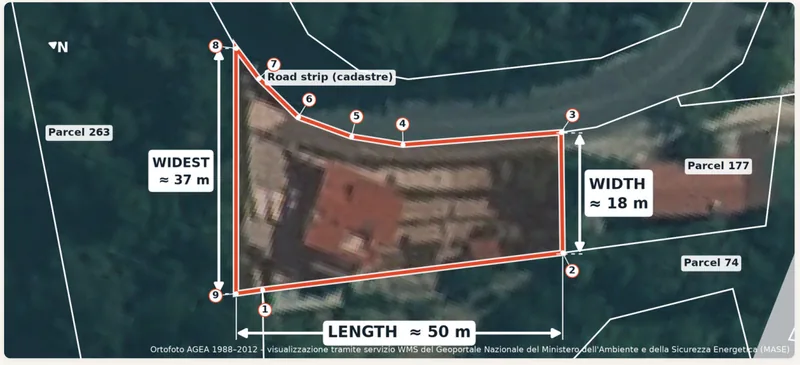
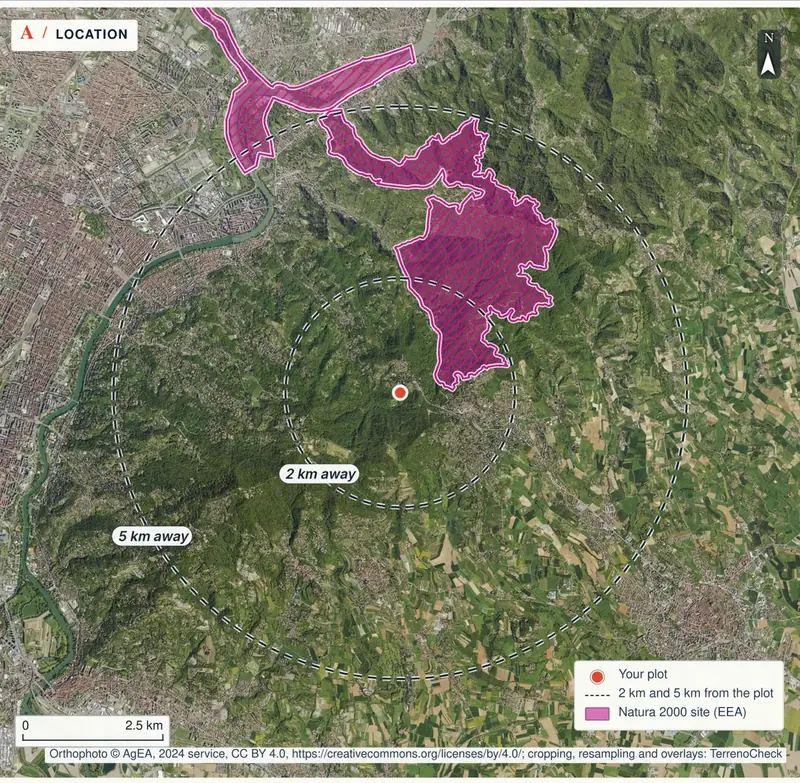
Your plot, read before you apply for a mortgage
Pick the parcel on the map: zoning, constraints, hazards, access and cadastral status are read for that plot, each with a source and date, before you apply for a mortgage and sign a preliminary contract.
€29 in English or Italian · €39 in both languages · total, VAT included