
Pillar guide: Hazards and constraints
Legga questo articolo in italiano.
Power lines near property in Italy: buffer zones and easements
On this page
Italy has no single distance in metres from power lines: the buffer zone is worked out line by line, from a quality target of 3 microtesla and the current the line carries. If you build, or change a building’s use, it may not be put to use as a home, school or healthcare facility, or for stays of four hours or more a day, inside that zone (Law 36/2001, Article 4); the figure to ask for is the DPA, through the comune (the municipality), which passes the request to the line operator. For a house that already stands next to an existing line, the reference is the 10 microtesla attention value, checked with a 24-hour measurement.
In short
- Inside a power line’s buffer zone a building may not be put to use as a home, school or healthcare facility, or for stays of four hours or more a day (Law 36/2001, Article 4): this governs new buildings and new uses. For an existing house near an existing line, the reference is the 10 µT attention value.
- The zone has no fixed width: it depends on the line and is calculated on the 3 µT quality target; the plan distance that contains it is called the DPA.
- To build near an existing line you ask the comune for the DPA; it passes the request to the line’s owner or operator and can have the regional environmental protection agency (ARPA) check it.
- An electricity line easement leaves the land with its owner, who, unless the deed says otherwise, may build even if the line then has to move, offering another suitable route.
3 µT
Quality target
For new homes near existing lines and new lines near homes; 24-hour median.
10 µT
Attention value
In homes and places where people stay four hours a day or more.
4 hours
Stays barred inside the zone
No homes, schools or healthcare uses inside the buffer zone.
Already have a parcel in mind? The report runs these checks on your land, with a source and date for every finding: €29 in English or Italian · €39 in both languages · total, VAT included.
No fixed distance: the zone is calculated line by line
The rule that matters to a buyer is in Italy’s framework law on electromagnetic fields: inside the buffer zones (fasce di rispetto) of electricity lines, “no building may be put to residential, school or healthcare use, or to any use involving a stay of four hours or more” (Law 36/2001, Article 4(1)(h)). A tool store where nobody stays four hours a day is outside that ban; a home, an office or a holiday let falls within it.
How wide is the zone? That depends on the line. The Prime Ministerial Decree (DPCM) of 8 July 2003 says it is worked out from the 3 µT quality target and the current the line carries in normal service, which the operator declares to the Environment Ministry for lines above 150 kV and to the regions for lines up to 150 kV; operators then send the data and the width of the zones to the authorities that check them (Article 6). The calculation method was approved by a ministerial decree of 29 May 2008.
In Italian law an electricity line (elettrodotto) means the whole set of power lines, substations and transformer cabins (Article 3(e)). The regions set the routes of lines up to 150 kV, with buffer zones and a duty to mark them; routes above 150 kV are set by the State (Articles 4 and 8).
Three thresholds for the magnetic field
The DPCM sets three values for the magnetic field of 50 Hz power lines, measured in microtesla (µT), and each applies in a different situation.
The framework law explains what each one is for. The exposure limit protects health from acute effects. The attention value is a precaution against possible long-term effects and must not be exceeded in homes, schools and places where people stay for long periods. Quality targets aim to reduce exposure step by step and also include siting criteria and planning standards set by regional laws (Law 36/2001, Article 3), so read the region’s law and the comune’s plan as well as the national values.
| Threshold | Value | Where and when it applies |
|---|---|---|
| Exposure limit | 100 µT (and 5 kV/m for the electric field) | Never to be exceeded (Article 3(1)) |
| Attention value | 10 µT, 24-hour median | Children’s play areas, homes, schools, places where people stay four hours a day or more (Article 3(2)) |
| Quality target | 3 µT, 24-hour median | Design of new lines near those places, and of new developments near lines already there (Article 4) |
If you are buying an existing house next to an existing line, the reference is the 10 µT attention value. If you are buying land to build on, the 3 µT target counts, because the new house is a new development near an existing line; it is also the value on which the buffer zone is calculated.
Sources: Prime Ministerial Decree of 8 July 2003; accessed 12 November 2026.
The buffer zone and the DPA: what to ask for
The buffer zone is the space around the line, above and below ground, where the magnetic field equals or exceeds the quality target. It is a volume, not a strip on a map. For planning a simpler figure is used, the first-approximation distance (distanza di prima approssimazione, DPA): the distance on plan from the line’s centre beyond which every point is certainly outside the zone. For a transformer cabin the DPA is measured from every face of the structure.
The DPA works for a straight stretch. Where lines cross, run in parallel, branch or change direction, the operator calculates a first-approximation area instead, and the simple DPA does not apply to the two spans sharing an angle pylon. If the building you plan falls even partly inside the DPA or that area, the exact zone has to be calculated (ISPRA guidance on the Decree of 29 May 2008).
The 2008 method covers overhead and underground lines, existing and planned, and ISPRA guidance applies it to transformer cabins too. The decree excludes, however, lines run at frequencies other than 50 Hz, class zero and class one lines under interministerial decree 449/1988, and medium-voltage lines in helically twisted cable, underground or overhead; for these the zones are narrower (Decree of 29 May 2008, annex, section 3.2). For an underground cable along the boundary or a cabin at the end of the garden, first ask the operator for the line’s type, voltage and layout, then whether a DPA is needed. This guide gives no DPA figures by voltage, because the operator supplies them for the specific line.
Sources: ISPRA guidelines for comuni (2012); Ministerial Decree of 29 May 2008; accessed 12 November 2026.
How to get the DPA and have the field measured
ISPRA’s guidelines for comuni set out the procedure for building near an existing line. It happens before the design stage, and is best done before you sign the preliminary contract (compromesso).
- Identify the line and its spans (a day, on site and on the map). Note the nearest pylons or poles and any marked cabins or underground cables.
- Ask the comune for the DPA (planning or building office). In complex cases, such as crossings or bends, ask for the first-approximation area, naming the lines and spans.
- If you need to build closer, ask for the buffer zone itself. This is only needed if the building falls inside the DPA or the first-approximation area.
- The comune passes the request to the line’s owner or operator. No national deadline applies: response times are set by local agreements, so ask the comune how long it usually takes.
- A check by ARPA, if the comune asks for one. The comune can ask ARPA to verify the operator’s calculation.
For an existing house the question is different: how strong the field is in the rooms. The buffer zone method is for planning new buildings near existing lines; the exposure of people already living near a line is checked by measurement (Decree of 29 May 2008, annex, section 3.1). The DPA alone does not tell you whether an existing house can be lived in. ISPRA guidance calls for readings logged over at least 24 hours, with a value at least every minute, ideally in the season when the line carries most load. A reading taken over a few minutes cannot be compared with a 24-hour median.
The electricity line easement
A line crossing private land is governed by an electricity line easement (servitù di elettrodotto). Every owner must let electricity lines, overhead or underground, pass across their land in line with the relevant laws (Civil Code, Article 1056). The easement lets the operator lay underground cables and put up supports, run wires over the land, install cabins, cut branches that could cause short circuits and send staff along the route (Royal Decree 1775/1933, Article 121). Houses are exempt, except for façades facing public streets and squares, and so are the courtyards, gardens, orchards and farmyards that belong to them.
What matters most to a buyer is what the owner keeps. The easement takes away neither ownership nor possession, and taxes and charges on the land stay with the owner. The owner may not make the easement harder to use but, unless the deed creating it says otherwise, may carry out any change, building or installation on the land, even if it forces the operator to move wires and supports, without owing the operator anything; the owner must, however, offer another suitable place where possible (Article 122).
Read the deed that created the easement, because it may contain exactly those “other terms” that limit building. The right to build under Article 122 does not override the ban on residential use inside the buffer zone. On compensation, for energy lines the decree imposing the easement states the amount (DPR 327/2001, Article 52-octies); the general compensation rules for easements do not apply to easements governed by special laws (Article 44(4)). How to read an easement in the title deeds is covered in our guide to access and servitù di passaggio.
Hypothetical example
An olive grove crossed by a line
A hypothetical example. A 6,000 m² olive grove for sale is crossed by an overhead line, and the buyer wants to build a house on the far side. Before the preliminary contract the buyer asks the seller for the deed that created the easement and finds it has no terms on building. The buyer then asks the comune for the DPA for the two spans over the land. The answer shows the chosen spot is outside the DPA; the preliminary contract refers to that answer and makes the purchase conditional on the building permit.
Sources: Royal Decree 1775/1933, Article 122; ISPRA guidelines for comuni (2012); accessed 12 November 2026.
Before you buy: what to check
A nearby line changes what you can build and live in on the land. These are the checks to close before the preliminary contract. Other buffer zones that can overlap, from roads and cemeteries, are covered in our guide to cemetery and road buffer zones.
Power lines near property in Italy: buffer zones and easements
https://terrenocheck.it/en/guide/power-lines-near-property-italy
Checklist
Before you make an offer on land near a power line
Common questions
How far from a power line can I build a house in Italy?
There is no single figure. The house must be outside the line’s buffer zone, which is calculated on the 3 µT quality target and the line’s current (Prime Ministerial Decree of 8 July 2003, Articles 4 and 6). The plan distance that contains the zone, the DPA, is supplied by the line’s owner or operator on a request passed on by the comune.
Do buffer zones apply to underground cables and substations too?
It depends on the line. In Italian law an electricity line (elettrodotto) covers lines, substations and transformer cabins (Law 36/2001, Article 3), and the 2008 method covers overhead and underground lines, existing and planned. It excludes, however, lines run at frequencies other than 50 Hz, class zero and class one lines under interministerial decree 449/1988, and medium-voltage lines in helically twisted cable, underground or overhead; for these the decree says the zones are narrower (Decree of 29 May 2008, annex, section 3.2). Before asking for a DPA, ask the operator for the line’s type, voltage and layout. For a cabin the DPA is measured from every face of the structure.
The house I want to buy already stands near a line. Which value matters?
In homes the attention value of 10 µT applies, as the median of readings over 24 hours under normal operating conditions (Prime Ministerial Decree of 8 July 2003, Article 3). The 3 µT target governs the design of new lines near homes and of new homes near lines already there (Article 4).
Can the owner build under a line that crosses the land?
The easement does not take away ownership. Unless the deed that created it says otherwise, the owner may build or install anything on the land even if the operator then has to move wires and supports, without compensating the operator, offering where possible another suitable place (Royal Decree 1775/1933, Article 122). The buffer zone and its limits on use still apply.
Is compensation paid for a power line easement?
For energy lines, the decree imposing the easement states the amount of compensation (DPR 327/2001, Article 52-octies). If you are buying land that already carries one, ask the seller for the deed or decree and for any sums paid.
Who can measure the magnetic field inside a house?
ISPRA guidance calls for recordings over at least 24 hours, with a reading at least every minute, during the line’s peak-load period where that is known. The comune can ask ARPA to check the operator’s buffer zone calculation; for a measurement, ask the ARPA in your region how to request one.
Keep reading
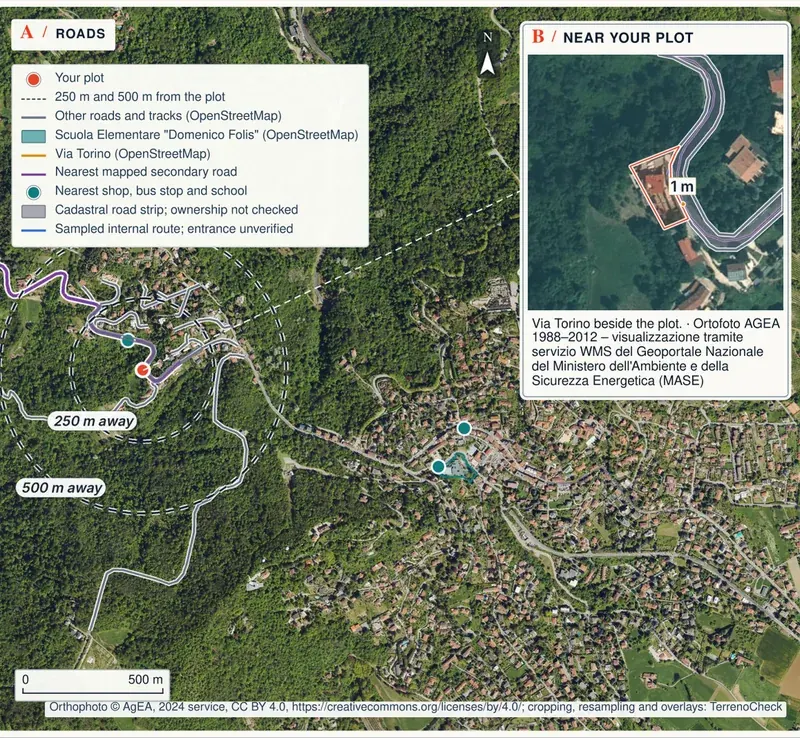
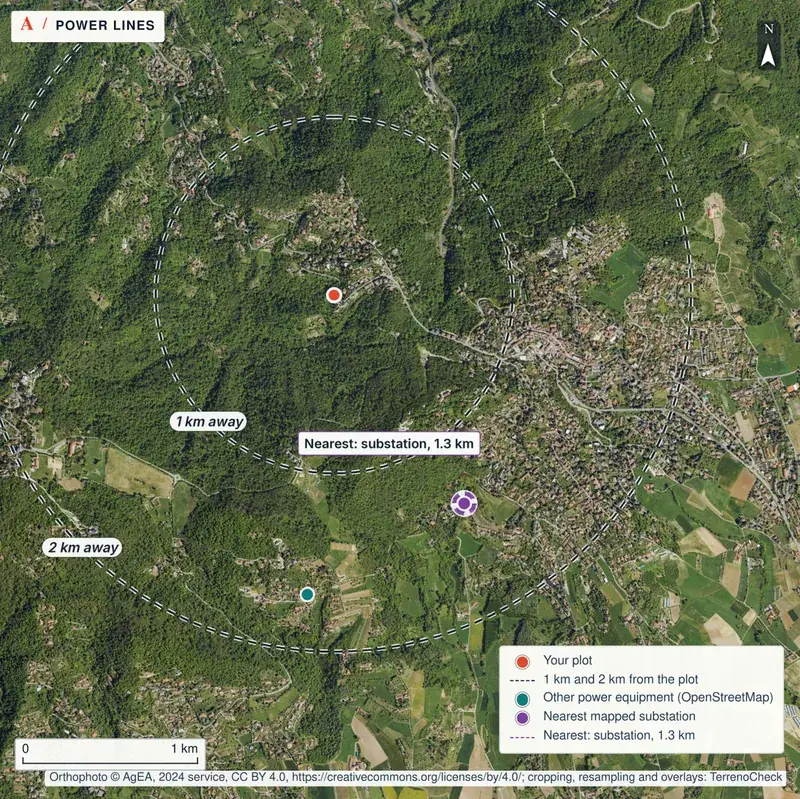
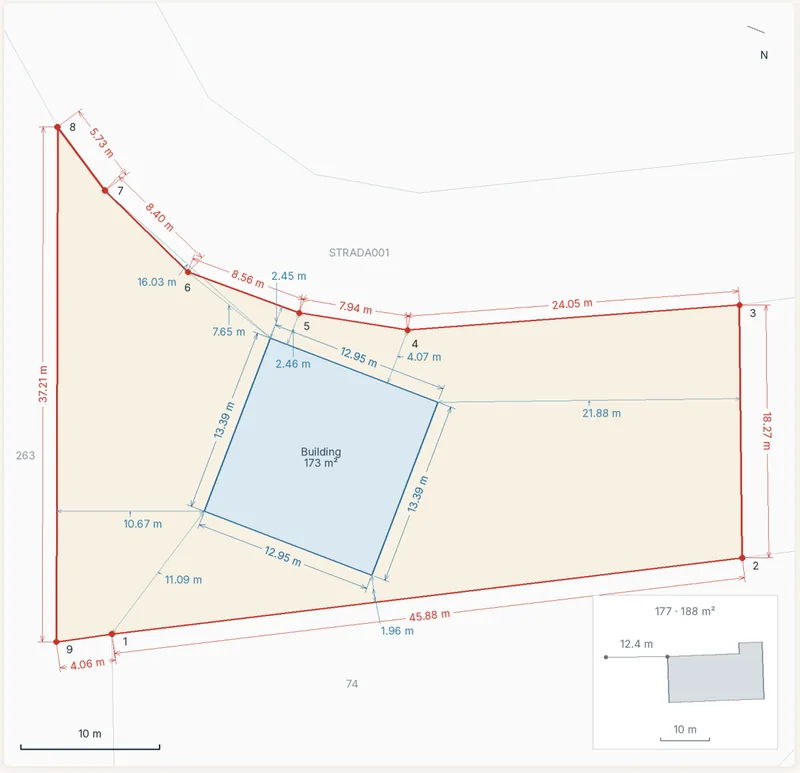
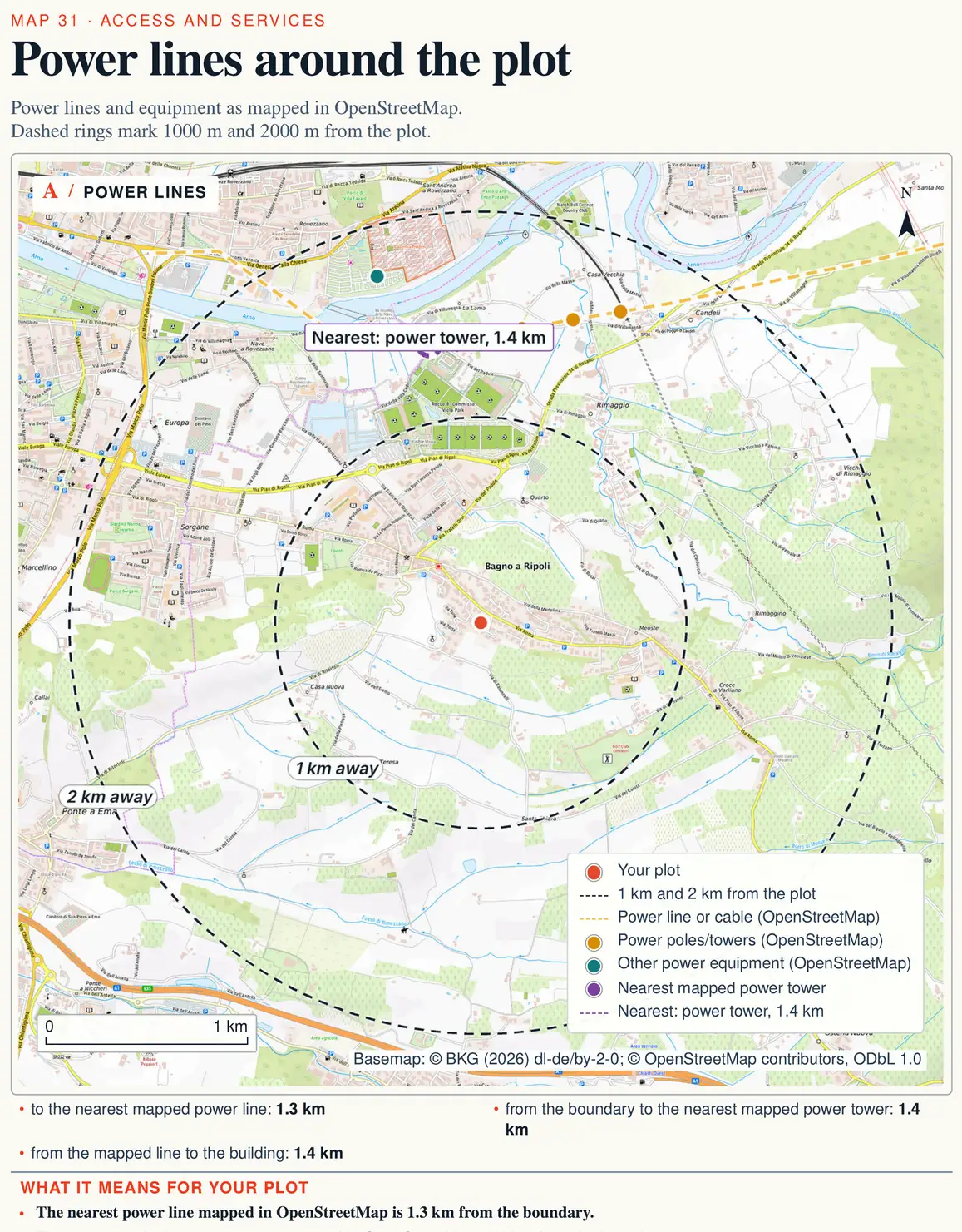
Power lines and constraints around the plot
Pick the parcel on the map: mapped power lines and equipment, access, buffer zones and constraints are read for that plot, each with a source and date, along with the questions to put to the comune and the operator.
€29 in English or Italian · €39 in both languages · total, VAT included