
Pillar guide: Water and services
Legga questo articolo in italiano.
Rural house without mains water in Italy: what to check
On this page
Before buying an Italian rural house without mains water, request the well or supply documents and the test reports for water used in the kitchen. Ask the local ASL health authority about drinking-water checks and the competent regional office about abstraction. A tank does not by itself establish a lawful, adequate supply.
In short
- Ask the water company whether connection is feasible for this property, with a delivery point, route and written quotation.
- For a well, check the abstraction documents and permitted use. Article 93 concerns domestic use by the landowner, subject to legal distances and precautions.
- Article 17 exempts the specified rainwater collection from an abstraction licence or concession. It does not exempt the tank from building and other applicable rules.
- Drinking water needs the applicable checks under D.Lgs. 18/2023. Clear-looking water does not replace the health authority’s assessment.
ASL
Local health authority
Ask which checks apply to your source and use; do not assume one testing frequency fits every house.
D.Lgs. 18/2023, Articles 3–4
Article 93
Domestic well use
Landowner, legal distances and precautions; check territorial procedures and the actual use.
RD 1775/1933, consolidated water law
Article 17
Rainwater collection
The specified collection needs no abstraction concession; the tank remains subject to other applicable law.
RD 1775/1933, consolidated water law
The report brings together public information about the land, with sources and dates, to prepare questions for the relevant offices: €29 in English or Italian · €39 in both languages · total, VAT included.
Identify the water actually reaching the kitchen
During the viewing, ask the seller to show you which source supplies the kitchen tap. “There is a well” leaves several questions unanswered: whether irrigation and indoor use share it, whether water passes through a tank, and what treatment is operating. Ask for a sketch of the system that your technician can check.
Collect the source documents and the available test results. A utility bill, laboratory report and tanker-delivery invoice provide different evidence. A delivery invoice does not show water quality after storage; a sample from months ago does not automatically describe water at the tap on completion day.
For an overseas buyer, establish who currently manages the system. Ask where the records are kept and who can explain maintenance in a language you understand. The country-house purchase guide covers the other property checks. Here the purpose is to trace the supply and allocate outstanding investigations before a deposit is paid.
Obtain a mains-connection quotation before ruling it out
Contact the water company for the address and cadastral parcel. Ask where it could provide a delivery point, which pipe route is envisaged and who would construct each part. If the route crosses somebody else’s land, take the drawing to your notary: physical access does not settle the legal right to keep a pipe there.
The written quotation should distinguish the company’s work from the owner’s work. Ask how construction dates are set and which applications or other conditions must be completed first. A pipe visible along the road does not confirm a connection offer or the pressure available at the house.
Do not calculate the cost simply from map distance. Follow the supplier’s published quotation or inspection procedure and retain its response, including validity, exclusions and conditions. The utility-connections guide helps you consider water alongside electricity and the physical access route.
- NetworkSupplier: feasibility, delivery point and quotation
- WellCompetent authority: documents and permitted use
- Drinking waterASL: applicable source and use checks
- Storage and deliveriesTechnician and supplier: usable capacity, maintenance and service
Sources: RD 1775/1933, consolidated water law Article 93: domestic use; RD 1775/1933, consolidated water law Article 17: abstraction and rainwater; D.Lgs. 18/2023, current Article 4: water-quality requirements; D.Lgs. 18/2023, current Article 3: scope and exemptions; DPR 380/2001, Article 6: agricultural rainwater tanks and other rules; accessed 13 November 2026.
Well water: check the source and its permitted use
Article 93 of the consolidated water law attached to RD 1775/1933 allows the landowner to extract and use groundwater for domestic purposes, subject to legal distances and precautions. It includes watering gardens and vegetable plots directly serving the owner and family, and watering livestock. Citing that provision does not complete every check for a particular well.
Ask the regional authority or delegated office which documents apply to this abstraction: notices, any decisions and the declared use. If you intend to provide guest accommodation or run a business, describe that at the outset. Do not have a commercial supply assessed as though it served only a family home.
For abstractions outside Article 93 and the separate Article 17(2) exception, Article 17 requires an authorising or concessionary decision. Obtain the seller’s complete file and any correspondence from the authority. An operating pump shows that equipment works; it does not establish the legal basis of the abstraction.
| Source or equipment | What to request | Who resolves the outstanding issue |
|---|---|---|
| Public network | Quote, delivery point and excluded works | Water-service company |
| Well | Abstraction documents, use and available yield data | Competent authority and technician |
| Delivered water | Documented origin, quantity and service terms | Supplier; ASL for health questions |
| Rainwater tank | Intended use and tank design | Municipality, technician and ASL where drinking-water use is involved |
| Treatment equipment | Specification, maintenance and checks | Installer and appointed professional, following ASL guidance |
Read a water test with its sampling details
D.Lgs. 18/2023 requires water intended for human consumption to be wholesome and clean and meet the applicable requirements (Article 4). Article 3 sets out scope and exemptions. Ask the ASL, the local health authority, to identify the relevant case, especially for guests or business use. Do not assign an exemption yourself based on occupancy alone.
Check the sample date, identity and sampling point on a laboratory report. Ask what treatment was operating and whether the result describes untreated well water or water at the household tap. Your adviser must be able to connect the report with the system you will use after purchasing.
The appropriate parameters and testing arrangements depend on the source, risks and applicable use. Request written guidance before commissioning a laboratory, with a quote and reporting time. A commercial testing package is not itself evidence that every necessary check for your case has been included.
Tanks and rainwater: calculate usable storage
Article 17(2) does not require an abstraction licence or concession for the rainwater collection it describes in tanks and reservoirs serving agricultural land or individual buildings. Construction remains subject to building, seismic and the other laws referred to there. The collection regime also does not turn rainfall into drinking water.
Request the usable volume rather than counting storage the installation cannot draw from. Identify the uses to be supplied and how networks carrying different water qualities will be kept separate. Tell the professional whether your requirement is garden irrigation or kitchen water; those should be specified independently.
A hypothetical arithmetic example, not an estimate of family consumption: 8 cubic metres of usable storage divided by an assumed daily demand of 0.4 cubic metres gives 20 days without replenishment. Replace that assumed demand with your own design data. The result does not guarantee summer autonomy, since it says nothing about the next rainfall or delivery.
If you will be absent for long periods, include that in the brief. Ask the installer what maintenance and recommissioning the particular system needs, and who can carry it out locally. Keep operating instructions with the property records so that a caretaker does not have to infer how different supplies are connected.
Sources: RD 1775/1933, consolidated water law Article 93: domestic use; RD 1775/1933, consolidated water law Article 17: abstraction and rainwater; D.Lgs. 18/2023, current Article 4: water-quality requirements; D.Lgs. 18/2023, current Article 3: scope and exemptions; DPR 380/2001, Article 6: agricultural rainwater tanks and other rules; accessed 13 November 2026.
Compare annual costs using quantities and records
Ask the seller for records covering a period that includes summer: deliveries, maintenance and testing, where available. Separate recurring expenditure from a breakdown or one-off intervention. If records are missing, obtain quotations for the installation and service you will actually use rather than adopting the seller’s informal annual estimate.
Compare delivered quantities and service conditions, including road access, discharge point and any necessary works. A deliberately hypothetical quote of €240 for 8 cubic metres would equal €30 per cubic metre; six identical deliveries would cost €1,440. These are arithmetic assumptions, not market prices. They show how to compare the same quantity in written offers.
Your total should also cover treatment, pump electricity and required checks using documents or quotations. The purchase cost of an existing well or tank is not the full supply cost. Check wastewater arrangements separately, particularly if you plan to change how the property is used.
Close the unresolved checks before the preliminary contract
- At the viewing, with the seller: identify sources, pipes and tanks; request records before the offer.
- Before the deposit, with the water company: request connection feasibility and a quotation, including the expected response and works dates.
- Before signing, with the abstraction authority: check the well file and intended use; ask the office for the applicable procedure, documents and timing.
- Before relying on drinking water, with the ASL and laboratory: agree investigations and sampling, with cost and delivery dates for the results.
- In the preliminary contract, with the notary: specify how outstanding checks will be evidenced, who pays for necessary work and which results must be obtained before completion.
Include the handover in the inspection brief
Ask to see how the tank is accessed for cleaning and maintenance. Where water is delivered, inspect the vehicle route with the technician and have the supplier confirm the service conditions. A road that suits a passenger car does not establish that the proposed delivery can be made.
At handover, request an inventory of the documents and instructions you will receive, including the system drawing, maintenance contacts and available service records. If the seller offers to improve the system before completion, identify the proposed work and the evidence of completion. Installing a filter should not replace checking the entire route from source to tap. Have the professional define the result needed and the notary reflect any outstanding obligation in the contract.
Rural house without mains water in Italy: what to check
https://terrenocheck.it/en/guide/rural-house-without-mains-water-italy
Checklist
A documented supply
Common questions
Can a house without mains water be used as a home?
The absence of a connection is only part of the question. Have the building records, water source, availability and applicable sanitary requirements checked with the municipality and ASL before buying.
Is the well water drinkable?
The seller drinking it is not evidence of compliance. Request the laboratory reports, sampling point and date, and treatment records; ask the ASL which checks apply.
Does rainwater collection need a concession?
Article 17(2) exempts the collection it describes from an abstraction licence or concession. Building and other laws still govern the tank or reservoir.
Does the TerrenoCheck report test the well?
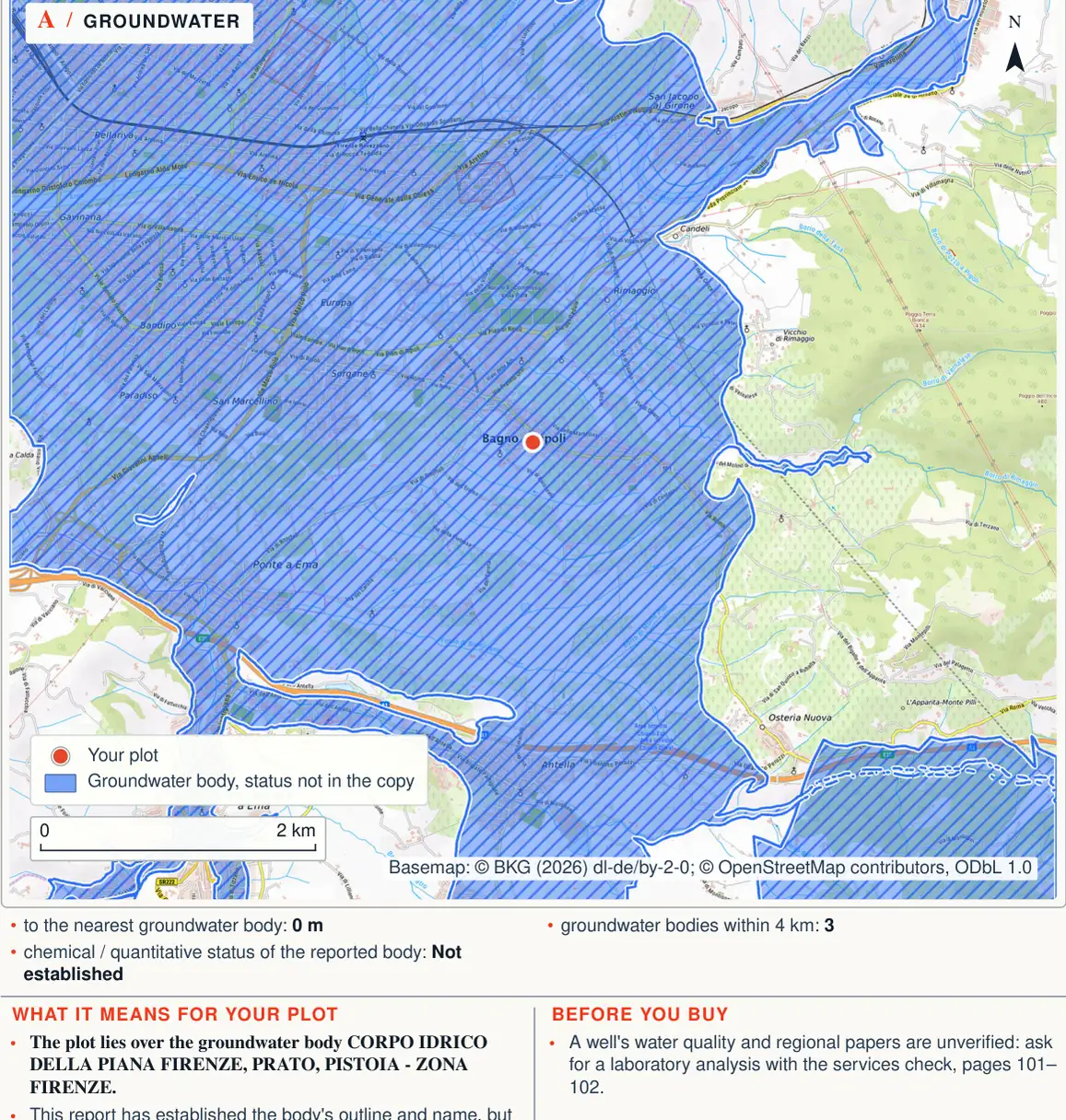
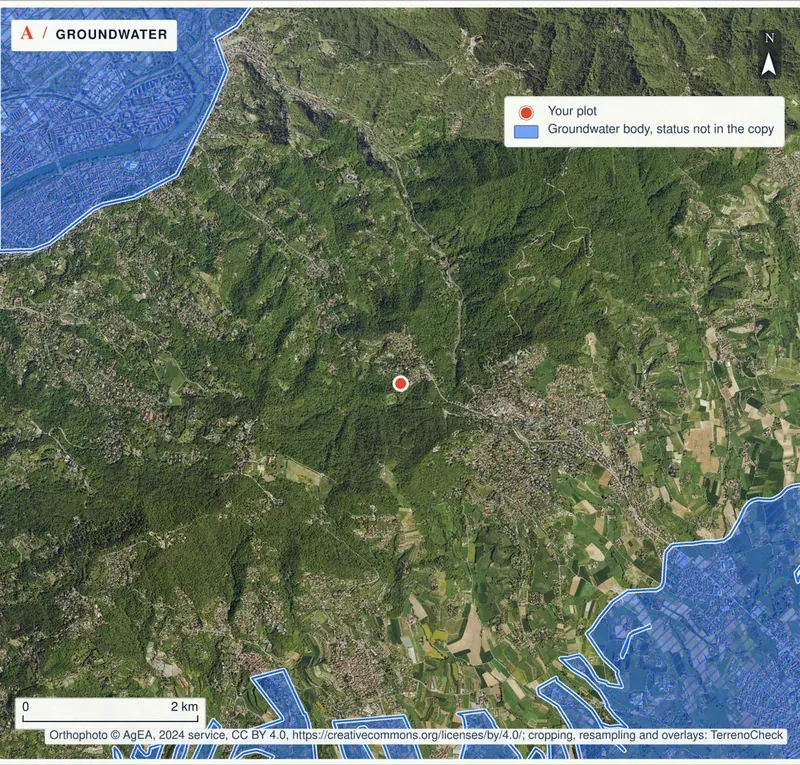
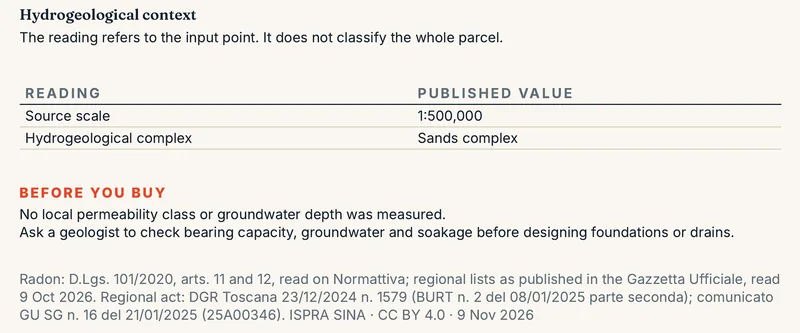
No. Its groundwater map provides territorial context; it does not test a well, measure its yield or certify drinking-water quality.
Keep reading
Prepare the questions for your parcel
Select the land on the map to review its territorial information, sources and questions to take to the relevant offices before buying.
€29 in English or Italian · €39 in both languages · total, VAT included