
Pillar guide: Planning and the building
Legga questo articolo in italiano.
Solar panels on agricultural land in Italy: ban and exceptions
On this page
On land the comune’s plan zones as agricultural, ground-mounted solar panels are allowed only in the areas listed in Article 11-bis, paragraph 2, of Legislative Decree 190/2024, including land within 300 metres of a motorway and land within 350 metres of an industrial plant not used for farming, livestock or renewable energy. Agrivoltaic systems with raised panels remain allowed if they keep at least 80% of the farm output.
In short
- Ground-mounted panels on land zoned agricultural only in the areas the law lists: existing plants without enlarging the area, disused quarries and mines, closed landfills, railway, motorway and airport sites, land within 350 m of an industrial plant not used for farming, livestock or renewable energy, land within 300 m of a motorway (Legislative Decree 190/2024, Article 11-bis).
- Agrivoltaics with raised panels are always allowed, backed by a sworn statement from a qualified professional that at least 80% of the saleable farm output is kept; the ban does not apply to projects for renewable energy communities or under Italy’s National Recovery and Resilience Plan (PNRR) or its complementary plan (PNC).
- Breaching the ban carries a fine of €1,000 to €100,000 plus restoration of the site, payable by the plant owner, the contractor and the works director; a plant built without a permit or departing from it falls under the separate amounts in paragraphs 1–4 of Article 11 of Legislative Decree 190/2024.
- The statutory guarantees for dismantling and restoration depend on the plant’s permit route (permit-free works, PAS, single authorisation) and are required by the authorities; the removal date and a guarantee in the landowner’s favour belong in the contract, which should be entered in the property registers, because when the right expires the landowner becomes owner of the plant (Civil Code, Article 953).
80%
Farm output to keep
For agrivoltaics, certified in a sworn statement attached to the project.
350 m
From an industrial plant
If the plant is not used for farming, livestock or renewable energy, agricultural land inside this perimeter can take ground panels; for motorways the limit is 300 m.
€1,000–100,000
Fine for breaching the ban
Unless the plant lacks a permit or departs from it, which carries separate amounts (Article 11, paragraphs 1–4). Plus restoring the site; it also applies to agrivoltaics that stop the farming.
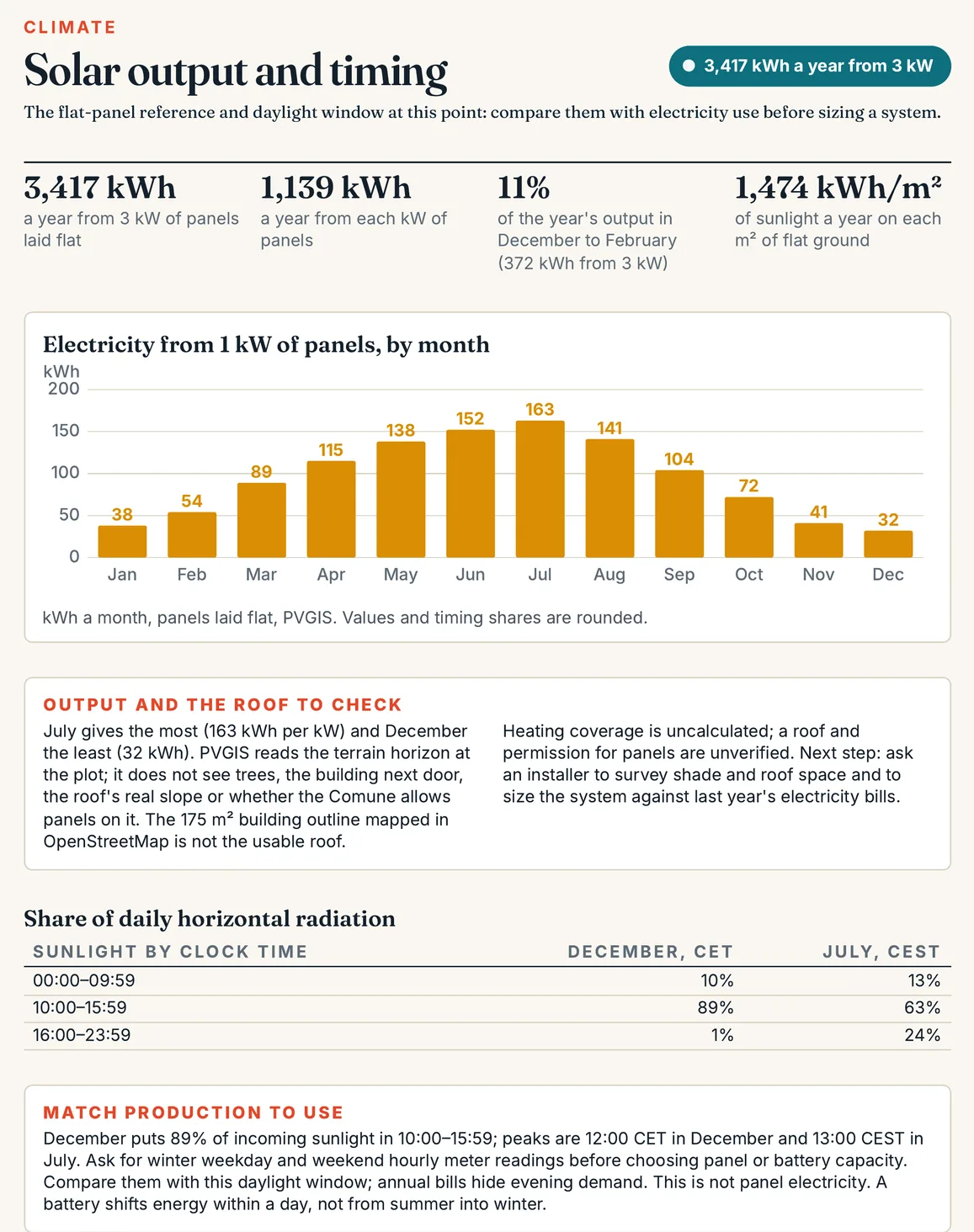
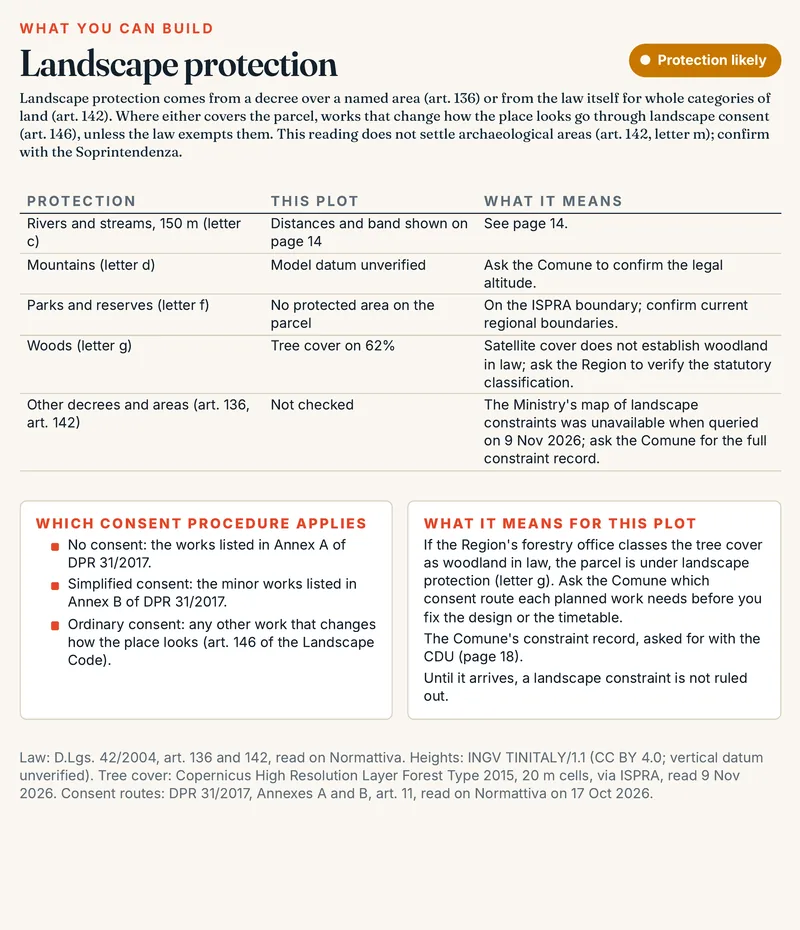
The report brings together public information about the land, with sources and dates, to prepare questions for the relevant offices: €29 in English or Italian · €39 in both languages · total, VAT included.
What the law bans, in short
The ban covers solar plants with panels mounted on the ground in zones classified as agricultural by the planning instruments in force. What matters is the zone in the comune’s town plan, shown on the zoning certificate (CDU), not the land quality written in the cadastre (the Italian land register). In those zones a plant is allowed only in the areas that Article 11-bis, paragraph 2, of Legislative Decree 190/2024 refers to.
| Area in an agricultural zone | Ground panels | Condition |
|---|---|---|
| Site with a plant already installed | Yes | Only modification, rebuilding, upgrading or reconstruction, with no increase in the area occupied |
| Disused, unrestored, abandoned or degraded quarries and mines | Yes | Including parts of quarries that can no longer be worked |
| Landfills or landfill cells that are closed or restored | Yes | |
| Sites of the state railways, rail operators and motorway concession holders | Yes | Sites at their disposal |
| Airport grounds | Yes | Subject to technical checks by ENAC, the civil aviation authority |
| Areas inside industrial plants and agricultural land within 350 m of them | Yes | Plants not used for farming, livestock or renewable energy |
| Land next to a motorway | Yes | Within 300 m of the motorway network |
| Any agricultural land, as agrivoltaics | Yes | Raised panels and a sworn statement on 80% of saleable farm output |
| Other land in an agricultural zone | No | Except projects for renewable energy communities and PNRR or PNC projects |
Paragraph 2 sets no power threshold and, among the suitable areas in paragraph 1, it does not include buildings and their appurtenant outdoor areas (letter l, point 3). If you are thinking of a few ground panels beside a farmhouse, ask the comune’s one-stop planning office (sportello unico) whether the array falls under the ban before you order anything. Rooftop panels are a separate matter: they are not ground-mounted, and buildings count as suitable areas.
- Area on the paragraph 2 listDisused quarries and mines, closed landfills, railway, motorway and airport sites, within 300 m of a motorway, within 350 m of an industrial plant not used for farming, livestock or renewable energy, existing plants without a larger area
- AgrivoltaicsRaised panels and a sworn statement: at least 80% of saleable farm output kept
- Energy community or PNRR/PNCThe ban does not apply to these projects
- Other land zoned agriculturalNo ground panels; projects already under way follow the transitional rules
Sources: Legislative Decree 190/2024, Article 11-bis; accessed 12 November 2026.
Where the rule comes from and which text to read
The ban was introduced by Decree-Law 63/2024, in force from 16 May 2024, as paragraph 1-bis of Article 20 of Legislative Decree 199/2021. That article has since been repealed. Decree-Law 175/2025, published in the Gazzetta Ufficiale on 21 November 2025 and converted by Law 4 of 15 January 2026, moved the rule into Article 11-bis of Legislative Decree 190/2024, the act that governs permits for renewable energy plants. On Normattiva, the official database of Italian law, Article 11-bis shows a text in force from 10 November 2026.
Two transitional rules matter if a project is already under way. Decree-Law 63/2024 exempted projects for which, on 16 May 2024, at least one of the procedures needed for the permits had been started, environmental assessments included, or at least one permit had been issued (Article 5, paragraph 2). Decree-Law 175/2025 provides that the list of suitable areas in paragraph 1 of Article 11-bis and the simplifications in Article 11-quater do not apply to procedures pending when it came into force, meaning those whose documents had already passed the completeness check; they continue under the earlier rules, and where the land has high agricultural value the region may object using the remedy in Article 14-quinquies of Law 241/1990.
The ban, date by date
- 16 May 2024Decree-Law 63/2024 in force: ground panels banned in agricultural zones, as paragraph 1-bis of Article 20 of Legislative Decree 199/2021
- 30 December 2024Legislative Decree 190/2024 on permits for renewables comes into force
- 21 November 2025Decree-Law 175/2025, published in the Gazzetta Ufficiale, moves the rule into Article 11-bis of Legislative Decree 190/2024; Article 20 is repealed
- 15 January 2026Conversion Law 4/2026
- 10 November 2026Text of Article 11-bis in force on the date of this guide
Sources: Decree-Law 63/2024, Article 5; Legislative Decree 199/2021, Article 20; Decree-Law 175/2025 (GU no. 271/2025); Legislative Decree 190/2024, Article 11-bis; accessed 12 November 2026.
The exceptions: agrivoltaics, energy communities, PNRR projects
Agrivoltaics. An agrivoltaic plant is a solar plant that keeps crops or grazing going on the site; it may use tracking panels raised off the ground and precision-farming tools (Article 4, paragraph 1, letter f-bis). In an agricultural zone it is always allowed if the panels are mounted suitably high. The developer must obtain a sworn statement (dichiarazione asseverata) from a qualified professional certifying that the plant keeps at least 80% of the saleable farm output; the statement is attached to the project and made available for inspections.
For five years after the plant is built, the comune checks that the site is still fit for farming or grazing. An agrivoltaic plant that stops the farming is fined like a banned plant (Article 11, paragraph 8). For a landowner this means the contract must say who farms under the panels and who answers if the farming stops.
The minimum heights of 2.1 m for crops and 1.3 m for livestock, the 70% of farmed area and the 60% of electricity output are conditions of Ministerial Decree 436/2023 for the PNRR incentives for agrivoltaics, for plants to be completed by 30 June 2026. They apply to those incentives, not as a general rule for every plant.
Energy communities and PNRR projects. The ban does not apply to ground-mounted projects set up to form a renewable energy community (Article 31 of Legislative Decree 199/2021), to projects implementing measures of the PNRR (Italy’s National Recovery and Resilience Plan, funded by the EU) and its complementary plan (PNC), or to projects needed to meet PNRR targets.
Suitable areas: what the regions decide
On top of the national list, each region designates further suitable areas for renewables by its own law, within 120 days of the provision coming into force; if the law is missing or does not meet the national criteria and targets, Article 41 of Law 234/2012 applies (Article 11-bis, paragraph 3). The criteria are national: agricultural land designated as suitable at regional level must be between 0.8% and 3% of the utilised agricultural area (SAU), including land under agrivoltaics, and the region may set a different ceiling for each comune. Land inside the boundary of assets protected under the Cultural Heritage and Landscape Code cannot be designated, nor land within 500 m of them for solar.
Paragraph 2, the ban itself, refers only to the areas in paragraph 1, not to those added by regional laws. To find out how your region’s law treats agricultural land, ask the region’s energy office or the comune’s one-stop planning office (sportello unico).
If you still see the Ministerial Decree of 21 June 2024 on suitable areas quoted, note that the Lazio Regional Administrative Court annulled paragraphs 2 and 3 of its Article 7, to the extent set out in its reasoning, in judgment 9155 published on 13 May 2025, and ordered the ministries to rewrite the criteria. Before relying on that decree, ask the region whether and how it applies it.
Surface right or lease: what the landowner signs
An operator rarely buys the land. It usually asks for a surface right (diritto di superficie): the right to build and keep the plant on someone else’s land, with the operator owning the plant (Civil Code, Article 952). The operator must have the land available, at a point that depends on the permit route. For permit-free works it must have it, on any legal basis, before work on the project starts (Legislative Decree 190/2024, Article 7, paragraph 1). Without the land available the simplified permit procedure (PAS) cannot be used and the single authorisation applies; a PAS filing must include a declaration that the developer lawfully has the land, on any legal basis including a preliminary contract, for the plant’s whole working life (Article 8, paragraphs 2 and 4, letter b).
Four Civil Code rules to read before signing:
- Expiry. If the right is for a fixed term, it ends when the term expires and the landowner becomes owner of the structure (Article 953). The operator’s duty to remove the plant before that date therefore has to be in the contract.
- Third-party rights. When the right ends by expiry, property rights the operator granted over it end too; leases of the structure last at most until the end of the current year (Article 954).
- Non-use. The right to build on someone else’s land is lost if it is not used for twenty years (Article 954).
- Registration. Contracts creating a surface right are entered in the property registers (trascrizione), as are leases of real estate longer than nine years (Article 2643).
The guarantees for dismantling and restoration that the law requires of the operator depend on the plant’s permit route (Legislative Decree 190/2024):
- Permit-free works (attività libera, Article 7, paragraph 7): if the plant takes up land not yet built on or otherwise altered by human use, the developer lodges a deposit by giving the comune a bank or insurance guarantee.
- Simplified permit procedure, PAS (Article 8, paragraph 4, letter i): the project includes an undertaking to restore the site and a restoration plan; before work starts, the developer provides a surety policy covering the expected costs.
- Single authorisation (autorizzazione unica, Article 9, paragraph 10, letter d): the permit estimates the cost of dismantling and restoration and sets the financial guarantees and the deadline for providing them, no later than 120 days after it is issued. No guarantees are due for plants on built surfaces or on car-park canopies. If the operator does not provide them in time, the authorisation lapses (Article 9, paragraph 11).
These guarantees are required by the authorities for the dismantling work. Ask the operator which permit route the project will follow and for a copy of the guarantee once it is provided. A guarantee in your own favour, covering unpaid fees, damage or late removal, exists only if you write it into the contract. Taxes on the deed depend on the type of right: the Agenzia delle Entrate rulings are summarised in our guide to buying land in Italy. If you sell the plot instead of granting a right, check the farmland pre-emption rights of neighbours and tenants.
| Clause | What it should say |
|---|---|
| Term and renewal | Number of years, start date, who may withdraw and with what notice |
| Permits | Who applies for permits and grid connection, by what date, and what happens if they are refused |
| Agrivoltaics | Who farms under the panels, who signs the 80% statement, who pays if the comune objects |
| End of the deal | Dismantling, disposal, restoring the soil, within how many months |
| Guarantees | Copy of the statutory guarantee (Article 7, 8 or 9); in addition a bank or insurance guarantee in the landowner’s favour, amount, duration |
| Registration | Notarial deed entered in the registers, and who pays for it |
Before you sign or buy: the checks in order
- Zone in the plan. Ask the comune’s planning office for the CDU: it must be issued within 30 days of the request and stays valid for one year as long as the plans have not changed (Presidential Decree 380/2001, Article 30). If the zone is agricultural, the paragraph 2 ban applies.
- An allowed area. Using the cadastral map and a straight-line measurement, check whether part of the land lies within 300 m of a motorway or within 350 m of an industrial plant not used for farming, livestock or renewable energy. Ask the operator to state in writing which letter of Article 11-bis the project relies on.
- Constraints. Listed cultural assets, protected areas and Natura 2000 sites rule out the permit-free route (Article 7, paragraph 2). Our guide to what you can do on non-building land explains how to find them.
- The contract. Have a notary read it before you sign anything, even a preliminary agreement, with the clauses in the table.
Hypothetical example
Arable land next to a motorway
A hypothetical example. A 6-hectare arable field zoned agricultural borders a motorway, and a strip of about 2 hectares lies within 300 m of it. An operator offers a 25-year surface right over the whole field. Under paragraph 2, ground panels can go only on the strip; on the rest, agrivoltaics with raised panels and the 80% statement are allowed, unless the project serves an energy community or the PNRR. The owner asks for a contract that names the letter of Article 11-bis for each area, who farms under the panels, the permit route with its statutory guarantee, removal before expiry backed by a bank guarantee in the owner’s favour, and registration of the deed.
Sources: Legislative Decree 190/2024, Article 11-bis; Legislative Decree 190/2024, Article 7; Legislative Decree 190/2024, Article 8; Legislative Decree 190/2024, Article 9; Civil Code, Article 953; Civil Code, Article 2643; accessed 12 November 2026.
Solar panels on agricultural land in Italy: ban and exceptions
https://terrenocheck.it/en/guide/solar-farm-on-agricultural-land-italy
Checklist
Before signing with a solar operator
Common questions
Can I put ground-mounted panels on my agricultural land?
Only if the land falls in one of the areas listed in Article 11-bis, paragraph 2, of Legislative Decree 190/2024 (for example within 300 m of a motorway, or within 350 m of an industrial plant not used for farming, livestock or renewable energy), if the system is agrivoltaic with raised panels and the sworn statement on 80% of farm output, or if the project serves a renewable energy community or the PNRR. Paragraph 2 sets no power threshold: for a small array next to the house, ask the comune’s one-stop planning office (sportello unico) whether it falls under the ban.
Does the ban cover panels on the roof of a house or barn?
Paragraph 2 concerns plants with panels mounted on the ground. Buildings, built structures and their outdoor appurtenant areas are among the suitable areas for solar (Article 11-bis, paragraph 1, letter l, point 3). Which procedure applies depends on where and how the panels are fitted, as set out in Annexes A and B of Legislative Decree 190/2024.
What counts: the cadastral quality or the zone in the plan?
The law refers to zones classified as agricultural by the planning instruments in force, so the zone in the comune’s plan decides. You read it in the zoning certificate (certificato di destinazione urbanistica, CDU). The cadastral quality, such as arable land or olive grove, does not decide on its own.
Is a project started before 2024 exempt?
Decree-Law 63/2024 exempted projects for which, on 16 May 2024, at least one procedure needed for the permits, environmental assessments included, had been started or at least one permit had been issued (Article 5, paragraph 2). That rule refers to Article 20 of Legislative Decree 199/2021, which has since been repealed: for a project of that period, ask the authority handling it to confirm.
When the surface right ends, who removes the panels?
The Civil Code says that when the term expires the surface right ends and the landowner becomes owner of the structure (Article 953). The statutory guarantees for dismantling and restoration depend on the permit route, with different conditions for permit-free works, PAS and the single authorisation (Legislative Decree 190/2024, Articles 7, 8 and 9). A removal date before expiry and a guarantee in the landowner’s favour have to be written into the contract.
Does selling or granting the land to an operator change taxes or pre-emption?
The taxes on the deed depend on the type of contract: our guide to buying land in Italy summarises the Agenzia delle Entrate rulings on surface rights for solar. If you sell a farm plot outright, ask the notary whether neighbours or tenants have a statutory right of pre-emption (prelazione agraria).
Keep reading
Non-building land in Italy: what you can really do on it
Buying agricultural land in Italy: pre-emption rights
The certificato di destinazione urbanistica (CDU): Italy’s zoning certificate, explained for foreign buyers
How to buy land in Italy: taxes, the notary, the CDU and every check before you sign
Zoning, constraints and sun, checked before you sign
Pick the parcel on the map: the comune’s plan, landscape constraints, protected areas and an estimate of solar output are read for that plot, each with a source and date, along with the questions to put to the comune.
€29 in English or Italian · €39 in both languages · total, VAT included