
Pillar guide: Documents and contract
Legga questo articolo in italiano.
Can foreigners buy land in Italy? Who can, and how to check
On this page
Yes, but the rule depends on who you are. Citizens and companies of the EU and of the EEA countries (Iceland, Liechtenstein, Norway) are treated as Italians and do not have to show reciprocity, according to the Italian Foreign Ministry; the same goes for holders of a carta di soggiorno or a permit for work, a sole business, family, humanitarian reasons or study. In other cases you can buy on condition of reciprocity, subject to special laws and investment treaties: the notary checks it and can ask the Ministry for data.
The rules depend on your citizenship and residence status, and any check falls to the notaio, the notary who drafts and signs the deed of sale as a public official. Work out which case you are in before you sign an offer, because in Italy a signed offer can bind you before any money changes hands.
In short
- A foreign national legally resident in Italy has an Italian citizen’s civil rights, unless an international convention or the immigration code provides otherwise (Legislative Decree 286/1998, Article 2).
- The Foreign Ministry lists as equal to Italians, and so exempt from the check: citizens (individuals or legal persons) of the EU and EEA, holders of a carta di soggiorno or a permit for work, a sole business, family, humanitarian reasons or study, and stateless people and refugees resident for at least three years.
- In other cases the reciprocity condition applies, to companies too (preleggi, Article 16), subject to special laws; the Ministry does not check it for countries with an investment treaty with Italy or the EU, within the treaty’s scope.
- The notary establishes reciprocity, and the Foreign Ministry sends data on your home country when asked (DPR 394/1999, Article 1).
- The deed is in Italian; if you declare that you do not know Italian, it can be drawn up in a language the notary and witnesses also know, or with an interpreter chosen by the parties (Notaries Act, Articles 54–55).
Art. 16
Reciprocity condition
Applies to foreign individuals and foreign legal persons, subject to special laws.
Art. 2
Legally resident foreigners
Hold an Italian citizen’s civil rights, unless conventions or the immigration code say otherwise.
EU and EEA
No reciprocity check
Citizens and legal persons of the EU, Iceland, Liechtenstein and Norway are treated as Italians.
Already have a parcel in mind? The report runs these checks on your land, with a source and date for every finding: €29 in English or Italian · €39 in both languages · total, VAT included.
Who can buy: four situations
The starting rule dates from 1942 and sits in the preleggi, the general provisions printed before the Civil Code: a foreigner may enjoy the civil rights granted to Italian citizens «on condition of reciprocity and subject to the provisions of special laws», and the same applies to foreign legal persons (Article 16). Reciprocity means Italy grants you a right to the extent that your country grants it to Italian citizens.
For people living in Italy, the 1998 immigration code matters most. A foreigner legally resident in the country (regolarmente soggiornante) enjoys the civil rights of an Italian citizen, unless an international convention in force for Italy or the code itself says otherwise (Legislative Decree 286/1998, Article 2(2)). The code does not apply to citizens of EU member states, except where EU law is being implemented (Article 1(2)).
The Italian Ministry of Foreign Affairs (MAECI) sums up the cases on its Diritti e Reciprocità page, in Italian. Treated as Italian citizens, and so exempt from the check, are citizens, individuals or legal persons, of EU member states and of the EEA countries (Iceland, Liechtenstein and Norway). The same goes for holders of a residence card or one of the permits listed further down, and for stateless people and refugees resident in Italy for at least three years. Switzerland is not on that list: ask the notary which rule applies.
| Your situation | Rule | What to show the notary |
|---|---|---|
| Citizen or company of an EU or EEA country (Iceland, Liechtenstein, Norway) | Treated as Italian, no reciprocity check (MAECI) | ID document and codice fiscale; for a company, the documents the notary asks for |
| Non-EU, with a carta di soggiorno or a permit for work, sole business, family, humanitarian reasons or study, plus lawfully resident family | No reciprocity check (DPR 394/1999, Article 1(2)) | Valid permit or carta, ID, codice fiscale |
| Other non-EU citizen, for example living abroad without an Italian permit | Reciprocity condition (preleggi, Article 16), subject to special laws and investment treaties; the notary checks it | Passport, codice fiscale; the notary assesses your country of citizenship |
| Company or body from a country outside the EU and EEA | Reciprocity also applies to legal persons (Article 16), assessed for the company’s country, subject to treaties | Company documents as the notary asks |
The Ministry also says that, on a settled interpretation, reciprocity is not checked for citizens of countries with which Italy has signed an investment promotion and protection treaty, within the matters the treaty covers, and that the same can apply to such a treaty between the EU and a non-EU country. The page links to the list of countries; the Ministry states that this information has no legal force and is only a general guide.
- EU or EEA citizen or companyTreated as Italian: no check (MAECI)
- Non-EU, with a carta or a listed permitNo reciprocity check
- Other non-EU citizenReciprocity checked by the notary, unless an investment treaty applies
- Company from outside the EU and EEAReciprocity for the company’s country, unless a treaty applies
Sources: Preleggi, Article 16; Legislative Decree 286/1998, Article 1; Legislative Decree 286/1998, Article 2; DPR 394/1999, Article 1; MAECI, Diritti e Reciprocità; accessed 12 November 2026.
Reciprocity, and who checks it
If you are in the third or fourth row of the table, the question is whether an Italian citizen could buy land in your country on the same terms. That is not for the estate agent or the seller to decide. The notary who draws up the deed makes the assessment.
The regulation implementing the immigration code gives the notary a specific route: on request, the Ministry of Foreign Affairs (MAECI) sends notaries, and the public offices that admit foreigners to civil rights, its data on how Italian citizens are treated in those foreigners’ home countries (DPR 394/1999, Article 1(1)).
For your own purchase, then, what counts is the notary’s assessment. The useful step is this: before making an offer, email the notary a copy of your passport and the details of the property, and ask in writing whether the condition is met.
When no check is needed: residence cards and permits
The regulation lists who is exempt from the check (DPR 394/1999, Article 1(2)):
- holders of the carta di soggiorno, the residence card under Article 9 of the immigration code;
- holders of a permesso di soggiorno, the residence permit, issued for employment or self-employment;
- or for running a sole business (impresa individuale);
- or for family, humanitarian or study reasons;
- family members of these people, as long as they are lawfully resident.
The Ministry’s page adds stateless people and refugees who have been resident in Italy for at least three years.
If your permit was issued for a reason that is not on the list, the regulation does not expressly exempt you. Ask the notary how Article 2 of the immigration code, which gives civil rights to legally resident foreigners, applies in your case.
If your permit expires before the planned date of the deed, or a renewal is pending, tell the notary straight away. Whether that is enough is the notary’s call, and you want to know before the date is fixed.
Buying through a foreign company
Article 16 of the preleggi extends the reciprocity condition to foreign legal persons. The Foreign Ministry exempts legal persons of EU member states and EEA countries from the check. For a company from another country, reciprocity is assessed for that country, subject to special laws and investment treaties, even if its shareholders live in Italy: the exemption in the regulation covers holders of a residence card or permit, meaning individuals.
Ask the notary which company documents the deed will need, for instance on the signatory’s powers, and whether they must be translated. Do it when you ask about reciprocity, before you agree a completion date with the seller.
Tax code, the language of the deed and interpreters
Before the deed, get an Italian codice fiscale, the personal tax code. The only valid one is the code issued by the Agenzia delle Entrate, the Italian Revenue Agency, not one worked out by a website. If you live abroad you can apply to the Italian consulate or embassy in your country of residence; for a first code requested at an Agenzia office in Italy, EU and non-EU citizens must book an appointment and go in person. Why you need it, the forms and special cases are in our guide to the codice fiscale for foreign buyers.
The deed is written in Italian. If the parties declare that they do not know Italian, it can be drawn up in a foreign language, provided the notary and the witnesses know it, with the Italian translation alongside or below the original and both signed (Notaries Act, Article 54).
If the notary does not know your language, an interpreter chosen by the parties takes part. The interpreter cannot be one of the witnesses and is sworn in by the notary. The deed stays in Italian, with the interpreter’s translation into the foreign language, and the interpreter signs the original and the translation at the end and in the margin of every sheet. If the parties can sign, it is enough for one of the witnesses, besides the interpreter, to know the foreign language (Article 55).
There is no national fee for the interpreter or the notary: it depends on the professional, the length of the deed and the language. Ask the notary’s office for a written quote together with the answer on reciprocity. Purchase taxes are covered in our guide to what buying in Italy costs.
Farmland: pre-emption applies to everyone
If the land is agricultural and let to a working farmer (coltivatore diretto), or held under sharecropping (mezzadria, colonia parziaria) or share-farming (compartecipazione, other than the seasonal kind), the person farming it under that contract may have a right of pre-emption on equal terms when it is sold. The 1965 law required four years of farming; Law 817 of 1971 cut that to two years (Law 590/1965, Article 8; Law 817/1971, Article 7). The other conditions and exclusions in Article 8 still apply, for example on other farmland the farmer has sold and on land that the town plan earmarks for building, industry or tourism.
Where no tenant, sharecropper or other working farmer is settled on the land, pre-emption can go to a working farmer who owns adjoining land, and to a professional farmer (imprenditore agricolo professionale) who owns adjoining land and is registered with the farmers’ social security scheme (Law 817/1971, Article 7). None of these rules distinguishes buyers by citizenship.
Pre-emption therefore works the same way for a foreign buyer as for an Italian one. Who holds the right, how the sale must be notified and what happens if it is not are explained in our guide to agricultural land and prelazione.
Steps before the deposit
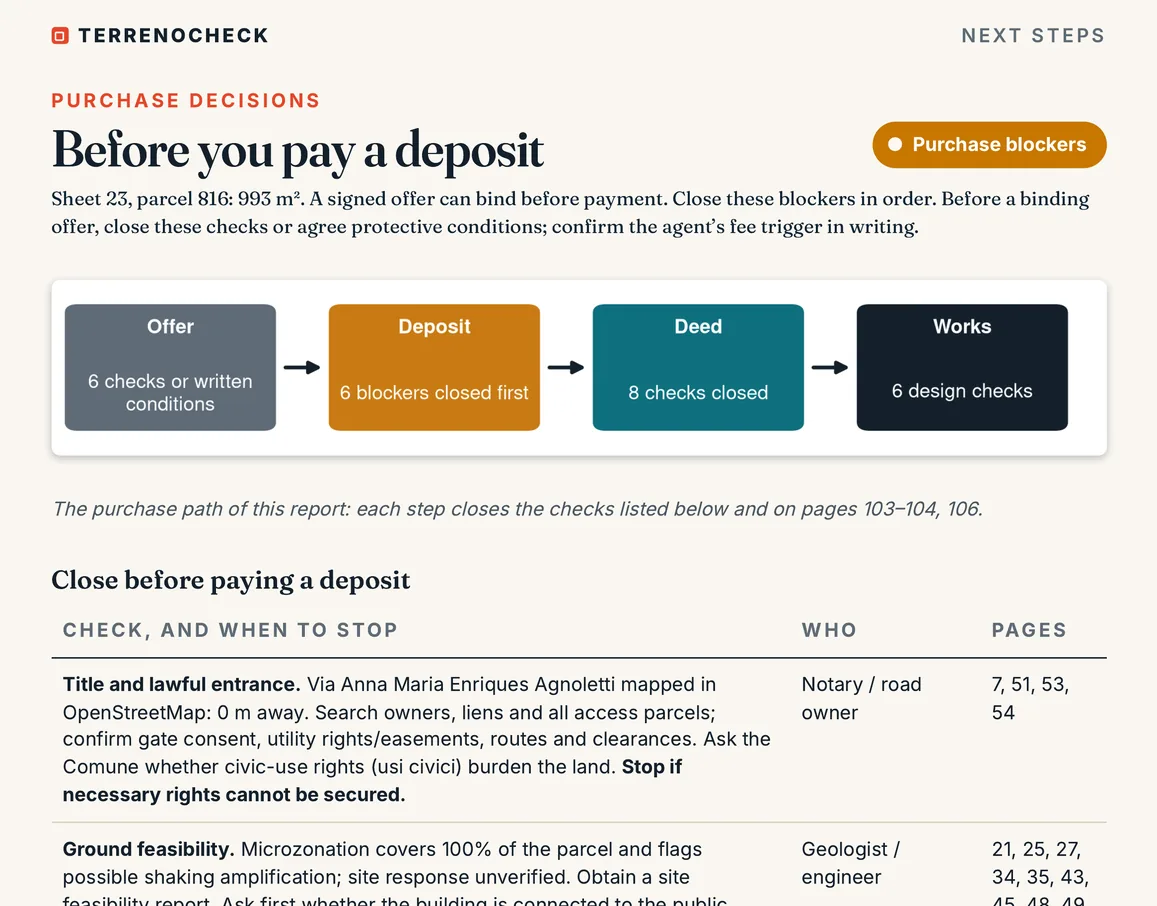
No rule sets a single deadline for these steps: for each one you will find where it happens and what the time depends on.
- Work out which row of the table you are in. You can do this yourself, with passport and permit in hand, before you start looking at plots. Note it if your permit is up for renewal or not on the list.
- Write to a notary. Before the offer, send your passport, any permit and the land’s identifiers (comune, sheet and parcel, called foglio and particella), and ask in writing whether a reciprocity check is needed. For an EU or EEA citizen, or a holder of a listed permit, the question is simple; if the notary has to ask the Ministry for data, the time depends on its reply.
- Get a codice fiscale. From the Italian consulate in your country of residence or, by appointment, at an Agenzia delle Entrate office in Italy; how long it takes depends on the office.
- Settle the language of the deed. Tell the notary whether you understand Italian. If you need an interpreter, the parties choose one: agree it with the seller and give the name to the office before the date is set.
- Sign the offer and pay the deposit. Only after the notary’s answer, or with the written condition described above. How the preliminary contract and the deposit (caparra) work is explained in our guide to the preliminary contract.
Hypothetical example
An olive grove for a buyer living outside the EU
A hypothetical example. A buyer who is a citizen of a country outside the EU and EEA, with no investment treaty with Italy, and holds no Italian residence permit finds an olive grove let to a local farmer; the agent wants an offer with a deposit signed within a week. She writes to a notary first, with her passport, the comune, sheet and parcel. The notary replies that the Foreign Ministry’s data is needed, so the offer is signed with a condition: the deposit comes back if reciprocity is not confirmed by a set date. Meanwhile she applies for a codice fiscale at the Italian consulate, agrees an interpreter with the seller because the notary does not speak her language, and has someone check whether the tenant farmer holds a pre-emption right.
Sources: DPR 394/1999, Article 1; Agenzia delle Entrate, tax code; Notaries Act, Article 55; Law 590/1965, Article 8; Law 817/1971, Article 7; accessed 12 November 2026.
Can foreigners buy land in Italy? Who can, and how to check
https://terrenocheck.it/en/guide/can-foreigners-buy-land-italy
Checklist
Before you sign an offer
Common questions
I am an EU citizen. Do I have to prove reciprocity?
No. The Italian Foreign Ministry states that citizens, individuals or legal persons, of EU member states and of the EEA countries (Iceland, Liechtenstein, Norway) are treated as Italian citizens and exempt from the check. The notary needs your ID; you still need a codice fiscale.
Where is the list of countries that meet the reciprocity condition?
The Italian Foreign Ministry publishes a list of countries and territories, with the investment treaties, on its «Diritti e Reciprocità» page (in Italian), and states that this information has no legal force and is only a general guide. For your purchase, what counts is the notary’s assessment: on request, the Ministry sends notaries data on how Italian citizens are treated in the buyer’s home country (DPR 394/1999, Article 1(1)).
I hold a student residence permit. Is a check needed?
No. The implementing regulation exempts holders of a permit for employment or self-employment, for running a sole business, for family, humanitarian or study reasons, holders of the carta di soggiorno, and their family members who are lawfully resident (DPR 394/1999, Article 1(2)). Bring the valid permit to the notary.
What if my country does not offer reciprocity?
Then the general rule in Article 16 of the preleggi does not let you enjoy that right as an Italian citizen would, subject to any special law; the Ministry treats an investment treaty between Italy, or the EU, and your country as one. Get a written answer from the notary before you sign an offer with a deposit. If you later obtain one of the permit types the regulation lists, the check is no longer needed.
Can I buy through a company set up abroad?
It depends on the company’s country. Legal persons of the EU and EEA are exempt from the check, according to the Foreign Ministry. For a company from another country the reciprocity condition applies (preleggi, Article 16(2)), subject to special laws and investment treaties; a shareholder’s residence permit does not extend to the company. The notary makes the assessment.
Can the deed be in English?
Notarial deeds are written in Italian. If the parties declare that they do not know Italian, the deed can be drawn up in a foreign language that the notary and the witnesses know, with an Italian translation alongside or below it (Notaries Act, Article 54). If the notary does not know the language, an interpreter chosen by the parties takes part (Article 55).
Keep reading
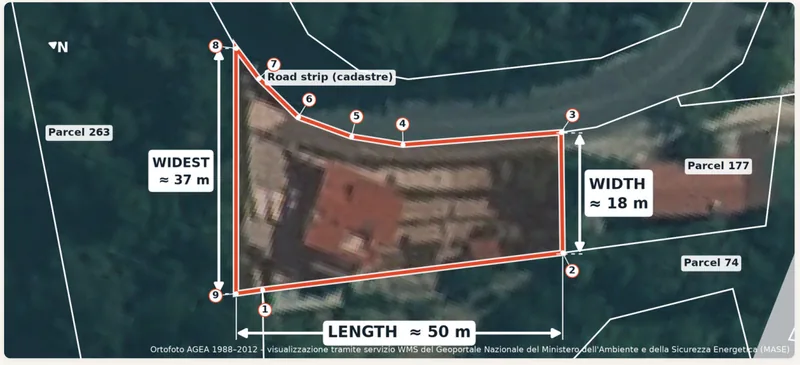
The land itself, checked before the deposit
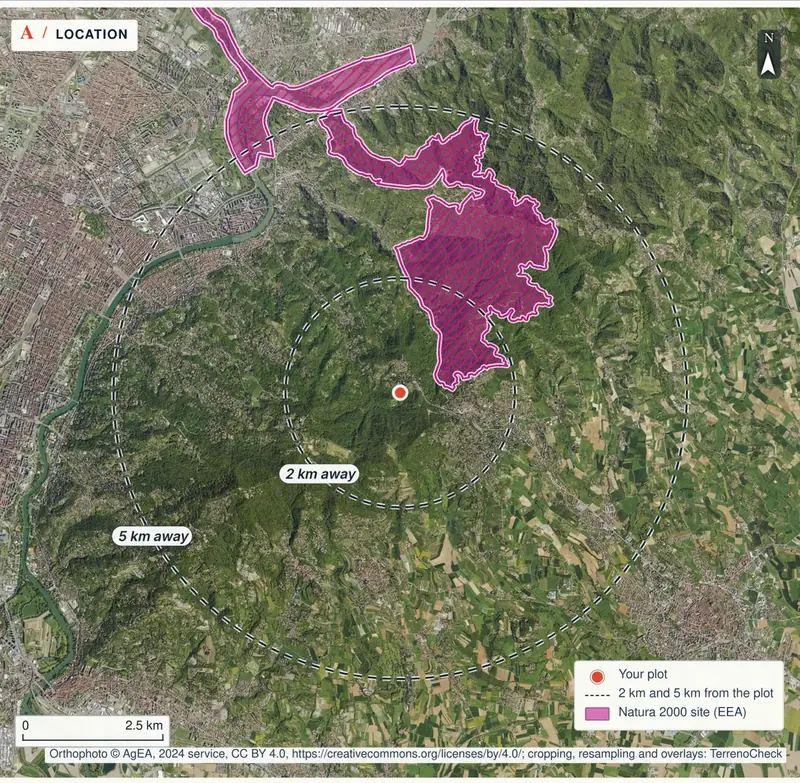
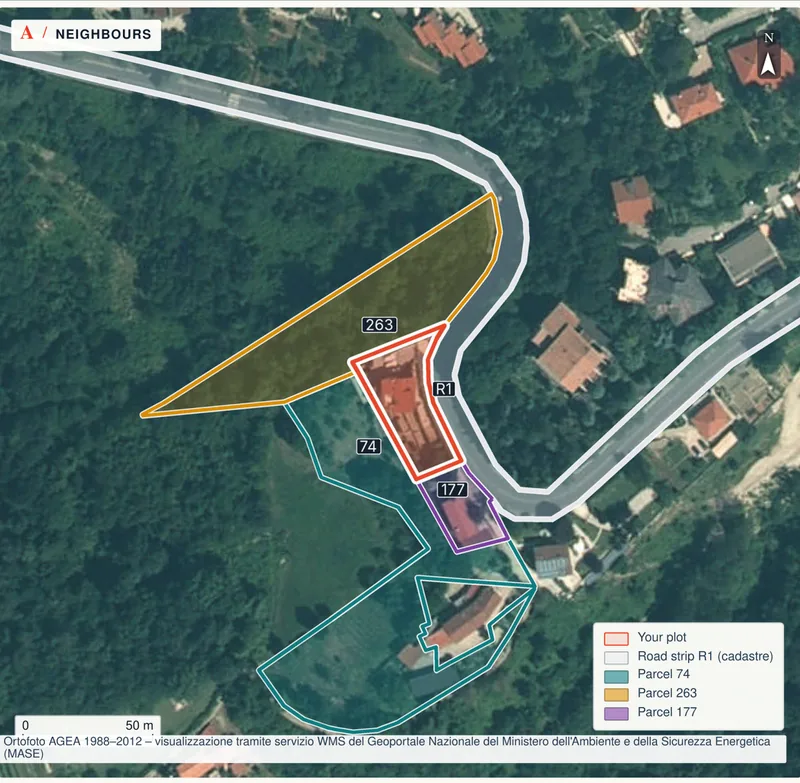
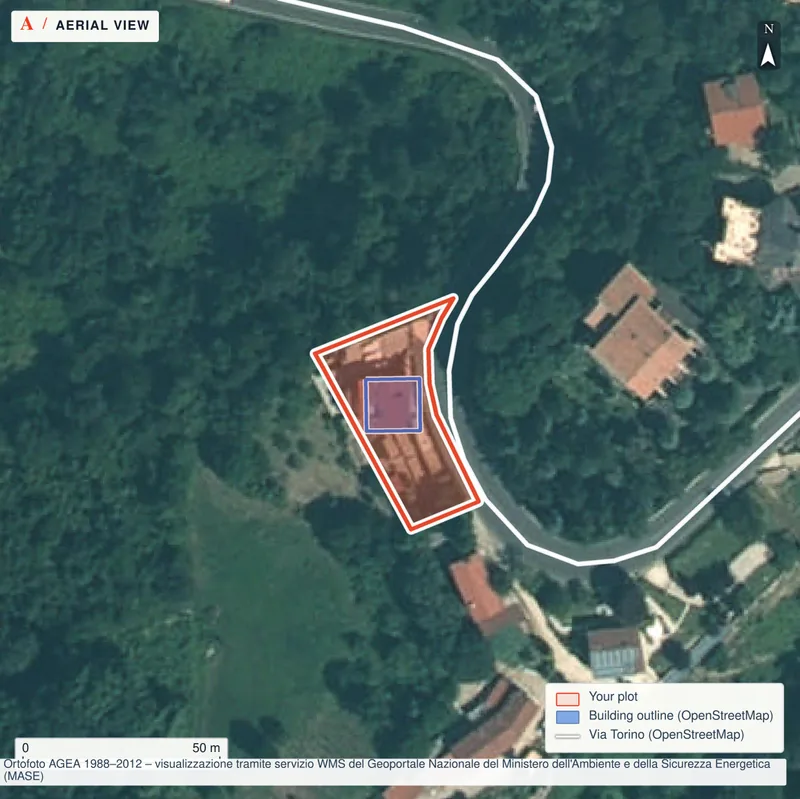
Pick the parcel on the map: cadastral data, access, constraints and permitted use are read for that plot, each with a source and date, along with the checks to close before a deposit. Reciprocity stays a question for the notary.
€29 in English or Italian · €39 in both languages · total, VAT included