
Pillar guide: Planning and the building
Legga questo articolo in italiano.
Land with an approved building permit in Italy: what to check
On this page
An Italian building permit (permesso di costruire) passes to whoever buys the land (DPR 380/2001, Article 11), but it has two deadlines: by law work must start within one year of issue and finish within three years of starting, subject to the extensions and exceptions below. Once a deadline passes, the permit lapses for the part not built. Check dates, extensions and fees in the comune’s file before paying a deposit.
In short
- The permit can be transferred with the property to the buyer; you then ask the comune to change the holder’s name (voltura), under that comune’s own procedure and fees (DPR 380/2001, Article 11).
- The permit states its dates: work must start within one year of issue and finish within three years of starting; unless an extension is requested before the deadline, it lapses for the part not built.
- For permits issued or formed up to 31 December 2025 the law extends both deadlines by 48 months, if the holder gives notice before they expire and on the conditions set out below.
- If a conflicting plan comes into force, the permit lapses, unless work had already started and is completed within three years of the start.
1 + 3 years
Permit deadlines
Start within one year of issue, finish within three years of starting; for plants under Article 12 of Legislative Decree 387/2003 the start may be three years.
48 months
Statutory extension
For permits issued or formed up to 31.12.2025, on notice from the holder before the deadlines pass.
€49–€221
Transfer fee in three comuni
Mantua €49, Trento €57, Genoa €221.10, in fees and stamp duty, according to the comuni’s pages.
The report brings together public information about the land, with sources and dates, to prepare questions for the relevant offices: €29 in English or Italian · €39 in both languages · total, VAT included.
The permit passes to the buyer of the land
A permesso di costruire (building permit, the Italian equivalent of planning permission plus building approval) is issued to the owner or to someone entitled to apply, but it belongs with the property: it “can be transferred, together with the property, to successors or assignees” and cannot be revoked (DPR 380/2001, Article 11). Buying a plot with an approved project means buying that permit too, with its dates and its conditions. Issuing it does not limit the rights of third parties (paragraph 3).
Changing the holder’s name is called voltura, and you apply to the comune’s sportello unico per l’edilizia (SUE, the building permits desk). The national code does not set out the procedure, so it differs between comuni. In Trento you apply only if the permit has been issued, is still valid and the end of works has not been notified; the new and the current holder both sign. The comune’s decision records the change of holder and does not alter the permit’s validity or expiry dates.
In Verona a voltura applies to building permits and single authorisations, while a SCIA or CILA has a separate notice; it is filed only online through the impresainungiorno portal. In Genoa it is filed only online with the SUE, and the comune has 30 days to decide.
Sources: DPR 380/2001, Article 11; Comune di Trento, transfer; Comune di Genova, transfer; Comune di Mantova, transfer; accessed 12 November 2026.
The dates that decide whether the permit still works
Every permit sets two deadlines. The start of work “cannot be later than one year after the permit is issued”, and completion cannot be later than three years after the start (Article 15, paragraph 2). For works authorised under Article 12 of Legislative Decree 387/2003, meaning renewable energy plants, the start can be up to three years.
When the deadlines pass, the permit lapses by law for the part not built, unless the holder asked for an extension before they ran out. The comune may grant one by a reasoned decision for events beyond the holder’s control, because of the size of the work or its technical features, or because of difficulties that arose after work began. An extension must be granted if work could not start or finish because of action by the authorities or a court that later proved unfounded (paragraph 2-bis).
Finishing the remaining part then needs a new permit, unless those works can be done with a SCIA under Article 22, and the building contribution is recalculated where necessary (paragraph 3).
These are the national code’s deadlines. Regions legislate on building within its principles, and the special-statute regions and the Provinces of Trento and Bolzano have exclusive powers (Article 2). Ask the SUE whether a regional law sets its own rules for the comune where the plot is.
The life of a building permit
- Permit issuedThe permit states the deadlines to start and to finish work
- Start of workBy the stated deadline, at most one year after issue (three years for plants under Article 12 of Legislative Decree 387/2003)
- CompletionBy the stated deadline, at most three years after the start
- ExtensionRequested from the comune before the deadline; for permits up to 31.12.2025 also 48 months on the holder’s notice, if the deadlines have not passed and there is no conflict with newly approved or protection plans
- LapseDeadlines passed with no extension: the unbuilt part needs a new permit or a SCIA, and the contribution may be recalculated
Sources: DPR 380/2001, Article 15; Decree-Law 21/2022, Article 10-septies; accessed 12 November 2026.
The 48-month statutory extension
Since 2022 a national law has extended the deadlines of permits already issued, and the cut-off date has been moved several times. Under the current text of Article 10-septies of Decree-Law 21/2022, the start and completion deadlines are extended by 48 months for permits issued or formed up to 31 December 2025, on three conditions:
- the holder must give notice that he or she wants to use the extension;
- the deadlines must not have passed when the notice is given;
- at that moment the permit must not conflict with newly approved planning instruments or with cultural heritage or landscape protection plans or measures.
The same extension covers the deadlines of SCIA notices and landscape and environmental authorisations, permits that had already been extended by the comune or under the 2020 laws, and the deadlines of subdivision agreements (convenzioni di lottizzazione) and implementing plans formed up to 31 December 2025, where they do not conflict with protection plans. For a permit issued on or after 1 January 2026 the text in force on 12 November 2026 provides no such extension: the dates in the permit and the ordinary extension under Article 15 apply.
If the plan has changed in the meantime
A permit also lapses when conflicting planning rules come into force, unless work had already started and is completed within three years of the start date (Article 15, paragraph 4). That is why the start of work has to be documented: the notice to the comune, site records and dated photographs.
If the project has only been submitted and no permit has been issued yet, a different rule matters: a newly adopted plan that conflicts with it suspends the decision. How long that lasts is explained in our guide to what you can build under the town plan.
A permit can also have been formed by silenzio-assenso (deemed approval, Article 20, paragraph 8). Silence from the comune is not enough on its own: the time limit for the final decision must have passed without a reasoned refusal. If the property is subject to hydrogeological, environmental, landscape or cultural heritage constraints, the services conference rules of Law 241/1990 apply instead, and deemed approval forms only if the authority in charge of the constraint had already issued its consent for the same project and that consent was still valid. The document to ask the SUE for is its statement that the time limits have passed: within fifteen days of the request it issues the statement if there are no unanswered requests for further documents or information and no refusal, or else tells you that such acts exist. Until the file contains that statement, or a surveyor or architect has checked these conditions, the comune’s silence is no basis for paying for the land as if it had a valid permit.
Fees already paid and fees still due
The permit is not free: it carries the contributo di costruzione (building contribution), made up of oneri di urbanizzazione (infrastructure charges) and a share based on the cost of construction (Article 16). Infrastructure charges are due when the permit is issued and can be paid in instalments on request; instead of paying, the holder can undertake to build the infrastructure. The construction-cost share is paid while work is in progress and no later than sixty days after completion, on the terms and with the guarantees the comune sets.
As a buyer you need to know how much has been paid, how many instalments remain and what guarantee, such as a bank or insurance bond (fideiussione), covers the balance. Some comuni ask for this in the transfer application itself: in Mantua you attach proof that the contribution was paid and the guarantee for the balance.
The comune’s file: what to ask for
The permit and its attachments are comune records. The right of access belongs to people with a direct, concrete and current interest; inspecting documents is free and copies cost the reproduction charge, plus stamp duty and search fees where they apply; if the comune does not reply within 30 days the request is treated as refused (Law 241/1990, Articles 22 and 25). The simplest route is for the seller, as permit holder, to request the file or give you written authority to do so.
The file should show:
- the permit with its issue date, start and completion deadlines and conditions;
- the notice that work started, if there was one, and any extensions, including the notice for the 48 months;
- the statement of the building contribution, with payments, instalments and guarantees;
- the approved drawings and any approved variations;
- the opinions and authorisations attached, such as landscape clearance, with their own expiry dates.
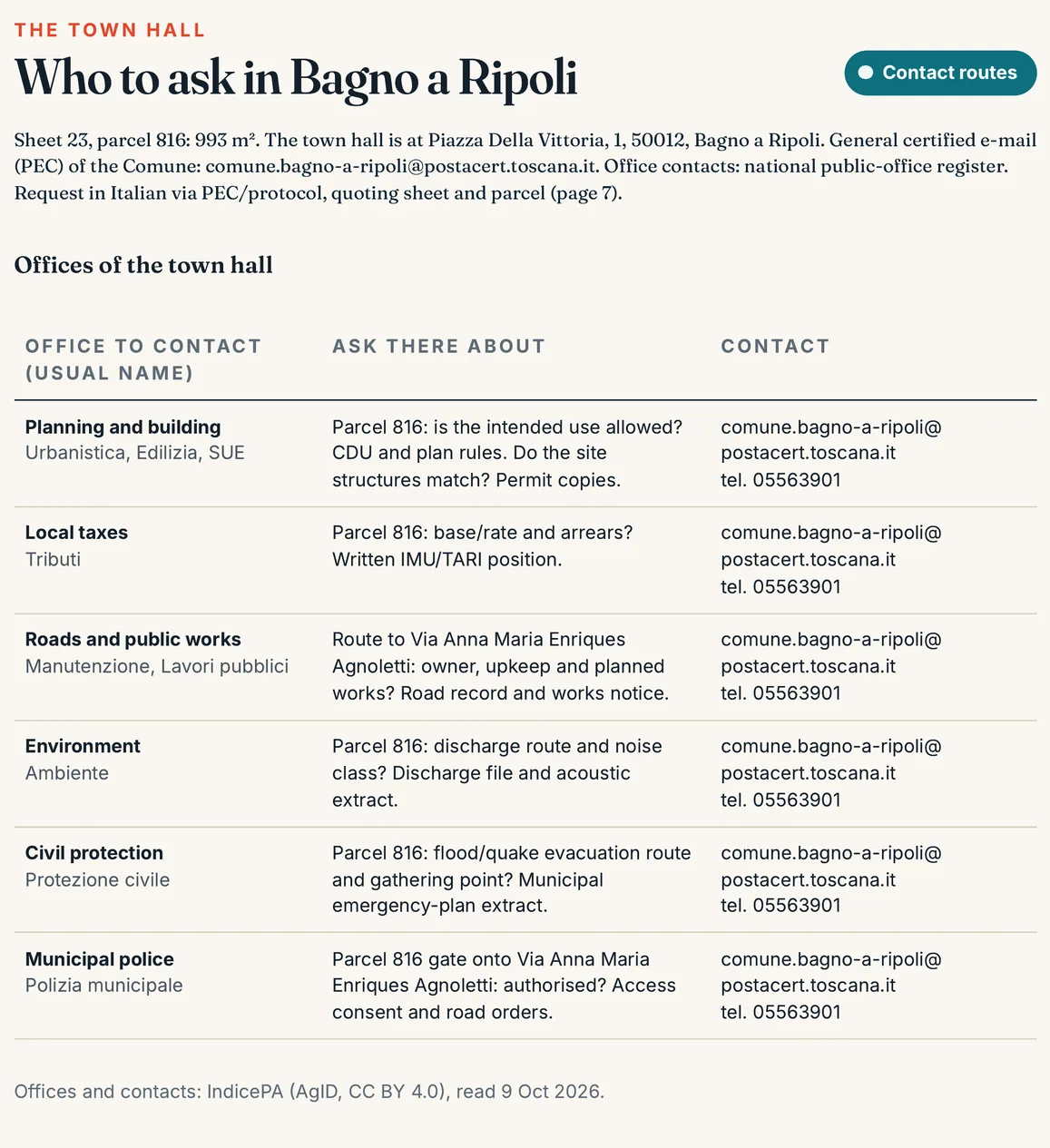
Ask the building desk for the copy at least a month before the preliminary contract, because after 30 days without a reply the request counts as refused. The certificato di destinazione urbanistica (CDU, zoning certificate) comes from the comune’s planning office. A deed transferring rights over land is void without it; it is not needed when the land belongs to a building registered in the urban buildings cadastre and the whole appurtenant area is under 5,000 m² (Article 30, paragraph 2). The notary checks whether your deed needs one; see also our guide to the CDU.
Sources: Law 241/1990, Articles 22 and 25; accessed 12 November 2026.
What to put in the preliminary contract
In the compromesso (preliminary contract) the checks on the permit become commitments by the seller. How the preliminary contract and deposit work is covered in our guide to the preliminary contract; for land with a permit you need a few extra clauses.
- The permit’s details, start and completion deadlines and any extensions, with the seller’s undertaking not to let them lapse before completion.
- If the start deadline falls before completion: who files the extension notice or the request to the comune, and by what date.
- Building contribution: how much is paid, who pays the remaining instalments, who provides the guarantees.
- An undertaking to sign the transfer application after the deed.
- What happens to the deposit if the comune refuses the transfer or the permit turns out to have lapsed.
If you want to change the project after buying, variations that do not affect planning parameters or volume, do not change the use or building category, do not alter the outline of a protected building and do not breach the permit’s conditions can be made by SCIA (Article 22, paragraph 2). Other variations that are not an essential variation (variazione essenziale) can also be made by SCIA, notified at the end of works with the professional’s statement, if they comply with the planning and building rules and any consents required by constraints and other sector rules were obtained first (paragraph 2-bis). The regions decide which variations are essential, within the criteria of Article 32, and ordinary-statute regions can widen or narrow the cases for SCIA (Article 22, paragraph 4): which procedure your change needs is for your architect or surveyor to assess under the regional law. For a new building, within fifteen days of finishing the final works the holder or whoever has taken over files the certified notice of fitness for use (agibilità); failing to file it carries a fine of €77 to €464 (Article 24).
Land with an approved building permit in Italy: what to check
https://terrenocheck.it/en/guide/land-with-approved-building-permit-italy
Checklist
Before paying a deposit on land with a permit
Common questions
Is the building permit valid for the person who buys the land?
Yes. The permit can be transferred with the property to successors and buyers, and it stays the same permit, with the same dates (DPR 380/2001, Article 11). After completion you ask the comune to put it in your name (voltura), following that comune’s procedure.
How long does an Italian building permit last?
The dates are written in the permit: work cannot start later than one year after issue or finish later than three years after starting. For plants authorised under Article 12 of Legislative Decree 387/2003 the start can be up to three years. Extensions requested before the deadline, and the 48-month statutory extension, can move these dates.
Is a permit issued in 2024 still valid in 2026?
It depends on the permit’s dates and any extensions. Permits issued or formed up to 31 December 2025 can have 48 more months to start and finish, if the holder gave notice before the deadlines passed and the permit did not conflict at that moment with newly approved plans or with cultural heritage or landscape protection measures. Ask the comune for a copy of the notice.
What happens if work did not start in time?
The permit lapses by law for the part not built, unless an extension was requested before the deadline. To build you need a new permit, or a SCIA (a certified notice of works) if the remaining works qualify under Article 22, and the building contribution may be recalculated (DPR 380/2001, Article 15).
Do the fees the seller paid stay with the land?
The comune collected them for that permit, and the permit passes to the buyer. How seller and buyer share what has been paid, the instalments still due and the guarantees is for them to write into the preliminary contract. Ask the comune for a statement of payments.
How much does it cost to transfer the permit?
Each comune sets its own fee. According to the comuni’s pages read on 12 November 2026: Mantua €33 in fees plus €16 stamp duty, Trento €57 in stamp duty and processing fees, Genoa €221.10 in processing fee, administrative fees and two stamps.
Keep reading
Can you build on land in Italy? PRG, PUC and zoning
Preliminary contract and deposit in Italy
Taxes on buying building land in Italy: private sale or VAT
The certificato di destinazione urbanistica (CDU): Italy’s zoning certificate, explained for foreign buyers
Before you buy land that comes with a project
Pick the parcel on the map and the report reads zoning, constraints, hazards and access for that plot, each with a source and date, and names the town hall offices to ask for the permit file.
€29 in English or Italian · €39 in both languages · total, VAT included