
Pillar guide: Costs, tax and use
Legga questo articolo in italiano.
Agricultural land prices in Italy per m²: 2025 regional averages
On this page
In 2025 a hectare of farmed agricultural land in Italy was worth 22,926 euros on average, or €2.29 per square metre, according to the farmland market survey of CREA, Italy’s public council for agricultural research. Regional averages run from €0.67/m² in Sardinia to €9.36/m² in Trentino-Alto Adige. These are broad figures for bare land: the price of your plot is a matter for a professional valuation.
In short
- Italian average for farmed land in 2025: €22,926 per hectare, €2.29 per m², up 0.9% on 2024 (CREA farmland market survey).
- Regional averages run from €6,693/ha (€0.67/m²) in Sardinia to €93,563/ha (€9.36/m²) in Trentino-Alto Adige; the North-East averages €48,862/ha, the islands €8,613.
- Crop type and terrain move the price most: vineyards average €6.98/m², meadows and pasture €0.93; plains €3.53/m², with exceptions such as Ligurian flower and vegetable land and Trentino orchards.
- CREA averages are broad indications for bare land that help a professional valuation and do not replace it. VAM figures are used in expropriation, in particular for additional payments, and OMI quotations give bands by property type, not by crop.
€2.29/m²
Italian average, 2025
€22,926 per hectare, farmed land, bare land.
€0.67–9.36/m²
Regional averages, 2025
From Sardinia to Trentino-Alto Adige.
€6.98/m²
Vineyards, Italian average 2025
Permanent meadows and pasture: €0.93/m².
The report brings together public information about the land, with sources and dates, to prepare questions for the relevant offices: €29 in English or Italian · €39 in both languages · total, VAT included.
CREA’s 2025 averages: from €0.67 to €9.36 per square metre
Average farmland prices in Italy are recorded by the farmland market survey (Indagine sul mercato fondiario) of CREA, the Council for Agricultural Research and Economics. Its policy and bioeconomy centre has run the survey every year since the 1950s. For 2025 the national average for farmed land is €22,926 per hectare, 0.9% more than the €22,731 of 2024.
Average prices differ widely between the five macro-regions: €48,862/ha in the North-East, €36,525 in the North-West, €15,196 in the Centre, €13,369 in the South and €8,613 on the islands. CREA links the gap to differences in land resources, farm structures and types of production. Among regions, the lowest average is Sardinia at €6,693/ha and the highest Trentino-Alto Adige at €93,563.
The prices recorded are for bare land: buildings and plantations are left out where possible, and prices that cannot safely be tied to farming use are discarded. The table below this section lists every region in alphabetical order, in euros per hectare and per square metre.
Average value of farmed agricultural land by region, 2025
| Region | €/ha | €/m² |
|---|---|---|
| Abruzzo | 11,660 | 1.17 |
| Aosta Valley | 14,886 | 1.49 |
| Apulia | 14,956 | 1.50 |
| Basilicata | 8,050 | 0.81 |
| Calabria | 12,544 | 1.25 |
| Campania | 17,260 | 1.73 |
| Emilia-Romagna | 29,435 | 2.94 |
| Friuli-Venezia Giulia | 36,747 | 3.67 |
| Lazio | 14,379 | 1.44 |
| Liguria | 37,426 | 3.74 |
| Lombardy | 51,311 | 5.13 |
| Marche | 13,505 | 1.35 |
| Molise | 13,089 | 1.31 |
| Piedmont | 23,653 | 2.37 |
| Sardinia | 6,693 | 0.67 |
| Sicily | 10,354 | 1.04 |
| Trentino-Alto Adige | 93,563 | 9.36 |
| Tuscany | 18,519 | 1.85 |
| Umbria | 12,139 | 1.21 |
| Veneto | 59,084 | 5.91 |
| Italy, average | 22,926 | 2.29 |
Bare land, utilised agricultural area (SAU). Euros per m² = euros per hectare divided by 10,000, rounded to the cent. These are regional averages: a single plot can sit well above or below. Sources: CREA, land values by region 2000–2025; accessed 13 November 2026.
From euros per hectare to euros per square metre
Farm statistics work in hectares: one hectare is 10,000 square metres. To get the price per square metre, divide by 10,000, so €22,926/ha is €2.29/m². The reverse sum helps when a listing gives a price per square metre: €1.50/m² is €15,000 per hectare.
Crop and terrain: what moves the price most
CREA records prices for 11 crop types in each agricultural region and groups them into five categories. The gaps are wide: in the 2025 Italian average a hectare of vineyard is worth €69,786 and a hectare of permanent meadow and pasture €9,342, so the vineyard average is about 7.5 times the meadow and pasture average. The chart at the end of this section sets out the five categories per square metre.
The second factor is the altitude zone. Plains are the most expensive at €35,264/ha (€3.53/m²); inland hills are at €16,806, coastal hills at €14,358 and coastal mountains at €8,861. Inland mountains reach €18,837/ha in the Italian average, but €61,888 in the North-East. CREA points out two exceptions to the rule that plains cost most: Ligurian vegetable and flower growing on the coastal hills and Trentino-Alto Adige orchards in the inland mountains.
In its 2025 summary CREA adds that demand for land for other uses, such as renewable energy plants, is affecting the market in some areas. If a price depends on a use other than farming, the CREA average does not describe it, because it leaves those prices out.
Sources: CREA, land values by region 2000–2025; CREA, 2025 survey summary; accessed 13 November 2026.
Very different prices in one region: the Tuscan example
The 2025 average for Tuscany is €18,519 per hectare, €1.85 per square metre. The price examples CREA publishes for specific areas and crops show how little that figure says about a single plot. The examples refer to land or whole farms with significant sales or letting activity during the year, so marginal land is probably under-represented. Unlike the averages, they may cover holdings including land improvements, so not bare land alone.
| Area and crop | Euros per hectare | Euros per m² |
|---|---|---|
| Coppice woodland in the Garfagnana (LU) | 2,000–5,000 | 0.20–0.50 |
| Hill arable land in the Alto Cecina (PI) | 4,000–12,000 | 0.40–1.20 |
| Olive groves in the Maremma hills (GR) | 15,000–19,000 | 1.50–1.90 |
| Vegetable land on the Florence plain | 30,000–50,000 | 3.00–5.00 |
| Chianti Classico DOCG vineyards (FI) | 90,000–210,000 | 9.00–21.00 |
| Bolgheri DOC vineyards (LI) | 300,000–1,000,000 | 30.00–100.00 |
What raises or lowers the price of a single plot
CREA explains that the same crop can fetch quite different prices depending on the land: dry or irrigated, how fertile it is, whether it can be improved. The table links each point to the document where you can check it before making an offer.
| Point | What CREA’s figures say | Where to check |
|---|---|---|
| Crop grown | Vineyards €6.98/m², meadows and pasture €0.93 in the 2025 Italian average | Site visit and the crop class in the cadastral extract |
| Water | Irrigated and dry arable land are recorded as separate crops | Site visit and the seller’s papers on water use |
| Altitude zone | Plains €3.53/m², coastal mountains €0.89, with exceptions | CREA list of agricultural regions and municipalities |
| Buildings and plantations | Left out, where possible, of bare land averages | A separate professional valuation |
| Non-farm uses | Left out of the averages; demand for renewable energy plants, for example, affects some areas | Zoning certificate (CDU) |
Two situations have guides of their own: land with a running farm lease, in buying tenanted farmland, and the pre-emption rights of neighbours and tenants, in the guide to agricultural pre-emption. Building land is valued on other criteria, covered in the guide to building land prices.
VAM and OMI quotations: what they are for
The valori agricoli medi (VAM, average agricultural values) are not a market price list. Every year, by 31 January, a commission set up by the Region in each province fixes them for each agricultural region, according to the crops actually grown, for the previous calendar year and for land treated as not subject to a farm lease (Presidential Decree 327/2001, Article 41(4)). They are expressed in euros per hectare and published in the regional official bulletins; the Agenzia delle Entrate, the Italian tax agency, collects them on its website.
According to the Agenzia delle Entrate, today they are used in the expropriation of non-building land, in particular for additional payments: an owner who is a coltivatore diretto (working farmer) or a full-time farm entrepreneur is entitled to an additional payment equal to the VAM of the crop actually grown (Article 40(4)). Article 42 grants an additional payment, set under the same Article 40(4), to a tenant farmer, sharecropper or crop-share partner as well, under the conditions it lists: direct cultivation of the area since at least one year before the declaration of public utility, having to leave all or part of the area because of the expropriation or a voluntary transfer, a statement by the person concerned and a check that the conditions are met.
Paragraphs 2 and 3 of Article 40, which tied to the VAM the compensation for uncultivated non-building land, the offer and the provisional compensation, were struck down by the Constitutional Court in judgment 181 of 2011. The Agenzia delle Entrate sums up the reason: compensation cannot rest on average prices that do not match actual market values.
The tax agency’s OMI quotations (Osservatorio del Mercato Immobiliare, its property market observatory) give, for each zone of every municipality, half-yearly bands in euros per square metre by property type and condition. The agency itself calls them broad indications that do not replace a professional valuation. Its service for looking up declared sale prices covers sales of units in the building cadastre, sometimes together with land parcels.
Sources: Presidential Decree 327/2001, Article 41; Presidential Decree 327/2001, Article 40; Presidential Decree 327/2001, Article 42; Agenzia delle Entrate, average agricultural values; Agenzia delle Entrate, OMI quotations; accessed 13 November 2026.
Price, value in the deed and taxes
Registration tax is not worked out on the CREA average but on the value of the property at the date of the deed (Presidential Decree 131/1986, Article 43). That is the value declared by the parties, or the price if it is higher; for property, value means open-market value (valore venale in comune commercio, Article 51).
To check that value, the tax office looks at transfers, divisions and court valuations of the same or similar properties dating from no more than three years before the date of the deed or the date on which the deed actually transfers or creates the right, at net income capitalised, and at any other relevant element, including information from municipalities (Article 51(3)). The three years mark the window for choosing comparable sales, not the time the office has to carry out its check. If it considers the market value higher, it adjusts it and claims the extra tax with interest and penalties (Article 52(1)).
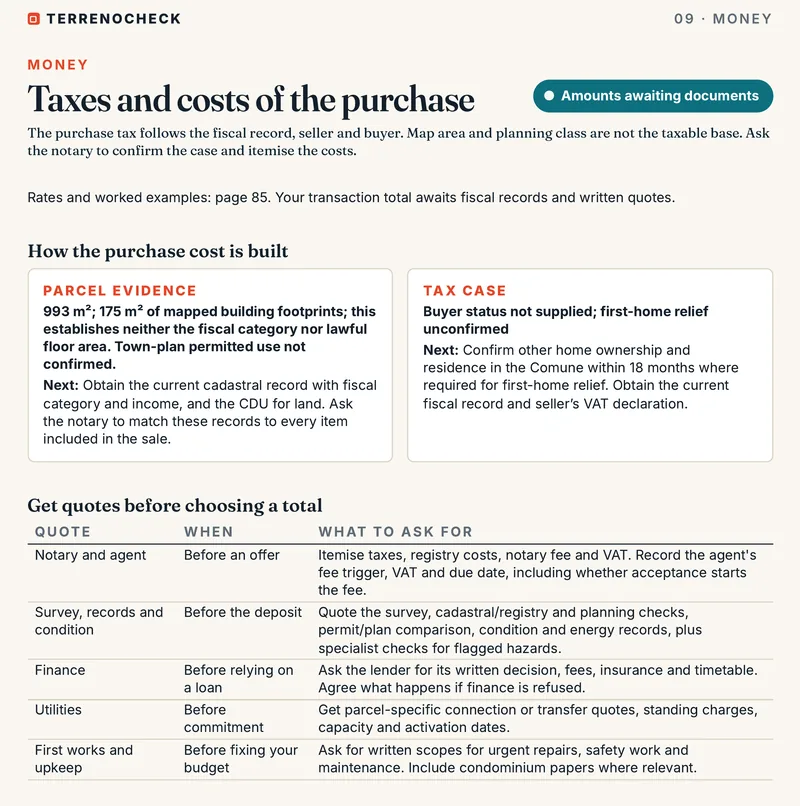
Rates, minimum amounts and reliefs, which also depend on who buys, are explained in the guide to taxes on buying agricultural land. From 1 January 2027 a new consolidated code on registration tax applies (Legislative Decree 123/2025, Article 205): if your deed (rogito) is signed on or after that date, ask the notary for the figures under the new code.
How to estimate your plot, step by step
- Find the agricultural region, on the CREA website. Look up the municipality in the list of agricultural regions: Bagno a Ripoli, for instance, is in the «Colline di Firenze» region. You download the file from the survey page.
- Read the values for the area, on the CREA website. The files by province and altitude zone and the 2025 minimum and maximum file give the average and the extremes for the crop category. CREA warns that minimum and maximum figures are averages too and do not show all local variation.
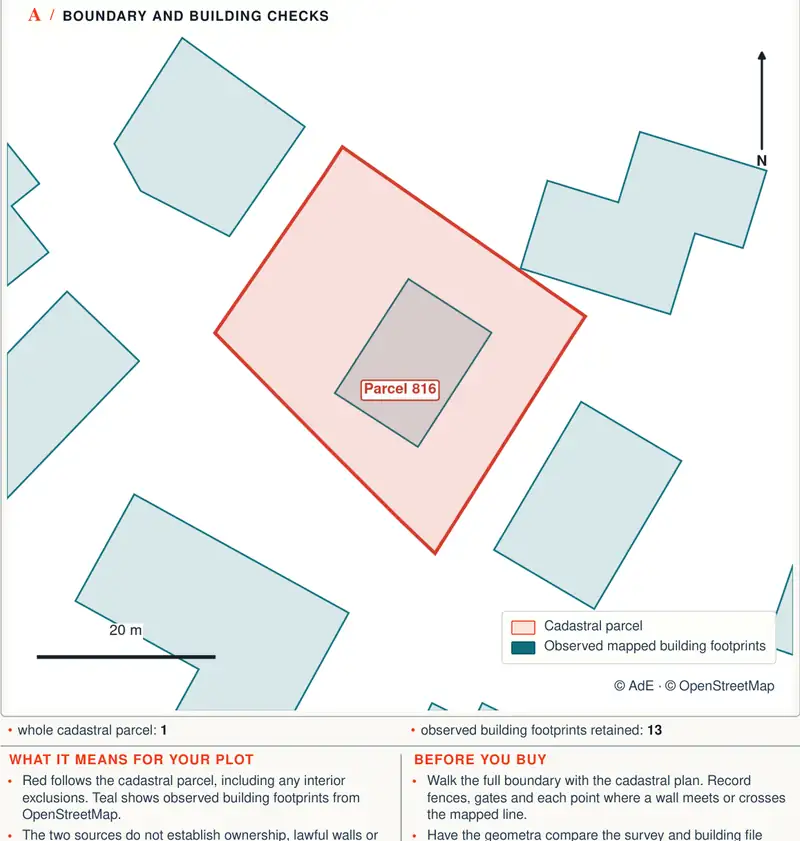
- Check crop and area, at the land registry and on site. The visura (cadastral extract) gives the registered crop class; a site visit shows what is really there, water and access included.
- Check the zoning, at the Comune (municipality). The certificato di destinazione urbanistica (CDU, zoning certificate) says whether the plan treats the land as agricultural. The Comune must issue it within thirty days of the request (Presidential Decree 380/2001, Article 30(3)).
- Ask a professional for a valuation. CREA writes that its figures are an aid to the valuation of a professional, the only document able to justify the value of a specific property. The professional gives timing and fee in the quote.
How to estimate farmland
- Agricultural region, CREA websiteList of municipalities by agricultural region, downloadable at once
- Values for the area, CREA websiteAverage by province, altitude zone and crop; 2025 minimum and maximum
- Crop and area, land registry and site visitCadastral extract against the land, water and access included
- Zoning, the Comune’s officeZoning certificate (CDU) within 30 days of the request (DPR 380/2001, art. 30)
- Valuation, an appointed professionalTiming and fee in the professional’s quote
Sources: CREA, agricultural regions and municipalities; CREA, note on minimum and maximum values; Presidential Decree 380/2001, Article 30; accessed 13 November 2026.
Agricultural land prices in Italy per m²: 2025 regional averages
https://terrenocheck.it/en/guide/agricultural-land-prices-italy
Checklist
Before making an offer for farmland
Common questions
How much does agricultural land cost per square metre in Italy?
According to CREA, the 2025 national average for farmed land is €22,926 per hectare, or €2.29 per m². Regional averages run from €0.67/m² in Sardinia to €9.36/m² in Trentino-Alto Adige. They refer to bare land: buildings and plantations are left out where possible.
Why is the land I have been offered far above the average?
Because the average mixes very different crops and areas. Within Tuscany alone, CREA’s 2025 examples range from €4,000–12,000/ha for hill arable land in the Alto Cecina area to €90,000–210,000/ha for Chianti Classico DOCG vineyards in the province of Florence. Water, access, buildings and possible non-farm uses count too; a justified price needs a professional valuation.
Is the VAM (average agricultural value) the price of the land?
No. A provincial commission sets it every year by 31 January (Presidential Decree 327/2001, Article 41(4)). In the expropriation code it is used in particular for the additional payments of Articles 40(4) and 42, for the people and under the conditions set out in those two articles. The Agenzia delle Entrate notes that, since Constitutional Court judgment 181/2011, expropriation compensation cannot rest on average prices.
Where do I find values for the area of my municipality?
On the CREA website: look up the municipality (Comune) and its agricultural region in the list of agricultural regions, then open the files of values by province and altitude zone and of the 2025 minimum and maximum values. The 2025 examples give ranges for specific areas and crops, in thousands of euros per hectare.
Is registration tax paid on the price or on the CREA value?
On the value declared in the deed, or on the price if that is higher; for property, value means open-market value (Presidential Decree 131/1986, Article 51). If the tax office considers the market value higher, it adjusts it and claims the extra tax with interest and penalties (Article 52). Rates and cases are in the guide to taxes on buying farmland.
Keep reading
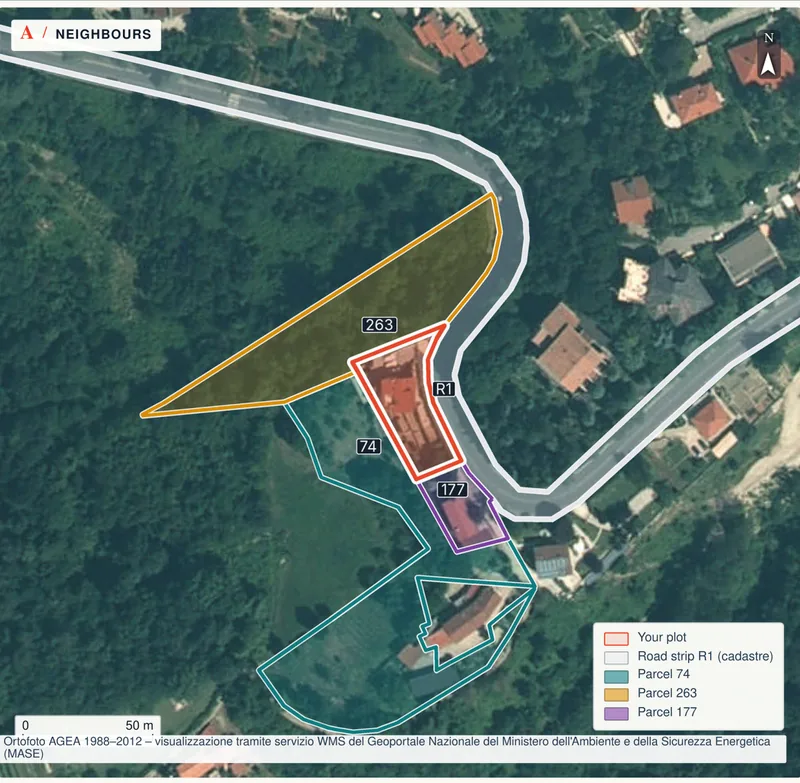
Your farmland, read before you make an offer
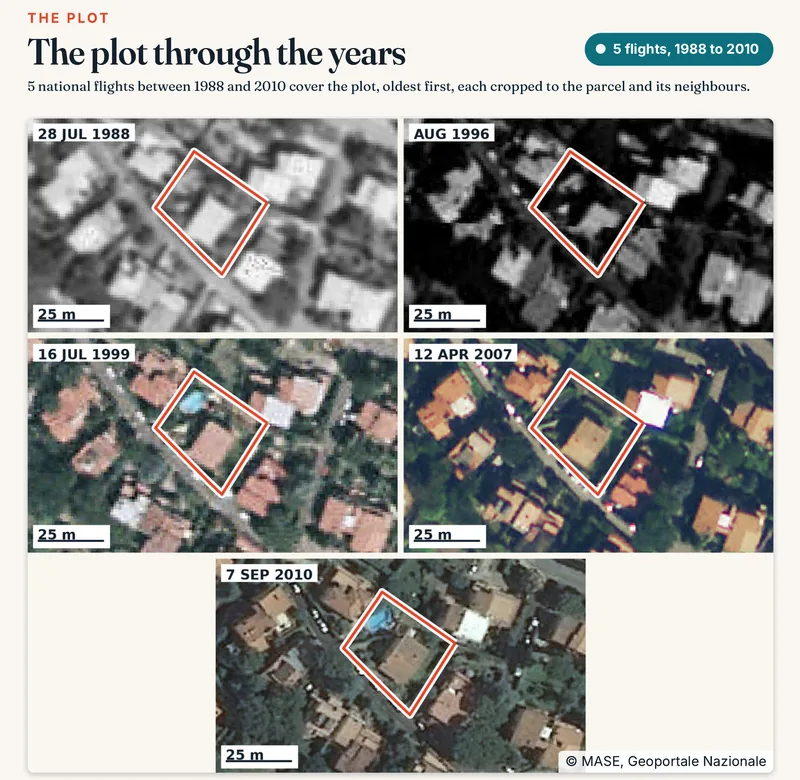
Pick the parcel on the map: zoning, constraints, hazards, access and cadastral status are read for that plot, each with a source and date. The report does not value the land: it gives you the public data to take to your valuer and notary.
€29 in English or Italian · €39 in both languages · total, VAT included